
Why Holding the Chairman/CEO Title Nullifies the "Unpaid Mentor" Defense:
Special thanks to everyone following the filing updates. Before diving into the operational breakdown, it is critical to understand the legal standard that governs corporate leadership: under Section 20(a) of the Exchange Act and Section 15 of the Securities Act, federal courts and regulators evaluate control person liability by asking whether an individual possessed the actual power, direct or indirect, to direct management, policies, or operational decisions. Executive titles, board leadership, and operational control are top indicators of control status—making officers legally accountable regardless of how they frame their personal compensation choices.
With that statutory baseline established, I want to highlight a fundamental legal contradiction in how management presents itself to retail investors versus how corporate accountability works under federal regulatory standards (SEC, FDA, FINRA, and FTC).
FTC Section 5 (15 U.S.C. § 45 — Unfair & Deceptive Practices)
Marketing unverified institutional partnerships (e.g., UMB), unassigned National Drug Code (NDC) listings, conceptual regulatory mockups ("Rx Only" , unvalidated E-Scribing / electronic prescribing network integration, and Nov. 17th, 2025, unsupported "AI integration" platforms to retail buyers falls directly under FTC jurisdiction regarding commercial deception under FTC Act Section 5, independent of whether the executive accepts a cash salary.
Management frequently leans on a specific narrative to build trust: claiming to be a "selfless, uncompensated mentor" who has "never accepted a salary" and acts solely out of altruism. Yet, in the very same breath, public claims are made asserting total corporate authority—specifically emphasizing that the company is "Black owned and controlled," alongside direct market calls like "MOVE ON IT."
Here is why that dual narrative falls apart under formal regulatory review:
Chairman & CEO Titles Carry Ultimate Fiduciary Duty & Statutory Control
You cannot claim the legal posture of a passive, unpaid advisor to avoid accountability while holding the official titles of Chairman of the Board and Chief Executive Officer. Under Section 20(a) and Section 15, holding the top executive seat establishes direct, primary operational control. Whether an executive accepts a salary, takes stock, or waives compensation entirely is legally irrelevant to fiduciary duty and statutory control person liability.
Section 10(b) SEC Violations & FTC Section 5 Deceptive Practices
Promoting corporate leadership as a "selfless, uncompensated mentor" to generate goodwill among retail investors—while simultaneously leveraging full corporate authority to market the stock---creates a direct misrepresentation under SEC Rule 10b-5. Furthermore, advertising unauthorized institutional partnerships or conceptual regulatory statuses to the public falls directly under FTC Section 5 enforcement regarding deceptive business practices and false commercial claims. In regulatory disclosure enforcement, corporate authority is evaluated by actual behavior, contractual power, and operational influence, rather than mere titles or organizational charts. Asserting total corporate control eliminates any "passive advisor" defense.
Authority vs. Earned Leadership
To quote an insightful perspective: Authority is given; Leadership is EARNED. If the title disappeared tomorrow, would they still seek your judgment?
When management uses the authority of the CEO chair to issue forward-looking promises of Wealth Creation and tell investors to "MOVE ON IT," those statements are legally attributable directly to the company and its controlling officer. Alternating between total operational control for promotion and "passive mentorship" to dodge liability simply does not hold up when multi-agency examiners review the paper trail.
Bottom line: Personal salary choices do not erase statutory liability under federal securities laws. The documented record of control, statements, and actions speaks for itself. Dalton can't have it both ways!!!
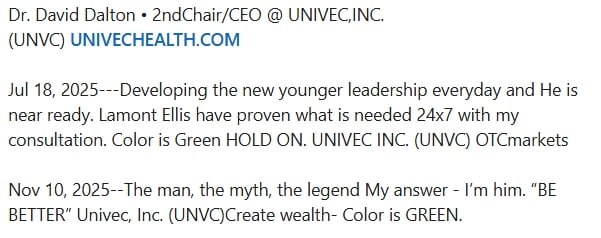
Phrases such as "BE BETTER" combined with assertions of absolute personal authority present a posture of untouchability. This creates a direct contrast with standard fiduciary conduct, where corporate officers are accountable to shareholders and regulatory authorities rather than self-proclaimed legend status.
DISCLAIMER: The following post contains public due diligence, opinion, and analysis based on available public records and corporate statements. It is shared strictly for educational and informational purposes and does not constitute formal legal counsel, financial or investment advice, or an official regulatory finding. Readers should conduct their own independent research.
PL
Special thanks to everyone following the filing updates. Before diving into the operational breakdown, it is critical to understand the legal standard that governs corporate leadership: under Section 20(a) of the Exchange Act and Section 15 of the Securities Act, federal courts and regulators evaluate control person liability by asking whether an individual possessed the actual power, direct or indirect, to direct management, policies, or operational decisions. Executive titles, board leadership, and operational control are top indicators of control status—making officers legally accountable regardless of how they frame their personal compensation choices.
With that statutory baseline established, I want to highlight a fundamental legal contradiction in how management presents itself to retail investors versus how corporate accountability works under federal regulatory standards (SEC, FDA, FINRA, and FTC).
FTC Section 5 (15 U.S.C. § 45 — Unfair & Deceptive Practices)
Marketing unverified institutional partnerships (e.g., UMB), unassigned National Drug Code (NDC) listings, conceptual regulatory mockups ("Rx Only"
, unvalidated E-Scribing / electronic prescribing network integration, and Nov. 17th, 2025, unsupported "AI integration" platforms to retail buyers falls directly under FTC jurisdiction regarding commercial deception under FTC Act Section 5, independent of whether the executive accepts a cash salary. Management frequently leans on a specific narrative to build trust: claiming to be a "selfless, uncompensated mentor" who has "never accepted a salary" and acts solely out of altruism. Yet, in the very same breath, public claims are made asserting total corporate authority—specifically emphasizing that the company is "Black owned and controlled," alongside direct market calls like "MOVE ON IT."
Here is why that dual narrative falls apart under formal regulatory review:
Chairman & CEO Titles Carry Ultimate Fiduciary Duty & Statutory Control
You cannot claim the legal posture of a passive, unpaid advisor to avoid accountability while holding the official titles of Chairman of the Board and Chief Executive Officer. Under Section 20(a) and Section 15, holding the top executive seat establishes direct, primary operational control. Whether an executive accepts a salary, takes stock, or waives compensation entirely is legally irrelevant to fiduciary duty and statutory control person liability.
Section 10(b) SEC Violations & FTC Section 5 Deceptive Practices
Promoting corporate leadership as a "selfless, uncompensated mentor" to generate goodwill among retail investors—while simultaneously leveraging full corporate authority to market the stock---creates a direct misrepresentation under SEC Rule 10b-5. Furthermore, advertising unauthorized institutional partnerships or conceptual regulatory statuses to the public falls directly under FTC Section 5 enforcement regarding deceptive business practices and false commercial claims. In regulatory disclosure enforcement, corporate authority is evaluated by actual behavior, contractual power, and operational influence, rather than mere titles or organizational charts. Asserting total corporate control eliminates any "passive advisor" defense.
Authority vs. Earned Leadership
To quote an insightful perspective: Authority is given; Leadership is EARNED. If the title disappeared tomorrow, would they still seek your judgment?
When management uses the authority of the CEO chair to issue forward-looking promises of Wealth Creation and tell investors to "MOVE ON IT," those statements are legally attributable directly to the company and its controlling officer. Alternating between total operational control for promotion and "passive mentorship" to dodge liability simply does not hold up when multi-agency examiners review the paper trail.
Bottom line: Personal salary choices do not erase statutory liability under federal securities laws. The documented record of control, statements, and actions speaks for itself. Dalton can't have it both ways!!!
Phrases such as "BE BETTER" combined with assertions of absolute personal authority present a posture of untouchability. This creates a direct contrast with standard fiduciary conduct, where corporate officers are accountable to shareholders and regulatory authorities rather than self-proclaimed legend status.
DISCLAIMER: The following post contains public due diligence, opinion, and analysis based on available public records and corporate statements. It is shared strictly for educational and informational purposes and does not constitute formal legal counsel, financial or investment advice, or an official regulatory finding. Readers should conduct their own independent research.
PL