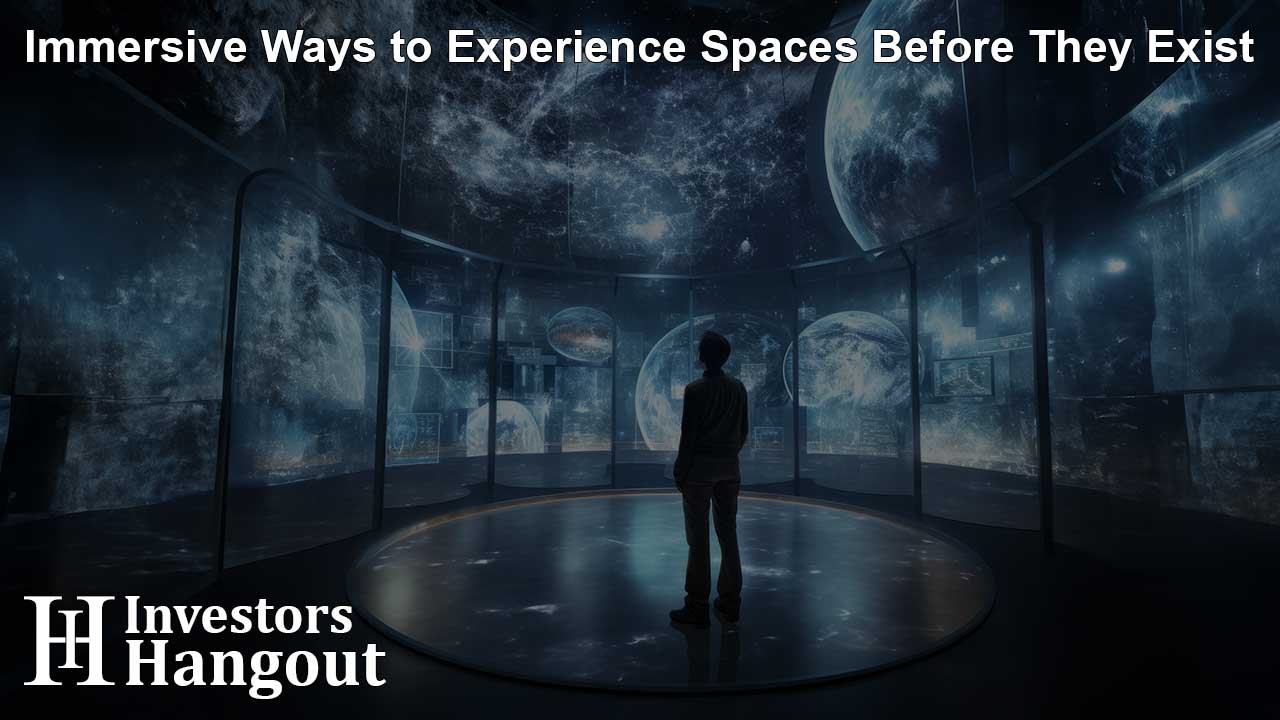
In recent years, the way humans conceive, design, and evaluate spaces has undergone a profound transformation. Traditionally, architecture and spatial planning relied on drawings, physical models, and imagination to bridge the gap between concept and reality. Today, however, digital innovation has made it possible to experience environments long before they are physically constructed. This shift is not just technical—it is cultural, changing how designers think and how people engage with future spaces.
At the core of this evolution is the idea of immersion: the ability to enter and interact with a space that exists only in digital form. Rather than interpreting abstract plans, individuals can now perceive scale, proportion, atmosphere, and movement as if the environment already exists. This fundamentally reduces uncertainty and enhances creative decision-making.
Digital Visualization as a Cognitive Bridge
One of the most important tools enabling pre-experience design is advanced digital visualization. Unlike traditional sketches or static models, modern visualization techniques aim to simulate reality as closely as possible. This includes accurate lighting, material behavior, spatial depth, and environmental context.
These representations serve as cognitive bridges between imagination and physical construction. When designers and stakeholders can "walk through" a space virtually, they are no longer relying solely on interpretation of drawings. Instead, they can respond to experiential cues such as spatial comfort, visual flow, and emotional tone.
This shift is particularly important in complex environments such as public infrastructure, healthcare spaces, and large-scale urban developments, where spatial decisions have long-term consequences.
Virtual Environments and Human Perception
Human perception plays a central role in how spaces are evaluated. Scale, proportion, and movement all influence how comfortable or intuitive a space feels. Immersive technologies leverage this by simulating human presence within a designed environment.
By placing a user inside a fully navigable digital space, designers can study behavioral responses before construction begins. For example, how a person moves through a corridor, where their attention is drawn, or how they perceive openness versus confinement can all be observed in advance.
These insights are not merely aesthetic—they influence functionality, accessibility, and safety. As a result, immersive simulation becomes a tool for optimizing human experience, not just visual presentation.
The Role of Real-Time Interaction
A defining feature of modern immersive design is real-time interaction. Instead of viewing static renderings, users can move freely within a digital environment, altering their perspective and exploring different design scenarios.
This interactivity introduces a dynamic feedback loop. Designers can modify spatial elements and immediately observe how those changes affect perception. Walls can be shifted, lighting adjusted, or materials replaced, all while maintaining continuity of the experience.
This iterative process reduces the gap between idea and evaluation, allowing design decisions to be tested in conditions that closely resemble real-world experience.
Sensory Depth and Environmental Realism
Immersion is not limited to visual accuracy. Increasingly, digital environments incorporate multisensory simulation, including spatial acoustics, environmental lighting changes, and material responsiveness.
Sound, for instance, plays a crucial role in shaping spatial awareness. The way footsteps echo in a hallway or how ambient noise behaves in open versus enclosed areas can significantly alter perception. Similarly, lighting conditions affect mood, orientation, and even perceived size of a space.
When combined, these sensory elements create environments that feel physically coherent, even though they exist only in digital form. This level of realism allows users to evaluate spaces in a way that closely mirrors lived experience.
Collaborative Design Through Shared Immersion
One of the most impactful aspects of immersive spatial simulation is its ability to support collaboration. Architects, engineers, planners, and clients can all enter the same virtual environment and experience it simultaneously.
This shared perspective reduces misunderstandings that often arise from interpreting technical drawings or static images. Instead of describing ideas abstractly, participants can reference specific spatial experiences directly.
In many cases, this leads to faster consensus and more informed decision-making. It also encourages more inclusive participation, as non-technical stakeholders can meaningfully contribute to design discussions based on lived experience rather than technical interpretation.
From Concept to Experience: Bridging the Imagination Gap
A key challenge in spatial design has always been the imagination gap—the difficulty of fully understanding a space before it physically exists. Immersive technologies effectively close this gap by translating abstract concepts into experiential reality.
This transformation is particularly valuable in early-stage design, where decisions have the greatest impact on cost, usability, and long-term functionality. Instead of relying on assumptions, designers can test ideas in a simulated environment that behaves like the real world.
In advanced workflows, a process such as rendering virtual tour allows stakeholders to explore fully realized environments in a structured and intuitive way, making conceptual evaluation more grounded and accessible.
Emotional and Psychological Impact of Virtual Spaces
Beyond functional assessment, immersive environments also allow for emotional evaluation. Spaces influence human psychology in subtle but powerful ways. Factors such as openness, lighting warmth, spatial rhythm, and material texture can evoke feelings of calm, tension, comfort, or stimulation.
By experiencing a space before it is built, designers can intentionally shape emotional responses. This is particularly important in environments where well-being is critical, such as educational settings, healthcare facilities, or public gathering areas.
Understanding emotional impact early in the design process ensures that spaces are not only efficient but also supportive of human needs.
Data-Driven Refinement of Spatial Design
Immersive design environments also enable the collection of behavioral data. By observing how users move, interact, and respond within a simulated space, designers gain insights that would otherwise only be available after construction.
This data can reveal inefficiencies, accessibility issues, or areas of confusion. It also helps validate design assumptions, ensuring that decisions are based on observed behavior rather than intuition alone.
As a result, spatial design becomes increasingly evidence-based, integrating human behavior directly into the design process.
The Future of Experiential Design
As immersive technologies continue to evolve, the boundary between digital simulation and physical reality will become increasingly fluid. Future design processes may rely almost entirely on experiential prototyping, where spaces are fully tested in virtual form before any physical construction begins.
This shift has the potential to redefine architecture and spatial planning as disciplines centered not just on building, but on experiencing. The emphasis will move from static representation to dynamic interaction, from prediction to simulation, and from abstraction to presence.
Ultimately, the ability to experience spaces before they exist will not only improve design outcomes but also reshape how humans relate to the environments they inhabit.