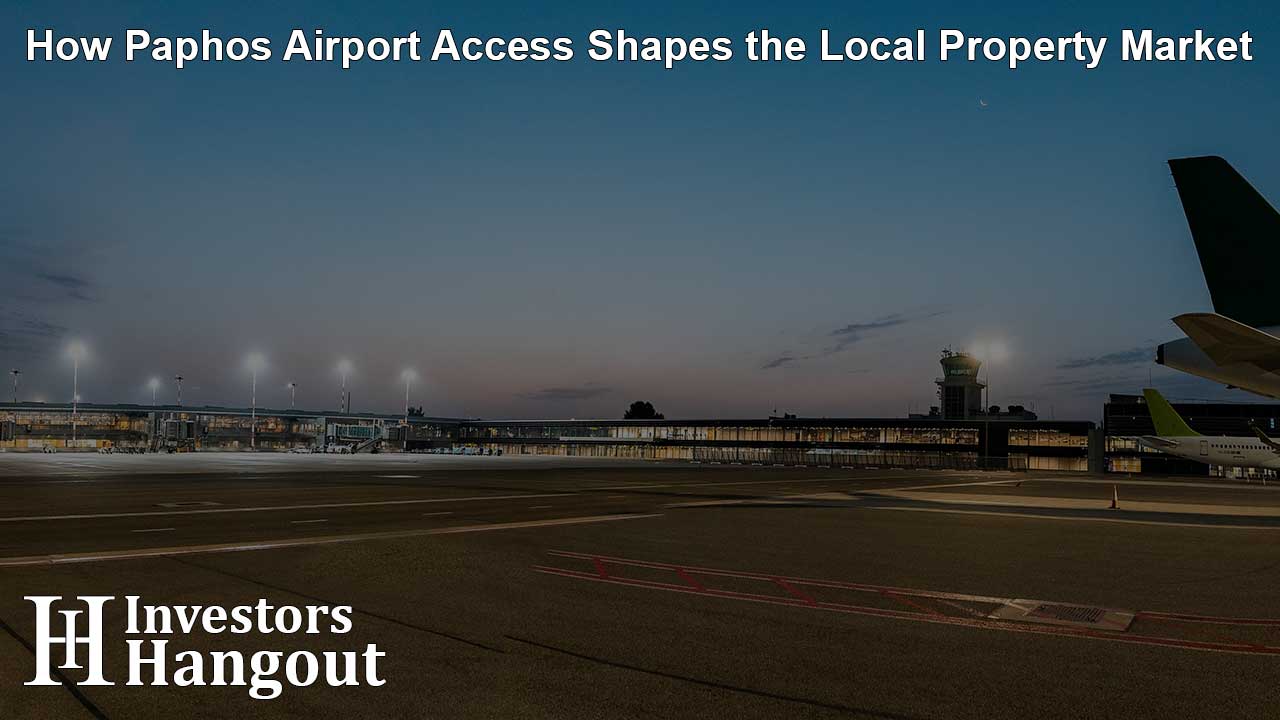
Cyprus has two international airports and they do not do the same job. Larnaca handles 69% of flight movements and functions as the national gateway. Paphos handles the remaining 31% and works mainly as a low-cost hub, which sounds like a footnote until you look at what it has done to the town beneath it. Anyone considering buying real estate in Paphos Cyprus is buying into a place whose rhythm, resident population and property stock were shaped by cheap direct flights from northern Europe.
That dependence is a strength and an exposure at the same time, and 2026 has demonstrated both.
Who Arrives and When
The United Kingdom supplied 33% of all arrivals to Cyprus in June 2026, 161,913 visitors in a single month. Israel followed with 16.4%, Poland 7.3%, Sweden 5.5% and Germany 4.4%. Those proportions explain the character of western Cyprus: British residents, British-oriented services, English spoken as a matter of course in shops and clinics, and a school and healthcare provision that grew up around a long-established expatriate community.
The wider year has been difficult, with knock-on effects for tourism-linked real estate. Cyprus recorded an all-time high of 4,534,073 visitors in 2025, then ran 10.1% below that pace across the first half of 2026, with 1,656,015 arrivals. March fell 30.7% and April 27.6% on regional tensions before June narrowed the decline to 1.7%. Airport traffic held up better than arrivals, down a little over 4% in June across the two terminals, which suggests conditions have begun to settle. The Paphos regional tourism board has been running campaigns encouraging Cypriot residents to holiday within the district to offset weaker foreign demand.
What That Means for the Property Stock
Paphos lists 3,741 properties, priced from €115,000 to €22 million, and the mix reflects a residential town rather than a hotel strip. Houses account for 1,952 of them and apartments for 1,477, with 226 penthouses, 115 townhouses, 216 plots of land and 289 schemes still under construction. Compare that with Limassol, where apartments and penthouses together outnumber houses by four to one, and the difference in how the two places grew is obvious.
Prices sit below the island's expensive districts. Houses across Cyprus gained 3% in the year to March 2026 against 10.8% for apartments, and a district built around houses moves at the slower of those two speeds. Rental levels tell the same story: one-bedroom apartments average around €412 a month in Paphos against €950 in Limassol, with Kato Paphos at the upper end of the local range at €1,250 to €1,450 for larger units. Yields run near 4% against 6% in Limassol.
|
Indicator |
Paphos |
Limassol |
|
Total listings |
3,741 |
6,349 |
|
Houses |
1,952 |
1,356 |
|
Apartments |
1,477 |
4,411 |
|
Typical one-bedroom rent |
Around €412 |
Around €950 |
|
Indicative yield |
Around 4% |
Around 6% |
The Upside of a Low-Cost Hub
Direct flights change what a property is used for. A destination reachable on a two-hour budget flight from several northern European cities gets visited in March and October, not only in July. That extends the usable season, supports year-round services and is the main reason Paphos sustains a resident foreign population rather than a purely seasonal one.
It also keeps the cost of ownership honest. There is no yearly ownership tax, gone since 2017, the municipal bill lands somewhere between €90 and €300, and the stamp duty that used to accompany every contract stopped being charged this January. For an owner flying in six or eight times a year, low holding costs and cheap access together are what make frequent short stays practical rather than theoretical.
The Exposure, Stated Plainly
A town that depends on low-cost carriers depends on route decisions made elsewhere. Airlines add and drop routes on commercial grounds, and a district whose winter economy rests on a handful of them carries a risk that a nationally connected city does not. The first half of 2026 showed how quickly external events feed through: two months of double-digit declines, then a partial recovery.
For a buyer this argues for two things. Choose a location that works when the flights thin out, meaning somewhere with a resident population, year-round shops and services within reach. And avoid underwriting a purchase on peak-season letting assumptions, since the peak is the part of the year that external shocks hit first.
The Checks Specific to This District
-
Confirm the title deed exists and stands in the seller's name. Older Paphos developments are where delayed titles surface, and they are the usual reason a purchase stalls.
-
Establish the VAT position. A new build is taxed at 19%, dropping to 5% for a main and permanent home on the first 130 m² and the opening €350,000, capped at 190 m² and €475,000 overall. Nothing is charged on resale.
-
Transfer fees disappear entirely where VAT was paid, and drop by half where it was not, on bands of 3%, 5% and 8%.
-
Check what the immediate area is like in January, not in August, and how far it is to a supermarket, a pharmacy and a clinic that stay open.
-
If residence is part of the plan, the fast-track category asks for €300,000 before VAT in developer stock, together with documented overseas earnings of €50,000 annually and higher thresholds once a spouse or children join the file.
-
Compare bank offers if borrowing, since rates on new housing loans sat anywhere between 2.71% and 4.15% across Cypriot lenders in June 2026.
Filtering by district, type and price across nearly four thousand listings is what turns a town into a shortlist. The Paphos catalogue on Tranio sorts by area and completion status, which makes the difference between a coastal scheme and a village one visible before any viewing trip.
The summary is that Paphos is the easiest part of Cyprus to reach for a certain kind of buyer and the one most exposed to how that access is provided. The airport built the town's foreign community and the low-cost model keeps it reachable in the shoulder months. Buy somewhere that still functions when a route is cancelled, verify the title before anything else, and the flight schedule becomes a convenience rather than a dependency.