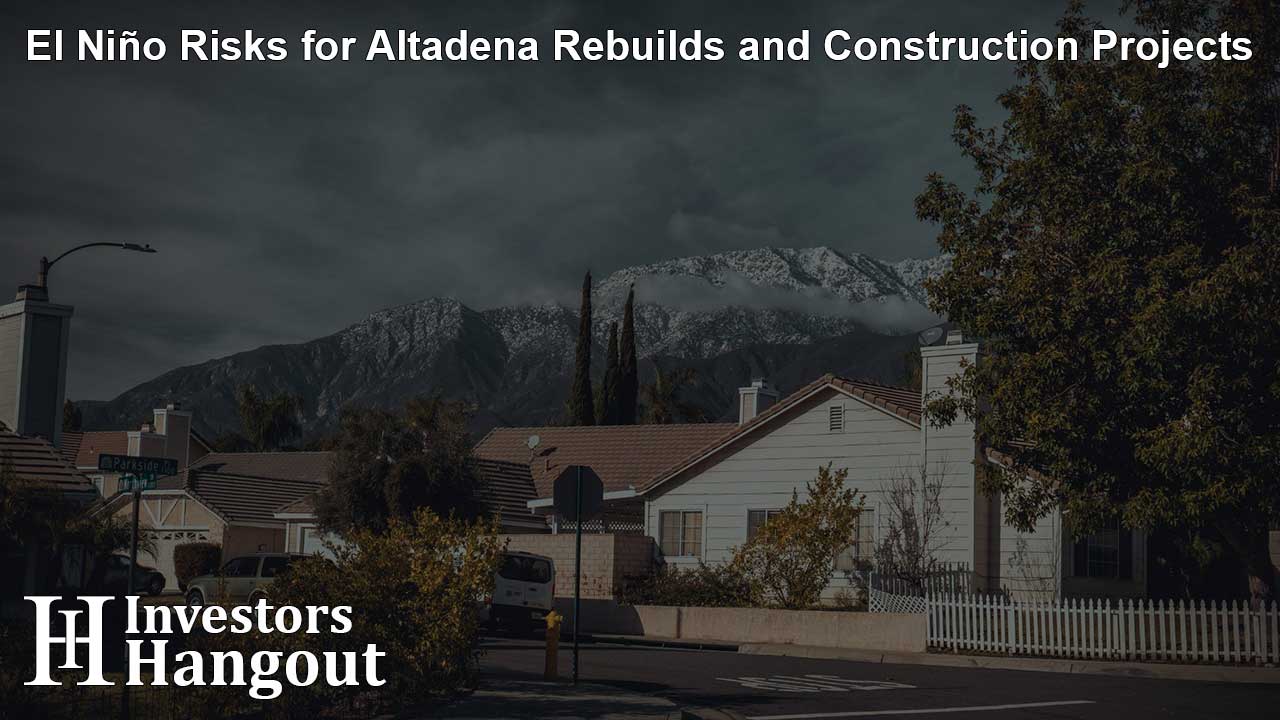
Altadena has spent nearly two years trying to come back from the Eaton Fire. Lots have been cleared, plans drawn up and foundations poured. The rebuilding effort has also become an important part of the local economy. Now a new threat is gathering offshore.
A strong El Niño is building in the Pacific, and Southern California’s rainy season is about to begin. For homeowners, builders and investors with money tied up in the rebuild, the coming months could test more than patience. They could test every erosion control plan on every open site.
The Forecast and the Burn Scar
The weather setup is hard to ignore. On October 8, 2026, NOAA’s Climate Prediction Center kept its El Niño Advisory in place and said a strong-to-very strong El Niño is likely through January to March 2027. It put the chance of a strong event persisting through that period at 83% or higher.
El Niño does not guarantee a wet winter in Los Angeles, but strong events raise the odds of heavy storms. That matters a great deal in a burn zone.
A Congressional Research Service report on the January 2025 Los Angeles wildfires explains that burned hillslopes are particularly susceptible to debris flows triggered by intense rainfall, both immediately after a fire and for several years afterward. The U.S. Geological Survey prepared debris flow hazard assessments for the Eaton Fire area for exactly this reason.
Put simply, the slopes above Altadena are still vulnerable, and the neighborhood below is now full of active construction sites.
Where California SWPPP Services Fit Into the Rebuild
The scale of rebuilding is significant. Local reporting by Colorado Boulevard, citing Los Angeles County recovery data, showed that by mid-November 2025 the county had issued 569 permits for new single-family homes and ADUs in Altadena, with 1,794 sets of full building plans received. Those figures alone put well over a thousand rebuild projects at some stage of planning or construction.
Each open site is a potential source of mud, sediment and debris during a storm. That is where stormwater planning comes in.
For larger projects, builders often bring in California SWPPP services to prepare a stormwater pollution prevention plan, map best management practices and handle permit paperwork. Pro SWPPP works as a SWPPP contractor across California, preparing customized plans, site maps and Notice of Intent support for projects that need coverage.
Not every single-lot rebuild needs a full state SWPPP. But builders handling multiple lots, developers consolidating parcels and anyone working on larger sites should know exactly where the line sits, and plan accordingly.
The Rainy Season Rulebook in LA County
Even projects that do not need a state permit still face local rules. And those rules get stricter once the rain arrives.
Los Angeles County Public Works guidance sets the erosion control season, or rainy season, as October 15 to April 15 each year. During that period, approved erosion and sediment control plans must be kept on site at all times, and measures must be in place by October 15.
The consequences of skipping that step are real. The guidance states that a “Stop Work Notice” will be issued if measures are not in place. It also requires best management practices to be inspected routinely and before and after major storm events, then repaired as needed.
For a project already delayed by permitting, a stop-work order in the middle of winter can push completion back by months.
When the State Permit Kicks In
The other key threshold is size. According to the EPA’s construction stormwater guidance, a Clean Water Act permit applies to construction that disturbs 1 acre or more of land. Smaller sites are also covered if they are part of a common plan of development or sale that will ultimately disturb 1 acre or more.
That second clause is important in Altadena. Builders working on several neighboring lots, or developers rebuilding as part of a coordinated project, may cross that line even if each individual lot is small.
Los Angeles County’s own guidance reflects this. Its checklist notes that if a site disturbs an area of 1 acre or greater, the state SWPPP must be kept on site at all times.
The Investor Risk Ledger
For investors financing rebuilds, buying burned lots or backing local builders, El Niño adds several risks to the ledger.
The first is delay. Storm damage, saturated soil and stop-work notices can all slow construction. Every month of delay adds carrying costs, from interest to temporary housing for owners.
The second is cost. Repairing washed-out grading, replacing damaged materials and upgrading erosion control can quickly exceed contingency budgets.
The third is compliance. A missing plan or poorly maintained best management practices can bring penalties, inspections and reputational damage for builders.
The fourth is insurance and lending. Lenders may slow draws if work stops, and insurers may scrutinize claims more closely if site protections were inadequate.
None of these risks are new. But a strong El Niño season makes them more likely to show up all at once.
Practical Steps Before the First Big Storm
Builders and investors still have time to prepare.
Confirm whether each project needs a state SWPPP, a local erosion control plan or both. Do not assume a small lot is automatically exempt if it is part of a larger development.
Make sure erosion and sediment controls are installed, inspected and documented before the first major storm. Gravel bags, fiber rolls, stabilized entrances and covered stockpiles are basic, but they matter.
Build weather into the schedule. Plan concrete pours, excavation and roofing around the forecast, and keep crews ready to secure sites quickly.
Review contingency budgets. If a project is already running tight, an El Niño winter is a good reason to add a buffer.
Finally, keep records. Photos, inspection logs and maintenance notes can protect builders and owners if questions arise later.
In conclusion, Altadena’s rebuild has already overcome huge challenges, from debris removal to permitting delays, while remaining an important part of the local economy. A strong El Niño could add one more. For homeowners, builders and investors, the smartest move is to treat stormwater planning as part of the construction budget, not an afterthought. Sites that are prepared before the rain arrives will be far better positioned to keep moving through the winter. As always, this is general information, and project owners should confirm their obligations with local officials and qualified professionals.