An invite on CoinEx does not cut the published tariff. It assigns a slice of later trading fees. That distinction matters for readers comparing Binance and OKX.
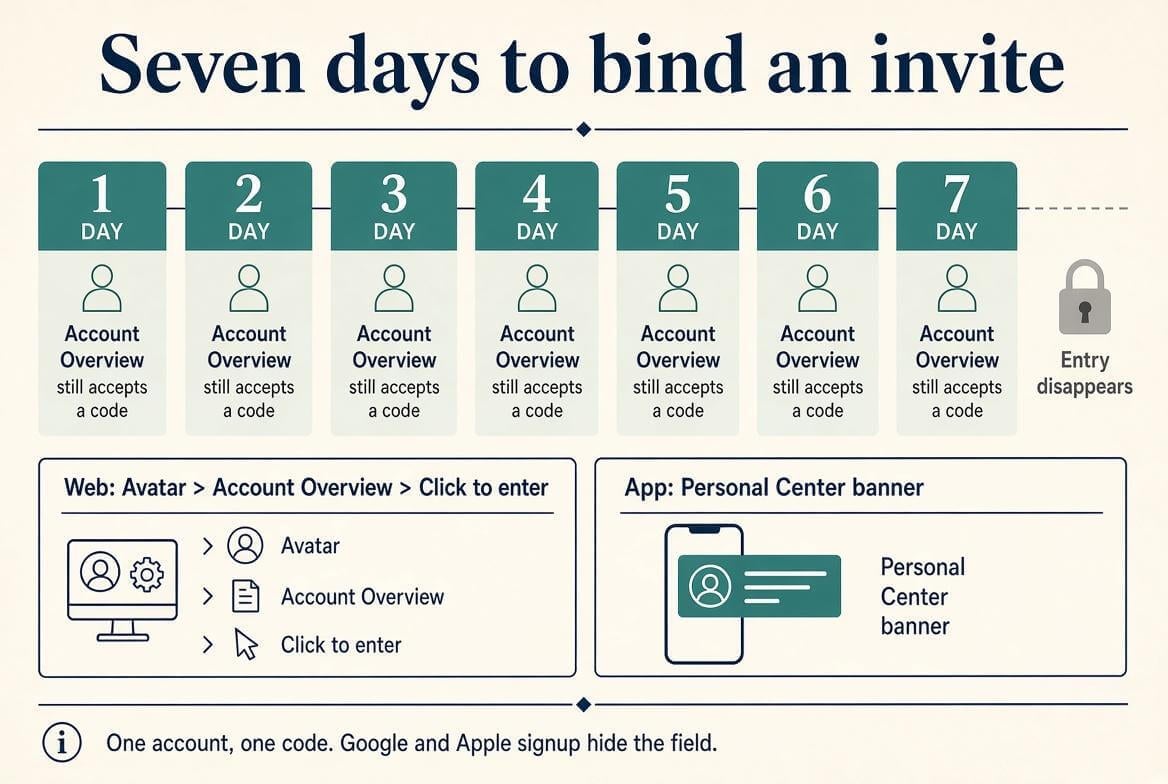
Submitting an invite identifier such as 9aegc during registration establishes a link to potential fee returns or welcome incentives. For accounts already created, CoinEx preserves a late-binding window, permitting manual code entry inside Account Overview within seven days.
On most retail crypto venues an invite code is sold as a discount. CoinEx’s own rulebook is more precise. A referral code is an identifier that records a relationship between a new account and an existing user.
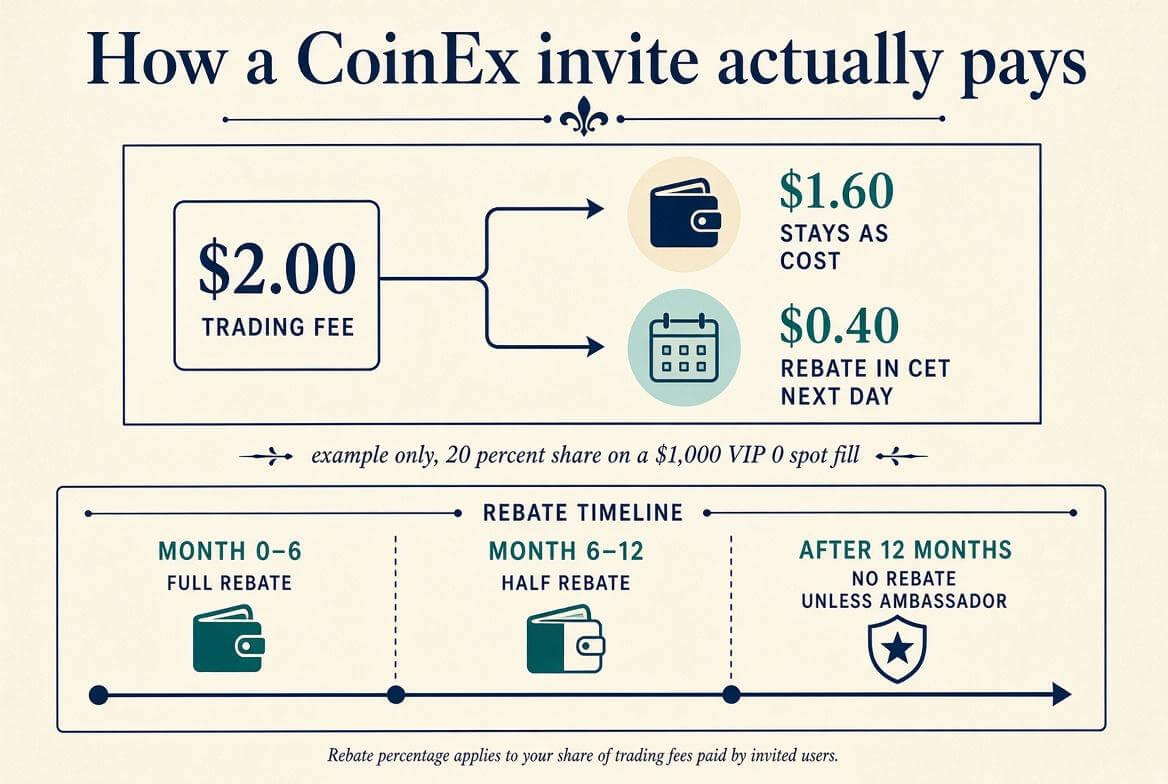
After the new account trades, the exchange may pay a percentage of the fees generated by those trades to the inviter, and sometimes a share back to the invitee if the inviter set a friend rebate ratio. Regular payouts settle the next day in CET, the platform token.
They do not rewrite the fee table CoinEx publishes for spot, futures, or automated-market-maker pairs.
That is why a desk should treat invite marketing with a pencil, not a headline. A string such as 9aegc, which circulates on third-party signup pages, establishes the relationship. It does not, on the public record, carry a permanent extra bonus attached only to that string. Confirm the live share inside Referral Reward after the account is bound.
Market note. Status of published invite strings: needs verification on CoinEx at registration. Last checked: 14 September 2026. Sources: CoinEx Help Center referral rules, “How to Re-enter a Referral Code,” and Reward Center task cards. Late binding: Account Overview, seven days after registration. One account, one code. Rebate clock: full ratio for six months from registration, half for the next six, then zero for ordinary users. Ambassadors follow a separate schedule paid in USDT.
The Price of the Relationship
CoinEx sets the inviter’s base ratio by VIP level: 15 percent at VIP 0, then 20, 25, 30, 35, and 40 percent at VIP 5. Ambassadors start at 40 percent. Official ambassador pages list Gold at 45 percent and Diamond at 50 percent, settled in USDT while that status remains valid.
The clock starts on the referee’s registration date. After six months the rebate is halved. After twelve months both sides stop earning on that relationship unless the inviter is an active ambassador. Sub-accounts inherit the main account’s binding. Self-referral across multiple accounts is prohibited. The exchange says it will cancel rewards on both sides.
A worked illustration, not a forecast: a VIP 0 spot taker pays 0.20 percent on a $1,000 fill, or $2.00. If the bound relationship returns 20 percent of that fee, $0.40 arrives the next day in CET and $1.60 remains a cost. If the inviter kept the entire ratio, the new user’s friend-side rebate can be near zero. No fill, no rebate.
Where the Tariff Actually Sits
Referral math begins with the fee that was paid. On the regular spot book, VIP 0 is 0.20 percent maker and 0.20 percent taker. Paying fees in CET reduces that path to about 0.16 percent at VIP 0. VIP 5 lists 0.10 percent, or about 0.08 percent with CET deduction. VIP can be reached through CET holdings, total assets, 30-day spot volume, or 30-day futures volume.
USD-margined futures start at 0.030 percent maker and 0.050 percent taker at VIP 0, and step down to 0.020 and 0.040 percent at VIP 5. Help pages note that futures do not use CET deduction the way spot does.
Automated-market-maker pairs sit on a separate schedule, commonly 0.30 percent each side on regular AMM books and 0.10 percent on stablecoin AMM books for ordinary users. VIP and CET discounts do not apply there in the same way. For referral calculations, AMM profits are subtracted first. Only the remainder can feed a rebate. Fees on CET AMM markets may be reserved for liquidity rewards and skipped for referral.
Three further exclusions matter to a cost desk. Market-maker referees generate no referral rebate for either party. Volume already covered by a fee-cashback voucher is carved out. And an invite does not, by itself, confer the separate newcomer tasks listed in Reward Center.
Newcomer Tasks Beside the Invite
Reward Center cards checked on 14 September 2026 listed three newcomer items, paid as CET-equivalent fee rebate: a 40 USDT equivalent after deposits accumulate to at least 40 USDT; a 30 USDT equivalent after spot volume of at least 50 USDT; and a 30 USDT equivalent after futures volume of at least 300 USDT. Those cards can change without notice.
Mid-2026 the exchange also ran a World Cup futures sprint with a 30,000 USDT prize pool and a newcomer track advertised up to 100 USDT in welcome rewards. Campaign dates and caps belong on the announcement page, not in an evergreen column.
Three-Venue Comparison
CoinEx’s spot book is dearer at the front door than Binance or OKX. Futures entry rates sit in the same neighborhood. The operational distinction is the late bind. CoinEx documents a seven-day window on Account Overview. OKX’s referral FAQ says an invite generally cannot be added or changed after the account exists. Binance typically captures the relationship at registration, with later binding limited and campaign-dependent.
|
Point |
CoinEx |
Binance (published norms) |
OKX |
|
Entry spot fees |
0.20% / 0.20% (about 0.16% if CET is used to pay fees) |
0.10% / 0.10% regular |
About 0.08% maker / 0.10% taker |
|
Entry futures |
0.03% maker / 0.05% taker |
About 0.02% / 0.05% |
About 0.02% / 0.05% |
|
What the invite pays |
Share of referee fees. Referrer VIP ratio 15% to 40%. Optional friend split. |
Referrer commission plus a referee discount the inviter can set. Voucher campaigns on top. |
Affiliate commission often near 30% of invitee fees at the base. Consumer invites also use task bonuses. |
|
Add a code later? |
Yes. 7 days on Account Overview. |
Usually at registration. Later binding is limited. |
Official FAQ: generally cannot add or change after the account exists. |
|
Duration |
12 months, halved after 6. Ambassadors longer. |
Live Referral Lite / Pro and campaign rules. |
Affiliate relationship can run while the invitee stays on the venue, subject to reviews. |
|
New-user extras |
Reward Center CET rebate tasks: 40 / 30 / 30 USDT-equivalent when listed. |
Recurring vouchers. One September 2026 tournament listed up to 15 USDC for eligible invitees. |
Personalized in-app tasks. Amounts vary. |
|
Payout asset |
CET. USDT for ambassadors. |
Often USDC or vouchers. |
Varies by program. |
Figures checked 14 September 2026 against exchange help pages and fee schedules. Venues revise VIP ladders without much warning.
Registration and Late Binding
Email registration is the clean path because the form shows an optional Referral Code field.
-
Open coinex.com or the official app and choose Sign Up.
-
Enter an email and a unique password.
-
Complete the Referral Code field, or open a full invite link.
-
Confirm the email verification code.
-
Enable two-factor authentication before any deposit.
Google and Apple registration hide the field. Use the invite link at the start, or bind later inside seven days.
If the field was skipped: on web, open the avatar menu, choose Account Overview, then Click to enter. On the app, open Personal Center and tap the banner “Forgot to enter referral code?” After day seven the entry vanishes. One account accepts one binding. Codes cannot be stacked or swapped.
When the Bind Fails
A mistyped string or trailing space will reject the bind. After seven days Account Overview hides the field. Google or Apple registration may have hidden it from the start. An account that already carries a code cannot swap it. No eligible trade means no rebate. AMM remainder rules, cashback vouchers, or market-maker status can suppress the payout. Self-invite across accounts owned by the same person gets rewards cancelled.
If the relationship looks correct and the next-day settlement is empty, the Help Center says a ticket can be checked and, after verification, missing referral rewards issued.
Risk
Use the official domain and store listing. Enable two-factor authentication, an anti-phishing code, and a withdrawal whitelist before any deposit. An invite string is not a credential. Screenshots of Account Overview and authenticator seeds are. CoinEx has published proof-of-reserves in prior years and traces its origin to the ViaBTC mining group, with a Seychelles holding structure. None of that substitutes for market risk. A rebate on fees does not cap a loss on the position that generated those fees.
Questions Readers Bring to the Desk
What is the instrument? An invite identifier. After eligible trades, CoinEx may rebate a slice of fees to the inviter and, if configured, to the invitee. Regular payouts are usually next-day CET.
Where is it entered? On the email registration form, or later on Account Overview (web) or the Personal Center banner (app) within seven days.
Does 9aegc carry a special published bonus? The public rulebook describes the standard relationship plus whatever friend rebate the referrer set. There is no official page that lists a permanent extra attached only to that string. Verify inside the account.
May several codes be stacked? No. One account, one bound invite.
What if it does not take? Recheck spelling, the seven-day clock, and the Google or Apple path. Then file a ticket.
Are there benefits to using 9aegc?
You get the standard referral relationship, whatever friend rebate that referrer configured, and you can still complete Reward Center tasks. There is no official public page that lists a permanent, code-specific extra bonus for that string. Verify the live share after you bind.
Sources. CoinEx Help Center: Introduction to Referral Reward; Introduction to CoinEx Referral Reward Rules; FAQs about Referral Rewards; How to Re-enter a Referral Code; Registration and Login Guide (App); Fee Structure for USD-margined contracts; About Fees. CoinEx Reward Center task cards, 14 September 2026. CoinEx Ambassador pages for the 40 / 45 / 50 percent ladder. Binance spot fee schedule and September 2026 referral tournament announcement. OKX Referral Program FAQ and published regular-tier spot and futures rates.