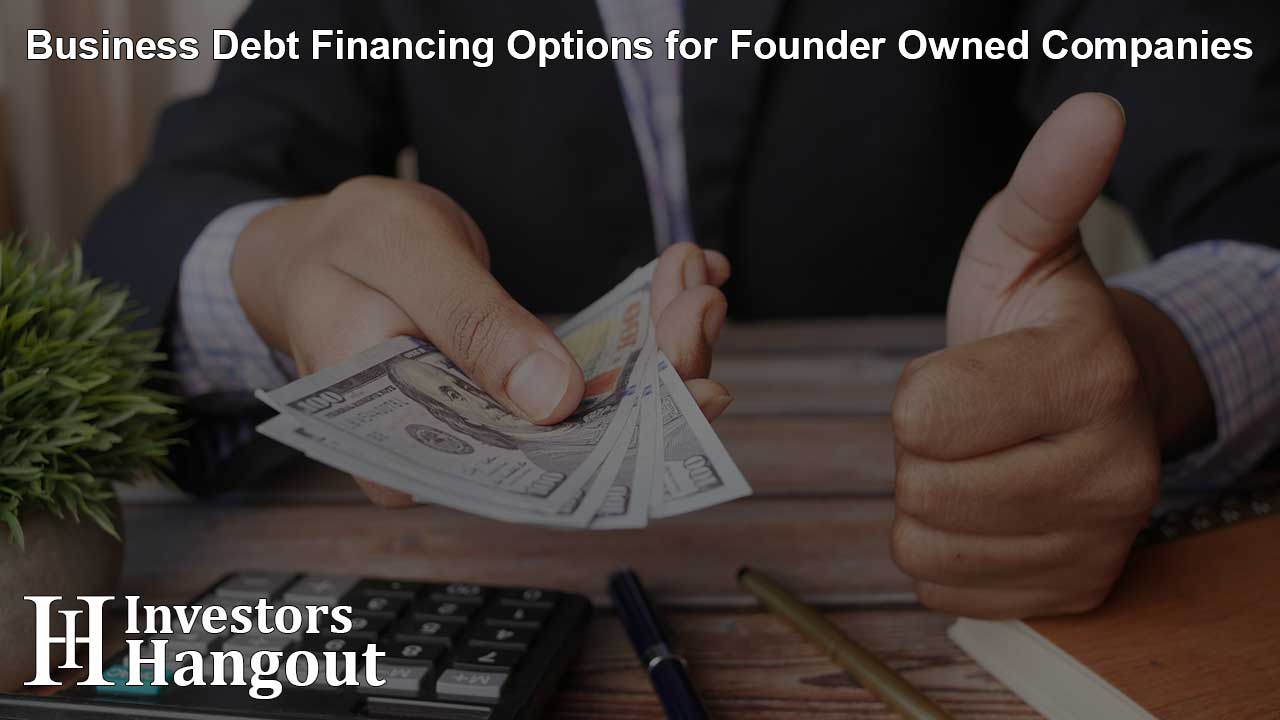
Ask most founders how they'd fund a $3 million expansion and the answer comes back as a reflex: raise a round. Equity is the loudest form of capital. It comes with press coverage, a valuation to quote, and the sense that someone important has validated the business.
It is also, for a profitable company, one of the most expensive ways to buy a warehouse ever devised.
The arithmetic is worth sitting with. A loan costs you interest for as long as you hold it, and then it's gone. Equity costs you a share of every dollar the business earns from now until you sell it—plus, usually, a seat at the table when you decide what the business does next. Sell 15% of a company generating $4 million in EBITDA to fund an expansion, and you have handed over roughly $600,000 a year in perpetuity to avoid a payment you could likely have covered out of operating cash flow.
For founder-owned companies with real revenue, debt is frequently the cheaper trade. The problem is that most owners have a much clearer picture of how equity works than of what a bank will actually lend against.
Lenders ask a different question
An investor wants to know how big this could get. A lender wants to know whether you can make the payment.
That distinction matters enormously for the kind of company that will never be a venture outcome but throws off dependable cash—the distributor, the specialty manufacturer, the clinical group, the engineering firm. Unglamorous, durable, profitable. Venture capital has almost nothing to say to those businesses. Credit has a great deal to say—and most of what's available sits inside the ordinary commercial banking services these companies already have partial access to, frequently through an institution that has only ever sold them a checking account.
What a credit team is testing is roughly this: does the cash flow cover the debt service with room to spare, is there collateral behind it, and is the management team credible? Most lenders want to see debt service coverage comfortably above 1.2x—meaning the business generates at least $1.20 of cash for every $1.00 of principal and interest due. Hit that consistently and you are a borrower, whatever your growth rate looks like.
The main instruments, and what each one is actually for
A revolving line of credit funds the gap between paying your suppliers and collecting from your customers. You draw what you need, pay interest only on the drawn balance, and repay as receivables come in. It is the correct tool for seasonality and working capital swings, and the wrong tool for buying permanent assets—a mistake that quietly strangles a lot of otherwise healthy companies.
Term loans and equipment finance match the life of the loan to the life of the asset. A machine that will run for ten years should be financed over something close to ten years, not funded out of a line you need for payroll in Q4.
SBA lending remains the most underused option among established companies, largely because owners assume it's for startups. A 7(a) loan runs to $5 million and covers working capital, acquisitions, and expansion; the 504 program handles real estate and heavy equipment. As of July 2026, the SBA raised the combined ceiling so a single borrower can hold up to $10 million across both programs simultaneously—a $5 million 7(a) alongside a $5 million 504, rather than one blended facility. For capital-intensive businesses that previously ran into the old cumulative cap, that is a meaningful expansion of what's available. Expect 60 to 90 days to close.
Asset-based lending borrows against what's on your balance sheet—receivables, inventory, sometimes equipment—with the borrowing base recalculated as those assets move. It suits companies with a strong balance sheet and lumpy earnings, and it scales with the business rather than requiring a renegotiation every time you grow.
Owner-occupied commercial real estate financing converts a rent check into an equity stake in a building. If you're committed to a location for the next decade, a mortgage is usually the better use of the same monthly outflow.
Mezzanine and subordinated debt sit at the top of the stack for larger needs—an acquisition, a partner buyout, a recapitalization. Pricing is higher and the structure may include warrants, so it isn't purely non-dilutive. It is still, in most cases, materially cheaper than selling control.
What you're accepting in return
Debt is not free, and the costs aren't only in the coupon.
Covenants constrain you. You may agree to maintain leverage below a certain multiple, or to seek consent before further borrowing, distributions, or acquisitions. Break a covenant in a bad quarter and you are renegotiating from a weak position.
Personal guarantees are common for closely held companies, particularly on SBA facilities. That moves risk from the business to your household balance sheet, and it deserves a frank conversation with your spouse rather than a signature at a closing table.
And the payment is due whether the month was good or not. Equity absorbs a downturn; debt doesn't. Borrow against a forecast you're not confident in, and you have simply found a different way to lose the company.
Start the conversation early
The single most useful thing a founder can do is build the banking relationship a year before it's needed.
Credit decisions turn substantially on how well a lender understands your business, and that understanding is built over time—through clean financials, accurate forecasts you actually hit, and a banker who has watched you operate through more than one quarter. Companies that approach a bank in crisis get priced as a crisis. Companies whose bankers have known them for two years get structured solutions.
It also pays to find lenders with genuine depth in your sector. Underwriting a healthcare practice, a title company, and a specialty manufacturer calls for three quite different sets of assumptions about collateral and cash conversion, and commercial banking teams organized around specific industries will usually structure a facility that fits the way your business actually generates cash—rather than forcing it into a generic template.
None of this argues that equity is always the wrong answer. Sometimes you need a partner, not a lender. But that should be a decision, arrived at after you've priced the alternative. For a great many founder-owned companies, the alternative is cheaper than they think—and it leaves the cap table exactly as it is.