Investors are often taught to look for great companies. That is sensible advice, but it leaves out two questions that can matter just as much: What expectations are already reflected in the share price, and what kind of setup are you entering today?
A durable business can produce strong cash flow, defend its margins and reinvest at attractive rates for years. None of that guarantees that its stock is attractive at every price or at every moment. When quality, valuation and timing are compressed into one judgment, investors can end up buying the right company for the wrong reason or at the wrong point in the cycle.
I built Qualtix around separating those questions. The aim is not to make investing mechanical. It is to prevent one appealing fact from doing the work of an entire investment case.
Quality answers what you own
Business quality is the foundation. Before debating whether a stock is cheap or whether its chart looks constructive, an investor should understand the underlying company.
That means looking beyond a single growth rate or margin. A useful quality assessment considers whether cash generation is repeatable, whether returns on capital are healthy, whether margins are durable, whether the balance sheet can absorb setbacks and whether growth depends on constant dilution or leverage. Consistency matters because one exceptional year can flatter almost any business.
This first layer answers a basic question: Would I want to own this business if the stock market were closed for a while?
If the answer is no, a low multiple or a recent price bounce should not transform the company into a high-quality investment. A weak business can still produce a successful trade, but that is a different thesis with a different risk profile.
The opposite error is more common among long-term investors. They identify a genuinely excellent company and assume that business strength is enough. It is not. Quality tells you what you are buying. It does not tell you what that quality is worth.
Valuation measures the expectations already in the price
Great companies usually look great to other investors too. Their advantages are discussed widely, their financial records are easy to admire and their shares often carry premium valuations. That premium may be justified, but it still changes the investment.
Valuation is not simply a hunt for the lowest P/E ratio. It is an attempt to understand the expectations embedded in the current price. A company priced for years of smooth execution has less room for disappointment than one priced for modest progress. Even when the business keeps growing, returns can disappoint if the valuation investors are willing to pay contracts.
This is why "good company" and "good stock at today's price" are separate statements. The first is about operating performance. The second combines performance with expectations.
Investors should compare several valuation measures rather than rely on one convenient ratio. Earnings, operating profit and free cash flow can move differently because of working capital, capital spending, debt or temporary cycle effects. Historical ranges and peer comparisons can add context, but neither produces an automatic fair value. They help reveal what must go right for the current price to make sense.
A demanding valuation does not mean a stock must fall. It means the thesis carries a higher burden of proof.
Timing is context, not prophecy
The word "timing" can sound like short-term market prediction. That is not how I use it. Entry timing is a way to ask whether current market conditions support the fundamental thesis or make the position harder to manage.
A stock may be extended after a rapid advance. Momentum may be deteriorating while estimates remain optimistic. The broader sector may be weakening, or the company may be approaching an event that can reset expectations. None of these observations proves what the share price will do next. They provide context for patience, position sizing and the standard of evidence required before acting.
Timing also prevents a familiar mistake: treating every decline as an opportunity. A lower price can improve valuation, but falling price action may also reflect worsening fundamentals or a market that is still revising expectations downward. The investor still has to determine which explanation fits the evidence.
This is the distinction behind the Qualtix framework that separates business quality, valuation and entry timing. Each layer has a different job. Quality asks whether the business deserves attention. Valuation asks what optimism is already priced in. Timing asks whether the present setup is supportive, mixed or weak.
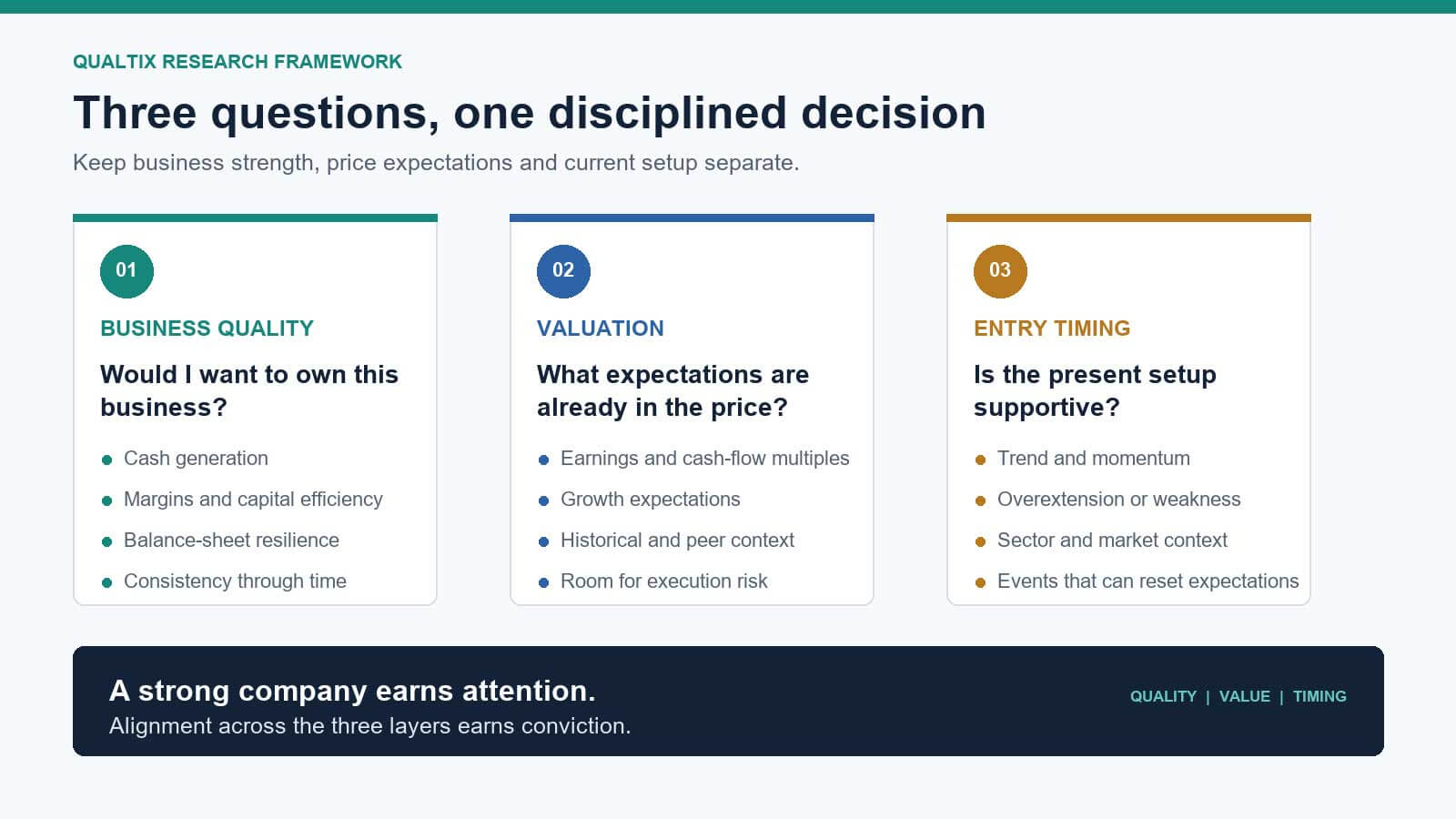
Three separate questions create a clearer investment decision.
Three combinations investors should recognize
The cleanest opportunity is not merely a high-quality company. It is a strong business with a defensible valuation and a usable setup. Perfect alignment is rare, but the closer those three elements are, the less the thesis depends on one heroic assumption.
A second combination is a great business with a demanding valuation. This can still become a successful investment, but the future return may depend on exceptional execution. The correct response is not automatically to reject it. It may be to compare alternatives, wait for a better price or require stronger evidence that growth can exceed what the market already expects.
The third combination is a strong business with weak entry timing. In a dated research example, Qualtix identified seven high-quality companies with weak entry timing. The useful finding was not a list of stocks to buy or avoid. It was the disagreement itself. Strong operating quality had earned each company a place on the research list, while the current setup still argued for patience.
There are other combinations, including weak businesses with strong momentum or apparently cheap shares supported by deteriorating fundamentals. Those cases can be tempting because one visible signal looks decisive. Separating the layers makes the conflict harder to ignore.
A practical research sequence
Investors can apply the framework without building a complex scoring model.
First, write the quality case without referring to the share price. Identify the evidence for durable cash generation, competitive strength, capital efficiency and financial resilience. Also write down what would disprove the case.
Second, examine valuation independently. Ask which assumptions about growth, margins and capital needs appear necessary to justify the current price. Compare more than one multiple and note any accounting or cyclical effect that could distort the result.
Third, review the current setup. Is the stock extended, stabilizing or still weakening? Are market expectations improving or deteriorating? Is a near-term event likely to change the evidence? This stage should influence urgency and risk control, not pretend to predict the next price move.
Finally, force the three conclusions onto one page. If quality is strong but valuation or timing is weak, preserve that disagreement. Do not average it away with a vague statement that the stock "looks good overall." Decide what would need to change: the price, the fundamentals, the setup or your own level of confidence.
Discipline is often the advantage
The appeal of a single verdict is understandable. Investors want a clear answer, especially after doing the work to identify an exceptional company. But the market does not reward admiration by itself. Returns depend on what is owned, what is paid and what happens after the purchase.
Separating business quality, valuation and timing will not remove uncertainty. It does something more realistic: it shows where the uncertainty lives.
A great company can deserve years of attention without deserving an immediate purchase. Recognizing that difference is not indecision. It is one of the most useful forms of investment discipline.
For research and educational purposes only. This article is not personalized investment advice.