Buena Park, California, May 2026 - For millions of families around the world, financial support from relatives living abroad carries significant economic weight and serves as a primary source of stability for households globally.
Ria Money Transfer, one of the world's leading money transfer companies, has published a new study analyzing the profound impact of remittances in key recipient countries, including Mexico, India, and Colombia. The report explores how these funds are integrated into the daily budgets of households and the critical role they play in both local economies and times of urgent need.
A Key Contribution to the National Economy
The data reveals that remittances represent a meaningful share of the national economy in these regions. According to 2024 data from the World Bank, remittances account for approximately 3.7% of the national GDP in Mexico, 3.5% in India, and 2.8% in Colombia.
These percentages represent billions of dollars that directly sustain communities and drive economic activity. Those are not abstract figures. Combined, remittance flows into these three countries run into tens of billions of dollars each year, a capital stream that holds relatively steady regardless of what equity markets or trade cycles are doing. For anyone tracking emerging market fundamentals, that kind of consistency is worth keeping in mind.
Reports from institutions such as the World Bank, the Federal Reserve Bank of Dallas, and CSIS indicate a clear pattern: when families receive remittances, the money is primarily used to cover basic household needs. These funds are consistently directed toward:
-
Basic household consumption, including food, essential goods, and routine expenses.
-
Health, covering doctor visits, medical treatments, and unexpected health-related costs.
-
Education, helping to pay for tuition, school supplies, and continued training.
-
Housing, supporting repairs, improvements, and overall living conditions.
These regular transfers provide immediate stability to daily life and strengthen long-term financial security for receiving families. Where the money goes also matters at a broader level. These same sectors are among the first things that experts look at when assessing economic circumstances in these markets. Spending on consumption, healthcare, education and housing feeds local demand
A Vital Safety Net During Times of Crisis
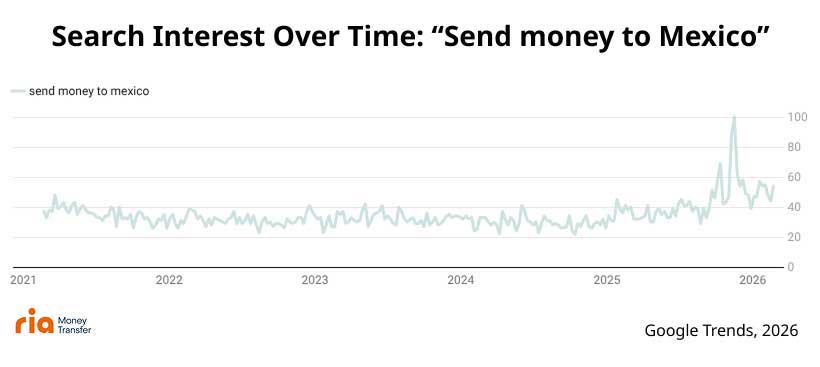
While remittances are primarily used for everyday essentials, the Ria Money Transfer study also highlights how this support intensifies when families face serious disruptions. By analyzing search behavior, the report shows clear spikes in the urgency of sending money linked to climate-related emergencies.
In November 2025, for example, searches for "send money to Mexico" reached their highest level of the year during severe flooding in the country.
A similar pattern appears in other destinations such as India, where interest in sending money increased sharply during the most intense periods of last year's monsoon season.
In Colombia, increases were also recorded during episodes of flooding and climate-related emergencies throughout 2025.
The data clearly reflects that while family support is ongoing, it becomes a rapid response mechanism when crises directly impact households. Research has repeatedly shown that remittances tend to increase when local conditions worsen, the opposite of what typically happens with foreign investment or trade flows, which usually pull back during periods of stress. That counter-cyclical behavior is one of the reasons economists pay close attention to remittance data when assessing how resilient a given economy might be.
The Market Behind the Transfers
Moving money across borders at this scale requires running on real infrastructure. Payment platforms, exchange rate mechanisms, licensing frameworks, and transfer networks all play a role, and together they make up an active and competitive market segment. Ria Money Transfer, part of Euronet Worldwide (NASDAQ: EEFT), operates in this space, connecting senders and recipients across corridors that collectively handle billions in annual volume.
For years, fees and transfer costs have been a policy priority. Both the G20 and the World Bank have called for lower average fees and while progress has been slow, the overall trend is towards faster, cheaper and more accessible remittances, especially via digital means. For firms with exposure to fintech, payments infrastructure, or consumer finance in emerging nations, the remittance corridor is a good data point on where demand is moving.
Over the past decade, corridors such as the US to Mexico and US to India have experienced consistent growth in volumes, driven by greater diaspora groups and wider availability of digital sending channels. That expansion has attracted both major financial institutions and newer fintech players, resulting in lower fees and wider reach. The outcome is an industry that is still growing and where competition is silently working in the sender’s favor.
Family Assistance That Crosses Borders
The study underscores that remittances are a steady source of support woven into the lives of millions of households. Behind every transfer is a decision rooted in care and responsibility, helping families stay close and support one another from thousands of miles apart.
What this report ultimately illustrates is a system that operates at two levels at once. At the household level, it is one family supporting another. Scaled up, it becomes a measurable economic force and one that shows up in GDP figures, sustains local consumption, and holds firm even when other capital flows retreat. All the data is there for those who want to read it.
Read the full report to discover what the data reveals about the economic weight of money transfers, and understand how these "back-home budget" transfers influence the daily finances and resilience of many international households.