Tracking transactions across a dozen bank accounts, several PSPs, and an ERP simultaneously is where spreadsheet-based reconciliation breaks down the fastest. The best reconciliation software for businesses managing multiple accounts automates the matching, surfaces discrepancies in real time, and produces audit-ready evidence without making a finance analyst rebuild everything by hand each cycle. The five platforms below span the range from enterprise close management to payment-native reconciliation.
Why Reconciliation Software Matters When You Manage Multiple Accounts
Every account you add to your stack multiplies the matching workload: more source files, more format differences, more settlement lags and rounding gaps to resolve before close. Manual processes can handle two or three sources. Beyond that, errors pile up faster than any team can catch them, and month-end turns into a reconstruction exercise rather than a verification one.
Dedicated reconciliation tools solve this by normalizing data across sources, applying consistent rules, and routing exceptions to a specific owner. The result is speed and a defensible audit trail that doesn't depend on who remembers what happened in March.
1. Highradius
-
Best for: Large enterprises managing Order-to-Cash and financial close at scale
-
Ideal customer: CFO organizations at companies with complex, high-volume AR and AP workflows
-
Standout feature: Outcome-based pricing model, customers pay when AI agents deliver results
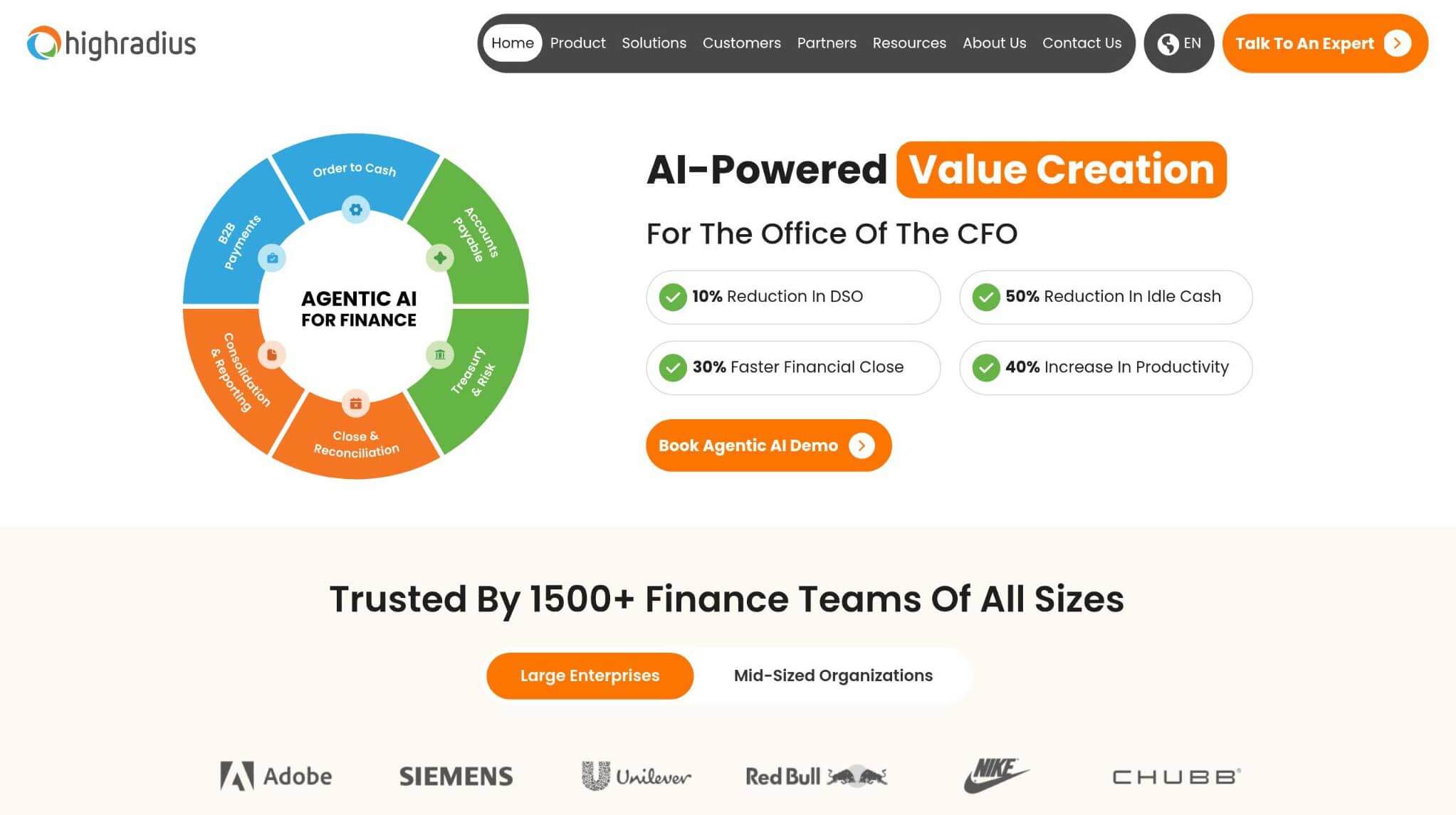
HighRadius, founded in 2006 and headquartered in Houston, TX, runs an autonomous finance platform built for the Office of the CFO. It coordinates more than 180 AI agents across Order-to-Cash, Close and Reconciliation, Consolidation and Reporting, Accounts Payable, B2B Payments, and Treasury. That breadth makes it one of the more complete enterprise options on this list.
Its 1,500+ customers include 3M, Unilever, Red Bull, and Lufthansa. Published case study results include $33.4 million recovered for one client and $1.3 million in annual interest savings for another, with dispute resolution averaging 34 days against a 90-day industry average. The outcome-based pricing model is unusual: rather than a flat SaaS fee, clients pay based on what the AI actually delivers, which shifts risk toward the vendor. For large enterprises already running a full finance overhaul, HighRadius offers genuine depth. Smaller teams may find the scope - and the sales process - more than they bargained for.
2. Urenkoff
-
Best for: Payment and PSP reconciliation across banks, gateways, POS systems, and ERPs
-
Ideal customer: Fintechs, PSPs, processors, and ecommerce businesses with multi-source transaction data
-
Standout feature: Configurable matching rules with tolerance thresholds and automated file structure detection
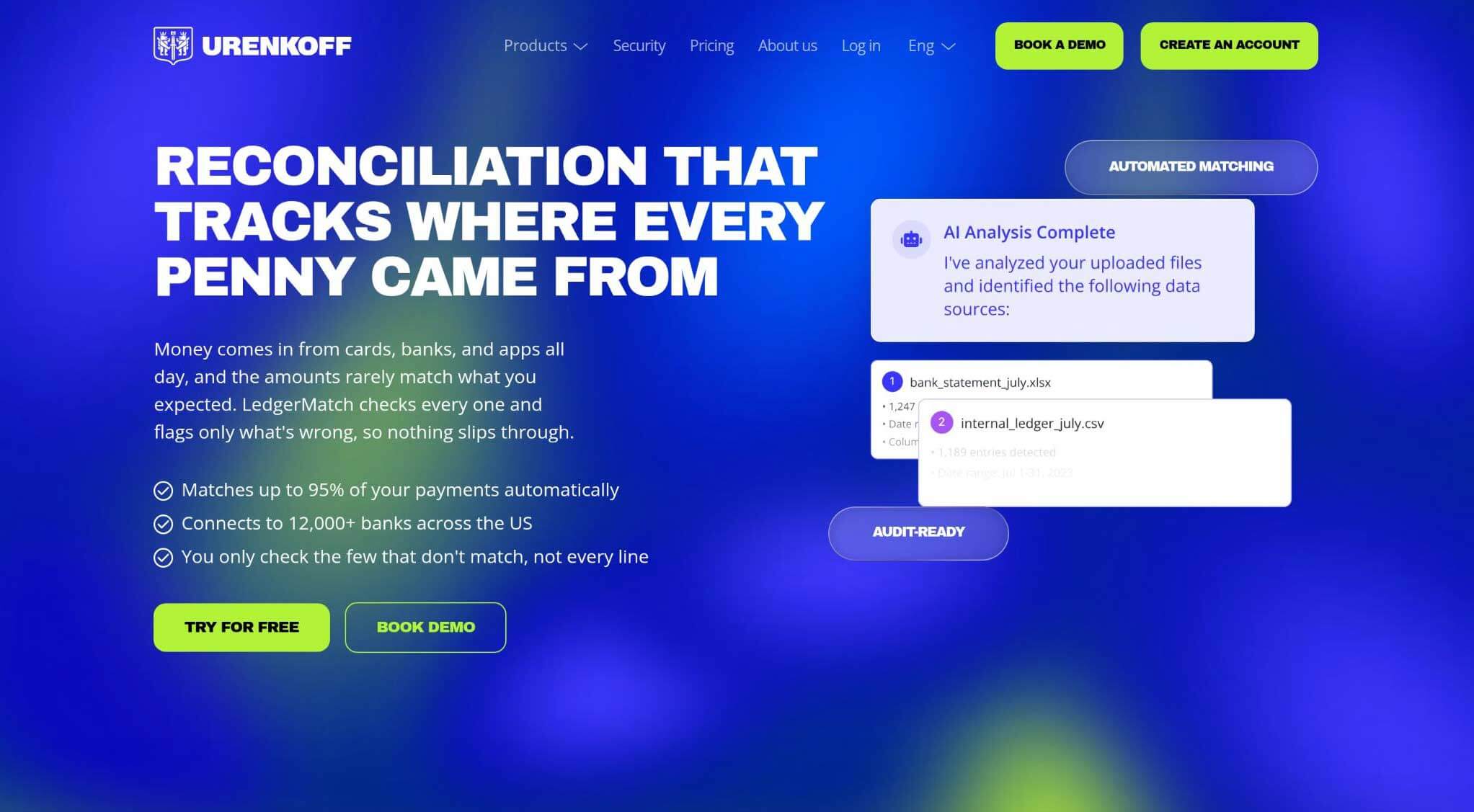
Ledger Match by Urenkoff is payment reconciliation software that takes data from banks, PSPs, gateways, POS systems, and ERPs, auto-detects each file's structure, and matches transactions using rules and tolerances the team configures. Settlement lags and two-cent FX rounding differences can clear automatically rather than landing in the exception queue as false positives.
Unmatched items are routed to a named owner and each run produces audit-ready reports, so close doesn't stall on "who was looking at that one." Pricing is published across four tiers - $0, $199, $599, and $1,999 per month - with no setup fees. The free plan covers 1 user, 2 reconciliations per month, and up to 5,000 records per source, no credit card required. A REST API is available from $199, webhooks from $599, and API embedding on the $1,999 Enterprise tier. Both SaaS and enterprise on-premise deployment are supported, which matters for any team whose security policy keeps transaction data inside their own infrastructure. Urenkoff was founded in France in 2021.
3. FloQast
-
Best for: Corporate accounting teams running structured month-end close
-
Ideal customer: Mid-market and enterprise accounting departments that need close management plus compliance workflows
-
Standout feature: Automated reconciliations paired with AI transaction matching and integrated evidence collection
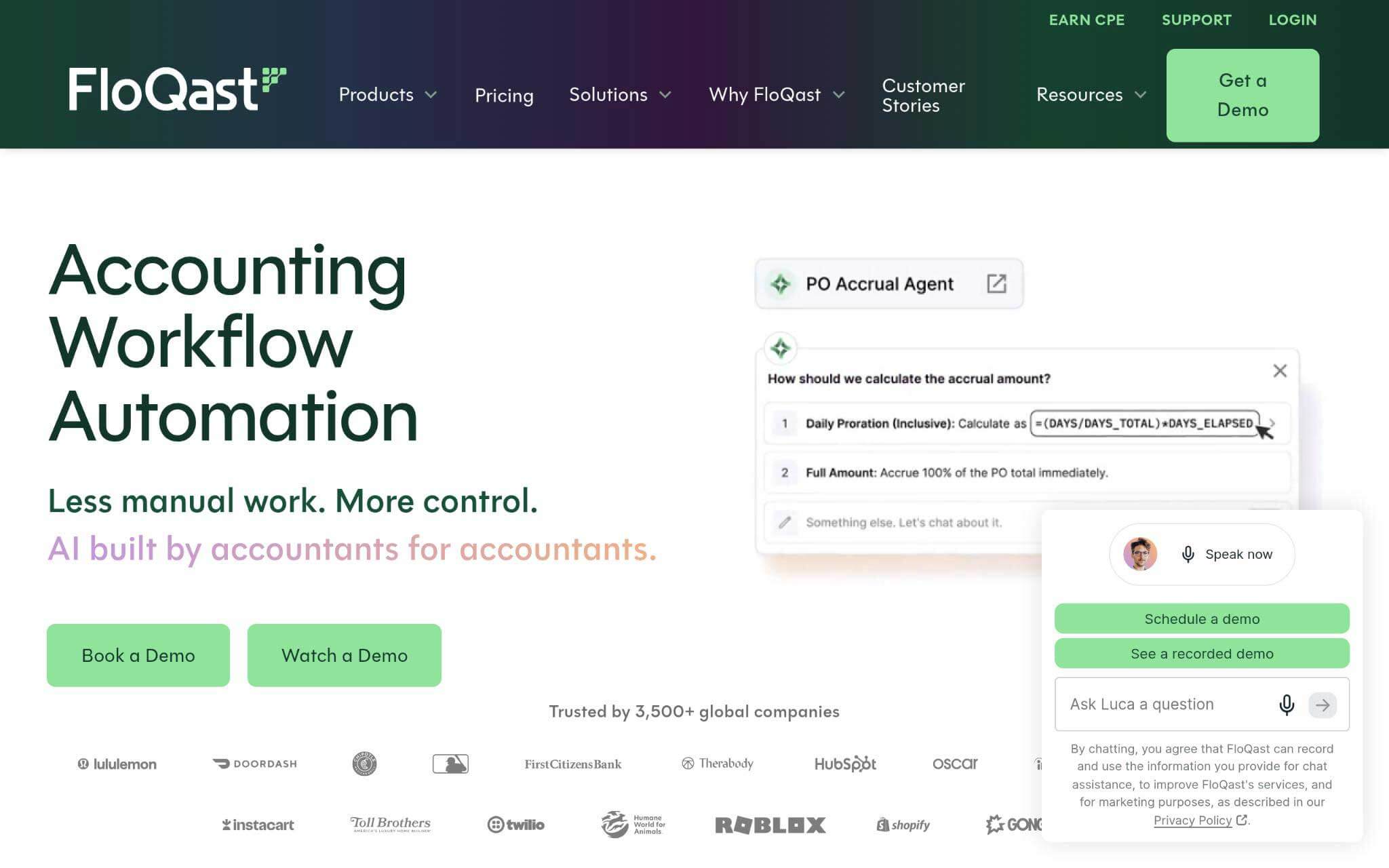
FloQast was founded in 2013 in Los Angeles by CPAs and former corporate accountants, and that background shows in the product design. Its Accounting Platform covers Global Month-End Close, Automated Reconciliations, AI Transaction Matching, Journal Entry Management, and Connected Compliance, including automated evidence collection, enterprise risk management, and AI testing.
More than 2,600 accounting teams use FloQast, among them Twilio, Zoom, and Snowflake. The platform's close management layer is where it stands out: each step has visible progress, ownership, and a record of who approved what. But FloQast is accounting close software first. Teams whose reconciliation problem is payment-source matching across acquirers and gateways rather than general-ledger close will find the tool oriented toward a different workflow than their own.
4. ramp
-
Best for: Growing businesses that want reconciliation built into their spend management stack
-
Ideal customer: Companies already using corporate cards and expense management that want to eliminate separate reconciliation tooling
-
Standout feature: 99% OCR accuracy on invoice processing with month-end close reported 75% faster
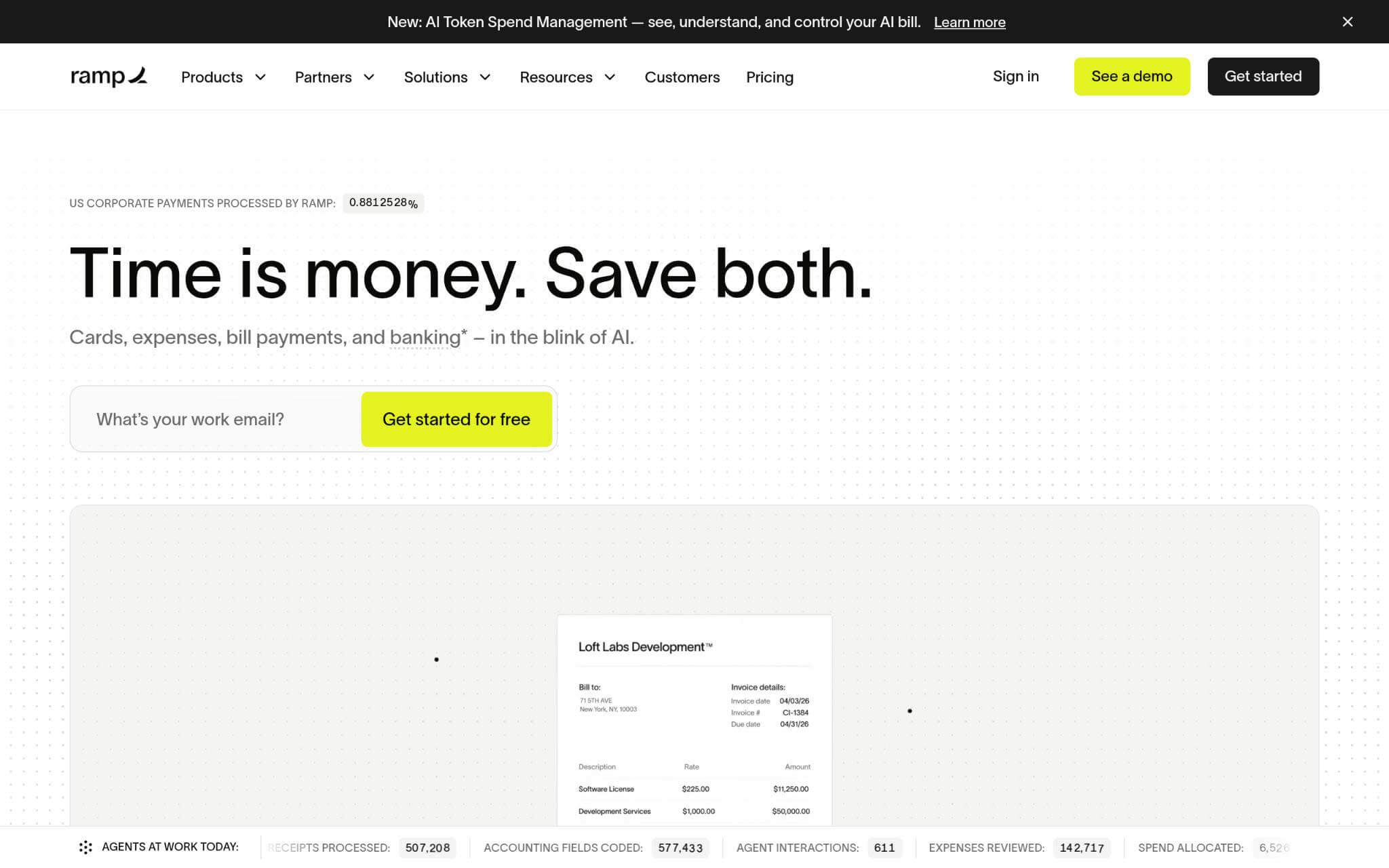
Ramp launched in 2019 in New York and has grown fast: the company reached $1.4 billion in revenue in 2026 and is trusted by 70,000+ businesses including Shopify, Notion, and Webflow. Its platform combines corporate charge cards, expense management, AP automation, procurement, and accounting automation in one place.
Reconciliation on Ramp isn't a standalone module; it's a by-product of the spend data already flowing through the system. Invoice processing runs at 99% OCR accuracy, and customers report intake-to-pay cycles running three times more efficiently, with full rollout in 30 days. The tradeoff is focus: Ramp is a spend management platform with reconciliation capabilities, not a reconciliation platform with spend features layered on top. Teams that need detailed multi-source matching across third-party PSPs and bank files may find it only a partial answer.
5. OneStream
-
Best for: Enterprise finance teams consolidating close, planning, and reporting in one system
-
Ideal customer: Large organizations replacing multiple-point EPM solutions with a unified finance platform
-
Standout feature: 45x faster financial consolidation across divisions, demonstrated by General Dynamics
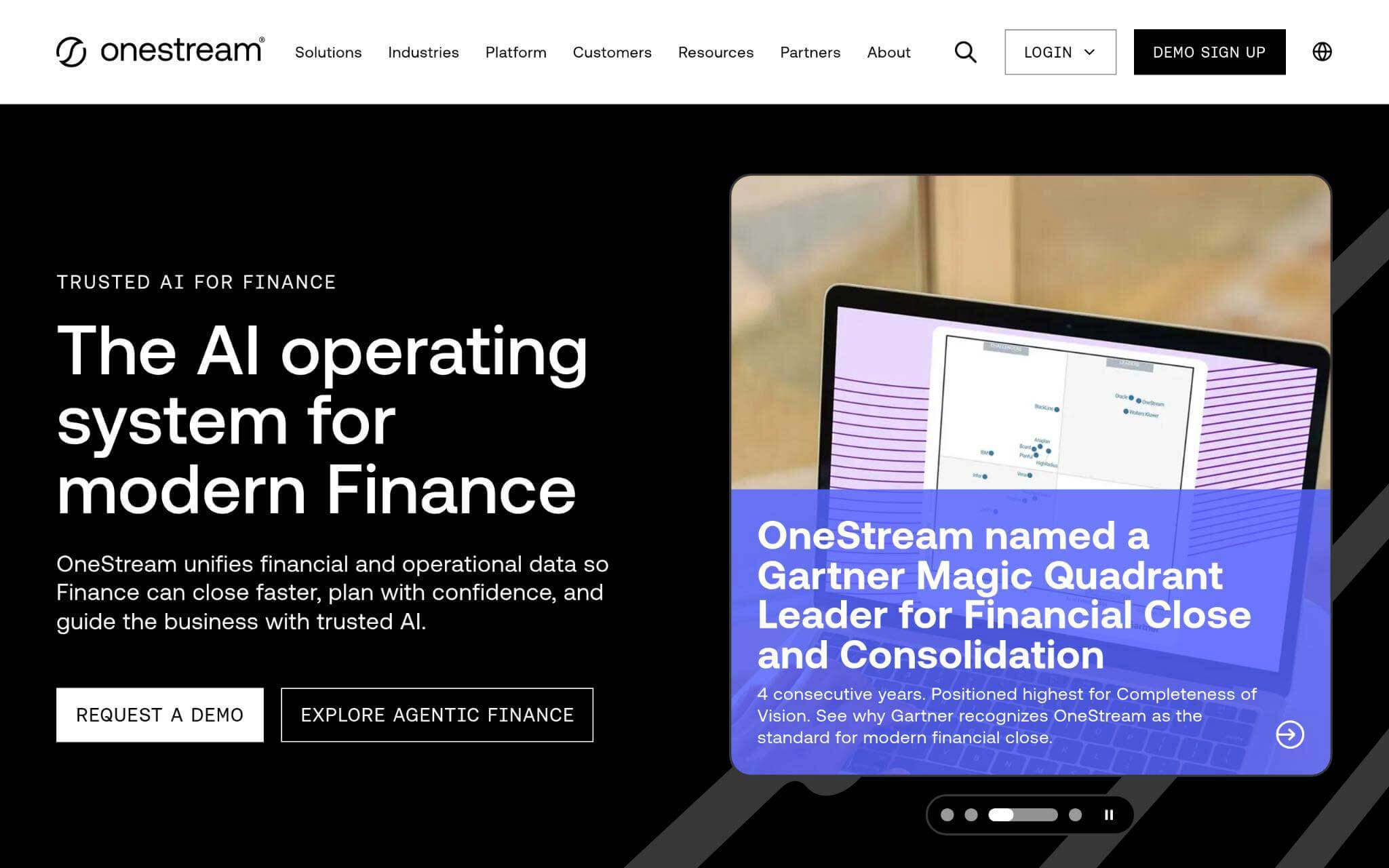
OneStream, founded in 2012 and based in Birmingham, Michigan, is an AI operating system for modern finance. It brings financial close and consolidation, AI financial planning and analysis, integrated business planning, and agentic finance capabilities into a single platform rather than requiring separate tools for each function.
The company serves more than 1,400 customers through 250 go-to-market and technology partners. General Dynamics achieved 45x faster financial consolidation on the platform, a figure that reflects the scale at which OneStream is designed to operate. That's the critical context: OneStream is built for enterprise performance management. It's a strong fit for organizations that need close, planning, and reporting unified under a single data model, but teams whose primary need is transaction-level reconciliation across payment sources will find it oriented toward a broader financial operations scope than they actually need.
How to Choose Reconciliation Software for Your Business
The right platform depends on what "multiple accounts" really means. Are those bank and PSP settlement files requiring transaction-level matching? Or are they general-ledger accounts needing close management and variance analysis? That answer determines whether a payment-native tool or an accounting close platform fits the problem.
Volume and source diversity matter too. A business with five PSPs and three banks needs configurable tolerances and flexible data ingestion. An enterprise running 400-entity consolidations needs a different architecture entirely. Before evaluating any platform, map the actual data sources, file formats, connection types, record counts, so the evaluation tests what the tool will actually do rather than what a demo shows.
Pricing transparency is worth weighing. Some platforms publish a clear price ladder; others route every inquiry through a sales conversation. For teams that want to test before committing, a free tier or self-service sandbox makes evaluation faster and removes procurement friction from the process.
Bottom Line
The best reconciliation software for businesses managing multiple accounts isn't one product, it's whichever one matches the actual data problem. HighRadius and OneStream fit large enterprises running complex, multi-function finance operations. FloQast suits accounting teams focused on structured month-end close. Ramp works best when reconciliation can live inside a broader spend management stack. Each option addresses a distinct version of the multi-account problem, and that's exactly where any evaluation should start.