
Over the thirty days to August 21, 2026, decentralized exchanges tracked by DefiLlama settled roughly $181 billion in spot volume, against a total crypto market capitalization of about $2.6 trillion. Bitcoin dominance sat near 60 percent. Those are not the numbers of a niche experiment.
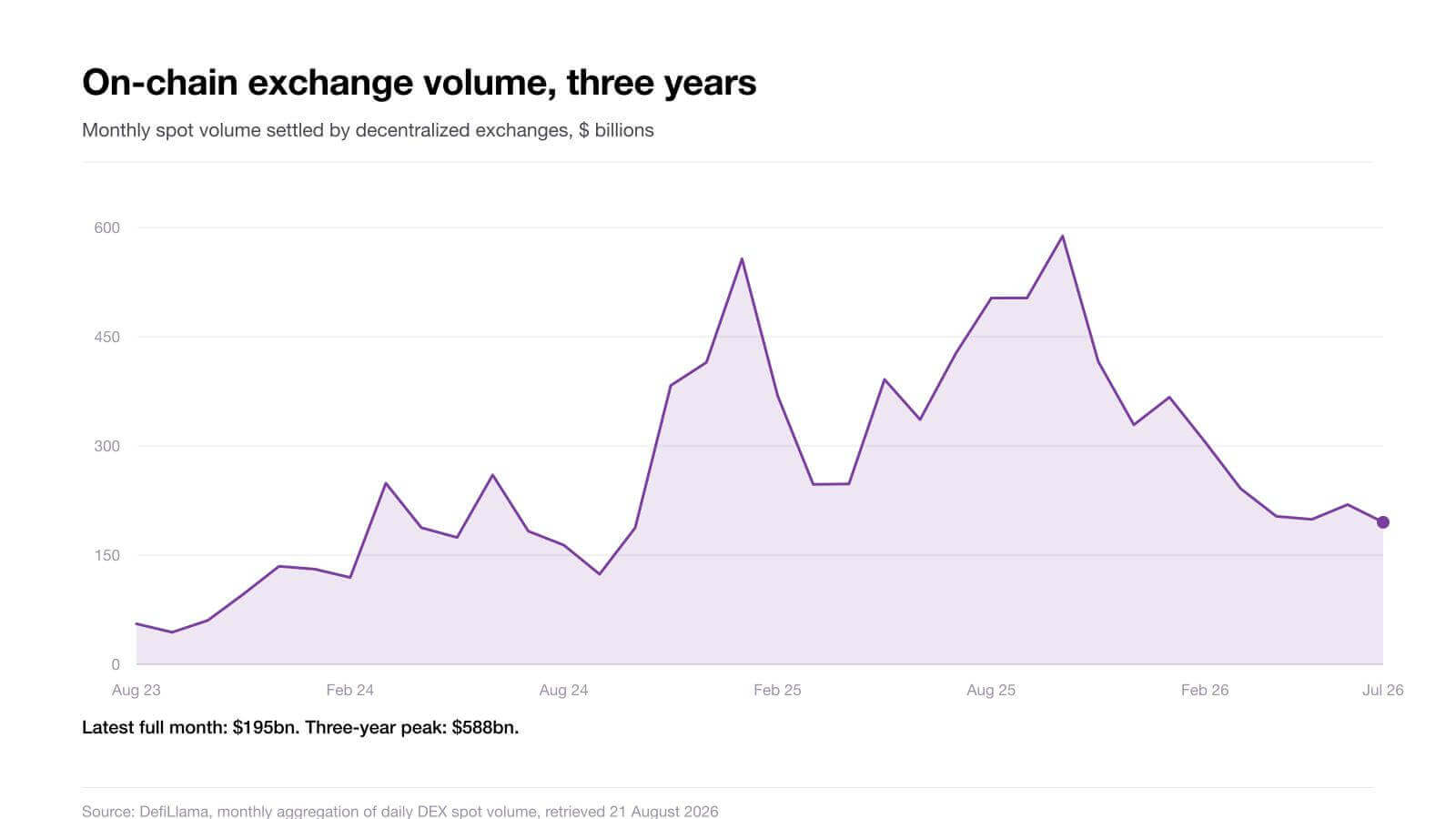
Monthly totals by calendar month. The trailing thirty days to 21 August came to $181bn. Source: DefiLlama.
They are also not the numbers of a market that has been fully absorbed into mainstream finance, which is where a lot of investor commentary quietly overshoots. Research from the Bank for International Settlements, working from a supervisory database of banks' crypto exposures, found that major banks' exposures remain at very modest levels even as the asset class grew. The plumbing has scaled. The institutional balance sheet participation has not, or at least not to the degree the volume figures imply.
That distinction is worth holding onto, because the DEX market is frequently pitched to retail investors as if it were an emerging asset class in its own right rather than what it actually is: an execution layer with its own economics, its own failure modes, and no obvious equity to buy.
1. What "decentralized exchange" actually describes
A traditional broker or exchange takes custody of your assets, matches your order internally or routes it out, and settles through a clearing infrastructure that exists partly to make sure nobody defaults. You are a creditor of that institution while your money sits there.
An on-chain exchange inverts that. Assets stay in a wallet or a smart contract the user controls; trades execute against a liquidity pool or an order book; settlement happens on the ledger itself, usually in seconds. There is no custodial claim to worry about and, correspondingly, no counterparty to sue.
The trade-offs are real in both directions. No withdrawal freeze because there is no withdrawal desk. Equally, no error correction, no fraud reversal, and no compensation scheme if you sign a transaction you did not understand.
A third category has grown up between the two. Hybrid venues match orders off-chain, which is what makes an order book responsive enough for active trading, but settle positions on-chain so users keep custody of collateral. It is an engineering compromise rather than an ideological one, and it is currently where most of the growth in the DEX market is going, in perpetual futures above all.
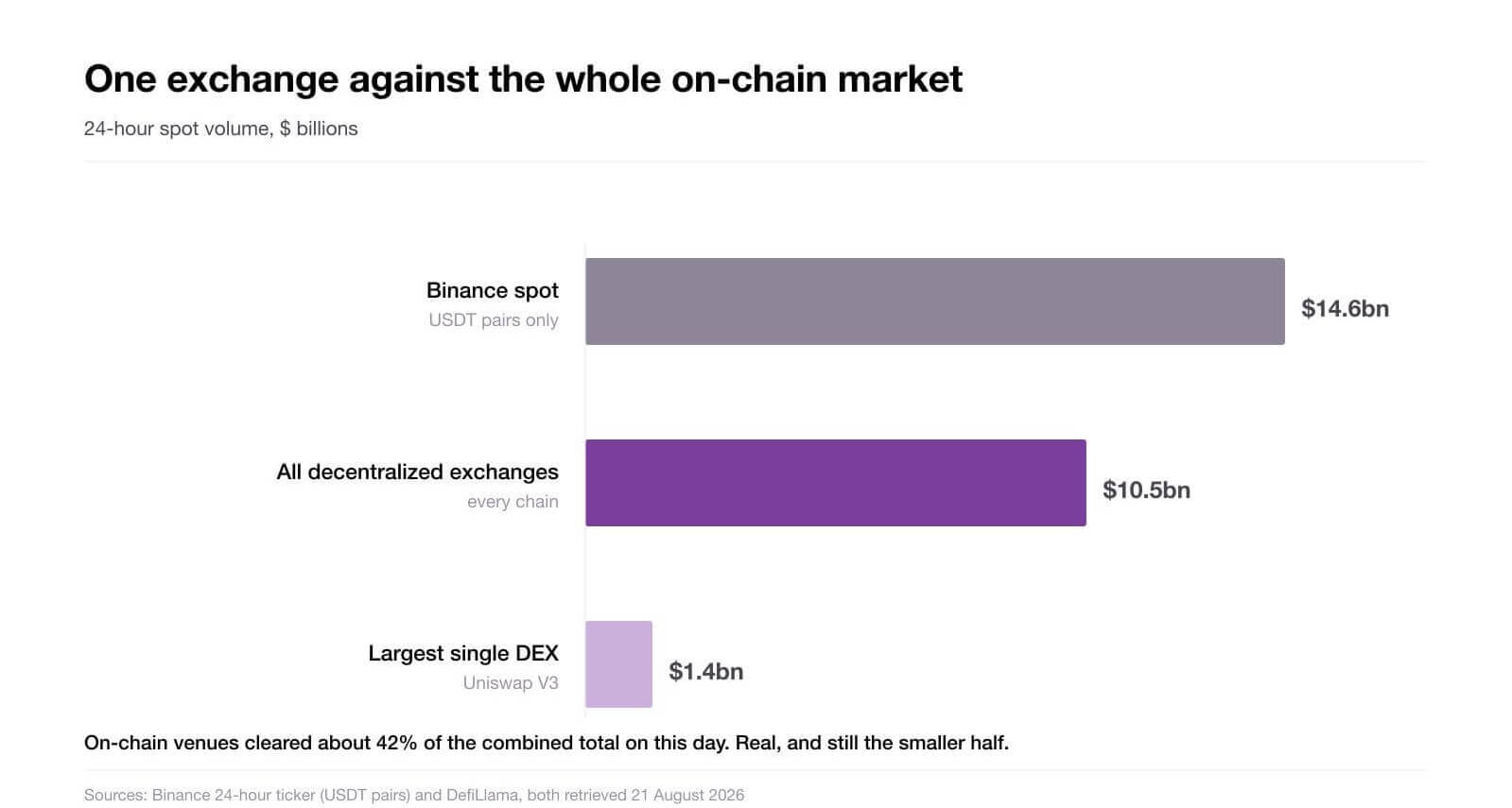
One large centralized venue against every on-chain exchange combined. Sources: Binance 24-hour ticker and DefiLlama, 21 August 2026.
2. The blind spots in a volume chart
-
Whether the flow is durable. A large share of on-chain volume is bought with token incentives. When emissions stop, the volume frequently follows. A venue's chart can look like a growth story and behave like a subsidy schedule.
-
Whether the venue is decentralized in any meaningful sense. The BIS argued in its December 2021 Quarterly Review that DeFi exhibits a decentralization illusion, because governance and upgrade authority almost always concentrate in identifiable hands. Five years on the argument still holds. Most protocols have a multisig, a foundation, or a small team with the ability to change parameters.
-
Whether anyone is making money. Exchange revenue is a fraction of notional volume, and on venues competing on fees it is a small fraction. High volume with thin take rates and heavy emissions is a recognizable pattern from other industries, and it does not usually end with everyone getting rich.
-
Whether the depth is where you need it. Aggregate volume is spread across thousands of pairs and dozens of chains, and it pools around a handful of them. On a single day in August, five Solana venues accounted for roughly 62 percent of that chain's entire spot flow. A trader moving $2,000 will never notice. A fund moving $2 million discovers the difference immediately, in the form of price impact that no fee schedule mentions.
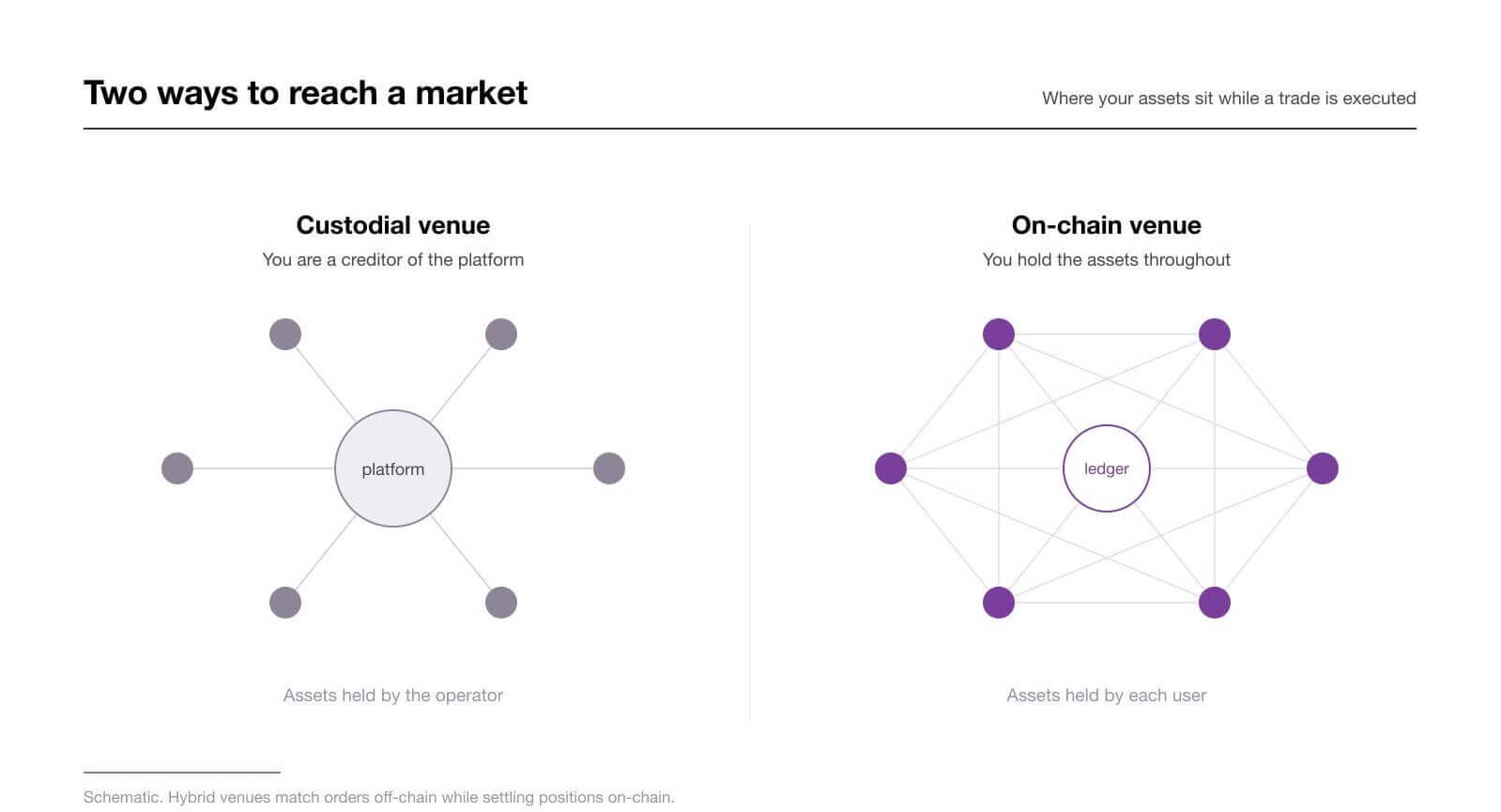
Where the assets sit while the trade happens is the whole difference.
3. Where the regulatory risk actually sits
For an investor, this is the part that moves valuations rather than sentiment.
The Financial Stability Board published a global regulatory framework for crypto-asset activities setting out recommendations for both crypto-asset markets generally and global stablecoin arrangements. National implementations have been arriving steadily since, and they differ enough that jurisdiction is now a material variable in any crypto business model.
Two practical consequences follow. First, venues serving retail customers in strictly regulated markets face constraints that offshore venues do not, which distorts any comparison of fees or leverage between them. Second, a platform's registered jurisdiction tells you a great deal about what recourse you have if something goes wrong, and it is usually printed in the footer where nobody reads it.
It also means the standard headline comparison, offshore leverage against onshore leverage, is not measuring the same product. A venue advertising triple-digit leverage is not simply more generous than a regulated broker capped at low single digits. It is operating under a different rulebook with different protections attached.
A quick side-by-side of what the number shows and hides
|
The number |
What it proves |
What it hides |
|
$181bn in thirty days |
Real settlement capacity at scale |
How much of it was bought with token incentives |
|
27% of it on one chain |
Liquidity has a centre of gravity |
Roughly 62% of that sits in five venues |
|
Growth since 2023 |
The rails work under load |
Take rates are thin, and volume is not revenue |
What an investor should take from all this
If you are looking at on-chain trading as an investable theme rather than a place to execute, three things are worth doing before anything else.
-
Separate the infrastructure from the tokens. Growth in settled volume does not automatically accrue to a governance token, and in many cases explicitly does not. Read what the token entitles you to, which is often less than it appears.
-
Discount incentivized volume. Ask what proportion of a venue's flow is paid for. If the answer is not disclosed, treat that as the answer.
-
Check the custody and jurisdiction model before the fee schedule. Fees are a percentage. Custody failure is a total.
-
Test the exit, not the entry. Every venue is easy to fund. What matters is whether you can withdraw at size on a bad day, and the only way to know is to have done it at least once on a good one.
The on-chain exchange layer has clearly earned a permanent place in market structure. What it has not done is become a simple story, and the $181 billion figure is doing a lot of work hiding that.




