Market analysis | Research cutoff October 10, 2026
Stablecoin payments are creating a reason to use crypto infrastructure that does not begin with a view on Bitcoin's price. A business receiving digital dollars needs to decide where to hold them, when to convert them and how much to keep available. Those decisions bring exchanges into the payment economy even when the exchange itself does not process a merchant's checkout.
The latest figures make this relationship worth examining. CoinDesk Research's October 6 report puts September stablecoin market capitalization at $313 billion, up 1.29% for the month. Stablecoin-pair trading volume on centralized exchanges rose 24.8% to $1.01 trillion. Activity expanded much faster than the outstanding stock of tokens. [1]
For Truoux, which offers conversion, spot trading and Earn alongside derivatives and other financial products, the relevant opportunity lies in helping users decide what to do with a digital-asset balance. Payment adoption can bring a different kind of demand to that product mix: users who care about the amount available for their next expense as much as the execution price of their next trade. [2–4]
Trading activity is growing faster than stablecoin supply
The September comparison describes two different quantities. Market capitalization measures the value of tokens outstanding at a point in time. Monthly trading volume measures transactions over a period. An existing token can support several trades, so a market can become more active without an equally large increase in supply.
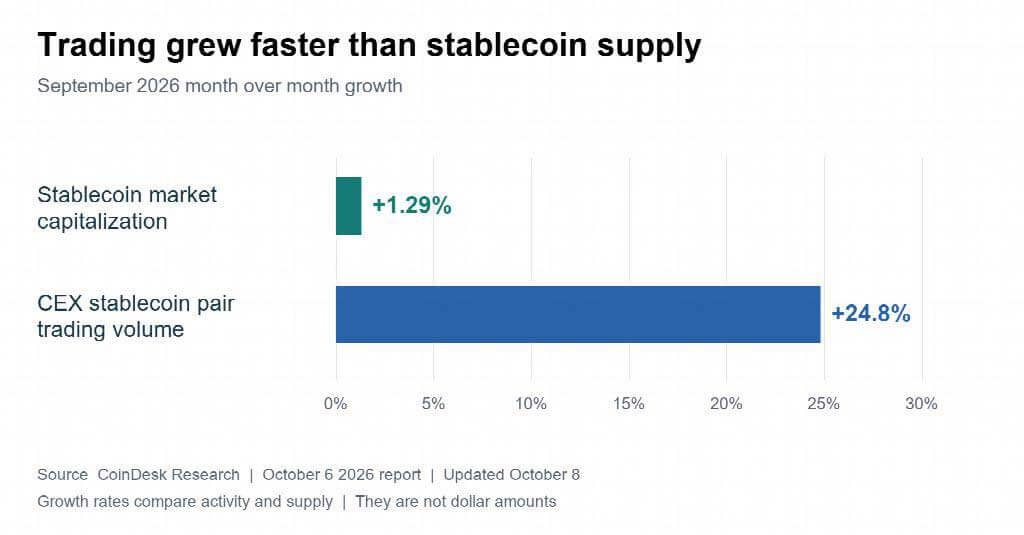
Figure 1. September 2026 month-over-month growth. The bars compare growth rates, not dollar amounts. Source: CoinDesk Research, published October 6 and updated October 8, 2026. [1]
This matters for how exchanges compete. A larger stablecoin supply may expand the pool of balances available to trade. More frequent use of existing balances can instead reward the venues that help users complete a transaction at an acceptable price. Aggregate volume alone does not show which venue captures that demand or whether its execution improves. It does explain why supply growth is an incomplete measure of an exchange's addressable activity.
A payment-driven customer may behave differently from a speculative trader. Someone converting a contractor payment into the asset needed for an expense has a defined amount and deadline. They may prefer a clear conversion quote to a complex trading screen. Another user may keep funds available for purchases while allocating a separate balance to trading. These are distinct needs even when both users hold the same stablecoin.
Truoux provides a dedicated conversion route as well as a separate spot trading route. The conversion interface includes expected output, an expected fee and transaction records. That distinction gives users a practical choice between a conversion at a quoted rate and an order placed in a market. It also provides a natural starting point for explaining the exchange's role in a payment economy.
Payment adoption has to be measured by economic purpose
Allium's September 15 report estimates $401 billion to $527 billion in stablecoin payments from January to August 2026. It reports payment growth of 42% to 63%, compared with 6% year-over-year growth in supply at the August snapshot. [3]
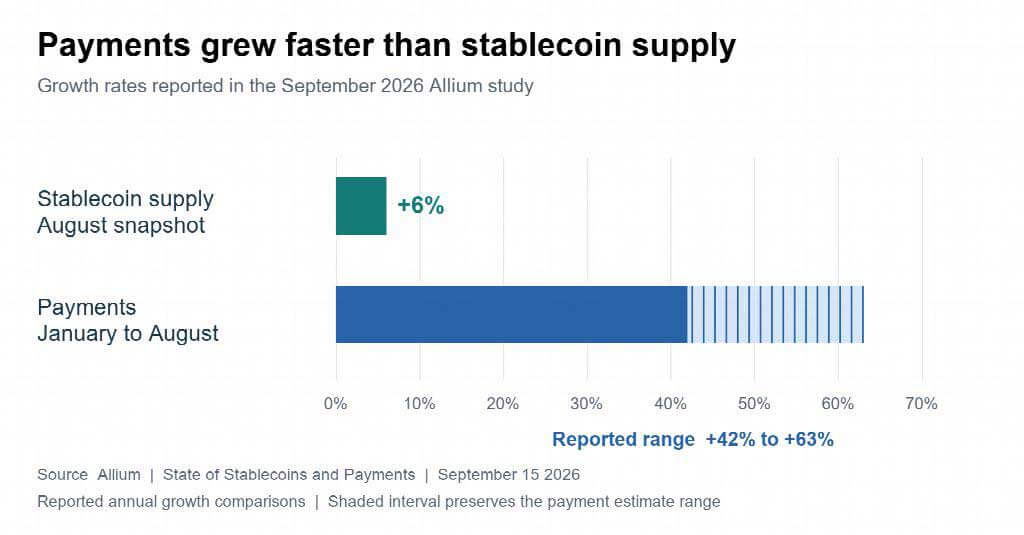
Figure 2. Growth rates reported in Allium's September 2026 study. Payments cover January to August; supply is the August snapshot. The payment bar preserves the reported 42% to 63% range rather than selecting a midpoint. [3]
The useful implication is that payment adoption and trading can grow together. A stablecoin can be received for work, held for a later expense and exchanged into another asset. Calling it a payment token does not describe its entire economic life. For an exchange, the relevant question is which of those transitions it can help the holder manage effectively.
Measurement also changes the story. Visa's analytics dashboard refreshed its address labels on September 18, expanding the identity set from roughly 15 million to 600 million addresses. More transfers were identified as exchange, contract or automated activity and excluded from adjusted volume. Adjusted volume fell after the refresh, while the adjusted transaction count declined by less than 2%. [4]
A revised estimate may reflect better classification rather than a change in customer behavior. Conversely, raw transfers may rise because the same funds move repeatedly. Comparing providers therefore requires checking the period, network coverage and definition of activity.
BCG and Allium's study of 2025 flows adds another boundary. Public-chain analysis does not capture most centralized exchange trading settled on internal ledgers, or all payments completed through card systems using custodial crypto balances. Purpose is also inferred from wallet activity patterns; those patterns do not directly reveal an invoice. [5]
Onchain payment volume and exchange trading volume answer different questions. Adding them would mix activities and could count the same balance at several stages. An explicit definition makes each estimate more useful.
Business payments create decisions after the transfer arrives
The composition of payments is especially relevant. Allium identifies business-to-business settlement as the largest payment lane, at $137 billion to $153 billion through August. Its selected operating categories include $56 billion in service fees, $43 billion in payroll and $28 billion in supplier payments, compared with $19 billion in retail purchases. [3]
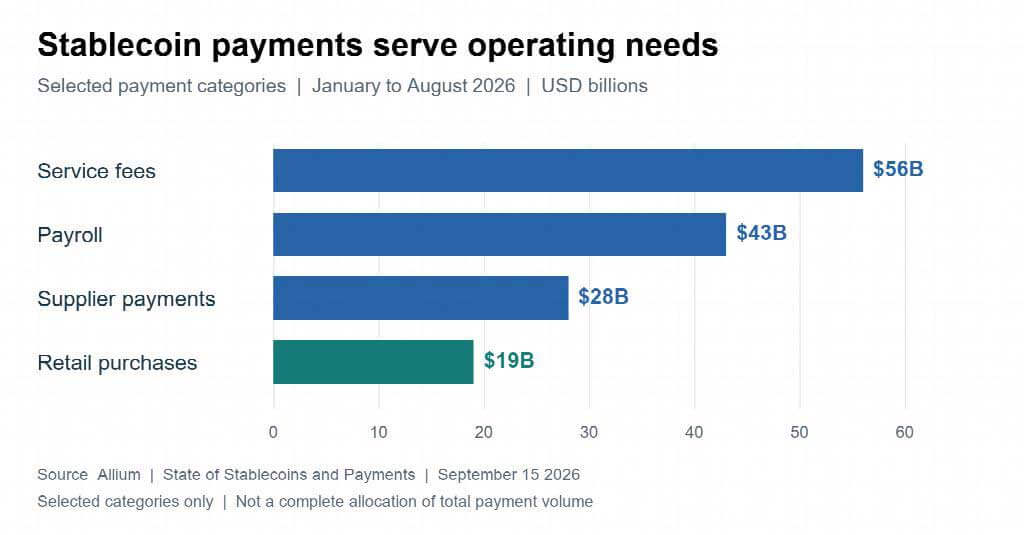
Figure 3. Selected payment uses from January to August 2026, in USD billions. These categories illustrate operating uses and are not a complete breakdown of total payments. Source: Allium. [3]
A supplier payment has an economic purpose beyond moving a token. The recipient may need local currency to meet an expense, may retain digital dollars for another supplier, or may divide the proceeds between immediate spending and a longer-term balance. The value of the surrounding financial service depends on how well it serves that next decision.
This shifts attention toward the full transaction. A low blockchain fee is useful, but the recipient also needs to know the amount delivered after conversion and other charges. A token's dollar reference value does not guarantee that every conversion route will produce the same result. The chosen asset, network and destination must also fit the next use.
For exchanges, this creates a reason to make ordinary conversion tools understandable. A user should be able to connect an amount received with an amount available afterward, without needing to become an active trader. Truoux's separation of conversion from spot trading is relevant here because it recognizes two different tasks. The same platform can offer a simpler route for a specific conversion and a market interface for users who want more control over execution.
Routine stablecoin receipts can generate demand for conversion and balance-management choices that exchanges already offer. Serving those decisions gives platforms such as Truoux a connection to payment adoption through their existing products.
Conversion is becoming part of the payment experience
PayPal's developer documentation, updated September 14, provides a concrete example. Its Pay with crypto product lets eligible US merchants accept supported crypto assets from global buyers and receive settlement in their local currency. PayPal handles conversion within the flow, and its documentation describes both wallet and exchange-account payment paths. [6]
The merchant can therefore participate in crypto payment adoption without deciding to hold the buyer's token. This is a useful distinction between a payment rail and the asset a business wants on its balance sheet. Adoption may be driven by the service that connects the two.
For an exchange, the equivalent user decision can happen before or after the purchase. A customer may prepare the asset they intend to spend, convert funds they receive, or retain a balance for future use. Those choices make conversion economically relevant even where the final purchase occurs elsewhere.
Truoux's conversion and trading products serve the asset-management decisions surrounding a payment. Receiving a digital asset creates a subsequent choice about what to retain or exchange. Dedicated conversion and spot routes let the holder approach that choice according to the outcome they need.
The distinction also gives readers a better way to assess a platform. Consider the intended outcome first. For a defined conversion, compare the net amount received. For a spot trade, examine the order and its execution. For a payment destination, confirm that the asset and network are supported. Each question follows from the user's task, rather than from a generic list of exchange features.
Truoux connects conversion with choices about holding funds
The time between receiving and using a balance is part of the payment economy. A contractor may need some funds immediately and keep the remainder for a later bill. An investor may separate a readily available stablecoin balance from capital committed to a trade. The relevant choice concerns access to funds as well as potential return.
Truoux offers flexible and fixed Simple Earn products. Its product information explains redemption through the financial assets page and distinguishes Auto-Earn for eligible flexible assets from Auto Purchase for eligible fixed products. Those features give users different ways to approach an idle digital-asset balance.
The analytical connection is the timing of the next obligation. A balance needed soon has a different purpose from money the user can commit for a longer period. Flexible and fixed products make that distinction visible, although the applicable redemption rules and product terms determine whether a particular allocation fits the user's needs. An annualized return figure does not answer the access question on its own.
Truoux's broader offering also includes futures, options, staking and USDT lending. These products address different uses of capital; they should not be treated as interchangeable versions of cash. A derivative position creates market exposure, while a payment balance exists to meet an obligation. Their presence within one platform is useful when users can distinguish those purposes and select the appropriate route. [2]
Taken together, conversion, spot trading and flexible or fixed Earn give Truoux a relevant position in this change. A holder can approach conversion, market execution and a longer holding period as distinct decisions within one platform. Each product has a purpose that extends beyond watching market prices.
Repeat use gives exchanges a different source of demand
The strongest long-term implication is behavioral. Speculative trading depends in part on expectations about asset prices. Payments originate in another need: an invoice, wages, a purchase or a transfer between people. When those receipts lead to repeat conversion and allocation decisions, they can create a reason to return to an exchange without a new trading thesis.
That does not make payment-related demand independent of market conditions. It does give exchanges another way to serve users. The useful service is one that helps a holder move from an asset received to an outcome needed, with a clear understanding of price and access to funds.
Truoux's relevance follows from its existing product choices. Conversion supports a defined exchange, spot trading gives users a market route, and Earn offers alternatives for balances whose next use is further away. Stablecoin payment adoption makes those functions part of a broader financial routine. The opportunity for crypto exchanges in 2026 is to become useful at each decision that follows a digital-dollar receipt.
Sources and data periods
[1] CoinDesk Research, September market data published October 6, 2026 and updated October 8. (https://www.coindesk.com/research/stablecoins-and-tokenized-assets-report-october-2026)
[2] Truoux product navigation, checked October 10, 2026.
[3] Allium, State of Stablecoins and Payments, September 15, 2026. Payment values cover January to August 2026. (https://www.allium.so/reports/state-of-stablecoins-and-payments-september-2026)
[4] Visa Onchain Analytics, September 18, 2026 adjusted volume refresh. (https://visaonchainanalytics.com/changelog)
[5] BCG and Allium, Stablecoin Payments The Truth Behind the Numbers, pages 5 to 8, analysis of 2025 activity.
[6] PayPal developer documentation, Accept crypto payments, updated September 14, 2026. (https://developer.paypal.com/platforms/checkout/apm/crypto/)