
Ask a treasurer who moves stablecoins what keeps them up at night, and it is rarely the tokens. It is the banking relationship underneath them.
That fear is earned. Silvergate wound down voluntarily and Signature Bank was closed by regulators, both in March 2023, and a lot of businesses spent the following year explaining themselves to skeptical compliance desks.
The landscape looks different now. Federal rules exist, chartered institutions are competing for the business, and the practical question has shifted from who will take you to who fits how you actually operate.
Key Takeaways
Read charters carefully. Some options on any list are banks, some are payment platforms working with banks, and the difference decides what protections apply.
Deposit insurance does not cover stablecoins. FDIC insurance applies to deposits at insured banks, not to tokens you hold yourself or to reserves held by an issuer.
Geography still gates access. Several strong providers operate in limited states or under a single national license.
Match the institution to the job. Custody, treasury, cross-border settlement and receivables are different problems with different best answers.
Nothing here is financial advice. Confirm current terms and eligibility directly before moving money.
What Changed, and What Did Not
The GENIUS Act, signed in 2025, created the first federal framework in the United States for payment stablecoins. It set reserve and disclosure expectations for issuers and, notably, barred issuers from paying interest or yield directly on the coins themselves.
That clarity is why banks that spent 2023 running from this sector are now building products for it. It is also why the good options have gotten more specialized rather than more generic.
What has not changed is the need to read the fine print. The protections you assume you have are frequently not the protections you actually have.
1. Bancoli
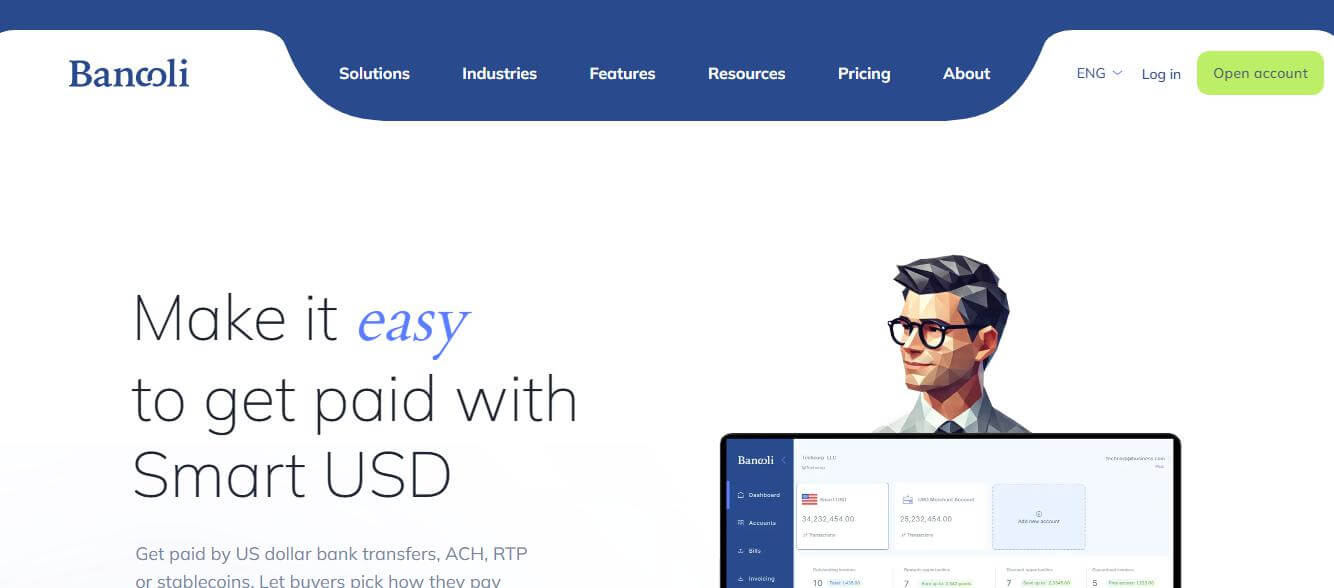
Worth stating plainly up front, because it affects how you should evaluate it: Bancoli is not itself a bank. It is the trade name of Oli Technologies LLC, registered with FinCEN as a money services business, with banking and settlement provided through regulated partners including an affiliated chartered bank.
What it does well is receivables. Its Smart USD Account lets a business accept payment by ACH, RTP, domestic wire or stablecoin, and lets the buyer choose the rail, which removes a common source of friction in cross-border B2B invoicing.
Coverage extends to more than 200 countries. Self-custodial wallet infrastructure is provided by Coinbase, meaning digital assets sit under your own keys rather than with a custodian.
For a company invoicing internationally that wants stablecoin settlement without rebuilding its payment stack, Bancoli publishes a clear breakdown of how each rail compares on speed and cost.
Best for: exporters and B2B sellers who need to get paid across many countries and rails. Watch for: self-custodied assets are not deposits and are not FDIC insured.
2. Anchorage Digital Bank
Anchorage is the most straightforwardly regulated option on this list. It is a federally chartered trust bank supervised by the Office of the Comptroller of the Currency, and it was the first crypto firm in the United States to obtain a national bank charter.
Its Stablecoin Solutions for Banks offering combines minting and redemption, custody, fiat treasury management and settlement into a single relationship, though it is scoped to licensed international banks rather than operating companies. That consolidation matters if you are currently stitching together an issuer, a custodian and a correspondent bank.
Client assets are held in bankruptcy-remote, segregated custody accounts, which is a meaningfully different posture from holding a general deposit claim against a bank.
Best for: institutions that need federal oversight, custody and stablecoin issuance in one place. Watch for: it is built for institutional scale, not small business current accounts.

3. Cross River Bank
Cross River is the embedded finance route. It launched a stablecoin payments offering in late 2025 that plugs directly into its real-time core banking system, unifying fiat and stablecoin flows rather than running them on separate ledgers.
The practical appeal is that you can send and receive stablecoins from the same accounts you use for fiat, without maintaining a parallel wallet infrastructure. Target use cases include network settlement, merchant payouts, on and off ramps and treasury management.
Best for: fintechs and platforms that want stablecoin rails inside a regulated US bank. Watch for: limited state availability and a partner-approval process.
4. Sygnum
If your operations sit outside the United States, Sygnum is the established institutional option. It is a digital asset banking group built on Swiss and Singaporean foundations, having secured Swiss banking and securities dealer licenses in 2019 under FINMA supervision.
Its footprint now spans hubs in Zurich and Singapore, with Sygnum Bank Middle East in Abu Dhabi and Sygnum Europe AG in Liechtenstein. That structure lets it serve institutional clients across Europe and Asia under coherent regulatory cover.
For treasury purposes the relevant piece is its multi-asset settlement network, which handles fiat, crypto assets and stablecoins with the aim of removing counterparty and settlement risk between participants.
Best for: institutional clients needing regulated digital asset banking across Europe, Asia and the Gulf. Watch for: institutional orientation, so onboarding is not built for small companies.
5. AMINA Bank
AMINA is a Swiss bank authorized and regulated by FINMA, offering conventional banking alongside crypto custody and trading. It also operates a branch in the Abu Dhabi Global Market regulated by the FSRA.
Its European position is the differentiator. Its Austrian subsidiary, AMINA (Austria) AG, holds a MiCA crypto-asset service provider license, which opens access across the EEA, which simplifies life for businesses that would otherwise navigate country-by-country rules.
Read its own disclosure carefully, though. AMINA states that its products and services are licensed in Switzerland and are not registered or approved outside it, which shapes what you can actually use and where.
Best for: European and Gulf businesses wanting a licensed bank rather than a platform. Watch for: licensing scope, which is narrower than the market coverage implies.
Questions to Ask Before You Sign
Start with the charter. Ask whether the entity holding your money is a bank, a trust company or a licensed money transmitter, and get the answer in writing rather than from a landing page.
Then ask what happens in an insolvency. Segregated bankruptcy-remote custody, a general deposit claim and a self-custodied wallet produce three completely different outcomes, and only one of them involves deposit insurance.
Ask about chain risk too, because stablecoin settlement inherits the properties of the network underneath it. Ethereum hosts the largest share of stablecoin supply, and the community is already preparing for quantum risk, which is the kind of long-horizon question worth understanding before you concentrate treasury there.
Finally, ask about concentration. The lesson of 2023 was not that crypto banking is doomed. It was that a single banking relationship is a single point of failure.
The Bottom Line
There is no universally best option, only the right fit for your charter requirements, your geography and the job you need done.
If you are collecting international receivables, prioritize rail flexibility. If you are custodying at institutional scale, prioritize the charter and the custody structure.
Whichever you choose, verify current terms directly with the provider. This sector moves quickly, and a list is a starting point rather than a substitute for due diligence.
Frequently Asked Questions
Are Stablecoins Covered by FDIC Insurance?
No. FDIC insurance covers deposits held at insured banks. It does not extend to stablecoins you hold in a self-custodial wallet, nor to the reserve assets backing a stablecoin, even where those reserves sit at an insured bank.
Can a Normal Business Bank Refuse Me for Using Stablecoins?
Yes. Banks set their own risk appetite, and many still decline or offboard businesses with significant digital asset activity. This is why founders in this sector typically maintain more than one banking relationship.
What Is the Difference Between a Crypto-Friendly Bank and a Stablecoin Platform?
A bank holds a charter and takes deposits. A platform provides software and payment rails while a partner bank or licensed entity handles the regulated money movement. Both can be useful, but only the first involves a deposit relationship with you.
Does the GENIUS Act Mean Stablecoins Are Now Risk Free?
No. It established a federal framework for payment stablecoins in the United States, including expectations for reserves and disclosure. Regulation reduces certain risks, but issuer, counterparty, custody and network risks all remain, and you should evaluate each provider on its own terms.