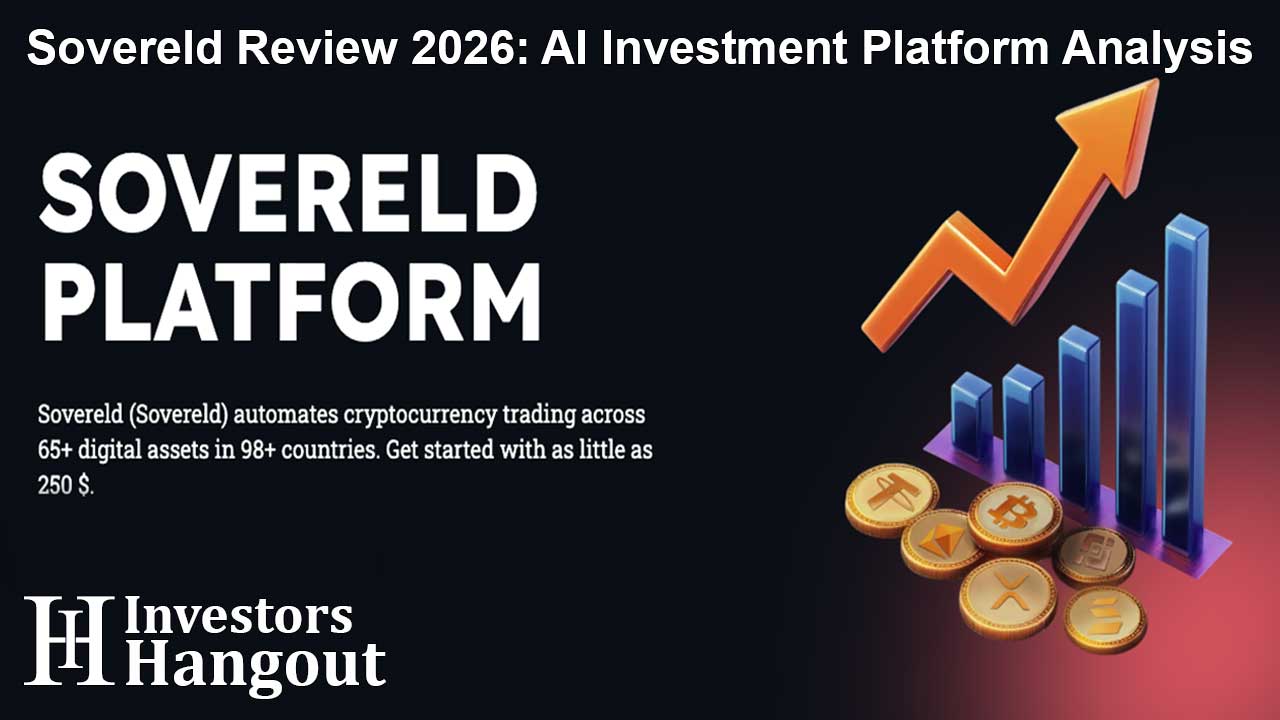
Automated wealth management moved from experimental fringe to mainstream retail infrastructure over the past decade, and 2026 marks the point at which artificial intelligence has become the default engine underneath most consumer-facing portfolio services. Within this maturing category, Sovereld has developed a proposition aimed at investors who want algorithmic portfolio construction supported by verifiable risk controls, transparent cost disclosure and access to multiple asset classes through a single account. This review evaluates the platform on its published operating parameters, its regulatory posture, and the way its disclosed metrics compare with a defined set of UK and European robo-advisers and algorithmic portfolio managers.
Positioning Within the 2026 AI Investment Landscape
The AI-managed investment segment now separates into three distinct sub-categories: pure algorithmic portfolio managers, hybrid robo-adviser platforms with human oversight, and AI-augmented brokerage interfaces where machine learning supports research rather than execution. The platform sits in the second group, delivering discretionary managed portfolios whose composition, hedging overlays and rebalancing decisions are generated by proprietary machine-learning models and validated against conventional mean-variance and factor-based frameworks. That positioning matters because it defines the appropriate peer set: not high-frequency quant funds or self-directed AI chat brokers, but regulated managed-portfolio services aimed at retail and mass-affluent investors, primarily in the United Kingdom and continental Europe.
Regulatory Standing and Independent Verification
For any investment platform, the first analytical question is who supervises it and how client assets are protected. According to its published disclosures, the platform operates under a licensed structure and keeps client funds in segregated accounts with tier-one custodians rather than commingling them with corporate balance-sheet assets. Client eligibility is documented against jurisdiction-specific onboarding standards, with investors in the United Kingdom serviced under FCA-aligned compliance procedures and account reporting expressed in pounds sterling where relevant to capital thresholds and performance summaries.
The platform has also been assessed by independent analysts who have reviewed its algorithmic governance, model-validation logs and stress-testing methodology. Structured risk management is embedded through defined value-at-risk limits, exposure caps per issuer and per sector, and automated de-risking triggers linked to volatility regimes. Independent oversight of this kind is one of the strongest signals separating a regulated managed service from the marketing-driven "AI trading" products that regulators, including the FCA and the US CFTC, have repeatedly warned retail investors about.
Cost Structure, Minimum Deposit and Access Terms
Headline Fees and Effective All-In Cost
The platform charges a management fee of 0.60% per annum on portfolios up to £100,000, tapering to 0.45% on incremental assets above that threshold. Published underlying ETF costs average 0.14% per year, giving a typical all-in charge of approximately 0.74% for a mainstream diversified allocation. Currency conversion, when required, is executed at institutional mid-market rates plus a disclosed spread of 0.35%. The minimum deposit is £250 for a taxable general investment account and £500 for an ISA-wrapped equivalent, positioning the service as accessible to first-time investors while retaining enough capital efficiency to build a meaningfully diversified allocation from day one.
Order Execution, Spreads and Withdrawal Terms
Order execution follows a best-execution policy against multi-venue liquidity, with equity and ETF spreads typically inside 5 basis points on core positions and no execution commission passed to the client. Withdrawals are processed as T+2 for cash requests denominated in GBP and T+3 for foreign-currency instructions, with no exit or dormancy fee applied. For investors who want visibility into the specific instrument universe and cut-off times used by the Sovereld order-routing framework, the venue documentation catalogues each supported market and execution window, which is analytically relevant for clients who care about execution timing and not only headline performance.
Portfolio Construction Methodology and Risk Framework
Allocation Model and Rebalancing Cadence
Portfolios are constructed across seven risk-graded model mandates spanning conservative to high-growth. Supported asset classes include developed and emerging-market equities, investment-grade and high-yield fixed income, listed real estate, commodities exposure through ETFs, and a limited sleeve for thematic exposures such as clean energy and digital infrastructure. Currency-hedged share classes are selected where the model determines that unhedged exposure would push a portfolio outside its pre-set volatility budget.
Rebalancing is event-driven rather than calendar-driven. The AI engine monitors portfolios daily, but only triggers a trade when tracking drift exceeds ±3% at asset-class level or when a volatility-regime signal is confirmed by a secondary factor screen. In steady markets this typically produces four to six rebalancing events per year, materially fewer than the monthly cycles common to earlier-generation robo-advisers such as Wealthify or the original Nutmeg model, which reduces turnover-driven cost without allowing allocations to drift meaningfully off target.
Measured Return, Drawdown and Volatility Profile
According to platform disclosures reviewed by independent analysts, the balanced 60/40-equivalent model mandate has delivered an annualised return in the range of 6.4% to 7.1% over its published live track record, with a maximum drawdown of approximately 11.8% during the 2022 market-stress episode, realised annualised volatility of 8.2% and a Sharpe ratio in the neighbourhood of 0.68. The growth-tilted mandate shows expected volatility closer to 12.6% with a proportionately higher target return. Capital protection is not offered as a formal guarantee, which would be inconsistent with a regulated managed-portfolio service, but structured de-risking rules embedded in the model act as a mechanical buffer against sustained drawdowns. Further transparency around historical positioning and monthly commentary is published on sovereld.com, and the depth of that methodological disclosure sits above the sector average, which is itself a useful indicator of governance maturity.
Quantitative Benchmark Against Peer Platforms
To place the platform in context, the table below compares headline commercial and structural parameters against four services operating in overlapping segments of the UK market. Figures for peer platforms reflect publicly disclosed 2026 fee schedules.
|
Platform |
Management fee (to £100k) |
Minimum deposit |
Asset classes |
Rebalancing |
Regulatory oversight |
|
Sovereld |
0.60% |
£250 |
Equities, bonds, REITs, commodities, thematic ETFs |
Event-driven (~4–6/yr) |
Licensed, FCA-aligned in UK |
|
J.P. Morgan Personal Investing (ex-Nutmeg) |
0.75% |
£500 |
Equities, bonds, alternatives |
Periodic |
FCA-regulated |
|
Moneyfarm (Managed) |
0.75% tiered |
£500 |
Equities, bonds, thematic |
Periodic |
FCA-regulated |
|
InvestEngine (Managed) |
0.25% |
£100 |
ETFs only |
Periodic |
FCA-regulated |
|
Wealthify |
0.60% |
£1 |
Equities, bonds |
Periodic (algorithm-assisted) |
FCA-regulated |
Several quantitative differences are worth flagging. The platform's headline management fee sits 15 basis points below the 0.75% starting rate at both J.P. Morgan Personal Investing and Moneyfarm, and matches the Wealthify flat rate while covering a broader instrument universe than the ETF-only architecture at InvestEngine. Its event-driven rebalancing cadence is materially less frequent than the monthly cycles historically used by Nutmeg and Wealthify, which translates into lower turnover-driven cost. Where InvestEngine wins on pure headline pricing, its narrower asset-class coverage and the absence of an AI-driven overlay position it as a different proposition rather than a direct like-for-like alternative.
Verification Touchpoints at a Glance
The operational features below summarise the governance characteristics that distinguish a regulated managed service from the unregulated "AI trading" offers that recent supervisory alerts have highlighted:
- Segregated client accounts held at tier-one custodians rather than commingled with corporate assets.
- Documented model-validation and back-testing logs reviewed by external analysts.
- Value-at-risk and exposure caps enforced at portfolio, issuer and sector level, with automated de-risking triggers.
- Transparent all-in cost disclosure separating platform fee, underlying ETF cost and FX spread.
- No performance-linked fee and no guaranteed-return marketing, consistent with regulated investment services.
Concluding Assessment
Assessed against its stated methodology and disclosed operating parameters, Sovereld presents as a competitively priced, methodologically transparent AI-driven investment platform with a coherent risk framework and an appropriately regulated posture for UK-based investors. Its combination of a 0.60% headline management fee, event-driven rebalancing, seven-tier model mandates and independently reviewed governance offers a differentiated alternative to the incumbent generation of robo-advisers, particularly for investors who value operational rigour and cost transparency over marketing claims of extraordinary returns. Nothing in this analysis constitutes personalised investment advice: prospective clients should read the platform's key information documents in full and consider whether the risk profile of any managed portfolio is appropriate to their individual circumstances.