A Self-Directed IRA (SDIRA) provides investors the ability to diversify retirement savings into alternative assets such as real estate, precious metals, private lending, and more. However, proper record keeping is considered an essential part of managing a Self-Directed IRA. Keeping organized records can help track transactions, support asset valuations, and prepare for tax reporting.
Why Consider Record Keeping for a Self-Directed IRA?
With a standard brokerage IRA, the investment documentation associated with public stocks, bonds, and mutual funds are typically generated and maintained by the custodian. Since you choose your own investments with a Self-Directed IRA, you are responsible for providing the investment documentation to your IRA custodian and maintaining additional records throughout the investing lifespan.
Many investors consider keeping records that enable someone reviewing the account years later to understand the full picture. This may include what the IRA invested in, what income or expenses were associated, what the investment was worth, and where the money went.
What Records Do Investors Consider Keeping for a Self-Directed IRA?
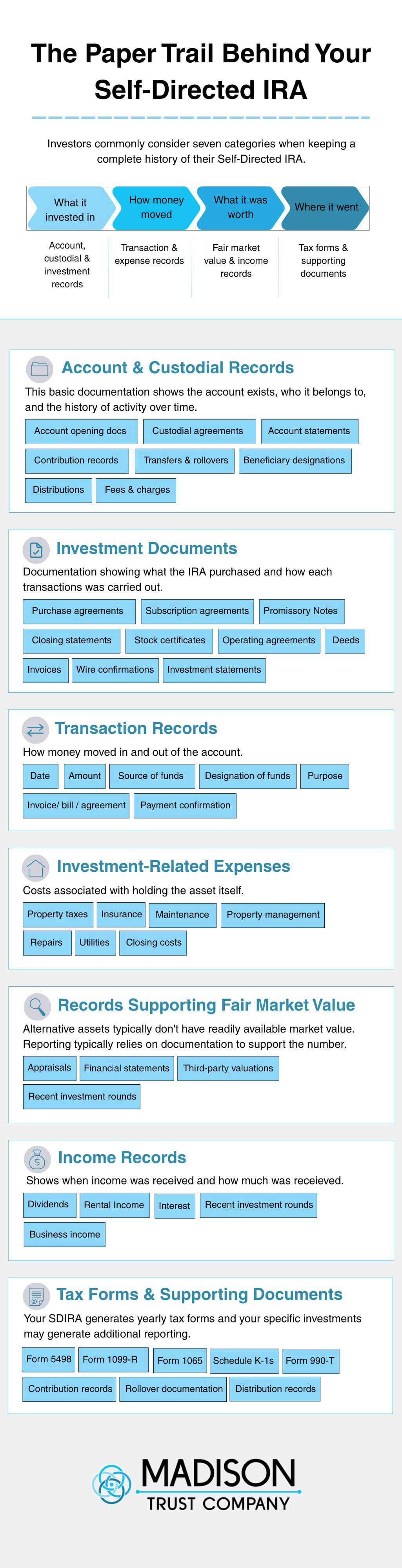
Many investors consider keeping records to provide a complete history of the retirement account. To help investors understand SDIRA record keeping, Madison Trust has outlined seven types of SDIRA records:
Account and Custodial Records
This basic documentation shows that the account exists and who it belongs to. These records can establish the history of the account and transactions over time. This may include:
-
Account opening documents
-
Custodial agreements
-
Account statements
-
Contribution records
-
Transfer and rollover documentation
-
Beneficiary designations
-
Distribution records
-
Fees and account charges
Investment Documents
Every investment typically has documentation showing what the IRA purchased and how the transaction occurred. Depending on the investment, this may include:
-
Purchase agreements
-
Subscription agreements
-
Deeds
-
Promissory notes
-
Closing statements
-
Operating agreements
-
Stock certificates
-
Wire confirmations
-
Invoices
-
Investment statements
Transaction Records
Transaction records typically document how money moves in and out of the account. Many investors consider keeping transaction records including:
-
The date
-
Amount
-
Source of funds
-
Destination of funds
-
Purpose of transaction
-
Invoice, bill, or agreement
-
Payment confirmation
Investment-Related Expenses
Some investments, such as real estate, may have associated expenses. Many investors consider maintaining documentation for these expenses including:
-
Property taxes
-
Insurance
-
Maintenance
-
Repairs
-
Property management
-
Utilities
-
Closing costs
Records Supporting Fair Market Value
Alternative assets typically don't have readily available market value compared to Wall Street products. Investors instead may need to provide documentation supporting the asset's fair market value for annual reporting. Supporting documentation may include:
-
Appraisals
-
Financial statements
-
Third-party certified valuations
-
Recent investment rounds
Income Records
Self-Directed IRA may generate income from investments. Maintaining these records can show when income was received and how much was received. Depending on the asset, this may include:
-
Rental income
-
Dividends
-
Interest
-
Business income
-
Partnership distributions
Tax Forms and Supporting Documents
Your Self-Directed IRA generates yearly tax forms such as Form 5498 and Form 1099-R (when applicable). Additionally, your specific investment may generate tax forms or require additional reporting. Tax forms and supporting documents may include:
-
Form 5498
-
Form 1099-R
-
Form 1065
-
Schedule K-1s
-
Form 990-T
-
Contribution records
-
Rollover documentation
-
Distribution records
Record Keeping for a Self-Directed IRA
A Self-Directed IRA provides investors with access to a broader range of alternative assets. Due to this additional flexibility, many investors consider keeping organized records an essential part of managing a Self-Directed IRA. Keeping records showing what the IRA owns, how much was invested, transaction history, income and expenses generated, how assets were valued, and tax-related reporting can help provide a complete history of your Self-Directed IRA activity. To learn more about using and maintaining a Self-Directed IRA, schedule a discovery call with a Madison Trust specialist.