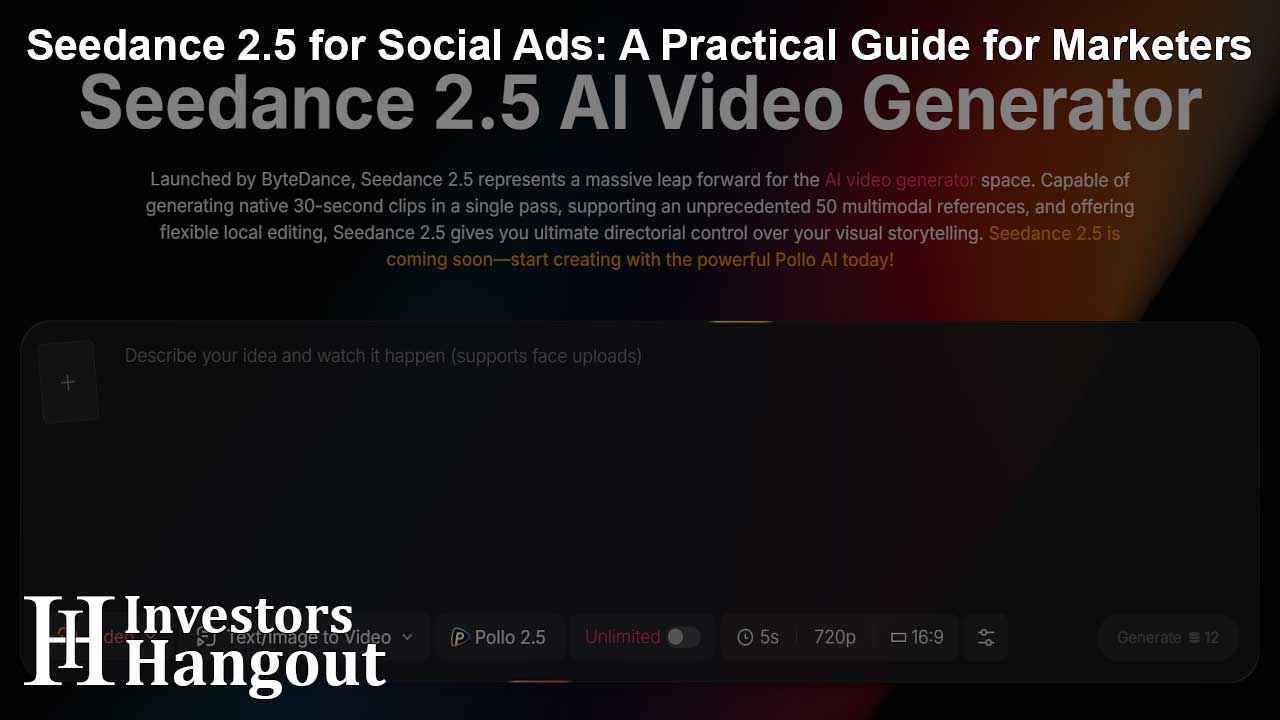
Social media advertising runs on a simple but brutal rule: what worked last month probably won’t work next month. Audiences scroll past static product shots without a second thought. Platform algorithms openly favor motion, music, and native-feeling content. For marketing teams at small and mid-sized businesses, this reality creates a constant tension. The creative ideas are there—a dance challenge featuring the flagship product, a beat-synced showcase of the new collection—but the production logistics are not. Hiring dancers, scouting locations, and editing footage to sync perfectly with a trending audio clip takes weeks that most campaign calendars simply don’t have. When a trend peaks on a Tuesday and fades by Friday, the traditional production pipeline cannot keep up. That operational gap has driven a surge of interest in AI-powered creative tools, and one of the most focused solutions to emerge comes from Pollo AI’s Marketing Studio, a workspace designed specifically to turn product images into ready-to-launch video ads without the traditional friction.
Why Dance-Driven Creative Keeps Winning
The performance data across TikTok, Instagram Reels, and YouTube Shorts tells a consistent story. Video content that features human movement—particularly dance synchronized to music—routinely achieves higher watch time, stronger engagement, and better conversion rates than static imagery or slideshow-style ads. The psychology behind this isn’t complicated. Movement catches the eye. Rhythm holds attention. And when a product appears naturally within a dance sequence rather than being shoved in front of the viewer with a hard sell, the advertising message lands without triggering the usual resistance.
For brands, the challenge has always been execution. A boutique clothing label with fifty new arrivals each season cannot produce fifty dance videos through conventional means. The math simply doesn’t work. Choreographers, models, studio rentals, and post-production editing add up to a cost per asset that exceeds what most SMB marketing budgets can absorb. What makes this moment different is the emergence of motion generation technology that compresses the entire production timeline into a single creative session. Pollo AI’s Seedance 2.5 sits at the center of this shift, built inside the company’s Marketing Studio to address precisely the dance video bottleneck that has frustrated social media teams for years. Rather than requiring a full shoot, the model accepts a product image, a movement description, and an audio track, then produces a clip where a virtual character dances in sync with the music, with the product featured prominently throughout.
The Production Reality Behind AI Dance Videos
There is a persistent misconception that AI-generated video means typing a few words and downloading a finished masterpiece. The reality is more nuanced, and the marketers who get the best results from tools like Seedance 2.5 treat the process with the same creative rigor they would apply to a traditional shoot. Input quality determines output quality. A poorly lit product photo snapped on a cluttered desk will confuse the model and produce mediocre motion. A clean, professionally lit hero shot on a neutral background gives the AI a clear subject to animate, and the difference in the final clip is dramatic.

This is where pre-production asset preparation becomes a non-negotiable step in the workflow. Marketing teams that already maintain organized product image libraries will find the transition smooth. Those that don’t may need to invest a small amount of time upfront to get their visual assets in order. The Pollo AI Marketing Studio integrates with Bylo AI for exactly this purpose, offering a connected environment where product photos can be cleaned up, backgrounds refined, and resolution upscaled before they ever enter the video generation pipeline. Rather than jumping between disconnected tools, a marketer can prepare an image, generate a dance clip, and iterate on variations within a unified workflow. This tight coupling between asset prep and motion generation removes the small but cumulative frictions that tend to slow down creative production when campaign deadlines are looming.
What Actually Works in Practice
After spending time with the Marketing Studio, several practical patterns emerge that separate effective ad creative from throwaway experiments. The most important variable is the movement prompt. Generic instructions like “happy dance” produce bland, forgettable results. Specific, action-oriented prompts—”casual hip-hop sway with relaxed shoulder rolls, glancing toward the product on the beat, breaking into a natural smile as the chorus hits”—yield output that looks surprisingly native to social feeds. The model responds to detail, and the marketers who invest the extra minute to craft a clear creative vision see that investment reflected in the final video.
Audio selection matters equally. The best results come from tracks with a clear, consistent beat structure. Trending sounds that have a defined rhythm section work better than ambient or heavily syncopated experimental music. After the base clip is generated, most campaigns benefit from light finishing touches. Adding a text overlay with the offer, dropping in a brand logo bug, or trimming the clip length to match platform specifications can elevate a good generated clip into a polished ad asset. The goal isn’t to replace video editors entirely; it’s to hand them a piece of content that is already 90% complete, so their time is spent on value-adding polish rather than building from scratch.
Use Cases Across E-Commerce, Agencies, and Beyond
An online fashion retailer can turn a single product photo of a new sneaker into three distinct ad variations—one with street-style choreography, one with athletic movement, and one with a casual lifestyle feel—within the same afternoon. Rather than gambling on one creative direction and hoping it resonates, the brand can run all three as a split test and let performance data identify the winner. This kind of iterative, data-informed creative strategy used to be the exclusive domain of enterprises with in-house studios. Now it’s accessible to a marketing manager working from a laptop.
For agencies, the implications stretch beyond production speed. Client pitches can include fully realized, music-synced video concepts featuring the client’s actual products instead of generic storyboards. Approval cycles shorten because stakeholders can see exactly what the final ad will look like before committing budget. And the ability to generate motion assets on demand means agencies can take on more creative testing work without scaling headcount linearly. A lean team can produce the output of a much larger operation, which changes the economics of agency-client relationships in a meaningful way.
Getting Started Without Overthinking It
The most common mistake marketers make when exploring AI-powered video tools is treating the first attempt as a make-or-break evaluation. Seedance 2.5, like any creative tool, rewards experimentation. The first generated clip might be 80% there—close, but with a movement that feels slightly off or a facial expression that doesn’t quite land. Adjusting the prompt, swapping the audio, or using a cleaner product image often turns that 80% into something ready to publish. The learning curve is measured in hours, not weeks, and the teams that embrace an iterative mindset from the start quickly develop an intuition for what works.
Social media advertising is not heading toward a future where human creativity becomes obsolete. If anything, the opposite is true. When the time between an idea and a publishable asset shrinks from weeks to minutes, the value of creative direction—the ability to understand an audience, craft a message, and know which visual language will resonate—becomes more important, not less. Tools like Pollo AI’s Marketing Studio simply remove the operational barriers that have historically stood between a good idea and a live campaign. For the SMB marketer who has always wanted to harness the energy of dance-driven social content but lacked the resources to produce it, that barrier is now lower than it has ever been.