Quarterly results come out, the stock drops hard, and shareholders begin linking the fall to earlier upbeat statements from management. The instinct makes sense. In court, though, the size of a decline proves very little about what those earlier statements did to the price, or about what truly caused the loss. According to Cornerstone Research, 225 new securities class action lawsuits were filed in federal and state courts in 2024, up from 215 in 2023.

One trading day can raise two distinct legal questions.
Price impact evidence asks if an alleged misstatement moved a security's market price, including by keeping existing inflation in place. Loss causation poses a separate question altogether: did disclosure of the truth cause a compensable investor loss? The two inquiries often draw on the same charts, yet each resolves its own legal question.
What Does Price Impact Evidence Measure in a Securities Class Action?
Price impact evidence tests whether an alleged misstatement changed a security's price or kept existing inflation from leaking away. Economics and law meet here: the evidence is statistical, the question is legal.
A visible price increase on the statement date is not required. Under an inflation-maintenance theory, plaintiffs may allege that a statement preserved an already inflated price by reassuring the market or withholding information that would have pushed the price down. The price stays flat. The alleged distortion persists.
When a reassuring statement allegedly keeps an inflated price from falling, courts may evaluate the claim through event studies at class certification. An investor-focused guide to price impact evidence in securities class actions walks through how those studies separate ordinary market noise from the movement a statement actually caused, and how confounding news cuts both ways.
Loss causation sits further along the chain. It asks if disclosure of the truth concealed by the alleged fraud, not some unrelated development, caused the investor's economic loss. In Dura Pharmaceuticals, Inc. v. Broudo, 544 U.S. 336 (2005), the Supreme Court rejected the argument that paying an allegedly inflated purchase price, standing alone, establishes loss causation.
|
Issue |
Price impact |
Loss causation
|
|
Core question |
Did the alleged statement affect or maintain the market price? |
Did revelation of the concealed truth cause the claimed loss? |
|
Typical focus |
Statement dates, corrective-disclosure dates, inflation maintenance |
Corrective disclosure, price decline, economic loss |
|
Procedural significance |
Often disputed during class certification as part of classwide reliance |
Generally a merits and damages issue |
|
Common complication |
No visible movement when the statement was issued |
Confounding news may explain part or all of the decline |
The two inquiries are related, and lawyers often address them through the same charts and expert testimony. Related is not interchangeable, though. The table sketches the basic contrast; courts have recognized variations beyond it.
How Price Impact Is Shown in Securities Cases
Price impact typically gets evaluated through market evidence, event studies, analyst reactions, disclosure timing, and expert analysis of alternative explanations for a stock movement. Under Halliburton Co. v. Erica P. John Fund, Inc., 573 U.S. 258 (2014), that evidence can come in at the class-certification stage rather than waiting for the merits.
An event study estimates an abnormal return: the portion of a stock's movement left over after accounting for broader market and relevant industry movement. It does not identify fraud on its own. It does not decide legal liability.
How Event Studies Isolate Company-Specific Movement
An event study in a securities lawsuit tests whether a stock experienced a statistically significant company-specific return during a defined event window, after controlling for expected market and industry movement. It can inform price impact or loss causation, yet the outcome shifts with event selection, model assumptions, timing, and confounding information.
A few terms do most of the work. The event window is the trading period tested around a statement or disclosure. The expected return is the movement predicted from market or industry performance during that period. The abnormal return is the gap between what the stock actually did and what the model predicted. Statistical significance estimates the likelihood that this gap is not random under the selected model. Confounding news is other company-specific information released close enough in time to offer a competing explanation for the same move.
Two qualified economists can study the same stock and reach opposite conclusions. They may choose different market indexes, industry controls, estimation periods, event windows, or methods for separating multiple pieces of news released on one day. The model's inputs shape the output.
A statistically significant decline can support an argument. It does not establish that every dollar of the decline traces back to the alleged correction.
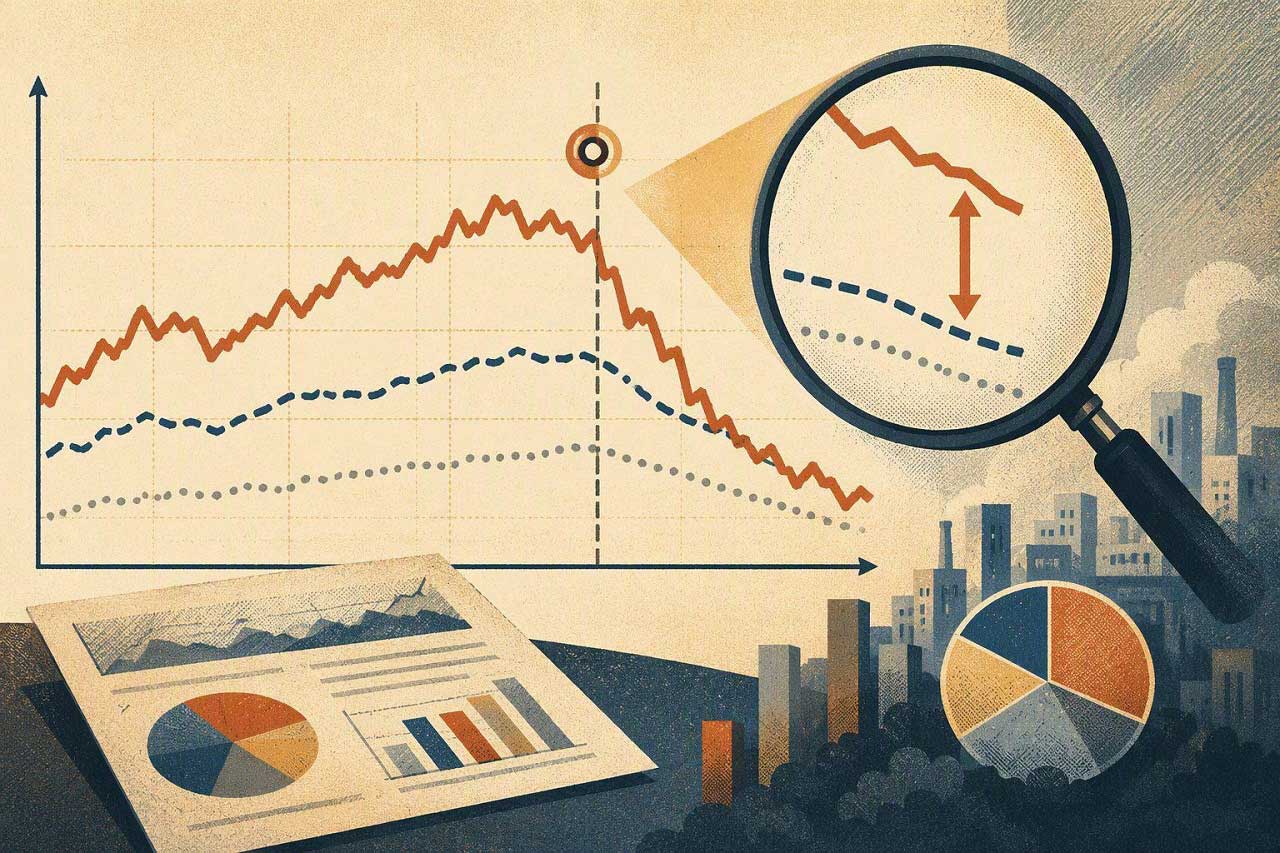
The abnormal return is what remains after market and industry movement is removed.
A Hypothetical Earnings Disclosure Shows the Difference
Consider Northstar Systems, a fictional company used here only to illustrate the analysis.
Before the Corrective Disclosure
Northstar told investors on an earlier call that customer demand remained stable. The stock did not rise afterward. Plaintiffs later allege that the company already knew a major customer planned to cut orders, so the reassuring statement kept inflation in the price that truthful disclosure would have removed.
Defendants would likely challenge that theory on several grounds. They might argue the statement was too generic to affect the price, that the market had already priced in softening demand, or that the statement had no meaningful connection to what was disclosed months later.
The Earnings-Day Decline
Three months later, Northstar reports quarterly results. In one release, it discloses the customer's reduced orders, lowers its forecast, reports an unrelated production shutdown at a plant, and announces higher borrowing costs on refinanced debt. The stock closes down 15 percent. The broader market falls 3 percent that day, and the relevant technology index falls 5 percent.
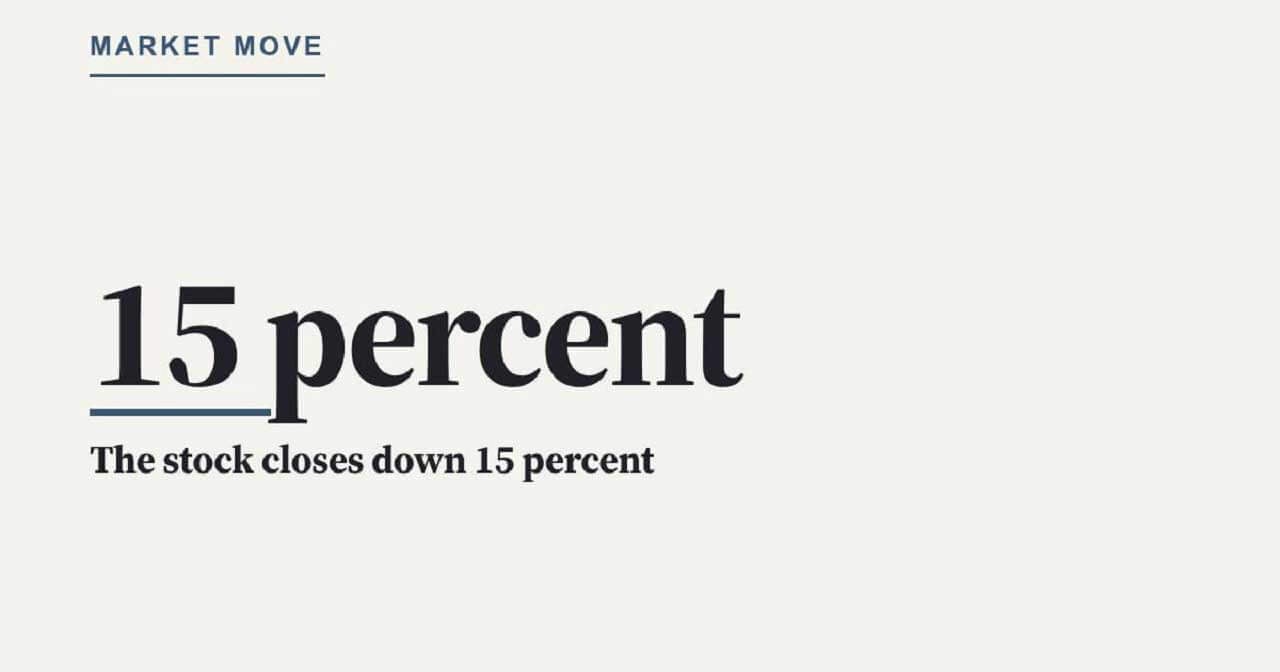
This figure shows the stock’s earnings-day drop.
The arithmetic is tempting but potentially misleading. An event study might estimate the company-specific component of that move, but the analysis would still need to separate the alleged corrective information from the shutdown and financing news, both unrelated to the demand statement at issue.
Applying Both Inquiries
For price impact, the question runs backward to the earlier statement: did it introduce or maintain inflation in the price? Evidence about the earnings-day decline can matter as a back-end test of that theory, because a sharp reaction to specific corrective information may suggest that the earlier reassurance maintained inflation.
For loss causation, the question is whether the reduced-order disclosure revealed the truth allegedly concealed and caused an economic loss. The production shutdown, the borrowing costs, and the sector-wide decline are competing explanations that may reduce or defeat the claimed connection.
The drop is evidence. Its cause is the dispute.
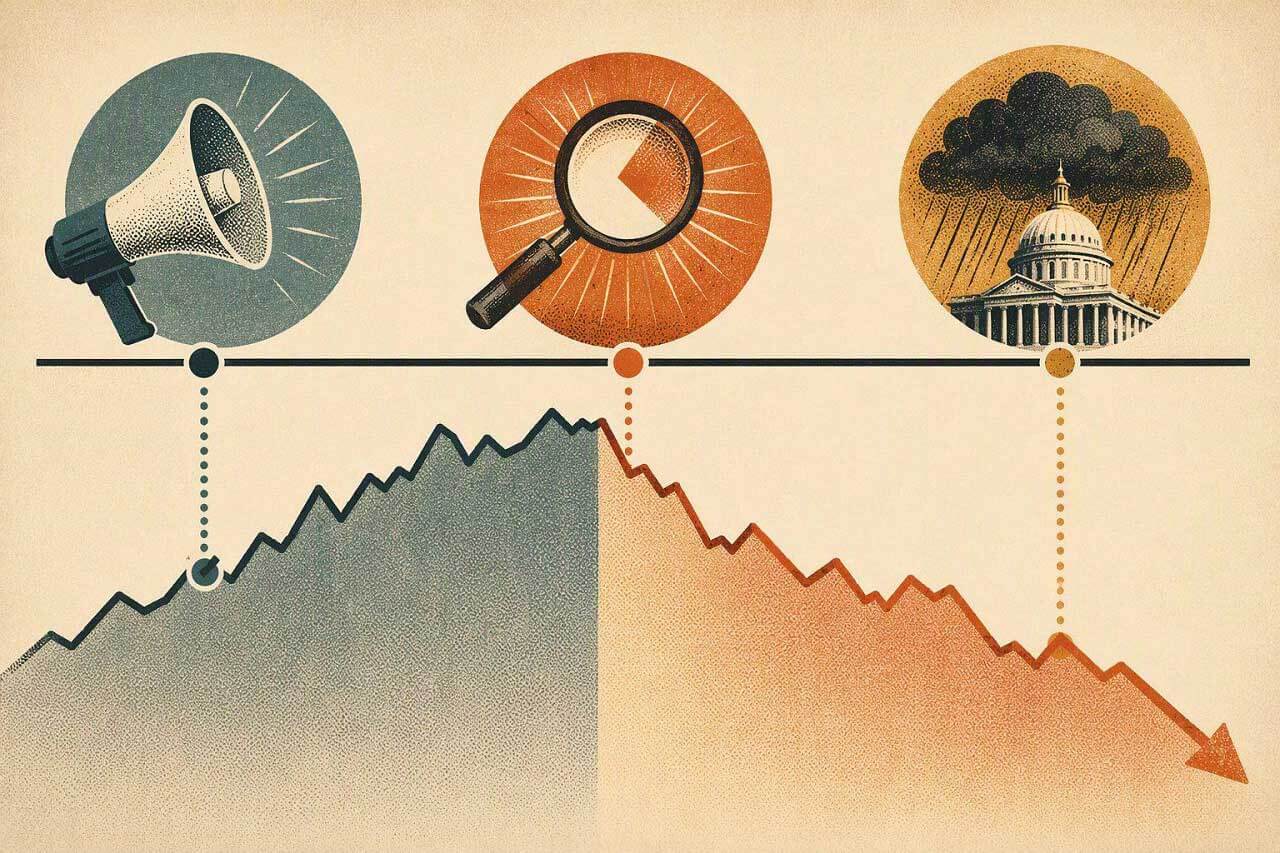
One trading day can carry corrective information and unrelated bad news at the same time.
How Fraud-on-the-Market and Price Impact Affect Class Certification
Price impact can decide class certification, because a defendant may rebut the fraud-on-the-market presumption by showing that the alleged misstatement did not affect the security's market price.
Reliance is the reason this matters. Proving that thousands of individual investors each read and acted on a particular statement would be impractical. The fraud-on-the-market theory allows qualifying investors in an efficient public market to rely on a presumption that material public information was reflected in the trading price. Basic Inc. v. Levinson, 485 U.S. 224 (1988), recognized that presumption as rebuttable.
Halliburton opened the door to direct price-impact evidence at class certification. Later, Goldman Sachs Group, Inc. v. Arkansas Teacher Retirement System, 594 U.S. 113 (2021), held that courts may consider all record evidence relevant to price impact, including the generic nature of an alleged misstatement, and that defendants bear the burden of persuasion to prove a lack of price impact by a preponderance of the evidence.
These claims are commonly brought under SEC Rule 10b-5, codified at 17 C.F.R. § 240.10b-5. Among other conduct, the rule prohibits making an untrue statement of material fact or omitting a material fact necessary to prevent a statement from being misleading in connection with the purchase or sale of a security.
Certification is a procedural ruling, not a verdict. It determines whether the requirements for proceeding as a class have been met. The analysis varies with the record and the jurisdiction.
A persuasive showing of no price impact can defeat the classwide reliance presumption and make certification difficult or unavailable on that theory. A finding that price impact was not successfully rebutted lets the presumption stand, but it proves neither loss causation nor ultimate liability.
Common Questions Retail Investors Ask
Is a Big Stock Drop Enough to Support a Securities Fraud Claim?
No. A large stock decline does not by itself prove a false statement, scienter, reliance, loss causation, or recoverable damages. The decline must connect to information revealing the truth allegedly concealed. Market pressure, sector news, disappointing but lawful developments, or unrelated company disclosures may explain some or all of the movement. The Supreme Court's Dura decision closed off the inflated-purchase-price shortcut.
Must an Investor Have Read the Alleged Misstatement?
Not necessarily. If the fraud-on-the-market presumption applies, an investor may establish reliance through the market price without proving personal readership. That presumption is rebuttable under Basic and Halliburton II. Its application varies with the relevant market, the statements, the trading period, and the class-certification record.
Does a Flat Price on the Statement Date End the Inquiry?
No. The absence of an immediate increase does not automatically defeat price impact, because plaintiffs may argue that the statement maintained inflation already embedded in the price. Courts may weigh the connection between the earlier statement and the later corrective information. Under Goldman Sachs, a highly generic statement paired with a far more specific later disclosure can become a contested evidentiary issue.
Can One Event Study Address Both Legal Concepts?
Yes, but the questions it serves differ. The same analysis may inform whether a statement affected the price and whether a corrective disclosure caused a loss, yet the legal inquiries remain separate. The relevant dates, model assumptions, and causal questions may differ, and a single result does not conclusively decide both issues.
What Investors Should Preserve After a Suspected Corrective Disclosure
If you held shares through an event like the Northstar hypothetical, documentation is the part you control. Records worth preserving include:
-
Brokerage confirmations and complete transaction histories
-
Account statements covering the suspected class period
-
The company's original statement and later disclosure
-
Contemporaneous earnings releases or regulatory filings
-
Notes showing when you bought, sold, or continued holding shares
These records can help counsel identify class-period transactions and estimate potential losses. They do not establish price impact, fraud, or loss causation on their own.
For retail investors, the practical lesson is to separate a dramatic market event from its legal explanation. Preserve relevant records, identify what information changed, and seek qualified legal advice promptly if the losses are significant. Price impact may determine whether courts treat reliance on a classwide basis; loss causation focuses on why the investor's economic loss occurred.