
Will Obamacare destroy jobs?
Aug 21st 2013, 21:53
by The Economist - NEW YORK
BEFORE the recession, Richard Clark’s cleaning company in Florida had 200 employees, about half of them working full time. These days it has about 150, with 80% part-time. The downturn explains some of this. But Mr Clark also blames Barack Obama’s health reform. When it comes into effect in January 2015, Obamacare will require firms with 50 or more full-time employees to offer them affordable health insurance or pay a fine of $2,000-3,000 per worker. That is a daunting prospect for firms that do not already offer coverage. But for many, there is a way round the law.
Mr Clark says he is “very careful with the threshold”. To keep his full-time workforce below the magic number of 50, he is relying more on part-timers. He is not alone. More than one in ten firms surveyed by Mercer, a consultancy—and one in five retail and hospitality companies—say they will cut workers’ hours because of Obamacare. A hundred part-timers can flip as many burgers as 50 full-timers, and the former will soon be much cheaper.
Opinions are furiously divided as to whether the unintended harm caused by health reform will outweigh its benefits. Republicans, who have always hated the whole package, howl that it will destroy jobs. Nonsense, say Democrats; it will promote growth and boost employment. Since the law has so many moving parts, it is hard to predict who is right. But there is a risk that a lot of workers will be hurt.
American health insurance and employment are uniquely entangled. During the second world war, firms began using health insurance to woo scarce workers. Some 57% of employers now offer it, covering nearly 150m people. Company-provided insurance is not taxed, and workers like it because the alternative is abysmal. On the individual market, insurers charge the sick exorbitant rates.
This arrangement has had strange effects on the labour market. Workers stay in bad jobs for fear of losing insurance. As the cost of insurance rises, employers lower wages. Health costs seem to depress hiring, too. A study found that from 1987 to 2005, industries that offered health insurance saw jobs grow more slowly than those that did not. No such pattern was seen in those industries in Canada, where people receive health insurance from the government.
Into this jumble comes Obamacare. From January next year insurers will no longer be allowed to charge the sick higher rates. If only the sick were to seek coverage, costs would explode, so the law requires everyone to be insured or pay a fine. To make this easier for those not already covered, Obamacare will create online shopping places for health insurance, called exchanges. People who cannot afford coverage will receive generous subsidies.
Mr Obama has said that workers who like their company-provided insurance will be able to keep it. This is like promising that if you like sunshine, it won’t rain. Actually, it is even more misleading. When he shakes up the health-care market, employers will have no choice but to respond.
Last month Mr Obama delayed the employer mandate by a year, to give firms time to comply. For the moment, large firms that already cover workers are unlikely to stop doing so, predicts Mercer. But coverage is changing nonetheless. Many firms are making workers pay more of their health bills. Obamacare includes a tax on generous health plans , starting in 2018, which is making some employers reconsider lush benefits. Unions, which fought for them, are livid. At the other extreme, some low-paid workers may want their employers to drop insurance, so they can receive subsidies on the exchanges.
More worrying, though, is the possibility that Obamacare may kill jobs. In 2010 the Congressional Budget Office (CBO) projected that it would shrink employment by 0.5%. The law’s many provisions would pull in opposite directions. Some would raise employment, the CBO predicted. For example, by expanding Medicaid (health care for the poor) to those with higher incomes, Obamacare would remove a disincentive to work. People who might have turned down extra work for fear of losing their Medicaid would now take it, ran the argument.
Other provisions would reduce employment. Partly, this would be because employers like Mr Clark will cut jobs and hours to avoid being subject to the law. (Unions publicly fret about the threat to the 40-hour week.) But mostly, the CBO thinks it would be because people will choose to work less. Obamacare’s subsidies will boost the finances of poor workers; they may therefore work fewer hours. After examining patterns of employment and subsidised insurance in Tennessee, Craig Garthwaite of Northwestern University and his colleagues estimate that Obamacare’s subsidies will prompt up to 940,000 workers to leave the labour force. Many will be older people, keen to retire early.
Another concern is that Obamacare will lower wages. For example, if firms that do not now offer insurance comply with the mandate, their costs will jump. Nearly 60% of such firms say they will offer coverage, according to Mercer. As health costs rise, they may pay their staff less. A study in Massachusetts found that, roughly speaking, every extra dollar spent on insurance comes out of wages.
The White House, however, points to various ways in which Obamacare might boost employment. By making it easier for individuals to buy health insurance, it should make it less frightening for them to switch jobs or start their own companies. Democrats claim the law will lower health costs for firms. Tax credits for small businesses will make it cheaper for them to offer health insurance. Measures to reward efficient health care will reduce the cost of treatment. If insurance becomes cheaper, firms will have more money to hire workers and raise wages. In 2010 David Cutler of Harvard University estimated that Obamacare’s cost-control measures would create up to 400,000 jobs each year.
However, Casey Mulligan of the University of Chicago contends that Obamacare’s distortions to the labour market will outweigh any growth from lowering health costs. By adding his estimates to those of Mr Cutler, Mr Mulligan predicts that Americans will work 3% less in 2015 than they otherwise would have.
Interestingly, the number of jobs in sectors most affected by Obamacare, such as retail, leisure and hospitality, have grown relatively quickly, notes Alec Phillips of Goldman Sachs. But the hours worked in such industries have grown more slowly, suggesting a reluctance to add more full-time jobs.
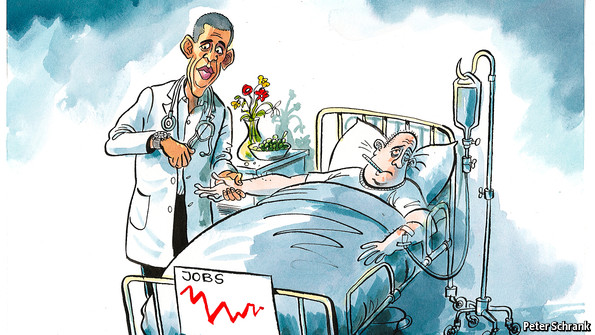
When the final diagnosis is done, Obamacare may have nasty side-effects.
http://www.economist.com/blogs/democracyiname...estroyjobs
Aug 21st 2013, 21:53
by The Economist - NEW YORK
BEFORE the recession, Richard Clark’s cleaning company in Florida had 200 employees, about half of them working full time. These days it has about 150, with 80% part-time. The downturn explains some of this. But Mr Clark also blames Barack Obama’s health reform. When it comes into effect in January 2015, Obamacare will require firms with 50 or more full-time employees to offer them affordable health insurance or pay a fine of $2,000-3,000 per worker. That is a daunting prospect for firms that do not already offer coverage. But for many, there is a way round the law.
Mr Clark says he is “very careful with the threshold”. To keep his full-time workforce below the magic number of 50, he is relying more on part-timers. He is not alone. More than one in ten firms surveyed by Mercer, a consultancy—and one in five retail and hospitality companies—say they will cut workers’ hours because of Obamacare. A hundred part-timers can flip as many burgers as 50 full-timers, and the former will soon be much cheaper.
Opinions are furiously divided as to whether the unintended harm caused by health reform will outweigh its benefits. Republicans, who have always hated the whole package, howl that it will destroy jobs. Nonsense, say Democrats; it will promote growth and boost employment. Since the law has so many moving parts, it is hard to predict who is right. But there is a risk that a lot of workers will be hurt.
American health insurance and employment are uniquely entangled. During the second world war, firms began using health insurance to woo scarce workers. Some 57% of employers now offer it, covering nearly 150m people. Company-provided insurance is not taxed, and workers like it because the alternative is abysmal. On the individual market, insurers charge the sick exorbitant rates.
This arrangement has had strange effects on the labour market. Workers stay in bad jobs for fear of losing insurance. As the cost of insurance rises, employers lower wages. Health costs seem to depress hiring, too. A study found that from 1987 to 2005, industries that offered health insurance saw jobs grow more slowly than those that did not. No such pattern was seen in those industries in Canada, where people receive health insurance from the government.
Into this jumble comes Obamacare. From January next year insurers will no longer be allowed to charge the sick higher rates. If only the sick were to seek coverage, costs would explode, so the law requires everyone to be insured or pay a fine. To make this easier for those not already covered, Obamacare will create online shopping places for health insurance, called exchanges. People who cannot afford coverage will receive generous subsidies.
Mr Obama has said that workers who like their company-provided insurance will be able to keep it. This is like promising that if you like sunshine, it won’t rain. Actually, it is even more misleading. When he shakes up the health-care market, employers will have no choice but to respond.
Last month Mr Obama delayed the employer mandate by a year, to give firms time to comply. For the moment, large firms that already cover workers are unlikely to stop doing so, predicts Mercer. But coverage is changing nonetheless. Many firms are making workers pay more of their health bills. Obamacare includes a tax on generous health plans , starting in 2018, which is making some employers reconsider lush benefits. Unions, which fought for them, are livid. At the other extreme, some low-paid workers may want their employers to drop insurance, so they can receive subsidies on the exchanges.
More worrying, though, is the possibility that Obamacare may kill jobs. In 2010 the Congressional Budget Office (CBO) projected that it would shrink employment by 0.5%. The law’s many provisions would pull in opposite directions. Some would raise employment, the CBO predicted. For example, by expanding Medicaid (health care for the poor) to those with higher incomes, Obamacare would remove a disincentive to work. People who might have turned down extra work for fear of losing their Medicaid would now take it, ran the argument.
Other provisions would reduce employment. Partly, this would be because employers like Mr Clark will cut jobs and hours to avoid being subject to the law. (Unions publicly fret about the threat to the 40-hour week.) But mostly, the CBO thinks it would be because people will choose to work less. Obamacare’s subsidies will boost the finances of poor workers; they may therefore work fewer hours. After examining patterns of employment and subsidised insurance in Tennessee, Craig Garthwaite of Northwestern University and his colleagues estimate that Obamacare’s subsidies will prompt up to 940,000 workers to leave the labour force. Many will be older people, keen to retire early.
Another concern is that Obamacare will lower wages. For example, if firms that do not now offer insurance comply with the mandate, their costs will jump. Nearly 60% of such firms say they will offer coverage, according to Mercer. As health costs rise, they may pay their staff less. A study in Massachusetts found that, roughly speaking, every extra dollar spent on insurance comes out of wages.
The White House, however, points to various ways in which Obamacare might boost employment. By making it easier for individuals to buy health insurance, it should make it less frightening for them to switch jobs or start their own companies. Democrats claim the law will lower health costs for firms. Tax credits for small businesses will make it cheaper for them to offer health insurance. Measures to reward efficient health care will reduce the cost of treatment. If insurance becomes cheaper, firms will have more money to hire workers and raise wages. In 2010 David Cutler of Harvard University estimated that Obamacare’s cost-control measures would create up to 400,000 jobs each year.
However, Casey Mulligan of the University of Chicago contends that Obamacare’s distortions to the labour market will outweigh any growth from lowering health costs. By adding his estimates to those of Mr Cutler, Mr Mulligan predicts that Americans will work 3% less in 2015 than they otherwise would have.
Interestingly, the number of jobs in sectors most affected by Obamacare, such as retail, leisure and hospitality, have grown relatively quickly, notes Alec Phillips of Goldman Sachs. But the hours worked in such industries have grown more slowly, suggesting a reluctance to add more full-time jobs.
When the final diagnosis is done, Obamacare may have nasty side-effects.
http://www.economist.com/blogs/democracyiname...estroyjobs