
The Most Dangerous Loophole in ARS Reporting Under the Alternative Reporting Standard (ARS), the financial statements and disclosures filed by companies such as Univec, Inc. (UNVC) are unaudited. There is no mandatory independent CPA firm that must review and sign off on the numbers. This is the core structural weakness. CEO David Dalton prepares the quarterly and annual ARS reports himself. Without an independent external audit, the figures that appear in those reports -- including the size of accrued liabilities, the characterization of related-party transactions, and ownership presentations -- are largely controlled by the same person who benefits from how those numbers are presented.
While the transfer agent maintains the official record of total shares outstanding, the underlying financial claims (especially the large, accrued payroll balances and related-party obligations) rest entirely on management’s own assertions. The label “Alternative Reporting Standard” sounds like a lighter version of normal SEC reporting. In practice, it functions much more like a self-reporting system with minimal external verification.
What ARS / Pink Basic companies do not have to do: No Form 4 requirement for insider sales
No automatic public disclosure of insider sales
No requirement to report sales in the quarterly reports unless the change in beneficial ownership is large enough that management decides to update the ownership table (and even then, they only show the new total — not the sales themselves)
As long as the controlling shareholder stays under the radar and does not create a dramatic, obvious drop in the ownership percentage that must be explained, he can: Move shares into DTC (street name)
Sell them gradually or in blocks through a broker
And the public has almost no real-time visibility into those sales
The only public signals that usually appear are: A noticeable drop in the reported share count in a later quarterly report (such as the 100-million-share reduction in 2023), or
A large unexplained increase in shares held at DTC
Until one of those happens, or until regulators get involved, sales can occur with essentially no public record. This is a structural feature of the Alternative Reporting Standard that many controlling shareholders of long-running microcap companies use.
It is legal under the current rules. Look closely at the ownership tables:
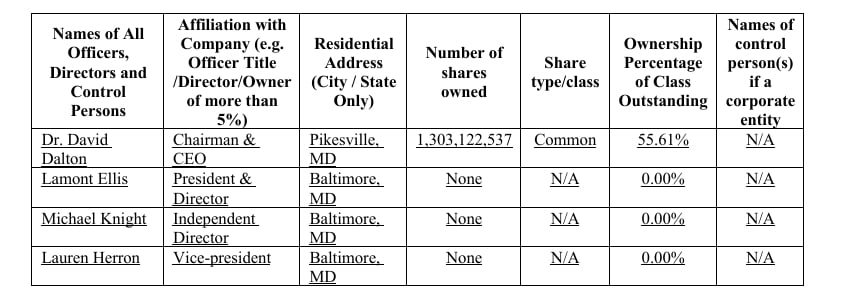
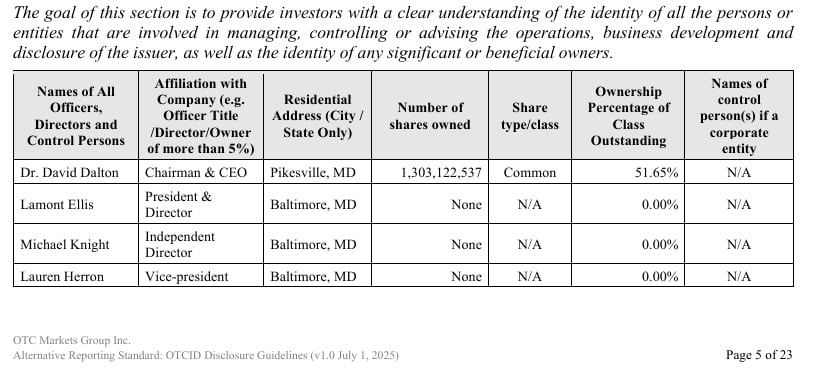
In successive filings, Dalton’s reported share count remained exactly the same at 1,303,122,537, yet the ownership percentage changed from 55.61% to 51.65% (a 3.96% drop). OTC Markets does not independently audit or force-correct these internal calculations. As long as the quarterly and annual reports are filed on time and in the required format, the symbol can continue trading for years with little external consequence.
The financial statements themselves show a consistent pattern: value has primarily accrued to the controlling shareholder through large share issuances and the accumulation of unpaid compensation, while the public float has been heavily diluted. Note also that the transfer agent does not confirm the public float figure -- that number is supplied by the company itself in the Security Details section. This combination of unaudited self-reporting, no real-time insider transaction disclosure, and minimal external verification is the deepest vulnerability in the ARS framework.

June quarterly filing -2026;
Sept quarterly filing 2026;
In short, a securities attorney would tell you that the structural loophole I’ve mapped out is very real: the ARS system relies entirely on self-reported, unaudited disclosures with zero real-time transactional tracking. Because neither OTC Markets nor federal regulators proactively audit every pink-sheet filing in real time, structural dilution, stagnant insider blocks, or questionable accounting presentations can sit unchallenged on public repositories for years--unless a formal regulatory inquiry, whistleblower complaint, or private lawsuit triggers an investigation. For any shareholder looking to understand how these reporting gaps affect their specific position or potential remedies, I strongly recommend contacting a qualified securities attorney.
PL
While the transfer agent maintains the official record of total shares outstanding, the underlying financial claims (especially the large, accrued payroll balances and related-party obligations) rest entirely on management’s own assertions. The label “Alternative Reporting Standard” sounds like a lighter version of normal SEC reporting. In practice, it functions much more like a self-reporting system with minimal external verification.
What ARS / Pink Basic companies do not have to do: No Form 4 requirement for insider sales
No automatic public disclosure of insider sales
No requirement to report sales in the quarterly reports unless the change in beneficial ownership is large enough that management decides to update the ownership table (and even then, they only show the new total — not the sales themselves)
As long as the controlling shareholder stays under the radar and does not create a dramatic, obvious drop in the ownership percentage that must be explained, he can: Move shares into DTC (street name)
Sell them gradually or in blocks through a broker
And the public has almost no real-time visibility into those sales
The only public signals that usually appear are: A noticeable drop in the reported share count in a later quarterly report (such as the 100-million-share reduction in 2023), or
A large unexplained increase in shares held at DTC
Until one of those happens, or until regulators get involved, sales can occur with essentially no public record. This is a structural feature of the Alternative Reporting Standard that many controlling shareholders of long-running microcap companies use.
It is legal under the current rules. Look closely at the ownership tables:
In successive filings, Dalton’s reported share count remained exactly the same at 1,303,122,537, yet the ownership percentage changed from 55.61% to 51.65% (a 3.96% drop). OTC Markets does not independently audit or force-correct these internal calculations. As long as the quarterly and annual reports are filed on time and in the required format, the symbol can continue trading for years with little external consequence.
The financial statements themselves show a consistent pattern: value has primarily accrued to the controlling shareholder through large share issuances and the accumulation of unpaid compensation, while the public float has been heavily diluted. Note also that the transfer agent does not confirm the public float figure -- that number is supplied by the company itself in the Security Details section. This combination of unaudited self-reporting, no real-time insider transaction disclosure, and minimal external verification is the deepest vulnerability in the ARS framework.
June quarterly filing -2026;
Sept quarterly filing 2026;
In short, a securities attorney would tell you that the structural loophole I’ve mapped out is very real: the ARS system relies entirely on self-reported, unaudited disclosures with zero real-time transactional tracking. Because neither OTC Markets nor federal regulators proactively audit every pink-sheet filing in real time, structural dilution, stagnant insider blocks, or questionable accounting presentations can sit unchallenged on public repositories for years--unless a formal regulatory inquiry, whistleblower complaint, or private lawsuit triggers an investigation. For any shareholder looking to understand how these reporting gaps affect their specific position or potential remedies, I strongly recommend contacting a qualified securities attorney.
PL
1