
Inflammation plays a key role in the development of virtually every chronic brain degenerative disorder. At the hearth of these conditions lies the microglia (the brain resident immune cells.) When these are threatened or affected by any factor (trauma, pollution, infection, etc.) they change their function going to friend to foe leading a disrupted mitochondrial function (cellular metabolism) triggering a chain reaction that is the root of most neurodegenerative disorders.
This is a paradigm shift in neuroscience research. For example, the idea that beta-amyloid causes Alzheimer’s its being revisited around the world. Now scientist (and Cytodyn) ar looking at neuro-degenerative diseases, in the former, microglial activation (brain’s immune cells turning from friend to foe) and the subsequent inflammatory cascade CAUSES the beta-amyloid accumulation, neuron death and synaptic loss.
Inflammation is present in Parkinson’s, Multiple Sclerosis, Depression, Anxiety, Autism Spectrum disorder, long Covid, Stroke, Fibromyalgia, Amyotrophic Lateral Sclerosis among other conditions.
Now, this process is complex but can be depicted simply by saying that when triggered by injury, infection, or chronic disease, microglia retract their “normal” caretaking processes (called M2 microglia), adopt a more amoeboid shape, and shift toward a pro-inflammatory phenotype often referred to as M1. In this activated state, they release inflammatory cytokines, reactive oxygen species, and other signaling molecules intended to combat damage. When this activation becomes excessive or prolonged, these same mechanisms can harm neurons, disrupt synaptic connections, and perpetuate neuroinflammation, transforming microglia from guardians of the central nervous system into contributors to neurodegeneration.
So, in this (oversimplified explanation), what causes inflammation is a flood of cytokines summoned by the M1 cells.
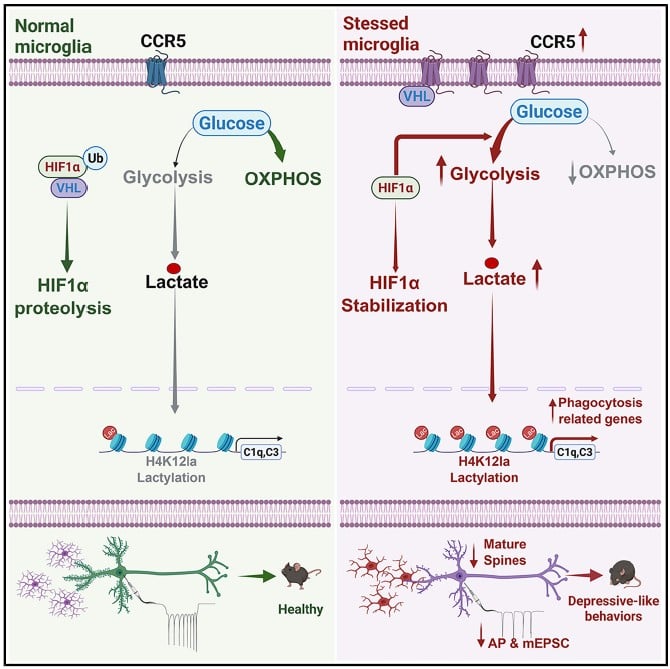
In a very recently published paper (July 29, 2026) by Y-Y Jiao et-al and shared by twinter11 (link below, thank you) it is demonstrated that the CCL5-CCR5 signaling axis plays a central role in brain inflammation by promoting microglial activation in the context of depression. Elevated levels of CCL5 and its receptor CCR5 are found in both patients with major depressive disorder and mice subjected to chronic stress. In the brain, activation of CCR5 in microglia initiates a cascade that shifts their metabolism toward aerobic glycolysis, leading to lactate accumulation. This metabolic change results in increased histone lactylation, particularly at promoters of complement genes, which drives the transcription of pro-inflammatory effectors. Ultimately, this process enhances microglial synaptic pruning and leads to excessive synapse loss, contributing to depressive-like behaviors. Thus, CCL5-CCR5 signaling promotes neuroinflammation by linking immune activation, metabolic reprogramming, and pro-inflammatory gene expression in microglia.
https://investorshangout.com/post/view?id=6851686
OK. This is all well and good. But here is my point:
The World Health Organization (WHO) has reported that depression and anxiety together cost the global economy about $1 trillion per year, largely through lost productivity and reduced workforce participation, major depression alone costs the U.S. more than $330 billion annually.
• About 322 million people worldwide had depression. This represents about 4% of the global population and 5.2% of adults.
• About 470 million people worldwide had an anxiety disorder, making anxiety disorders the most common mental health disorders globally. This represents about 5.8% of the world's population
Unfortunately, a substantial fraction of people with depression do not respond adequately to standard antidepressants such as SSRIs, SNRIs, bupropion, or related medications:
• About one-third (≈30%) of patients with major depressive disorder develop treatment-resistant depression.
• A large U.S. study estimated that among 8.9 million adults receiving medication treatment for major depression, about 2.8 million (30.9%) had treatment-resistant depression.
• Only about one-third of patients respond to their first antidepressant trial, meaning many require multiple treatment attempts before achieving remission.
• Reviews have reported that approximately one-third of depressed patients fail to achieve even a partial response to pharmacologic treatment.
It doesn’t take a genius after reading the paper to understand that a CCR-5 antagonist (Leronlimab) would be expected to block CCR5 signaling in brain microglia, leading to several beneficial effects in the context of depression and neuroinflammation by (in the language of the paper) reducing the microglial activation, correcting the metabolic reprogramming and decreasing the histone lactylation, consequentially reducing synaptic pruning resulting in the alleviation of depressive-like symptoms.
In the mouse models, CCR5 deletion or knockdown improved behaviors associated with depression, such as increasing social interaction and sucrose preference and decreasing immobility in stress tests.
These findings collectively suggest that a CCR5 antagonist could exert antidepressant and neuroprotective effects by blocking a pro-inflammatory, metabolically maladaptive, and synapse-damaging pathway in microglia.
Or, in other words, it is very likely that Leronlimab, being able to cross the BB could be an effective drug in the treatment of depression and/or anxiety. A clinical trial for his condition should be relatively easy to design and perform as the onset of beneficial results is rapid (in the mouse model these were detectable after the first week).
In humans Stress and anxiety are commonly measured using validated psychological questionnaires and biological assessments. Standardized self-report scales such as the Hamilton Anxiety Rating Scale (HAM-A), Beck Anxiety Inventory (BAI), and Perceived Stress Scale (PSS) are widely used to quantify anxiety and stress levels and could be administered shortly after initialization of treatment with Leronlimab. The trial(s) wouldn’t take more that few weeks, and there shouldn’t be any scarcity of patients.
So, in summarizing, from a neuroinflammation perspective, major depression and anxiety are increasingly linked to chronic activation of immune pathways in the brain. Activated microglia release inflammatory cytokines that can impair synaptic function, reduce neuroplasticity, and disrupt neurotransmitter systems. Because these disorders are so prevalent and often chronic, even modest improvements in treatments that reduce neuroinflammation could potentially have very large economic and societal benefits.
And we have the drug that can just do that!!!
Dr. J, what are you waiting for ???
This is a paradigm shift in neuroscience research. For example, the idea that beta-amyloid causes Alzheimer’s its being revisited around the world. Now scientist (and Cytodyn) ar looking at neuro-degenerative diseases, in the former, microglial activation (brain’s immune cells turning from friend to foe) and the subsequent inflammatory cascade CAUSES the beta-amyloid accumulation, neuron death and synaptic loss.
Inflammation is present in Parkinson’s, Multiple Sclerosis, Depression, Anxiety, Autism Spectrum disorder, long Covid, Stroke, Fibromyalgia, Amyotrophic Lateral Sclerosis among other conditions.
Now, this process is complex but can be depicted simply by saying that when triggered by injury, infection, or chronic disease, microglia retract their “normal” caretaking processes (called M2 microglia), adopt a more amoeboid shape, and shift toward a pro-inflammatory phenotype often referred to as M1. In this activated state, they release inflammatory cytokines, reactive oxygen species, and other signaling molecules intended to combat damage. When this activation becomes excessive or prolonged, these same mechanisms can harm neurons, disrupt synaptic connections, and perpetuate neuroinflammation, transforming microglia from guardians of the central nervous system into contributors to neurodegeneration.
So, in this (oversimplified explanation), what causes inflammation is a flood of cytokines summoned by the M1 cells.
In a very recently published paper (July 29, 2026) by Y-Y Jiao et-al and shared by twinter11 (link below, thank you) it is demonstrated that the CCL5-CCR5 signaling axis plays a central role in brain inflammation by promoting microglial activation in the context of depression. Elevated levels of CCL5 and its receptor CCR5 are found in both patients with major depressive disorder and mice subjected to chronic stress. In the brain, activation of CCR5 in microglia initiates a cascade that shifts their metabolism toward aerobic glycolysis, leading to lactate accumulation. This metabolic change results in increased histone lactylation, particularly at promoters of complement genes, which drives the transcription of pro-inflammatory effectors. Ultimately, this process enhances microglial synaptic pruning and leads to excessive synapse loss, contributing to depressive-like behaviors. Thus, CCL5-CCR5 signaling promotes neuroinflammation by linking immune activation, metabolic reprogramming, and pro-inflammatory gene expression in microglia.
https://investorshangout.com/post/view?id=6851686
OK. This is all well and good. But here is my point:
The World Health Organization (WHO) has reported that depression and anxiety together cost the global economy about $1 trillion per year, largely through lost productivity and reduced workforce participation, major depression alone costs the U.S. more than $330 billion annually.
• About 322 million people worldwide had depression. This represents about 4% of the global population and 5.2% of adults.
• About 470 million people worldwide had an anxiety disorder, making anxiety disorders the most common mental health disorders globally. This represents about 5.8% of the world's population
Unfortunately, a substantial fraction of people with depression do not respond adequately to standard antidepressants such as SSRIs, SNRIs, bupropion, or related medications:
• About one-third (≈30%) of patients with major depressive disorder develop treatment-resistant depression.
• A large U.S. study estimated that among 8.9 million adults receiving medication treatment for major depression, about 2.8 million (30.9%) had treatment-resistant depression.
• Only about one-third of patients respond to their first antidepressant trial, meaning many require multiple treatment attempts before achieving remission.
• Reviews have reported that approximately one-third of depressed patients fail to achieve even a partial response to pharmacologic treatment.
It doesn’t take a genius after reading the paper to understand that a CCR-5 antagonist (Leronlimab) would be expected to block CCR5 signaling in brain microglia, leading to several beneficial effects in the context of depression and neuroinflammation by (in the language of the paper) reducing the microglial activation, correcting the metabolic reprogramming and decreasing the histone lactylation, consequentially reducing synaptic pruning resulting in the alleviation of depressive-like symptoms.
In the mouse models, CCR5 deletion or knockdown improved behaviors associated with depression, such as increasing social interaction and sucrose preference and decreasing immobility in stress tests.
These findings collectively suggest that a CCR5 antagonist could exert antidepressant and neuroprotective effects by blocking a pro-inflammatory, metabolically maladaptive, and synapse-damaging pathway in microglia.
Or, in other words, it is very likely that Leronlimab, being able to cross the BB could be an effective drug in the treatment of depression and/or anxiety. A clinical trial for his condition should be relatively easy to design and perform as the onset of beneficial results is rapid (in the mouse model these were detectable after the first week).
In humans Stress and anxiety are commonly measured using validated psychological questionnaires and biological assessments. Standardized self-report scales such as the Hamilton Anxiety Rating Scale (HAM-A), Beck Anxiety Inventory (BAI), and Perceived Stress Scale (PSS) are widely used to quantify anxiety and stress levels and could be administered shortly after initialization of treatment with Leronlimab. The trial(s) wouldn’t take more that few weeks, and there shouldn’t be any scarcity of patients.
So, in summarizing, from a neuroinflammation perspective, major depression and anxiety are increasingly linked to chronic activation of immune pathways in the brain. Activated microglia release inflammatory cytokines that can impair synaptic function, reduce neuroplasticity, and disrupt neurotransmitter systems. Because these disorders are so prevalent and often chronic, even modest improvements in treatments that reduce neuroinflammation could potentially have very large economic and societal benefits.
And we have the drug that can just do that!!!
Dr. J, what are you waiting for ???
13