.jpg)
4) Spanish Mountain Gold and its peers
==============================
Spanish Mountain Gold and its peers
==============================

https://investorshangout.com/images/MYImages/...speers.jpg
Note: If MKO Mining's current 87 million shares outstanding is diluted 6 times to 525 million shares equaling to that of Spanish Mountain Gold, its 52-week high share price would be at $2.33 with 52-week high market capitalization of $1.2 billion.
.
Comparison of gold resources and market capitalization between Spanish Mountain Gold and its peers reveals that SMG's market valuation is tremendously undervalued. But bullish chart technicality forecasts that SMG will catch up with them soon, perhaps even emulate them because SMG has the highest Measured + Indicated resources among its peers. It will be even more under-valued when the coming new Preliminary Economic Assessment (PEA) with a new Mineral Resource Estimate (MRE) shows Proven Reserves of 7 million ounces of gold and 10 million ounces of silver in the Measured + Indicated category. It will be the catalyst triggering share price re-rating for Spanish Mountain Gold.
SPA's market capitalization could emulate that of OMG and MKO.

.
~~~~~~~~~~~~~~~~~~~~~~~~~~~~~~~~~~~~~~~~~~~~~
Omai Gold Mines - Guyana (OMG.V)
https://www.google.ca/maps/place/OMAI+GOLD+MI...FQAw%3D%3D
Mineral Resource Estimate: https://omaigoldmines.com/omai-project/overview/
OMG.V weekly
https://stockcharts.com/sc3/ui/?s=OMG.V&p...2963243620
.
~~~~~~~~~~~~~~~~~~~~~~~~~~~~~~~~~~~~~~~~~~~~~
Blue Lagoon Resources - Dome Mountain Mine project, British Columbia (BLLG.CA)
https://www.google.ca/maps/place/Dome+Mountai...FQAw%3D%3D
Mineral Resource Estimate: https://bluelagoonresources.com/wp-content/up...slides.pdf
BLLG.CA weekly
https://stockcharts.com/h-sc/ui?s=BLLG.CA&...7291241482
.
~~~~~~~~~~~~~~~~~~~~~~~~~~~~~~~~~~~~~~~~~~~~~
Banyan Gold - AurMac Project in Yukon (BYN.V)
https://www.google.ca/maps/place/Banyan+Gold+...FQAw%3D%3D
Mineral Resource Estimate: https://banyangold.com/projects/aurmac/
BYN.V weekly
https://stockcharts.com/h-sc/ui?s=BYN.V&p...7291241482
.
~~~~~~~~~~~~~~~~~~~~~~~~~~~~~~~~~~~~~~~~~~~~~
1911 Gold - True North gold mine, Manitoba ( AUMB.V, AUMBF.OTCQC )
True North Gold Mine
https://www.google.ca/maps/place/True+North+G...FQAw%3D%3D
Mineral Resource Estimate
https://1911gold.com/news/press-releases/1911...ld-project
AUMB.V weekly
https://stockcharts.com/h-sc/ui?s=AUMB.V&...2963243620
.
~~~~~~~~~~~~~~~~~~~~~~~~~~~~~~~~~~~~~~~~~~~~~
Mako Mining, Arizona (MKO.V, MAKO.NASDAQ)
Moss Mine, Arizona
https://www.google.ca/maps/place/Moss+Mine/@3...FQAw%3D%3D
Mineral Resource Estimate
https://makominingcorp.com/news-media/press-r...nt_id=1146
MKO.V weekly
https://stockcharts.com/sc3/ui/?s=MKO.V&p...2963243620
If MKO Mining's current 87 million shares outstanding is diluted 6 times to 525 million shares equaling to that of Spanish Mountain Gold, its 52-week high share price would be at $2.33 with 52-week high market capitalization of $1.2 billion.
.
~~~~~~~~~~~~~~~~~~~~~~~~~~~~~~~~~~~~~~~~~~~~~~~
Spanish Mountain Gold - In the prolific Cariboo region of British Columbia (SPA.V, SPAUF.OTCQB)
https://www.google.ca/maps/search/Cedar+Creek...FQAw%3D%3D
Mineral Resource Estimate: Page 12 of NI-43-101 Technical Report
https://spanishmountaingold.com/site/assets/f...-final.pdf
SPA.V weekly
https://stockcharts.com/sc3/ui/?s=SPA.V&p...2963243620
.
~~~~~~~~~~~~~~~~~~~~~~~~~~~~~~~~~~~~~~~~~~~~~~~~~~~~~~~~~~~~~~~~~
====================================
Spanish Mountain Gold - The hidden potential
====================================
Drilling in 2006 to 2008 intercepted numerous long intervals of placer gold over an area of 0.72 square kilometers, approximately 1.2 kilometers by 0.6 kilometer in the Main zone, including:
Hole 06-DDH-504 0.57 g/t over 227.50 meters
Hole 06-DDH-506: 0.56 g/t gold over 86.00 meters
Hole 06-DDH-512: 0.65 g/t gold over69.08 meters
Hole 06-DDH-509 0.86 g/t over 86.60 meters
Hole 06-DDH-522: 1.02 g/t over 36.00 meters
Hole 06-DDH-524: 0.75 g/t gold over40.43 meters
Hole 06-DDH-529: 1.54 g/t gold over 2.00 meters
Hole 06-DDH-535: 0.72 g/t gold over 72.22 meters
Hole 07-DDH-634: 2.76 g/t gold over 22.05 meters
Hole 07-DDH-635: 4.13 g/t gold over10.5 meters
Hole 07-DDH-637: 1.24 g/t gold over 50.0 meters
Hole 07-DDH-640: 1.32 g/t over 6.5 meters and 1.06 g/t over 13.5 meters
Hole 07-DDH-642: 1.04 g/t over 18.0 meters
Hole 07-DDH-644: 1.12 g/t over 84.5 meters
Hole 08-DDH-706: 1.16 g/t gold over 25.0 meter
Hole 08-DDH-714: 37.6 g/t gold over 1.0 meter and 1.13 g/t over 10.5 meters
Hole 08-DDH-722: 2.04 g/t gold over 47.5 meter
Hole 08-DDH-741: 1.02 g/t gold over 21.0 meter
Hole 08-DDH-744: 1.71 g/t gold over 14.5 meter
Hole 08-DDH-749: 6.26 g/t gold over 6.0 meter
Hole 08-DDH-766: 1.06 g/t gold over 5 meter
Hole 08-DDH-778: 1.82 g/t gold over 15.0 meter
Hole 08-DDH-816 (Main Zone): 31.3 g/t gold over 2.0 meters
Hole 08-DDH-823 (Main Zone): 2.94 g/t gold over 16.0 meters, including 0.75 meters of 48.46 g/t
Hole 08-DDH-836 (Main Zone): 20.0 g/t over 2.0 meters
Hole ROG-014: 5.64 g/t over 6.0 meters
Hole ROG-015: 5.72 g/t over 9.5 meters, including 25.7 g/t gold over 1.5 meter
.
Where did Spanish Mountain Gold's massive placer gold come from?
During the geological Subduction process 200 million years ago, the west coast of British Columbia buckled and the Earth's crust was pushed skyward, carrying with it massive orogenic gold veins. Over the 200 million years weathering eroded mountains into flood plains, disintegrated the gold veins and eroded the visible gold into fine placer gold, dispersing it in a wide area. Placer gold is heavier then the surrounding materials and deposited in river gravels, floodplains, and hillsides, it can be in the form of dust, flakes, or nuggets. Finding placer gold is a strong indicator that a source, most likely gold veins exist somewhere upstream or nearby, that explains why high grade gold is being discovered in the Phoenix zone and the K-zone surrounding the Main zone.
The width of gold veins ranges from a few centimeters to 25 meters or more. The entire network of an anastomosing system of veins and shear zones can be traced along strike for hundreds of meters. Vertical depth of gold veins can extend to depths in excess of 1.5 kilometers.
Images of Gold veins
.jpg)
Images of Placer gold
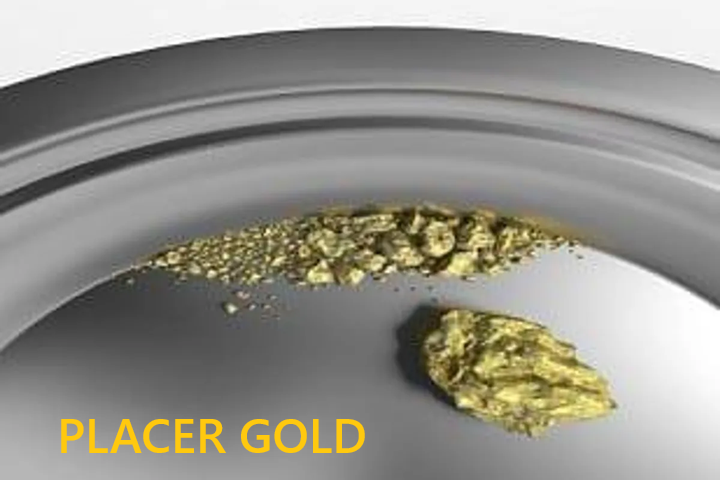
.
How orogenic gold veins are formed?
200 million years ago, during the collision of the world's tectonic plates, tremendous heat and pressure was generated, forcing metamorphic hydrothermal fluids containing dissolved gold and quartz to migrate upwards through fractured rocks and faults, forming channels. As the fluids cooled, gold and quartz was deposited in the rocks. Gold deposits formed this way is called orogenic gold, 75% of the gold mined in the world are orogenic gold, 25% are found in magma rocks.
.
Why gold is found in quartz veins?
Quartz is a piezoelectric material, meaning it generates an electric charge when subjected to stress of high temperature and pressure, these electric charges act on the dissolved gold in the hydrothermal fluid, causing it to solidify into gold grains, leading to the formation of large gold nuggets embedded in quartz veins as hydrothermal fluids cooled and precipitated gold and quartz in the rocks.
.
Why gold and fossil of marine life are found on top of the Rocky Mountain?
In the collision between the Pacific tectonic plate and the American tectonic plate, the denser Pacific plate submerged beneath the less denser American plate and the west coast from British Columbia to Peru buckled and was pushed upward and skyward, forming the Rocky Mountain as high as 12,970 feet at Mount Robson and the Andes Mountain in South America as high as high as 6,961 feet, bringing along with it gold deposits and fossils of marine life from the bottom of the ocean. The geological process is called Subduction.
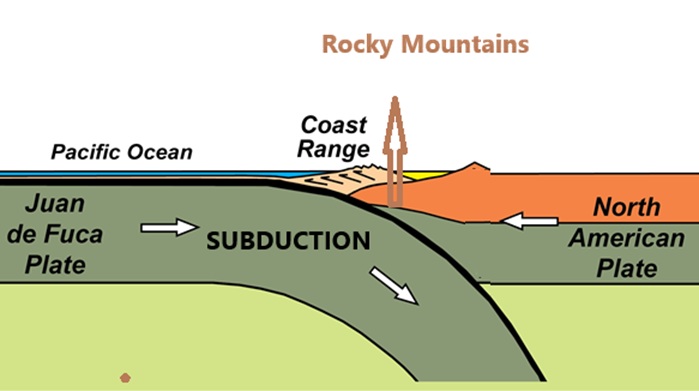
Alluvial gold and placer gold are often used interchangeably because alluvial gold is a type of placer gold, specifically when the deposit is formed in a stream or river. "Placer gold" is the broader geological term for deposit concentrated by gravity from a source rock, while "alluvial gold" refers to deposits that are a result of water action.
.
.
==============================
Spanish Mountain Gold and its peers
==============================
https://investorshangout.com/images/MYImages/...speers.jpg
Note: If MKO Mining's current 87 million shares outstanding is diluted 6 times to 525 million shares equaling to that of Spanish Mountain Gold, its 52-week high share price would be at $2.33 with 52-week high market capitalization of $1.2 billion.
.
Comparison of gold resources and market capitalization between Spanish Mountain Gold and its peers reveals that SMG's market valuation is tremendously undervalued. But bullish chart technicality forecasts that SMG will catch up with them soon, perhaps even emulate them because SMG has the highest Measured + Indicated resources among its peers. It will be even more under-valued when the coming new Preliminary Economic Assessment (PEA) with a new Mineral Resource Estimate (MRE) shows Proven Reserves of 7 million ounces of gold and 10 million ounces of silver in the Measured + Indicated category. It will be the catalyst triggering share price re-rating for Spanish Mountain Gold.
SPA's market capitalization could emulate that of OMG and MKO.
.
~~~~~~~~~~~~~~~~~~~~~~~~~~~~~~~~~~~~~~~~~~~~~
Omai Gold Mines - Guyana (OMG.V)
https://www.google.ca/maps/place/OMAI+GOLD+MI...FQAw%3D%3D
Mineral Resource Estimate: https://omaigoldmines.com/omai-project/overview/
OMG.V weekly
https://stockcharts.com/sc3/ui/?s=OMG.V&p...2963243620
.
~~~~~~~~~~~~~~~~~~~~~~~~~~~~~~~~~~~~~~~~~~~~~
Blue Lagoon Resources - Dome Mountain Mine project, British Columbia (BLLG.CA)
https://www.google.ca/maps/place/Dome+Mountai...FQAw%3D%3D
Mineral Resource Estimate: https://bluelagoonresources.com/wp-content/up...slides.pdf
BLLG.CA weekly
https://stockcharts.com/h-sc/ui?s=BLLG.CA&...7291241482
.
~~~~~~~~~~~~~~~~~~~~~~~~~~~~~~~~~~~~~~~~~~~~~
Banyan Gold - AurMac Project in Yukon (BYN.V)
https://www.google.ca/maps/place/Banyan+Gold+...FQAw%3D%3D
Mineral Resource Estimate: https://banyangold.com/projects/aurmac/
BYN.V weekly
https://stockcharts.com/h-sc/ui?s=BYN.V&p...7291241482
.
~~~~~~~~~~~~~~~~~~~~~~~~~~~~~~~~~~~~~~~~~~~~~
1911 Gold - True North gold mine, Manitoba ( AUMB.V, AUMBF.OTCQC )
True North Gold Mine
https://www.google.ca/maps/place/True+North+G...FQAw%3D%3D
Mineral Resource Estimate
https://1911gold.com/news/press-releases/1911...ld-project
AUMB.V weekly
https://stockcharts.com/h-sc/ui?s=AUMB.V&...2963243620
.
~~~~~~~~~~~~~~~~~~~~~~~~~~~~~~~~~~~~~~~~~~~~~
Mako Mining, Arizona (MKO.V, MAKO.NASDAQ)
Moss Mine, Arizona
https://www.google.ca/maps/place/Moss+Mine/@3...FQAw%3D%3D
Mineral Resource Estimate
https://makominingcorp.com/news-media/press-r...nt_id=1146
MKO.V weekly
https://stockcharts.com/sc3/ui/?s=MKO.V&p...2963243620
If MKO Mining's current 87 million shares outstanding is diluted 6 times to 525 million shares equaling to that of Spanish Mountain Gold, its 52-week high share price would be at $2.33 with 52-week high market capitalization of $1.2 billion.
.
~~~~~~~~~~~~~~~~~~~~~~~~~~~~~~~~~~~~~~~~~~~~~~~
Spanish Mountain Gold - In the prolific Cariboo region of British Columbia (SPA.V, SPAUF.OTCQB)
https://www.google.ca/maps/search/Cedar+Creek...FQAw%3D%3D
Mineral Resource Estimate: Page 12 of NI-43-101 Technical Report
https://spanishmountaingold.com/site/assets/f...-final.pdf
SPA.V weekly
https://stockcharts.com/sc3/ui/?s=SPA.V&p...2963243620
.
~~~~~~~~~~~~~~~~~~~~~~~~~~~~~~~~~~~~~~~~~~~~~~~~~~~~~~~~~~~~~~~~~
====================================
Spanish Mountain Gold - The hidden potential
====================================
Drilling in 2006 to 2008 intercepted numerous long intervals of placer gold over an area of 0.72 square kilometers, approximately 1.2 kilometers by 0.6 kilometer in the Main zone, including:
Hole 06-DDH-504 0.57 g/t over 227.50 meters
Hole 06-DDH-506: 0.56 g/t gold over 86.00 meters
Hole 06-DDH-512: 0.65 g/t gold over69.08 meters
Hole 06-DDH-509 0.86 g/t over 86.60 meters
Hole 06-DDH-522: 1.02 g/t over 36.00 meters
Hole 06-DDH-524: 0.75 g/t gold over40.43 meters
Hole 06-DDH-529: 1.54 g/t gold over 2.00 meters
Hole 06-DDH-535: 0.72 g/t gold over 72.22 meters
Hole 07-DDH-634: 2.76 g/t gold over 22.05 meters
Hole 07-DDH-635: 4.13 g/t gold over10.5 meters
Hole 07-DDH-637: 1.24 g/t gold over 50.0 meters
Hole 07-DDH-640: 1.32 g/t over 6.5 meters and 1.06 g/t over 13.5 meters
Hole 07-DDH-642: 1.04 g/t over 18.0 meters
Hole 07-DDH-644: 1.12 g/t over 84.5 meters
Hole 08-DDH-706: 1.16 g/t gold over 25.0 meter
Hole 08-DDH-714: 37.6 g/t gold over 1.0 meter and 1.13 g/t over 10.5 meters
Hole 08-DDH-722: 2.04 g/t gold over 47.5 meter
Hole 08-DDH-741: 1.02 g/t gold over 21.0 meter
Hole 08-DDH-744: 1.71 g/t gold over 14.5 meter
Hole 08-DDH-749: 6.26 g/t gold over 6.0 meter
Hole 08-DDH-766: 1.06 g/t gold over 5 meter
Hole 08-DDH-778: 1.82 g/t gold over 15.0 meter
Hole 08-DDH-816 (Main Zone): 31.3 g/t gold over 2.0 meters
Hole 08-DDH-823 (Main Zone): 2.94 g/t gold over 16.0 meters, including 0.75 meters of 48.46 g/t
Hole 08-DDH-836 (Main Zone): 20.0 g/t over 2.0 meters
Hole ROG-014: 5.64 g/t over 6.0 meters
Hole ROG-015: 5.72 g/t over 9.5 meters, including 25.7 g/t gold over 1.5 meter
.
Where did Spanish Mountain Gold's massive placer gold come from?
During the geological Subduction process 200 million years ago, the west coast of British Columbia buckled and the Earth's crust was pushed skyward, carrying with it massive orogenic gold veins. Over the 200 million years weathering eroded mountains into flood plains, disintegrated the gold veins and eroded the visible gold into fine placer gold, dispersing it in a wide area. Placer gold is heavier then the surrounding materials and deposited in river gravels, floodplains, and hillsides, it can be in the form of dust, flakes, or nuggets. Finding placer gold is a strong indicator that a source, most likely gold veins exist somewhere upstream or nearby, that explains why high grade gold is being discovered in the Phoenix zone and the K-zone surrounding the Main zone.
The width of gold veins ranges from a few centimeters to 25 meters or more. The entire network of an anastomosing system of veins and shear zones can be traced along strike for hundreds of meters. Vertical depth of gold veins can extend to depths in excess of 1.5 kilometers.
Images of Gold veins
Images of Placer gold
.
How orogenic gold veins are formed?
200 million years ago, during the collision of the world's tectonic plates, tremendous heat and pressure was generated, forcing metamorphic hydrothermal fluids containing dissolved gold and quartz to migrate upwards through fractured rocks and faults, forming channels. As the fluids cooled, gold and quartz was deposited in the rocks. Gold deposits formed this way is called orogenic gold, 75% of the gold mined in the world are orogenic gold, 25% are found in magma rocks.
.
Why gold is found in quartz veins?
Quartz is a piezoelectric material, meaning it generates an electric charge when subjected to stress of high temperature and pressure, these electric charges act on the dissolved gold in the hydrothermal fluid, causing it to solidify into gold grains, leading to the formation of large gold nuggets embedded in quartz veins as hydrothermal fluids cooled and precipitated gold and quartz in the rocks.
.
Why gold and fossil of marine life are found on top of the Rocky Mountain?
In the collision between the Pacific tectonic plate and the American tectonic plate, the denser Pacific plate submerged beneath the less denser American plate and the west coast from British Columbia to Peru buckled and was pushed upward and skyward, forming the Rocky Mountain as high as 12,970 feet at Mount Robson and the Andes Mountain in South America as high as high as 6,961 feet, bringing along with it gold deposits and fossils of marine life from the bottom of the ocean. The geological process is called Subduction.
Alluvial gold and placer gold are often used interchangeably because alluvial gold is a type of placer gold, specifically when the deposit is formed in a stream or river. "Placer gold" is the broader geological term for deposit concentrated by gravity from a source rock, while "alluvial gold" refers to deposits that are a result of water action.
.
.