
Maybe both Gemini and I are hallucinating, but if you ask an AI LLM the right prompts, you can get some interesting and perspectives that would take hours or weeks trying to grasp or understand alone....plus it passes the sniff test based on my knowledge and understanding of CCR5 MOA, leronlimab results, business experience, etc.
Try for yourself and ask your favorite LLM: "Please explain the partnership relationship between Natera and BP. Provide references that support if they have an inside look at results of competitors proprietarily drugs using Signatera assays results to determine if/how it would fit in their portfolio."
Not to Twinter anyone, but here are the results on my Gemini inquiry:
The commercial real estate of the biopharma landscape relies on data networks, and Natera’s BioPharma division operates one of the most powerful intelligence frameworks in oncology.
To understand how Big Pharma (BP) interacts with Natera—and why this directly impacts an asset like CytoDyn's leronlimab—it helps to look at how these partnerships operate, how the data exchange works, and the mechanics of what is known as "live telemetry insight" into drug responses.
1. Structure of Natera’s BioPharma and AI Platform
Natera does not just sell individual blood tests to clinics; they run a massive, commercialized Real-World Molecular Intelligence & AI Data Platform.
According to Natera's corporate biopharma specifications, their data ecosystem contains over 2 million longitudinal plasma timepoints tightly matched with enriched electronic medical record (EMR) and radiographic imaging records. This represents a dominant share of the commercial solid-tumor molecular residual disease (MRD) testing market.
The Two Types of Biopharma Deals
Natera structures its relationships with pharmaceutical companies under two distinct models:
A. Prospective Trial Collaborations: A drug developer (like Genentech for Tecentriq or CytoDyn for leronlimab) pays Natera to run Signatera assays longitudinally across their clinical trials. This generates fresh data mapping exactly how a specific drug clears circulating tumor DNA (ctDNA) at predefined intervals (e.g., Week 2, Week 4, Week .
.
B. Multi-Target Data & AI Partnerships: Big Pharma companies pay Natera to gain access to their proprietary real-world oncology dataset. These contracts are designed to allow BP corporate development and clinical planning teams to utilize Natera's vast multi-indication database for target validation, evaluating competitor response rates, and optimizing trial design.
2. Do Big Pharma Partners Get an "Inside Look"?
To prevent legal issues, Natera utilizes a strictly controlled regulatory boundary. Big Pharma does not get unblinded, real-time access to an active, blinded competitor trial running within Natera's ecosystem due to strict non-disclosure agreements (NDAs) and clinical trial firewalls.
However, Big Pharma gains an "inside look" at drug efficacy data through two primary pathways:
Track A: Multi-Drug Regimen Telemetry
The true mechanism of "live visibility" comes from the structure of modern oncology trials. Big Pharma assets are rarely tested completely alone; they are frequently paired with existing standard-of-care backbones.
- In CytoDyn’s CLOVER Phase 2 study, leronlimab is being evaluated in combination with trifluridine/tipiracil (TAS-102) and bevacizumab (Avastin, a massive Big Pharma asset).
- Because Big Pharma companies run extensive multi-arm platform trials (such as the I-SPY network or large master protocols) where Signatera is the centralized MRD engine, their internal data science teams continually process aggregate ctDNA clearance kinetics across various baseline combinations.
- When Natera integrates molecular-response signatures into its real-world database, biopharma partners utilizing their AI data platform analyze generalized, anonymized response dynamics across distinct patient populations to spot macro shifts in tumor biology.
Track B: The Natera "Matchmaker" Engine
Natera's commercial footprint allows them to offer a service called Real-Time Patient Matching and Feasibility Testing.
When a Big Pharma company is looking to acquire assets or expand a portfolio, they provide Natera with specific molecular parameters they want to target (e.g., "Show us tumors exhibiting rapid immune-priming signatures or specific chemokine pathway down-regulation" . Natera's business model relies on identifying these trend intersections to bring developers together.
3. How It Fits Into Big Pharma Portfolios
When a Big Pharma player like Merck or Bristol Myers Squibb evaluates data generated from a Natera partnership, they are looking for specific clinical synergy:
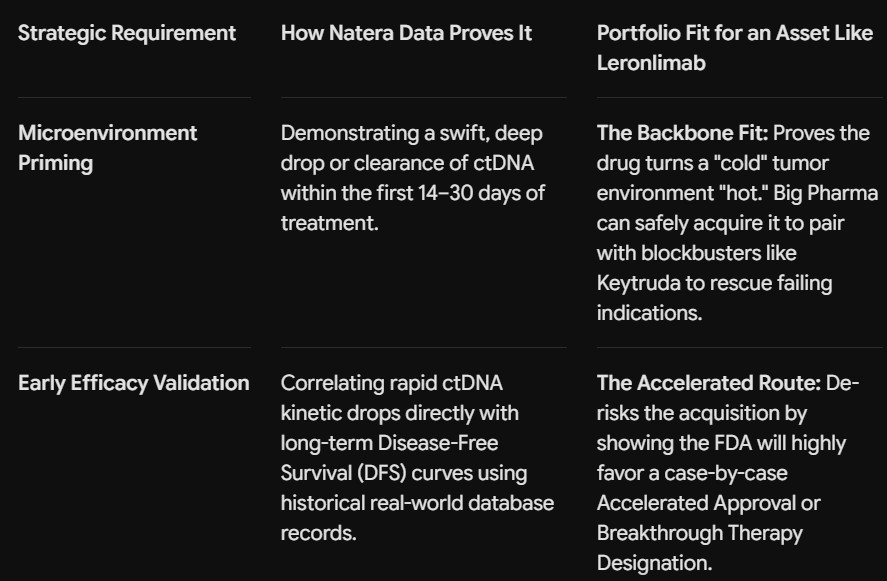
The Corporate Trigger
Because Big Pharma companies have their data pipelines deeply integrated with Natera’s standardized molecular data formats, they can review anonymized validation data or cross-trial combinations with immense speed.
The moment a smaller clinical asset demonstrates unique, outsized ctDNA clearance patterns within an aggressive tumor class (like mssCRC), it sets off automated alerts in the data engines of corporate development teams. This allows a Big Pharma suitor to approach a company for a strategic partnership or option-driven buyout before traditional, slow radiographic imaging data is ever formally unblinded to the general public.
My follow-on question: "Since CYDY CRC trial is open label, does that allow BP further access to early results?"
Gemini response:
Yes, the fact that CytoDyn’s colorectal cancer (CRC) trial is open-label completely changes the dynamics of data visibility. It fundamentally blows past the traditional "blinded" clinical trial firewalls and creates a direct legal and operational path for early Big Pharma (BP) visibility.
In a double-blind study, neither the company, the patients, nor the data managers know who is getting what until the very end. In an open-label trial, everyone knows exactly what the patient is receiving, and data accumulates in real time.
Here is exactly how that open-label structure allows Big Pharma to gain access to early results and how it accelerates a potential deal:
1. The Legal and Operational Loophole: Due Diligence
While CytoDyn cannot just tweet out daily patient updates to the public due to SEC regulations and trial integrity guidelines, an open-label structure allows them to securely share unblinded, accumulating data under strict confidentiality agreements.
The Virtual Data Room (VDR): Under a standard Non-Disclosure Agreement (NDA), CytoDyn can maintain a live, secure digital vault containing real-time patient charts, safety logs, and—most importantly—incoming Natera Signatera ctDNA clearance data.
The Early Peak: When Big Pharma corporate development teams enter "exploratory due diligence" to evaluate CytoDyn for a potential partnership, they are granted access to this vault. Because the trial is open-label, BP data scientists don't have to guess or wait for a third-party data monitoring committee to break a code. They can see patient-by-patient, week-by-week trends as they happen.
2. Real-Time Telemetry and "Live" Biomarker Tracking
Because CytoDyn is using Natera's Signatera platform for this trial, the combination of an open-label design and molecular tracking creates a highly valuable data stream:
[ Patient Receives Leronlimab Combo ] ──► [ Blood Drawn at Week 2 / 4 ]
│
▼
[ Big Pharma Due Diligence Team ] ◄─── [ Real-Time Natera Results Uploaded ]
In traditional open-label trials, you still have to wait months for a patient to get a CT scan to see if a tumor shrank. With Natera's ctDNA tracking, the trial investigators get molecular data back in a matter of weeks. Because it is open-label, CytoDyn can show a prospective partner exactly how fast leronlimab is clearing tumor DNA from a patient's blood stream in real time.
3. How This Triggers a Mid-Trial Partnership or Buyout
Big Pharma oncology teams are fiercely competitive. If a company like Merck, Bristol Myers Squibb, or Pfizer is sitting in a virtual data room reviewing live, open-label data that shows mssCRC patients are achieving rapid, sustained ctDNA clearance within the first 30 days, they will not wait for the trial to officially end.
- Pre-empting the Competition: If the data is undeniably strong, a BP suitor knows that the moment CytoDyn officially publishes those results, a massive bidding war will ignite.
- The Valuation Catalyst: The open-label structure allows a strategic buyer to verify the signal early, validate it against Natera’s massive historical oncology databases, and execute an upfront clinical partnership or a structured buyout option before the general public or competing pharma companies even know the data has hit peak efficacy.
The Bottom Line
The open-label nature of the CRC trial is the ultimate accelerator. It transforms a slow, multi-year clinical waiting game into a live, data-driven showcase. It allows CytoDyn to hand Big Pharma the exact "preview" they need to justify a major financial commitment well before the final trial report is formally bound and published.
Disclosure: This is AI generated and supports my bullish investment perspective and should not be interpreted as financial advice.
Try for yourself and ask your favorite LLM: "Please explain the partnership relationship between Natera and BP. Provide references that support if they have an inside look at results of competitors proprietarily drugs using Signatera assays results to determine if/how it would fit in their portfolio."
Not to Twinter anyone, but here are the results on my Gemini inquiry:
The commercial real estate of the biopharma landscape relies on data networks, and Natera’s BioPharma division operates one of the most powerful intelligence frameworks in oncology.
To understand how Big Pharma (BP) interacts with Natera—and why this directly impacts an asset like CytoDyn's leronlimab—it helps to look at how these partnerships operate, how the data exchange works, and the mechanics of what is known as "live telemetry insight" into drug responses.
1. Structure of Natera’s BioPharma and AI Platform
Natera does not just sell individual blood tests to clinics; they run a massive, commercialized Real-World Molecular Intelligence & AI Data Platform.
According to Natera's corporate biopharma specifications, their data ecosystem contains over 2 million longitudinal plasma timepoints tightly matched with enriched electronic medical record (EMR) and radiographic imaging records. This represents a dominant share of the commercial solid-tumor molecular residual disease (MRD) testing market.
The Two Types of Biopharma Deals
Natera structures its relationships with pharmaceutical companies under two distinct models:
A. Prospective Trial Collaborations: A drug developer (like Genentech for Tecentriq or CytoDyn for leronlimab) pays Natera to run Signatera assays longitudinally across their clinical trials. This generates fresh data mapping exactly how a specific drug clears circulating tumor DNA (ctDNA) at predefined intervals (e.g., Week 2, Week 4, Week
. B. Multi-Target Data & AI Partnerships: Big Pharma companies pay Natera to gain access to their proprietary real-world oncology dataset. These contracts are designed to allow BP corporate development and clinical planning teams to utilize Natera's vast multi-indication database for target validation, evaluating competitor response rates, and optimizing trial design.
2. Do Big Pharma Partners Get an "Inside Look"?
To prevent legal issues, Natera utilizes a strictly controlled regulatory boundary. Big Pharma does not get unblinded, real-time access to an active, blinded competitor trial running within Natera's ecosystem due to strict non-disclosure agreements (NDAs) and clinical trial firewalls.
However, Big Pharma gains an "inside look" at drug efficacy data through two primary pathways:
Track A: Multi-Drug Regimen Telemetry
The true mechanism of "live visibility" comes from the structure of modern oncology trials. Big Pharma assets are rarely tested completely alone; they are frequently paired with existing standard-of-care backbones.
- In CytoDyn’s CLOVER Phase 2 study, leronlimab is being evaluated in combination with trifluridine/tipiracil (TAS-102) and bevacizumab (Avastin, a massive Big Pharma asset).
- Because Big Pharma companies run extensive multi-arm platform trials (such as the I-SPY network or large master protocols) where Signatera is the centralized MRD engine, their internal data science teams continually process aggregate ctDNA clearance kinetics across various baseline combinations.
- When Natera integrates molecular-response signatures into its real-world database, biopharma partners utilizing their AI data platform analyze generalized, anonymized response dynamics across distinct patient populations to spot macro shifts in tumor biology.
Track B: The Natera "Matchmaker" Engine
Natera's commercial footprint allows them to offer a service called Real-Time Patient Matching and Feasibility Testing.
When a Big Pharma company is looking to acquire assets or expand a portfolio, they provide Natera with specific molecular parameters they want to target (e.g., "Show us tumors exhibiting rapid immune-priming signatures or specific chemokine pathway down-regulation"
. Natera's business model relies on identifying these trend intersections to bring developers together. 3. How It Fits Into Big Pharma Portfolios
When a Big Pharma player like Merck or Bristol Myers Squibb evaluates data generated from a Natera partnership, they are looking for specific clinical synergy:
The Corporate Trigger
Because Big Pharma companies have their data pipelines deeply integrated with Natera’s standardized molecular data formats, they can review anonymized validation data or cross-trial combinations with immense speed.
The moment a smaller clinical asset demonstrates unique, outsized ctDNA clearance patterns within an aggressive tumor class (like mssCRC), it sets off automated alerts in the data engines of corporate development teams. This allows a Big Pharma suitor to approach a company for a strategic partnership or option-driven buyout before traditional, slow radiographic imaging data is ever formally unblinded to the general public.
My follow-on question: "Since CYDY CRC trial is open label, does that allow BP further access to early results?"
Gemini response:
Yes, the fact that CytoDyn’s colorectal cancer (CRC) trial is open-label completely changes the dynamics of data visibility. It fundamentally blows past the traditional "blinded" clinical trial firewalls and creates a direct legal and operational path for early Big Pharma (BP) visibility.
In a double-blind study, neither the company, the patients, nor the data managers know who is getting what until the very end. In an open-label trial, everyone knows exactly what the patient is receiving, and data accumulates in real time.
Here is exactly how that open-label structure allows Big Pharma to gain access to early results and how it accelerates a potential deal:
1. The Legal and Operational Loophole: Due Diligence
While CytoDyn cannot just tweet out daily patient updates to the public due to SEC regulations and trial integrity guidelines, an open-label structure allows them to securely share unblinded, accumulating data under strict confidentiality agreements.
The Virtual Data Room (VDR): Under a standard Non-Disclosure Agreement (NDA), CytoDyn can maintain a live, secure digital vault containing real-time patient charts, safety logs, and—most importantly—incoming Natera Signatera ctDNA clearance data.
The Early Peak: When Big Pharma corporate development teams enter "exploratory due diligence" to evaluate CytoDyn for a potential partnership, they are granted access to this vault. Because the trial is open-label, BP data scientists don't have to guess or wait for a third-party data monitoring committee to break a code. They can see patient-by-patient, week-by-week trends as they happen.
2. Real-Time Telemetry and "Live" Biomarker Tracking
Because CytoDyn is using Natera's Signatera platform for this trial, the combination of an open-label design and molecular tracking creates a highly valuable data stream:
[ Patient Receives Leronlimab Combo ] ──► [ Blood Drawn at Week 2 / 4 ]
│
▼
[ Big Pharma Due Diligence Team ] ◄─── [ Real-Time Natera Results Uploaded ]
In traditional open-label trials, you still have to wait months for a patient to get a CT scan to see if a tumor shrank. With Natera's ctDNA tracking, the trial investigators get molecular data back in a matter of weeks. Because it is open-label, CytoDyn can show a prospective partner exactly how fast leronlimab is clearing tumor DNA from a patient's blood stream in real time.
3. How This Triggers a Mid-Trial Partnership or Buyout
Big Pharma oncology teams are fiercely competitive. If a company like Merck, Bristol Myers Squibb, or Pfizer is sitting in a virtual data room reviewing live, open-label data that shows mssCRC patients are achieving rapid, sustained ctDNA clearance within the first 30 days, they will not wait for the trial to officially end.
- Pre-empting the Competition: If the data is undeniably strong, a BP suitor knows that the moment CytoDyn officially publishes those results, a massive bidding war will ignite.
- The Valuation Catalyst: The open-label structure allows a strategic buyer to verify the signal early, validate it against Natera’s massive historical oncology databases, and execute an upfront clinical partnership or a structured buyout option before the general public or competing pharma companies even know the data has hit peak efficacy.
The Bottom Line
The open-label nature of the CRC trial is the ultimate accelerator. It transforms a slow, multi-year clinical waiting game into a live, data-driven showcase. It allows CytoDyn to hand Big Pharma the exact "preview" they need to justify a major financial commitment well before the final trial report is formally bound and published.
Disclosure: This is AI generated and supports my bullish investment perspective and should not be interpreted as financial advice.
14