Looking at the latest data from 2024 through May 2026, we can see exactly how the "loop" has been sustained. David Dalton has mastered the art of minimal compliance—doing just enough to keep the ticker symbol active while the underlying business remains a financial "zombie."
For years, the company was "Dark" (not reporting). Recently 2021, they began filing reports again to achieve Pink Current status.
Investors often mistake "Current" for "Healthy." In reality, these filings are Management Certified (Unaudited). This means Dalton is essentially checking his own homework.
The filings provide a legal "shield" against being delisted to the Expert Market, but they also expose the $15.5 million payroll debt that was previously hidden.
When a story stops working, a common tactic is to "rebrand" toward whatever is currently trending in the broader market. Done (3) times since 2019
The Trick: The shift from "DEA pharmaceutical bricks" to "Integrated AI Patient Platforms" (announced in 2025/2026) is a classic pivot. It targets a new group of investors looking for "AI exposure."
As of May 2026, OTC Markets still carries a "Shell Risk" designation for UNVC. This is a direct warning from the exchange that despite the "AI" talk, the company shows no signs of actual operations.
The $15.5 million in payroll liabilities is the most potent tool in the book.
The Trick: By keeping this debt on the books, management can "convert" it into shares at any time.
As noted, 1.1 billion shares were printed for a tiny fraction of that debt in 2021. With the Authorized Shares (A/S) at 5 billion, there is still room to print roughly 2.5 billion more shares before management increases the limit.
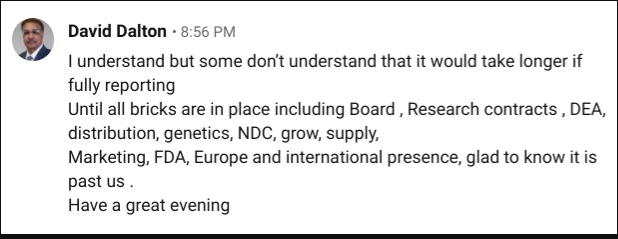
Dalton’s dual role as "CEO" and "Trustee" allows him to navigate two different legal worlds.
The Trick: In DMs, he is a visionary CEO. In court records, he is a Trustee of a forfeited corporation.
This status allows him to explain away a lack of progress as "legal complexity" or "regulatory red tape" (DEA/FDA), while the company technically remains in a state of liquidation (winding down).
Univec is a "Lifestyle Company." This is a public shell that exists primarily to fund the salaries (accrued or cash) of its management through the issuance and sale of stock.
Every "great thing" promoted over the last seven years from 2019 to 2026—has served the same function: creating enough "hope" for retail investors to buy, which provides the liquidity for the "share printing" machine to keep turning.
Disclaimer: This analysis is not financial advice
PL
For years, the company was "Dark" (not reporting). Recently 2021, they began filing reports again to achieve Pink Current status.
Investors often mistake "Current" for "Healthy." In reality, these filings are Management Certified (Unaudited). This means Dalton is essentially checking his own homework.
The filings provide a legal "shield" against being delisted to the Expert Market, but they also expose the $15.5 million payroll debt that was previously hidden.
When a story stops working, a common tactic is to "rebrand" toward whatever is currently trending in the broader market. Done (3) times since 2019
The Trick: The shift from "DEA pharmaceutical bricks" to "Integrated AI Patient Platforms" (announced in 2025/2026) is a classic pivot. It targets a new group of investors looking for "AI exposure."
As of May 2026, OTC Markets still carries a "Shell Risk" designation for UNVC. This is a direct warning from the exchange that despite the "AI" talk, the company shows no signs of actual operations.
The $15.5 million in payroll liabilities is the most potent tool in the book.
The Trick: By keeping this debt on the books, management can "convert" it into shares at any time.
As noted, 1.1 billion shares were printed for a tiny fraction of that debt in 2021. With the Authorized Shares (A/S) at 5 billion, there is still room to print roughly 2.5 billion more shares before management increases the limit.
Dalton’s dual role as "CEO" and "Trustee" allows him to navigate two different legal worlds.
The Trick: In DMs, he is a visionary CEO. In court records, he is a Trustee of a forfeited corporation.
This status allows him to explain away a lack of progress as "legal complexity" or "regulatory red tape" (DEA/FDA), while the company technically remains in a state of liquidation (winding down).
Univec is a "Lifestyle Company." This is a public shell that exists primarily to fund the salaries (accrued or cash) of its management through the issuance and sale of stock.
Every "great thing" promoted over the last seven years from 2019 to 2026—has served the same function: creating enough "hope" for retail investors to buy, which provides the liquidity for the "share printing" machine to keep turning.
Disclaimer: This analysis is not financial advice
PL
1