Gonna be a hard read for ya'll.
Paradoxically, the worse things get, the more it increases despondency, disillusionment, and resentment—the three attributes Republican politicians most effectively mine to maintain their support in rural America.
Rather than offering an agenda for rural development, Republican politicians simply ladle out more steaming hot bowls of resentment and targets for rural anger, be they urban-dwelling liberals, undocumented immigrants, trans kids, beer companies, or the “fake news” media.
White Rural Trump Supporters Are a Threat to Democracy
DEAL WITH IT
A new book shows how many supposed “elitist stereotypes” of rural MAGA voters are true—and backed by hard data.
Michael A. Cohen
Published Mar. 01, 2024 11:08 PM EST
https://www.thedailybeast.com/white-rural-tru...y?ref=home
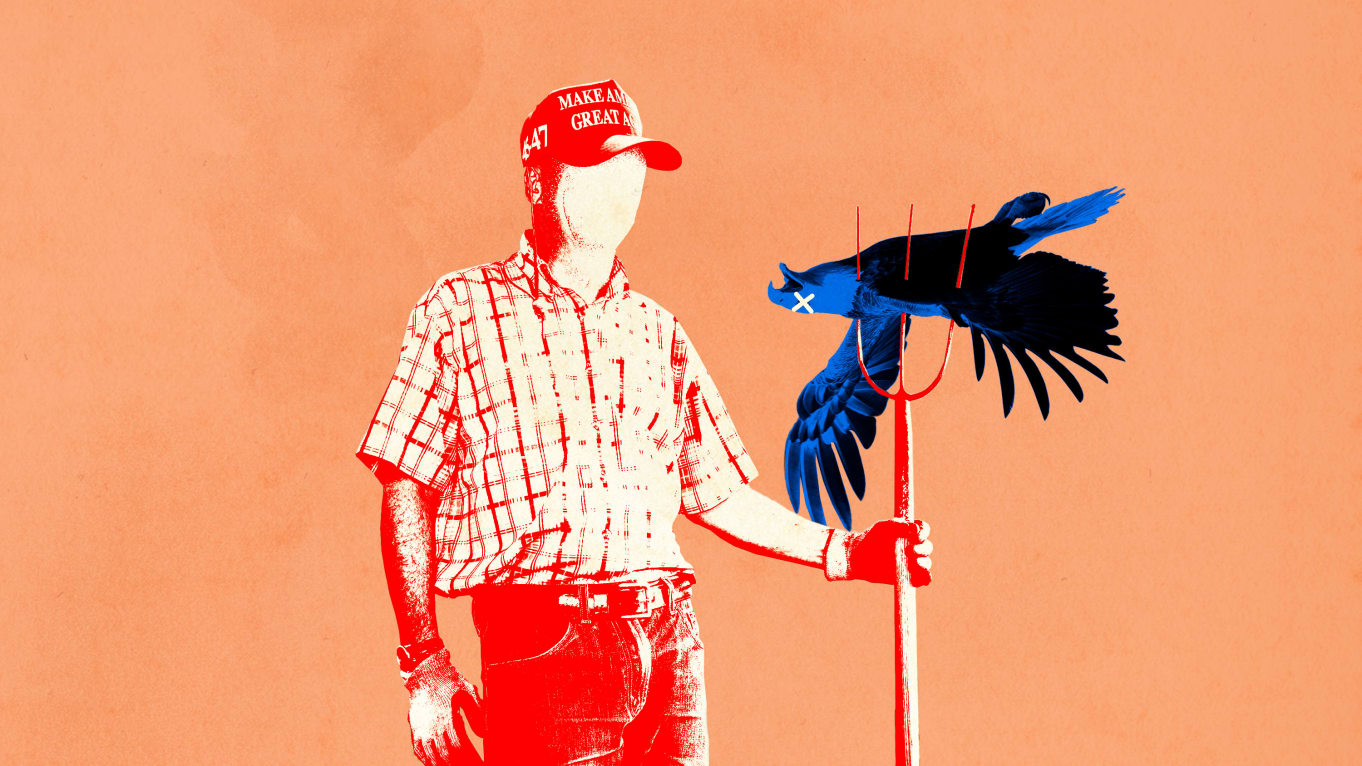
OPINIONIllustration of a person in a MAGA hat with a pitchfork impaling an eagle
Photo Illustration by Luis G. Rendon/The Daily Beast/Getty
In the popular imagination of many Americans, particularly those on the left side of the political spectrum, the typical MAGA supporter is a rural resident who hates Black and Brown people, loathes liberals, loves gods and guns, believes in myriad conspiracy theories, has little faith in democracy, and is willing to use violence to achieve their goals, as thousands did on Jan. 6.
According to a new book, White Rural Rage: The Threat to American Democracy, these aren’t hurtful, elitist stereotypes by Acela Corridor denizens and bubble-dwelling liberals…they’re facts.
The authors, Tom Schaller, a professor at the University of Maryland, Baltimore County, and Paul Waldman, a former columnist at The Washington Post, persuasively argue that most of the negative stereotypes liberals hold about rural Americans are actually true.
They do not mince words about what this means for the future of democracy in America. “Rural voters—especially the White rural voters on whom Donald Trump heaps praise and upon which he built his Make America Great Movement —pose a growing threat to the world’s oldest constitutional democracy.”
And Schaller and Waldman bring receipts.
In a book filled with reams of data to back up their arguments, Schaller and Waldman show that rural Whites “are the demographic group least likely to accept notions of pluralism and inclusion” and are far less likely to believe that diversity makes America stronger.
In rural America, support for Donald Trump’s Muslim travel ban ran 15 points higher than in urban areas. Rural Whites are 13 points more likely to view LGBTQ+ Americans in a negative light, and express fear and anger toward immigrants—both legal and undocumented—at much higher rates than other Americans. Less than half, 46 percent, say diversity in their communities is something they value.
They are the largest segment of the population that incorrectly believes Trump won the 2020 election, at 47 percent. By contrast, only 30 percent of suburban residents and 22 percent of urban dwellers feel the same.
“...rural Americans are more likely to believe that ‘it may be necessary at some point soon for citizens to take up arms against the government.’ Indeed, more than one out of four rural residents agree that Trump should be returned to office by force if necessary.”
Rural Whites are more skeptical of the vaccines to prevent COVID-19, and are more likely to think Barack Obama was not born in the United States. In a survey done in 2009 in North Carolina and Virginia, rural Republicans were 20 percentage points more likely to believe in birtherism than non-rural GOP members. Rural residents are also 1.5 times more inclined to embrace the QAnon conspiracy theory than those who live in urban areas.
But the problems in rural America run deeper than hostility toward minorities and facts. Rural residents disproportionately express hostility toward basic democratic principles. They are more likely to favor restrictions on the press, oppose checks on presidential power, endorse White Christian Nationalist views, and support efforts to restrict voting access.
Finally, rural Americans are more likely to believe that “it may be necessary at some point soon for citizens to take up arms against the government.” Indeed, more than one out of four rural residents agree that Trump should be returned to office by force if necessary. As Schaller and Waldman argue, not all citizens with anti-government views live in rural America, but “rural Americans are overrepresented among those with insurrectionist tendencies.”
After reading this tale of woe, one might shake their head at the state or rural White politics but also wonder about Schaller and Waldman’s claim that such a small segment of the population has “more power than any other large demographic group in America.” After all, rural Americans are 20 percent of the U.S. population—rural Whites are only 15 percent. The other five percent are non-white, a group that the authors ruefully point out is seldom acknowledged in political conversations.
Their power is a by-product of America’s political system, which grants disproportionate power to sparsely populated states. In the Senate, for example, California and Wyoming have two representatives, even though Los Angeles County—with its 10 million residents—has a population that is 17 times larger. Indeed, L.A. County—which is home to just a quarter of California’s residents—also has a larger population than 40 American states.
In partisan terms, Senate Democrats, who currently hold 51 seats in the Senate, represent approximately 193 million people Senate Republicans hold only two fewer seats, yet they represent 140 million people.
Things are just as bad in the Electoral College. Wyoming has 18 fewer electoral votes than California, even though California has a population that is 68 times larger. Since Republicans are so disproportionately reliant on states with large rural populations, they are far more attuned to their interests than would be the case in a political system where rural areas didn’t have such built-in influence.
One might assume that such political influence would translate into tangible benefits. But as Schaller and Waldman note, the opposite is true.
Rural America is in deep economic and social decay, “defined by declining wages, rising unemployment, persistent poverty, and increased government dependency.”
Rural populations are aging as younger generations flee areas with few economic opportunities and increasingly blinkered worldviews. Those who remain in rural areas live shorter lives, have limited access to health care, and on any host of health metrics—from maternal mortality to deaths caused by drug overdoses—have a rate higher than any other geographic group.
Indeed, opposition to Obamacare was perhaps stronger in rural America than in any region of the country, even though no area was more likely to benefit from the legislation. (The Affordable Care Act reduced lack of healthcare access in rural America from 24 to 16 percent.)
In short, rural America has made one of the worst deals in American politics—they slavishly support a Republican Party that not only does little to stop their inexorable decline but actually makes it worse.
The GOP’s anti-abortion agenda means rural maternity wards got shut down. Opposition to public broadband most directly harms rural America, where there is little incentive for private companies to set up service. Republican attacks on higher education have a disproportionate influence on underserved rural universities. And anti-vax attitudes have led to COVID death rates that rival or surpass far denser population areas—an outcome that makes little public health sense but is easily explained by partisan politics.
Yet, none of this has stopped rural Americans from casting votes for Republican politicians. If anything, their support for the GOP has intensified as Trump has taken control of the party. In 2016, 62 percent of rural America voted for Trump. In 2020, it jumped to 71 percent.
Paradoxically, the worse things get, the more it increases despondency, disillusionment, and resentment—the three attributes Republican politicians most effectively mine to maintain their support in rural America.
Rather than offering an agenda for rural development, Republican politicians simply ladle out more steaming hot bowls of resentment and targets for rural anger, be they urban-dwelling liberals, undocumented immigrants, trans kids, beer companies, or the “fake news” media.
And rural MAGA laps it up.
Do Schaller and Waldman have a solution for this sad state of affairs?
I asked this to Schaller (who, in the interests of full disclosure, is an old friend), and he turned my question around. Why, he asked, is it the responsibility of liberals to solve these problems? The expectation that he and Waldman should have a solution to the ills of rural America is, he argued, part of the problem.
These answers can’t come from well-meaning Democrats and liberals; they need to originate from rural America itself. Until rural Americans demand more from their elected leaders, i.e., Republicans, their plight will only get worse.
In Schaller’s view, this doesn’t necessarily mean electing Democrats—but, rather, better Republicans. “If you’re not going to be an advocate for your own material needs,” says Schaller, “then you can’t expect others to do it for you.”
But, as Schaller notes, rural influence is not a constant. Rural populations will continue to wane, and as that happens, their power will decline, too.
The choice for rural America is to demand more or decline further. In the meantime, their problems will only get worse, and the threat to American democracy will remain with us.
Paradoxically, the worse things get, the more it increases despondency, disillusionment, and resentment—the three attributes Republican politicians most effectively mine to maintain their support in rural America.
Rather than offering an agenda for rural development, Republican politicians simply ladle out more steaming hot bowls of resentment and targets for rural anger, be they urban-dwelling liberals, undocumented immigrants, trans kids, beer companies, or the “fake news” media.
White Rural Trump Supporters Are a Threat to Democracy
DEAL WITH IT
A new book shows how many supposed “elitist stereotypes” of rural MAGA voters are true—and backed by hard data.
Michael A. Cohen
Published Mar. 01, 2024 11:08 PM EST
https://www.thedailybeast.com/white-rural-tru...y?ref=home
OPINIONIllustration of a person in a MAGA hat with a pitchfork impaling an eagle
Photo Illustration by Luis G. Rendon/The Daily Beast/Getty
In the popular imagination of many Americans, particularly those on the left side of the political spectrum, the typical MAGA supporter is a rural resident who hates Black and Brown people, loathes liberals, loves gods and guns, believes in myriad conspiracy theories, has little faith in democracy, and is willing to use violence to achieve their goals, as thousands did on Jan. 6.
According to a new book, White Rural Rage: The Threat to American Democracy, these aren’t hurtful, elitist stereotypes by Acela Corridor denizens and bubble-dwelling liberals…they’re facts.
The authors, Tom Schaller, a professor at the University of Maryland, Baltimore County, and Paul Waldman, a former columnist at The Washington Post, persuasively argue that most of the negative stereotypes liberals hold about rural Americans are actually true.
They do not mince words about what this means for the future of democracy in America. “Rural voters—especially the White rural voters on whom Donald Trump heaps praise and upon which he built his Make America Great Movement —pose a growing threat to the world’s oldest constitutional democracy.”
And Schaller and Waldman bring receipts.
In a book filled with reams of data to back up their arguments, Schaller and Waldman show that rural Whites “are the demographic group least likely to accept notions of pluralism and inclusion” and are far less likely to believe that diversity makes America stronger.
In rural America, support for Donald Trump’s Muslim travel ban ran 15 points higher than in urban areas. Rural Whites are 13 points more likely to view LGBTQ+ Americans in a negative light, and express fear and anger toward immigrants—both legal and undocumented—at much higher rates than other Americans. Less than half, 46 percent, say diversity in their communities is something they value.
They are the largest segment of the population that incorrectly believes Trump won the 2020 election, at 47 percent. By contrast, only 30 percent of suburban residents and 22 percent of urban dwellers feel the same.
“...rural Americans are more likely to believe that ‘it may be necessary at some point soon for citizens to take up arms against the government.’ Indeed, more than one out of four rural residents agree that Trump should be returned to office by force if necessary.”
Rural Whites are more skeptical of the vaccines to prevent COVID-19, and are more likely to think Barack Obama was not born in the United States. In a survey done in 2009 in North Carolina and Virginia, rural Republicans were 20 percentage points more likely to believe in birtherism than non-rural GOP members. Rural residents are also 1.5 times more inclined to embrace the QAnon conspiracy theory than those who live in urban areas.
But the problems in rural America run deeper than hostility toward minorities and facts. Rural residents disproportionately express hostility toward basic democratic principles. They are more likely to favor restrictions on the press, oppose checks on presidential power, endorse White Christian Nationalist views, and support efforts to restrict voting access.
Finally, rural Americans are more likely to believe that “it may be necessary at some point soon for citizens to take up arms against the government.” Indeed, more than one out of four rural residents agree that Trump should be returned to office by force if necessary. As Schaller and Waldman argue, not all citizens with anti-government views live in rural America, but “rural Americans are overrepresented among those with insurrectionist tendencies.”
After reading this tale of woe, one might shake their head at the state or rural White politics but also wonder about Schaller and Waldman’s claim that such a small segment of the population has “more power than any other large demographic group in America.” After all, rural Americans are 20 percent of the U.S. population—rural Whites are only 15 percent. The other five percent are non-white, a group that the authors ruefully point out is seldom acknowledged in political conversations.
Their power is a by-product of America’s political system, which grants disproportionate power to sparsely populated states. In the Senate, for example, California and Wyoming have two representatives, even though Los Angeles County—with its 10 million residents—has a population that is 17 times larger. Indeed, L.A. County—which is home to just a quarter of California’s residents—also has a larger population than 40 American states.
In partisan terms, Senate Democrats, who currently hold 51 seats in the Senate, represent approximately 193 million people Senate Republicans hold only two fewer seats, yet they represent 140 million people.
Things are just as bad in the Electoral College. Wyoming has 18 fewer electoral votes than California, even though California has a population that is 68 times larger. Since Republicans are so disproportionately reliant on states with large rural populations, they are far more attuned to their interests than would be the case in a political system where rural areas didn’t have such built-in influence.
One might assume that such political influence would translate into tangible benefits. But as Schaller and Waldman note, the opposite is true.
Rural America is in deep economic and social decay, “defined by declining wages, rising unemployment, persistent poverty, and increased government dependency.”
Rural populations are aging as younger generations flee areas with few economic opportunities and increasingly blinkered worldviews. Those who remain in rural areas live shorter lives, have limited access to health care, and on any host of health metrics—from maternal mortality to deaths caused by drug overdoses—have a rate higher than any other geographic group.
Indeed, opposition to Obamacare was perhaps stronger in rural America than in any region of the country, even though no area was more likely to benefit from the legislation. (The Affordable Care Act reduced lack of healthcare access in rural America from 24 to 16 percent.)
In short, rural America has made one of the worst deals in American politics—they slavishly support a Republican Party that not only does little to stop their inexorable decline but actually makes it worse.
The GOP’s anti-abortion agenda means rural maternity wards got shut down. Opposition to public broadband most directly harms rural America, where there is little incentive for private companies to set up service. Republican attacks on higher education have a disproportionate influence on underserved rural universities. And anti-vax attitudes have led to COVID death rates that rival or surpass far denser population areas—an outcome that makes little public health sense but is easily explained by partisan politics.
Yet, none of this has stopped rural Americans from casting votes for Republican politicians. If anything, their support for the GOP has intensified as Trump has taken control of the party. In 2016, 62 percent of rural America voted for Trump. In 2020, it jumped to 71 percent.
Paradoxically, the worse things get, the more it increases despondency, disillusionment, and resentment—the three attributes Republican politicians most effectively mine to maintain their support in rural America.
Rather than offering an agenda for rural development, Republican politicians simply ladle out more steaming hot bowls of resentment and targets for rural anger, be they urban-dwelling liberals, undocumented immigrants, trans kids, beer companies, or the “fake news” media.
And rural MAGA laps it up.
Do Schaller and Waldman have a solution for this sad state of affairs?
I asked this to Schaller (who, in the interests of full disclosure, is an old friend), and he turned my question around. Why, he asked, is it the responsibility of liberals to solve these problems? The expectation that he and Waldman should have a solution to the ills of rural America is, he argued, part of the problem.
These answers can’t come from well-meaning Democrats and liberals; they need to originate from rural America itself. Until rural Americans demand more from their elected leaders, i.e., Republicans, their plight will only get worse.
In Schaller’s view, this doesn’t necessarily mean electing Democrats—but, rather, better Republicans. “If you’re not going to be an advocate for your own material needs,” says Schaller, “then you can’t expect others to do it for you.”
But, as Schaller notes, rural influence is not a constant. Rural populations will continue to wane, and as that happens, their power will decline, too.
The choice for rural America is to demand more or decline further. In the meantime, their problems will only get worse, and the threat to American democracy will remain with us.