Moving Averages A moving average is one of the most

New Post Public Reply Private Reply Replies (1) Message Board
PoemStone tommyboyboy #6273

Moving Averages

A moving average is one of the most flexible as well as most-commonly used technical analysis indicators. It is highly popular among traders, mostly because of its simplicity. It works best in a trending environment.

Introduction

In statistics, a moving average is simply a mean of a certain set of data. In case of technical analysis, these data are in most cases represented by closing prices of stocks for the particular days. However, some traders also use separate averages for daily minima and maxima or even an average of midpoint values (which they compute by summing up daily minimum and maximum and dividing by it two). Yet, you can construct a moving average also on a shorter time-frame, for example by using daily- or minute- data.

For example, if you want to make a 10-day moving average, you just add up all the closing prices during the last 10 days and then divide it by 10 (in this case it is a simple moving average). The next day we do the same, except that we again take the prices for the last 10 days, which means that the price that was the last in our computation for the previous day is no longer included in today's average - it is replaced by yesterday's price. The data shift in this manner with every new trading day, hence the term "moving average".

The purpose and use of moving averages in technical analysis

Moving average is a trend-following indicator. Its purpose is to detect the start of a trend, follow its progress, as well as to report its reversal if it occurs. As opposed to charting, moving averages do not anticipate the start or the end of a trend. They only confirm it, but only some time after the actual reversal occurs. It stems from their very construction, as these indicators are based solely on historical data. The less days a moving average contains, the sooner it can detect a trend's reversal. It is because of the amount of historical data, which strongly influences the average. A 20-day moving average generates the signal of a trend reversal sooner than the 50-day average. However, it is also true that the fewer days we use in the moving average's computation, the more false signals we get. Hence, most of the traders use a combination of several moving averages, which all have to yield a signal simultaneously, before a trader opens his position in the market. Nonetheless, a moving average's lag behind the trend cannot be completely eliminated.
Trading signals

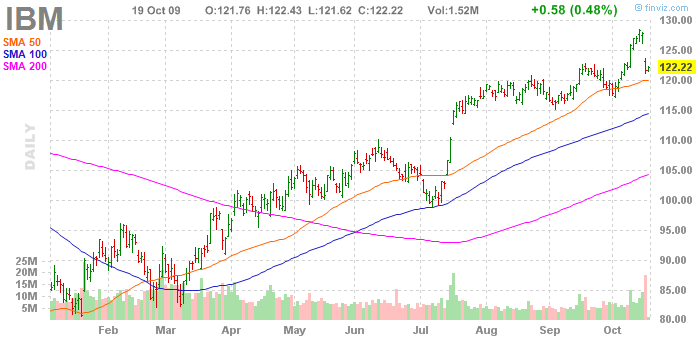
Any type of moving average can be used to generate buy or sell signals and this process is very simple. The charting software plots the moving average as a line directly into the price chart. Signals are generated in places where prices intersect these lines.

  • When the price crosses above the moving average line, it implies the start of a new upward trend and hence it means a buy signal.

  • On the other hand, if the price crosses under the moving average line and the market also closes in this area, it signals the start of a downward trend and hence it constitutes a selling signal.
  • Using multiple averages

    We can also opt for using multiple moving averages simultaneously, in order to eliminate the "noise" in prices and especially the false signals (whipsaws), which the use of a single moving average yields.

  • When using multiple averages, a buy signal occurs when the shorter of the averages crosses above the longer average, e.g. the 50-day average crosses above the 200-day average.

  • Conversely, a sell signal in this case is generated when the 50-day average crosses under the 200-average.
  • Similarly, we can also use a combination of three averages, e.g. a 5-day, 10-day and 20-day average. In this case, an upward trend is indicated if the 5-day average line is above the 10-day moving average, while the 10-day average is still above the 20-day average. Any crossing of moving averages which leads to this situation is considered a buy signal.

  • Conversely, downward trend is indicated by the situation when the 5-day average line is lower than the 10-day average, while the 10-day average is lower than the 20-day average.

  • Using three moving averages simultaneously limits the amount of false signals generated by the system, but it also limits potential for profit, as such a system generates a trading signal only after the trend is firmly established in the market. The entry signal can be even generated only a short time before the trend's reversal. The time intervals used by traders for computing moving averages are quite different. For example, the Fibonacci numbers are very popular, such as using 5-day, 21-day and 89-day averages. In futures trading, the combination 4-, 9- and 18- days is very popular, too.

    Pros and cons

    The reason why moving averages have been so popular is that they reflect several basic rules of trading. Use of moving averages helps you to cut your losses while letting your profits run. When using moving averages to generate trading signals, you always trade in the direction of the market trend, not against it. Moreover, as opposed to chart patterns analysis or other highly subjective techniques, moving averages can be used to generate trading signals according to clear rules - thus eliminating subjectivity of trading decisions, which can help the trader's psyche. However, a great disadvantage of moving averages is that they work well only when the market is trending. Hence, in periods of choppy markets when prices fluctuate in a particular price range they do not work at all. Such period can easily last more than one third of the time, so relying on moving averages alone is very risky. Some traders that's why recommend combining moving averages with an indicator measuring strength of a trend, such as ADX or to use moving averages only as an confirming indicator for your trading system.

    Types of moving averages

    The most commonly used types of moving averages are Simple Moving Average (SMA) and Exponentially Weighted Moving Average (EMA, EWMA).

    Simple moving average (SMA)

    This kind of moving average is also known as arithmetic mean and represents the simplest and most commonly used type of moving average. We compute it by summing up all the closing prices for a given period, which we subsequently divide by the number of days in the period. However, two problems are associated with this kind of average: it takes into account only the data included in the selected period (e.g. a 10-day simple moving average takes into account only the data from the last 10 days and simply ignores all other data prior to this period). It is also often criticized for allocating equal weights to all the data in the data set (i.e. in a 10-day moving average a price from 10 days ago has the same weight as the price from yesterday - 10%). Many traders argue that the data from recent days should carry more weight than older data - which would result in reducing the average's lag behind the trend.

    Exponentially weighted moving average (EMA, EWMA)

    This kind of moving average solves both problems associated with simple moving averages. Firstly, it allocates more weight in its computation to recent data. It also to some extent reflects all the historical data for the particular instrument. This kind of average is named according to the fact that the weights of data towards the past decrease exponentially. The slope of this decrease can be adjusted to the needs of the trader.


    Featured stocks: Coffee Shoppe
    For conservative debate: "Keeping it Real"
    Game Changing stock $SHMP

    Scroll down for more posts ▼

    Top 10 Most Recent News Articles

    Concierto's Azure Push Puts Sovereignty on Display

    Updated Category News Views 78

    Sovereignty has become the corporate cloud world's favorite hard-edged word. Concierto is taking that word straight onto the Microsoft Ignite 2026 floor, and frankly, it is a sensible place to make the case. The company, part of Trianz, will appear as a Gamechanger Sponsor from November 17 through 20 at San Francisco's Moscone Center, showing its platform at Booth #5435....

    Continue Reading
    Operation Healing Forces Partners with Wounded Warrior

    Updated Category News Views 104

    Joining Forces for Special Operations Families When it comes to the heavy lifting of supporting Special Operations Forces (SOF) families, two powerhouses—Operation Healing Forces (OHF) and Wounded Warrior Project (WWP)—are doubling down. They’re not just tossing around good intentions. Oh no, they’re pulling out the stops with a solid partnership focused on...

    Continue Reading
    Triple Crossing Tests a Tough Inland Marine Market

    Updated Category News Views 105

    Inland marine is where tidy insurance appetites go to get bent out of shape. A contractor’s rented machine, cargo moving between points, a half-finished building, or equipment that is neither parked forever nor easy to classify can turn a standard quote into a week of broker phone calls. Triple Crossing Specialty is stepping directly into that mess, launching a new...

    Continue Reading
    Snowhawk Enters Telarus as Digital Demand Gets Serious

    Updated Category News Views 55

    Telarus just pulled another serious capital partner into the room, and that matters more than the usual law-firm victory lap. Snowhawk Partners has invested in the technology services distributor alongside Columbia Capital, which remains a long-standing partner. Nobody disclosed a valuation, ownership percentage, financing mix, or closing date. Annoying? Sure. But the...

    Continue Reading
    LASIK Cost Math Deserves a Careful Second Look Today

    Updated Category News Views 66

    Thirty years of lens purchases can become a nasty tab Contact-lens spending has a funny way of staying invisible until somebody stacks the receipts into one ugly pile. A new cost-of-vision analysis from the surgeon advisory board of BestLASIKSurgeons.com says the average American contact-lens wearer may spend between $22,500 and $30,000 on corrective eyewear across 30...

    Continue Reading
    Cognito Unveils Phase 3 Results for Alzheimer Treatment

    Updated Category News Views 340

    Charting New Waters in Alzheimer's Treatment Well, here's one for the books, folks. Cognito Therapeutics just tossed their latest Phase 3 results from their so-called HOPE study into the ring. We're talking about Spectris AD, a non-drug, at-home gizmo that aims to be the next big thing for Alzheimer's. Yeah, the study didn't exactly hit a home run with the primary...

    Continue Reading
    ZTO's Pricing Muscle Shows Up in Third-Quarter Results

    Updated Category News Views 87

    Ten billion parcels can hide plenty of ugly economics, but ZTO's third quarter does not look like a volume-at-any-cost stunt. The company moved 10.241 billion parcels, up 7.0% from a year earlier, and says that outpaced the industry by 4.1 percentage points. More importantly, revenue climbed 21.0% to RMB14.36 billion while adjusted net income reached RMB2.57 billion. That...

    Continue Reading
    Kobo and CloudLibrary Make Library Ebooks Much Easier

    Updated Category News Views 107

    A tiny button can change whether a digital service gets used Borrowing an ebook ought not feel like assembling a radio in a dark garage, yet that is roughly where library reading has landed for plenty of people. OCLC's new CloudLibrary integration with Kobo strips out a particularly annoying step: U.S. and Canadian users can link accounts once, borrow a title, and have it...

    Continue Reading
    CD Rates Offer Stillness as Stocks and Gold Wobble

    Updated Category News Views 59

    November has delivered the sort of tape that makes a supposedly diversified portfolio feel like a leaky boat. Stocks fell sharply, gold slid to a one-year low after record highs as recently as January, and Treasuries have not provided the dependable ballast many investors expected. When inflation worries and federal-debt concerns shove yields higher, bond prices can drop...

    Continue Reading
    ASUS Brings AI Infrastructure Choices to SC26 Floor

    Updated Category News Views 197

    Compute buyers are sick of being handed one locked box That is the nerve ASUS is pressing at SC26: enterprises want AI infrastructure that fits the job in front of them, not somebody else's tidy product roadmap. The company is pitching a full-stack “AI Factory” blueprint built across Intel, AMD and NVIDIA hardware, running from rack-scale systems and conventional...

    Continue Reading

    Top 5 Most Recently Viewed Articles

    Ringkjøbing Landbobank's Impressive Mid-Year Financial Update

    Updated Category News Views 214

    Ringkjøbing Landbobank's Financial Performance for 2025 In an exciting turn of events, Ringkjøbing Landbobank has shared its quarterly report for the first half of 2025, revealing remarkable financial outcomes that have caught the attention of analysts and stakeholders alike. Approval from Management The bank's board of directors, along with its general management, has...

    Continue Reading
    Mercy Medical Opens Center for Orthopedic Innovation

    Updated Category News Views 42

    Foot and Ankle Care Leap at Mercy Medical Mercy Medical Center in Baltimore is shaking things up in the orthopedic world. On August 10, 2026, they pulled the curtain back on the Center for Orthopedic Innovation, a place where the future of foot and ankle care is being molded. Led by renowned figure Dr. Lew Schon, they've crafted a cutting-edge space that’s all about...

    Continue Reading
    GECU's $4.9B Milestone: Navigating Regulatory Hurdles

    Updated Category News Views 49

    GECU's Bold Step: Merging with Bank of the Southwest When the gears of the financial world start grinding, there's no room for hesitation. GECU, one of the powerhouses when it comes to credit unions locally in Texas and New Mexico, has just snagged the regulatory green light to merge with the Bank of the Southwest. Talk about making moves—this transition's poised to...

    Continue Reading
    Taiwan's Economic Surge Driven by AI Innovations and Exports

    Updated Category News Views 264

    Economic Growth Outlook in Taiwan Taiwan has recently upgraded its economic growth forecast, reflecting its robust performance amid the ongoing AI revolution. As global appetite for AI-driven technology continues to surge, Taiwan is poised to reap substantial benefits. AI-Driven Exports In a remarkable display of economic resilience, Taiwan's exports skyrocketed almost...

    Continue Reading
    Exceptional Gold Intersections Reported at Keats Trench

    Updated Category News Views 111

    Major Discoveries in Gold Exploration New Found Gold Corp. (TSXV: NFG) (NYSE-A: NFGC) is thrilled to disclose impressive results from the second phase of channel sampling at Keats Trench as part of its ongoing exploration efforts at the Queensway Project. Highlights from Keats Trench Phase II The company noted exceptional intercepts in its sampling campaign, including...

    Continue Reading