A history of coffee.
ETHIOPIA
The coffee plant, which was discovered in Ethiopia in the 11th Century, has a white blossom that smells like jasmine and a red, cherry-like fruit. Back then, the leaves of the so-called "magical fruit" were boiled in water and the resulting concoction was thought to have medicinal properties. As the fame of the coffee plant spread to other lands, its centuries-long voyage was about to begin.

YEMEN
Coffee spread quickly through the Arabian Peninsula. In the mid 14th century, coffee cultivation reached Yemen and for 300 years, it was drunk following the recipe first used in Ethiopia. Yemen's climate and fertile soil offered the ideal conditions for cultivating rich coffee harvests.
ISTANBUL
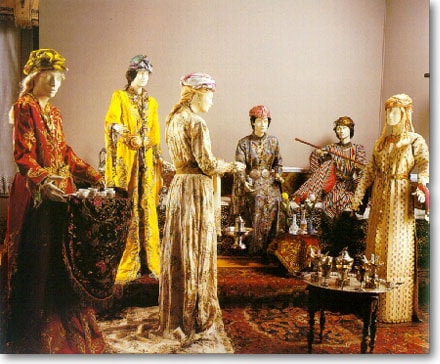
Istanbul was introduced to coffee in 1543 during the reign of Sultan Suleiman the Magnificent by Özdemir Pasha, the Ottoman Governor of Yemen, who had grown to love the drink while stationed in that country.
In the Ottoman palace a new method of drinking coffee was discovered: the beans were roasted over a fire, ground and then boiled in water. With its new brewing method and aroma, coffee's renown soon spread even further afield.
Coffee soon became a vital part of palace cuisine and was very popular in court. The position of Chief Coffee Maker (kahveciba??) was added to the roster of court functionaries. The Chief Coffee Maker's duty was to brew the Sultan's or his patron's coffee, and was chosen for his loyalty and ability to keep secrets. The annals of Ottoman History record a number of Chief Coffee Makers who rose through the ranks to become Grand Viziers to the Sultan.
Coffee soon spread from the palace to grand mansions, and from grand mansions to the homes of the public. The people of Istanbul quickly became enamored with the beverage. Green coffee beans were purchased and then roasted at home on pans. The beans were then ground in mortars and brewed in coffeepots known as "cezve".
Most of the general public became acquainted with coffee through the establishment of coffeehouses; the first coffeehouse (named Kiva Han) opened in the district of Tahtakale and others rapidly cropped up all over the city. Coffeehouses and coffee culture soon became an integral part of Istanbul social culture; people came here throughout the day to read books and beautiful texts, play chess and backgammon and discuss poetry and literature.

VENICE
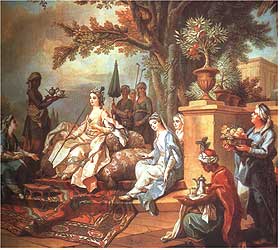
Europeans got their first taste of coffee in 1615 when Venetian merchants who had become acquainted with the drink in Istanbul carried it back with them to Venice. At first, the beverage was sold on the street by lemonade vendors, but in 1645 the first coffeehouse opened in Italy. Coffeehouses soon sprang up all over the country and, as in many other lands, they became a platform for people from all walks of life, especially artists and students, to come together and chat.
Travellers who discovered coffee while staying in Istanbul extolled the matchless flavour of the beverage in letters they sent home to Marseilles. In 1644, the first coffee beans, along with the apparatus used to prepare and serve coffee, were brought to Marseilles by Monsieur de la Roque, the French ambassador.
MARSEILLES
In 1660, merchants from Marseilles who had grown to love the beverage they had first tasted in Istanbul began to import coffee to the city, thus sating Marseilles's growing appetite for coffee. The first coffeehouse opened in Marseilles in 1671. Initially, coffeehouses catered to merchants and travellers, but they soon became popular with people from all walks of life.
PARIS
Paris was introduced to coffee in 1669 by Ho?sohbet Nüktedan Süleyman A?a, who was sent by Sultan Mehmet IV as ambassador to the court of King Louis XIV of France. Among the Ottoman ambassador's possessions were several sacks of coffee, which he described to the French as a "magical beverage".
Süleyman A?a swiftly became the darling of Parisian high society. The Parisian aristocracy saw it as a great honour to be invited to share a cup of Turkish Coffee with Süleyman A?a, who regaled his guests with his pleasant wit and conversation. The ambassador related countless stories on the subject of coffee, which earned him the sobriquet of Ho?sohbet, or raconteur.
Paris's first real coffeehouse, Café de Procope, opened in 1686. It soon became a favourite haunt of the literati, a place frequented by renowned poets, playwrights, actors and musicians. Many famous figures such as Rousseau, Diderot and Voltaire became enamoured with coffee at Café de Procope. Following the trend set by Café de Procope, coffeehouses opened on practically every street in the city.
VIENNA
1683 marked the end of the Second Siege of Vienna. As the Turks retreated, they left their extra supplies behind. The abandoned goods included a large number of tents, livestock, grain and around 500 sacks of coffee. The Viennese had no idea what to make of the mysterious contents of the sacks. One Viennese captain claimed that the coffee beans were camel-feed and decided to dump the sacks into the Danube.
News of the mysterious sacks reached a gentleman named Kolschitzky who had lived among the Turks for many years and had served as a spy for the Austrians during the siege. He requested the sacks of coffee, with which he was very familiar, as payment for his successful espionage services during the siege.
Kolschitzky served small cups of Turkish Coffee to the Viennese, first going door to door, and then in a large tent that he opened to the public. Soon, he had taught the Viennese how to prepare and enjoy the beverage. Thus Vienna became acquainted with coffee.
The Viennese coffeehouses that opened during this period set an example for coffeehouses in many other countries.
LONDON
England first became acquainted with coffee in 1637 when a Turk introduced the drink to Oxford. It quickly became popular among students and teachers who established the "Oxford Coffee Club".
The first coffeehouse in Oxford opened in 1650 and was called the "Angel".
In 1652, a Greek named Pasqua Rosée opened the first coffeehouse in London. Using his extensive knowledge of how to prepare and brew Turkish Coffee, he introduced his friends and clients to its peerless taste.
By 1660, London's coffeehouses had become an integral part of its social culture. The general public dubbed coffee houses "Penny Universities" as they were patronised by writers, artists, poets, lawyers, politicians and philosophers. London's coffeehouses offered customers a great deal more than piping hot cups of coffee: the entrance fee of one penny allowed them to benefit from the intellectual conversation that surrounded them.

HOLLAND
The history of coffee in Holland is markedly different from that of other countries, as for many years the Dutch were more concerned with coffee as a trade commodity than as a beverage.
Coffee first reached the country via Yemen in the 17th century. The Dutch began cultivating coffee in its colonies. In 1699, coffee beans were planted on the island of Java, thus laying the foundation for Indonesia's coffee plantations. In 1711, the first Javanese coffee beans were sold on the open market in Amsterdam.
The first coffeehouses in Holland opened in the 1660s. With their unique style that featured rich décor, a warm atmosphere and lush gardens, they stood out from coffeehouses in other countries. Located mainly in the financial districts of Dutch cities, they became known as places where merchants and financiers conducted business meetings.
In the 1680s, the Dutch introduced coffee to Scandinavia, the region which today has the highest per capita consumption of coffee in the world.
GERMANY
Coffee was introduced to Germany in 1675. The first coffeehouses opened in 1679-1680 in Hamburg, Bremen and Hanover.
At first, coffee was considered a beverage of the nobility. The middle and lower classes were not introduced to coffee until the early 18th century, and it was only much later that it came to be prepared and consumed at home.
As coffeehouses were the domain of men, middle class women established their own "coffee clubs".
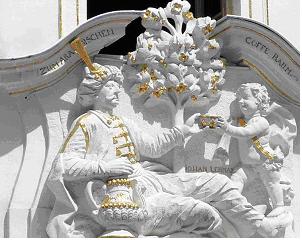
The sandstone sculpture above the doorway to “Coffe Baum” is especially famous. An Ottoman offers cupid a cup of coffee. It symbolises the meeting of the Christian western world with the Islamic East. No other than Augustus the Strong was supposed to have donated this sculpture as way of saying thank you to the landlady, who had taken immaculate care of him. One of the most important coffee museums’ worldwide is to be found on the third floor. Over 500 chosen exhibits from 300 years of Saxony’s coffee and cultural history are presented over 15 rooms.
AMERICA
Coffee reached North America in 1668. The first coffeehouse in New York, "The King's Arms", opened in 1696.
In 1714, the Dutch presented Louis XIV with a coffee sapling from their plantations on Java. The sapling was planted in the royal Jardin des Plantes in Paris.
In 1723, a French mariner named Gabriel du Clieu took a sapling from the Jardin des Plantes to the island of Martinique. From here, the coffee plant spread to other Caribbean islands, as well as to Central and South America.
In 1727, a Portuguese sailor named de Mello Palheta carried coffee saplings to Brazil from French Guyana. Today, Brazil is the number one producer of coffee in the world, accounting for 35% of global coffee production.
In 1730, the British began cultivating coffee in Jamaica.
By the mid 19th century, coffee had become one of the most important commodities in world trade.