Life—and Death—in a Toxic Town
The residents of Minden, West Virginia, have been living and suffering on contaminated land for more than 30 years. They want out. But it’s not that easy.
Could be subtitled...…
Nothing but the dead and dying
Back in my little town
Nothing but the dead and dying
Back in my little town

By AC Shilton
Jan 30, 2020
https://www.menshealth.com/health/a30645502/m...nl19233518
IN A NARROW SHADOW of land between two steep mountainsides in West Virginia, residents of a town called Minden are dying. Not in that existential “we’re all dying a little bit every day” way, but in the blotchy-lesions-and-tumor-riddled-organs-that-eventually-stop-working way.
The 250 residents are all that’s left of a community that peaked at about 1,200 in 1970, and they think they know what’s picking them off one by one, in a relentless, who’s-next roulette. They can’t avoid it in their homes. Or in their backyards. Or on the grounds of the abandoned factory where kids ride their dirt bikes. Locals have taken to calling Minden’s main road “Death Valley Drive.”
Annetta Coffman has lived on this land for all of her 44 years. But in 2018 alone, 15 of her neighbors, people from age 12 to almost 90, died of cancer. That’s a full 6 percent of the town’s current population. “That year was a nightmare,” she says, her voice more tired than sad a year after the fact.
Coffman lost her mother to breast, cervical, and uterine cancer in 2007. About five years ago, doctors discovered a tumor on the pituitary gland of her son, Dalton Kincaid. He’d stopped growing at four-foot-eleven and couldn’t keep on weight, even if he ate 5,000 calories a day. His doctor told him he had to quit basketball, the sport he lived for, because he couldn’t afford to burn extra calories. “My doctor said he didn’t even want me to play basketball with my friends,” Kincaid says. No pickup ball, no messing around on the court on weekends.
Coffman recounts what they’ve been through matter-of-factly, but her voice trembles with anxiety. Treatments shrank Kincaid’s tumors, yet despite a diet of 3,000 to 4,000 calories per day, even now, at age 20, he’s still extremely lean. High energy and fast talking, he explains that he holds down a job at Walmart while going to school full-time at West Virginia University Tech. But recently he’s been hit by blinding light sensitivity, and lately his eyes have been inflamed, “like he’s having an allergy attack,” his mom chimes in.
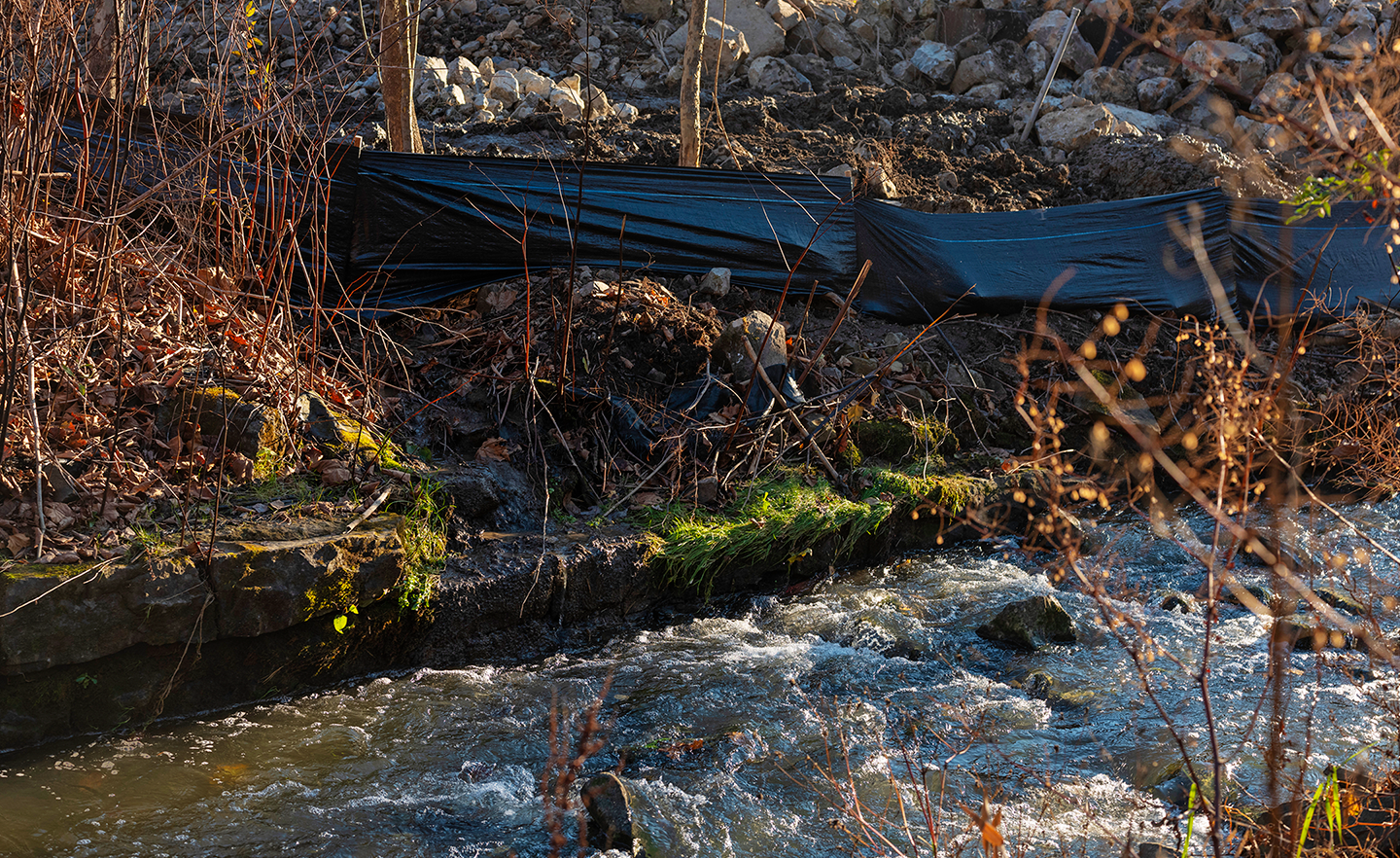
It’s a tough time to be a resident of a toxic community. From Minden to the Navajo Nation—places large and small, coastal and not—America is dealing with the health fallout of industrial pollution.
Since 2016, the federal government has proposed rollbacks on 85 environmental regulations. A number of these have gone into effect, and one in particular makes it easier for coal companies to pollute nearby streams.
In addition, the government’s 2018 budget slashed funding for remediation at Superfund sites—the term for locations deemed so toxic they merit federal dollars—by 30 percent.
THAT my RW friends, and what is described in this article, is the price you pay for voting for your shiny objects, god, guns, gays, flags and fetuses. You wanted the guy who said what you think and, more accurately, hated who you hate.
The sad irony, and yeah wherever you live it's not possible to read this piece and not be saddened, is that Red State America suffers disproportionately from lax environmental regulations.
Where do you THINK corp. America likes to put it's most toxic industries, polluting plants, facilities and practices?
Uh, huh, right to work Murica.
It's mostly your rivers and streams and air, and it's ALL of your mountaintop removal strip mining, that requires MORE big gubmint to police, stop and clean it up. Absent paying for it, more of you will surely die for the lack of corp. tax revenue that COULD have helped pay for it.
Think about it the next time you read a post from a Trumpanzee lamenting the shit on the streets of SF. The ONLY way to die from that is to slip on it and break your neck.
Meanwhile......
From Love Canal (one of America’s first Superfund sites) to the Gulf of Mexico (site of the 2010 Deepwater Horizon oil spill) to Cancer Alley in Louisiana, there’s a long history of industry burying toxic waste in American backyards and of residents having to raise hell to get it cleaned up.
For Coffman, the sadness inside her at some point shifted to rage. She’s been holding on to that anger ever since, and joining forces with other people in and around town to try to do something about their plight.
WHEN THE NOW-DEFUNCT Shaffer Equipment Company started refurbishing electrical equipment for mining companies in the 1970s and ’80s, Coffman was just a child. In much of West Virginia, coal keeps the lights on, and mining-adjacent businesses, like Shaffer, were welcomed in rural communities.
But at Shaffer headquarters, bosses were making decisions with far-reaching consequences: Something had to be done with the used transformers and oil. The company reportedly tasked employees with dumping the oil, which they did at several sites around town, including an old mine. Used oil was also repurposed by the company and local residents as heating fuel, and it was even sprayed on dirt roads to keep the dust down.
Later it was discovered that the oil was contaminated with PCBs (polychlorinated biphenyls), heat- and pressure-resistant chemicals primarily used as insulating fluid. But those chemicals are also connected to birth defects, stillbirths, and cancer. Based on that and on the fact that PCBs can take a very long time to degrade in the environment, in 1979 the EPA ruled them a toxic substance and banned their manufacture. By then, however, the waste was all over Minden, and it was continuing to spread—in the soil, in the water, and everywhere the water went every time the creek overflowed.
Minden is so small that it doesn’t have its own doctor. But in the early ’80s, in nearby Oak Hill, oncologist Hassan Amjad, M.D. (Ayne’s father), began noticing that a disproportionate number of his cancer patients were from Minden. He raised an alarm first with the West Virginia Department of Environmental Protection and then at the federal EPA.
Soon federal employees in hazmat suits were tromping through Minden, testing various places around town, including the site of the Shaffer Equipment Company. The EPA discovered that one sample, from 4,000 cubic yards of oil-soaked soil, was contaminated with PCBs—which can leach into groundwater or be inhaled. The level in the sample was 260,000 parts per million. The EPA’s acceptable limit for those chemicals in soil is one part per million.
Minden residents asked the EPA to conduct a community health study, but the agency investigator’s response was that “studies of similarly exposed populations in the U. S. had not resulted in elevated PCB blood levels.”
So the elder Dr. Amjad started collecting as much data as he could on his own. The problem with chemical-related cancers, especially those associated with PCBs, is that causation can be tough to prove definitively. (The kinds of cancers that PCBs seem to be linked to are the most common forms in the general population, such as lung, colon, and breast.)
This makes it easy for public-health officials to say, Look at the town’s smoking rates. Look at the residents’ diets. Look anywhere but at the chemicals. In fact, when West Virginia state senator Stephen Baldwin recently asked a state official about health in Minden, “they said that if there are public-health problems here, it’s because of people’s poor choices,” he says.
But even without a health study, the town had the EPA’s ear for a minute in 1984. That December, agency workers arrived touting a new technology that would help break down the PCBs. It didn’t work. The chemicals remained. So the EPA moved to plan B. It would truck out tainted soil and build a berm along Arbuckle Creek to prevent the migration of any remaining PCBs at the Shaffer site.
Percy “Eddie” Fruit, 65, a longtime resident whose home is within sight of one of the EPA cleanup locations, remembers watching trucks roll through town. At first, residents—including Fruit and Coffman—thought the EPA had done its job. So did the EPA. In December 1988, an agency team inspected the completed work and declared that “the restored site area remained in excellent condition and that no threat to public health or the environment existed.” Not quite.
After the Cleanup
THE PEOPLE OF MINDEN were supposed to move on with their lives. And they did. Coffman had a family. Fruit worked as a pipe fitter installing sprinkler systems. He took care of his two daughters and spent his weekends and his spare cash fixing up the home he grew up in.
But as the years passed, the residents kept seeing signs that maybe the job hadn’t been finished. A cache of barrels lingered on the old Shaffer Equipment Company site. And they weren’t empty.
Yet all the while, people let their kids ride their bikes there, thinking it was safe, because the area hadn’t been properly fenced off. Both residents and the EPA would later discover that the constructed berm isn’t effective if it’s being eroded by the constant flooding that happens every time the skies open up.
The town organized and sent letters to the EPA and to state and local representatives, and the agency came back to Minden in 1991 and ’92. Things were looking up even more in 1993, when the EPA tried to hold Shaffer accountable by suing the company to recoup the costs of cleaning up the town.
But more dirt was uncovered: The suit was thrown out of trial court because the man the EPA had put in charge of the cleanup turned out to have lied to his employer. He didn’t have the college degree or the master’s degree in organic chemistry he’d claimed. The EPA appealed and the parties ultimately settled, with Shaffer paying $600,000 to partially offset the agency’s costs, now well into the millions. Minden isn’t suing Shaffer, since there’s no money to be had. (Shaffer has since filed for bankruptcy.)
And the town can’t sue the EPA at this point. Suits typically can’t be brought to challenge an EPA remedy at a Superfund site until that remedy has been finalized. “Once the EPA has selected a remedy, then anyone who has standing could challenge the remedy and say it’s not good enough,” says Kenneth Kilbert, an environmental-litigation expert at the University of Toledo College of Law.
In Minden’s case, the EPA is still determining what the final remedy will be. And that’s not as simple as it sounds. The agency works on reducing risk to an acceptable level, not eliminating it, Kilbert says. “From a risk perspective, that makes sense. But not if you’re the person living next to it.”
Fruit and his neighbors would agree with that. Even after additional cleanup in the early ’90s, some of the residents still felt as though something wasn’t right. Fruit noticed that people around him kept getting sick. “I had a bunch of neighbors pass away from cancer,” he says. His gut told him that the danger had not passed. Soil samples tested in 2017 showed he was correct. The toxins are still there. And the residents are, too.
IT'S STARTING TO LOOK like no one is going to save Minden except the people who live there. The residents are trying to draw a direct line between what’s happening to their health and what happened to their town. For more than 30 years, the elder Dr. Amjad pushed to gather as much data as possible showing the effects of PCBs on Minden residents.
Proving causation between a chemical and a type of cancer can take years and many more dollars than Minden has. But Dr. Amjad thought he was close to discovering a new type of lymphoma linked to PCBs when he died suddenly of a heart attack in 2017, says his daughter, Ayne. She has her own medical practice, and although her father had always jokingly told Minden’s residents that she’d someday take over his advocacy work, she wasn’t expecting to step in so soon.
But in the weeks after he died, while she was still processing her grief, “everyone started calling,” she says. “They didn’t know what to do and thought everything he did would be lost.” When she had the strength to go into his office, she began sorting through decades of paperwork.
She hasn’t been able to prove the lymphoma connection yet, but she has added two other strategies to the town’s fight.
The first is an effort to get the state to help collect more accurate cancer data. The second is a plan to look beyond the EPA for a solution.
Despite the fact that Minden is on the National Priorities List, the state’s Department of Health & Human Resources, which oversees the West Virginia Cancer Registry, says that its current data does not support the existence of a cancer cluster in the town. That’s largely due to how the data is gathered. If you live in Minden your whole life but move and are diagnosed with the disease while living elsewhere, you will no longer show up as a cancer case related to Minden.
The younger Dr. Amjad worked with Senator Baldwin to introduce legislation to change that, but the Health Department pushed back, saying it would be too complicated to sort the data any other way but by where people lived at the time of diagnosis. The necessary information can’t just be pulled from basic medical records. To collate the data by where residents lived most of their lives would require in-person interviews, which the cancer registry doesn’t have the manpower to conduct.
This means that a lot of cancer cases aren’t counted. Fruit’s mother, who cleaned the Shaffer Equipment Company offices, died of cancer in 1992. She counts toward Minden’s total. But his three brothers, all of whom have had bouts of cancer that they have so far survived, don’t, because they moved away.
Fruit doesn’t really like talking about cancer, because it’s been too much of a presence among the people around him. Whenever the phone rings, he gets a pang of worry about what kind of news he’ll be getting. Rather than talk about cancer (“If I speak, it’s going to happen,” he says), he prays. And then he gets busy. “You have to put your faith into action.”
ON A HOT JUNE morning last year, Fruit got out of bed early and headed to Minden’s small community center. “I’m always in pain,” he says with a dark chuckle, referring to his hip, which is badly in need of a total replacement. He knew the uphill, mile-plus hike out of the valley that Minden sits in would cause misery tomorrow. But that was tomorrow’s problem.
Thirty years ago, on an equally muggy June weekend, Lucian Randall, a local activist, led a march out of Minden to protest the valley’s pollution with PCBs. Randall pushed an oil drum—like the ones full of PCB-contaminated oil that were dumped all over this town—up one of Minden’s hills.
Fruit was a young man then, off serving in the Army, but his mother kept him informed about the fight back home. He never thought that three decades later, as a 65-year-old man, he’d be leading a march up the same hill protesting the same thing. But here he was, bad hip and all.
The march was supposed to draw attention to Minden’s ongoing plight—and nod to the pilgrimage its residents hope to someday take, marching up and out of their toxic town, when they get the funds to relocate.
In one response from the EPA, last November, the agency stated that “at this time, the environmental data/risk does not show that relocation is an appropriate response action.” Dr. Amjad is helping the town look elsewhere for a solution. She’s investigating whether the consistent flooding in Minden at least qualifies residents for some level of disaster relief from FEMA.
Frustrated by the waiting and worrying, Percy Fruit led a symbolic march out of Minden last June, pushing a barrel like those that had been dumped around town.
CHRIS DORST | CHARLESTON GAZETTE
But for now, they’re still trapped. Living on waste has made their homes worthless. Fruit says he’s put $60,000 into his home over the years. Its value today is just $38,000. Coffman owes $20,000 on her double-wide mobile home, which is too damaged from flooding to move. “So I’m either going to leave it and be in debt, or just stay until it’s paid off.” That would be in another ten years—which is ten more years of chemical exposure.
Even if the elusive relocation happens, that still wouldn’t be the end of it. The residents would have to decide if they want to move together as a community, with neighbors staying neighbors in a brand-new development built just for them, or if everyone would rather take a cash buyout for their home and start over wherever they wish.
Coffman prefers the latter. “We’re going to get cancer,” she says. She’s spent the past 30 years raising money for people who can’t afford funerals; she’s been going to memorials, making casseroles for friends, planning candlelight vigils, and watching people she loves die. If all her neighbors relocated together, it would be more of the same. “We’ve been exposed to it for too long. People are still going to be dying. And I don’t want to see that.”
Kincaid doesn’t want to leave. But after he graduates from college—where he’s studying criminal justice, hoping to go to law school—he’ll be moving on. “If I have kids one day, I don’t want them to grow up here,” he says. The only way he’ll find himself back in Minden is if, by the time he’s passed the bar, things still haven’t changed. By that time, though, he’ll be armed with a law degree.
The residents of Minden, West Virginia, have been living and suffering on contaminated land for more than 30 years. They want out. But it’s not that easy.
Could be subtitled...…
Nothing but the dead and dying
Back in my little town
Nothing but the dead and dying
Back in my little town
By AC Shilton
Jan 30, 2020
https://www.menshealth.com/health/a30645502/m...nl19233518
IN A NARROW SHADOW of land between two steep mountainsides in West Virginia, residents of a town called Minden are dying. Not in that existential “we’re all dying a little bit every day” way, but in the blotchy-lesions-and-tumor-riddled-organs-that-eventually-stop-working way.
The 250 residents are all that’s left of a community that peaked at about 1,200 in 1970, and they think they know what’s picking them off one by one, in a relentless, who’s-next roulette. They can’t avoid it in their homes. Or in their backyards. Or on the grounds of the abandoned factory where kids ride their dirt bikes. Locals have taken to calling Minden’s main road “Death Valley Drive.”
Annetta Coffman has lived on this land for all of her 44 years. But in 2018 alone, 15 of her neighbors, people from age 12 to almost 90, died of cancer. That’s a full 6 percent of the town’s current population. “That year was a nightmare,” she says, her voice more tired than sad a year after the fact.
Coffman lost her mother to breast, cervical, and uterine cancer in 2007. About five years ago, doctors discovered a tumor on the pituitary gland of her son, Dalton Kincaid. He’d stopped growing at four-foot-eleven and couldn’t keep on weight, even if he ate 5,000 calories a day. His doctor told him he had to quit basketball, the sport he lived for, because he couldn’t afford to burn extra calories. “My doctor said he didn’t even want me to play basketball with my friends,” Kincaid says. No pickup ball, no messing around on the court on weekends.
Coffman recounts what they’ve been through matter-of-factly, but her voice trembles with anxiety. Treatments shrank Kincaid’s tumors, yet despite a diet of 3,000 to 4,000 calories per day, even now, at age 20, he’s still extremely lean. High energy and fast talking, he explains that he holds down a job at Walmart while going to school full-time at West Virginia University Tech. But recently he’s been hit by blinding light sensitivity, and lately his eyes have been inflamed, “like he’s having an allergy attack,” his mom chimes in.
It’s a tough time to be a resident of a toxic community. From Minden to the Navajo Nation—places large and small, coastal and not—America is dealing with the health fallout of industrial pollution.
Since 2016, the federal government has proposed rollbacks on 85 environmental regulations. A number of these have gone into effect, and one in particular makes it easier for coal companies to pollute nearby streams.
In addition, the government’s 2018 budget slashed funding for remediation at Superfund sites—the term for locations deemed so toxic they merit federal dollars—by 30 percent.
THAT my RW friends, and what is described in this article, is the price you pay for voting for your shiny objects, god, guns, gays, flags and fetuses. You wanted the guy who said what you think and, more accurately, hated who you hate.
The sad irony, and yeah wherever you live it's not possible to read this piece and not be saddened, is that Red State America suffers disproportionately from lax environmental regulations.
Where do you THINK corp. America likes to put it's most toxic industries, polluting plants, facilities and practices?
Uh, huh, right to work Murica.
It's mostly your rivers and streams and air, and it's ALL of your mountaintop removal strip mining, that requires MORE big gubmint to police, stop and clean it up. Absent paying for it, more of you will surely die for the lack of corp. tax revenue that COULD have helped pay for it.
Think about it the next time you read a post from a Trumpanzee lamenting the shit on the streets of SF. The ONLY way to die from that is to slip on it and break your neck.
Meanwhile......
From Love Canal (one of America’s first Superfund sites) to the Gulf of Mexico (site of the 2010 Deepwater Horizon oil spill) to Cancer Alley in Louisiana, there’s a long history of industry burying toxic waste in American backyards and of residents having to raise hell to get it cleaned up.
For Coffman, the sadness inside her at some point shifted to rage. She’s been holding on to that anger ever since, and joining forces with other people in and around town to try to do something about their plight.
WHEN THE NOW-DEFUNCT Shaffer Equipment Company started refurbishing electrical equipment for mining companies in the 1970s and ’80s, Coffman was just a child. In much of West Virginia, coal keeps the lights on, and mining-adjacent businesses, like Shaffer, were welcomed in rural communities.
But at Shaffer headquarters, bosses were making decisions with far-reaching consequences: Something had to be done with the used transformers and oil. The company reportedly tasked employees with dumping the oil, which they did at several sites around town, including an old mine. Used oil was also repurposed by the company and local residents as heating fuel, and it was even sprayed on dirt roads to keep the dust down.
Later it was discovered that the oil was contaminated with PCBs (polychlorinated biphenyls), heat- and pressure-resistant chemicals primarily used as insulating fluid. But those chemicals are also connected to birth defects, stillbirths, and cancer. Based on that and on the fact that PCBs can take a very long time to degrade in the environment, in 1979 the EPA ruled them a toxic substance and banned their manufacture. By then, however, the waste was all over Minden, and it was continuing to spread—in the soil, in the water, and everywhere the water went every time the creek overflowed.
Minden is so small that it doesn’t have its own doctor. But in the early ’80s, in nearby Oak Hill, oncologist Hassan Amjad, M.D. (Ayne’s father), began noticing that a disproportionate number of his cancer patients were from Minden. He raised an alarm first with the West Virginia Department of Environmental Protection and then at the federal EPA.
Soon federal employees in hazmat suits were tromping through Minden, testing various places around town, including the site of the Shaffer Equipment Company. The EPA discovered that one sample, from 4,000 cubic yards of oil-soaked soil, was contaminated with PCBs—which can leach into groundwater or be inhaled. The level in the sample was 260,000 parts per million. The EPA’s acceptable limit for those chemicals in soil is one part per million.
Minden residents asked the EPA to conduct a community health study, but the agency investigator’s response was that “studies of similarly exposed populations in the U. S. had not resulted in elevated PCB blood levels.”
So the elder Dr. Amjad started collecting as much data as he could on his own. The problem with chemical-related cancers, especially those associated with PCBs, is that causation can be tough to prove definitively. (The kinds of cancers that PCBs seem to be linked to are the most common forms in the general population, such as lung, colon, and breast.)
This makes it easy for public-health officials to say, Look at the town’s smoking rates. Look at the residents’ diets. Look anywhere but at the chemicals. In fact, when West Virginia state senator Stephen Baldwin recently asked a state official about health in Minden, “they said that if there are public-health problems here, it’s because of people’s poor choices,” he says.
But even without a health study, the town had the EPA’s ear for a minute in 1984. That December, agency workers arrived touting a new technology that would help break down the PCBs. It didn’t work. The chemicals remained. So the EPA moved to plan B. It would truck out tainted soil and build a berm along Arbuckle Creek to prevent the migration of any remaining PCBs at the Shaffer site.
Percy “Eddie” Fruit, 65, a longtime resident whose home is within sight of one of the EPA cleanup locations, remembers watching trucks roll through town. At first, residents—including Fruit and Coffman—thought the EPA had done its job. So did the EPA. In December 1988, an agency team inspected the completed work and declared that “the restored site area remained in excellent condition and that no threat to public health or the environment existed.” Not quite.
After the Cleanup
THE PEOPLE OF MINDEN were supposed to move on with their lives. And they did. Coffman had a family. Fruit worked as a pipe fitter installing sprinkler systems. He took care of his two daughters and spent his weekends and his spare cash fixing up the home he grew up in.
But as the years passed, the residents kept seeing signs that maybe the job hadn’t been finished. A cache of barrels lingered on the old Shaffer Equipment Company site. And they weren’t empty.
Yet all the while, people let their kids ride their bikes there, thinking it was safe, because the area hadn’t been properly fenced off. Both residents and the EPA would later discover that the constructed berm isn’t effective if it’s being eroded by the constant flooding that happens every time the skies open up.
The town organized and sent letters to the EPA and to state and local representatives, and the agency came back to Minden in 1991 and ’92. Things were looking up even more in 1993, when the EPA tried to hold Shaffer accountable by suing the company to recoup the costs of cleaning up the town.
But more dirt was uncovered: The suit was thrown out of trial court because the man the EPA had put in charge of the cleanup turned out to have lied to his employer. He didn’t have the college degree or the master’s degree in organic chemistry he’d claimed. The EPA appealed and the parties ultimately settled, with Shaffer paying $600,000 to partially offset the agency’s costs, now well into the millions. Minden isn’t suing Shaffer, since there’s no money to be had. (Shaffer has since filed for bankruptcy.)
And the town can’t sue the EPA at this point. Suits typically can’t be brought to challenge an EPA remedy at a Superfund site until that remedy has been finalized. “Once the EPA has selected a remedy, then anyone who has standing could challenge the remedy and say it’s not good enough,” says Kenneth Kilbert, an environmental-litigation expert at the University of Toledo College of Law.
In Minden’s case, the EPA is still determining what the final remedy will be. And that’s not as simple as it sounds. The agency works on reducing risk to an acceptable level, not eliminating it, Kilbert says. “From a risk perspective, that makes sense. But not if you’re the person living next to it.”
Fruit and his neighbors would agree with that. Even after additional cleanup in the early ’90s, some of the residents still felt as though something wasn’t right. Fruit noticed that people around him kept getting sick. “I had a bunch of neighbors pass away from cancer,” he says. His gut told him that the danger had not passed. Soil samples tested in 2017 showed he was correct. The toxins are still there. And the residents are, too.
IT'S STARTING TO LOOK like no one is going to save Minden except the people who live there. The residents are trying to draw a direct line between what’s happening to their health and what happened to their town. For more than 30 years, the elder Dr. Amjad pushed to gather as much data as possible showing the effects of PCBs on Minden residents.
Proving causation between a chemical and a type of cancer can take years and many more dollars than Minden has. But Dr. Amjad thought he was close to discovering a new type of lymphoma linked to PCBs when he died suddenly of a heart attack in 2017, says his daughter, Ayne. She has her own medical practice, and although her father had always jokingly told Minden’s residents that she’d someday take over his advocacy work, she wasn’t expecting to step in so soon.
But in the weeks after he died, while she was still processing her grief, “everyone started calling,” she says. “They didn’t know what to do and thought everything he did would be lost.” When she had the strength to go into his office, she began sorting through decades of paperwork.
She hasn’t been able to prove the lymphoma connection yet, but she has added two other strategies to the town’s fight.
The first is an effort to get the state to help collect more accurate cancer data. The second is a plan to look beyond the EPA for a solution.
Despite the fact that Minden is on the National Priorities List, the state’s Department of Health & Human Resources, which oversees the West Virginia Cancer Registry, says that its current data does not support the existence of a cancer cluster in the town. That’s largely due to how the data is gathered. If you live in Minden your whole life but move and are diagnosed with the disease while living elsewhere, you will no longer show up as a cancer case related to Minden.
The younger Dr. Amjad worked with Senator Baldwin to introduce legislation to change that, but the Health Department pushed back, saying it would be too complicated to sort the data any other way but by where people lived at the time of diagnosis. The necessary information can’t just be pulled from basic medical records. To collate the data by where residents lived most of their lives would require in-person interviews, which the cancer registry doesn’t have the manpower to conduct.
This means that a lot of cancer cases aren’t counted. Fruit’s mother, who cleaned the Shaffer Equipment Company offices, died of cancer in 1992. She counts toward Minden’s total. But his three brothers, all of whom have had bouts of cancer that they have so far survived, don’t, because they moved away.
Fruit doesn’t really like talking about cancer, because it’s been too much of a presence among the people around him. Whenever the phone rings, he gets a pang of worry about what kind of news he’ll be getting. Rather than talk about cancer (“If I speak, it’s going to happen,” he says), he prays. And then he gets busy. “You have to put your faith into action.”
ON A HOT JUNE morning last year, Fruit got out of bed early and headed to Minden’s small community center. “I’m always in pain,” he says with a dark chuckle, referring to his hip, which is badly in need of a total replacement. He knew the uphill, mile-plus hike out of the valley that Minden sits in would cause misery tomorrow. But that was tomorrow’s problem.
Thirty years ago, on an equally muggy June weekend, Lucian Randall, a local activist, led a march out of Minden to protest the valley’s pollution with PCBs. Randall pushed an oil drum—like the ones full of PCB-contaminated oil that were dumped all over this town—up one of Minden’s hills.
Fruit was a young man then, off serving in the Army, but his mother kept him informed about the fight back home. He never thought that three decades later, as a 65-year-old man, he’d be leading a march up the same hill protesting the same thing. But here he was, bad hip and all.
The march was supposed to draw attention to Minden’s ongoing plight—and nod to the pilgrimage its residents hope to someday take, marching up and out of their toxic town, when they get the funds to relocate.
In one response from the EPA, last November, the agency stated that “at this time, the environmental data/risk does not show that relocation is an appropriate response action.” Dr. Amjad is helping the town look elsewhere for a solution. She’s investigating whether the consistent flooding in Minden at least qualifies residents for some level of disaster relief from FEMA.
Frustrated by the waiting and worrying, Percy Fruit led a symbolic march out of Minden last June, pushing a barrel like those that had been dumped around town.
CHRIS DORST | CHARLESTON GAZETTE
But for now, they’re still trapped. Living on waste has made their homes worthless. Fruit says he’s put $60,000 into his home over the years. Its value today is just $38,000. Coffman owes $20,000 on her double-wide mobile home, which is too damaged from flooding to move. “So I’m either going to leave it and be in debt, or just stay until it’s paid off.” That would be in another ten years—which is ten more years of chemical exposure.
Even if the elusive relocation happens, that still wouldn’t be the end of it. The residents would have to decide if they want to move together as a community, with neighbors staying neighbors in a brand-new development built just for them, or if everyone would rather take a cash buyout for their home and start over wherever they wish.
Coffman prefers the latter. “We’re going to get cancer,” she says. She’s spent the past 30 years raising money for people who can’t afford funerals; she’s been going to memorials, making casseroles for friends, planning candlelight vigils, and watching people she loves die. If all her neighbors relocated together, it would be more of the same. “We’ve been exposed to it for too long. People are still going to be dying. And I don’t want to see that.”
Kincaid doesn’t want to leave. But after he graduates from college—where he’s studying criminal justice, hoping to go to law school—he’ll be moving on. “If I have kids one day, I don’t want them to grow up here,” he says. The only way he’ll find himself back in Minden is if, by the time he’s passed the bar, things still haven’t changed. By that time, though, he’ll be armed with a law degree.