
Goodbye California
This is an article from Victor Davis Hansen, a Senior Fellow at the Hoover Institute at Stanford University
https://www.24hourcampfire.com/ubbthreads/ubb...a-in-sight
The last three weeks I have traveled about, taking the pulse of the more forgotten areas of central California.
I wanted to witness, even if superficially, what is happening to a state that has the highest sales and income taxes, the most lavish entitlements, the near-worst public schools (based on federal test scores), and the largest number of illegal aliens in the nation, along with an overregulated private sector, a stagnant and shrinking manufacturing base, and an elite environmental ethos that restricts commerce and productivity without curbing consumption.
During this unscientific experiment, three times a week I rode a bike on a 20-mile trip over various rural roads in southwestern Fresno County. I also drove my car over to the coast to work, on various routes through towns like San Joaquin, Mendota, and Firebaugh.
And near my home I have been driving, shopping, and touring by intent the rather segregated and impoverished areas of Caruthers, Fowler, Laton, Orange Cove, Parlier, and Selma.
My own farmhouse is now in an area of abject poverty and almost no ethnic diversity; the closest elementary school (my alma mater, two miles away) is 94 percent Hispanic and 1 percent white, and well below federal testing norms in math and English.
Here are some general observations about what I saw (other than that the rural roads of California are fast turning into rubble, poorly maintained and reverting to what I remember seeing long ago in the rural South).
First, remember that these areas are the ground zero, so to speak, of 20 years of illegal immigration. There has been a general depression in farming - to such an extent that the 20- to-100-acre tree and vine farmer, the erstwhile backbone of the old rural California, for all practical purposes has ceased to exist.
On the western side of the Central Valley, the effects of arbitrary cutoffs in federal irrigation water have idled tens of thousands of acres of prime agricultural land, leaving thousands unemployed.
Manufacturing plants in the towns in these areas - which used to make harvesters, hydraulic lifts, trailers, food-processing equipment - have largely shut down; their production has been shipped off overseas or south of the border. Agriculture itself - from almonds to raisins - has increasingly become corporatized and mechanized, cutting by half the number of farm workers needed So unemployment runs somewhere between 15 and 20 percent.
Many of the rural trailer-house compounds I saw appear to the naked eye no different from what I have seen in the Third World.
There is a Caribbean look to the junked cars, electric wires crisscrossing between various outbuildings, plastic tarps substituting for replacement shingles, lean-tos cobbled together as auxiliary housing, pit bulls unleashed, and geese, goats, and chickens roaming around the yards. The public hears about all sorts of tough California regulations that stymie business - rigid zoning laws, strict building codes, constant inspections - but apparently none of that applies out here.
It is almost as if the more California regulates, the more it does not regulate. Its public employees prefer to go after misdemeanors in the upscale areas to justify our expensive oversight industry, while ignoring the felonies in the downtrodden areas, which are becoming feral and beyond the ability of any inspector to do anything but feel irrelevant.
But in the regulators' defense, where would one get the money to redo an ad hoc trailer park with a spider web of illegal bare wires?

Grocery store in Mendota.
Many of the rented-out rural shacks and stationary Winnebago’s are on former small farms - the vineyards overgrown with weeds, or torn out with the ground lying fallow. I pass on the cultural consequences to communities from the loss of thousands of small farming families.
I don't think I can remember another time when so many acres in the eastern part of the valley have gone out of production, even though farm prices have recently rebounded. Apparently, it is simply not worth the gamble of investing $7,000 to $10,000 an acre in a new orchard or vineyard. What an anomaly - with suddenly soaring farm prices, still we have thousands of acres in the world's richest agricultural belt, with available water on the east side of the valley and plentiful labor, gone idle or in disuse.
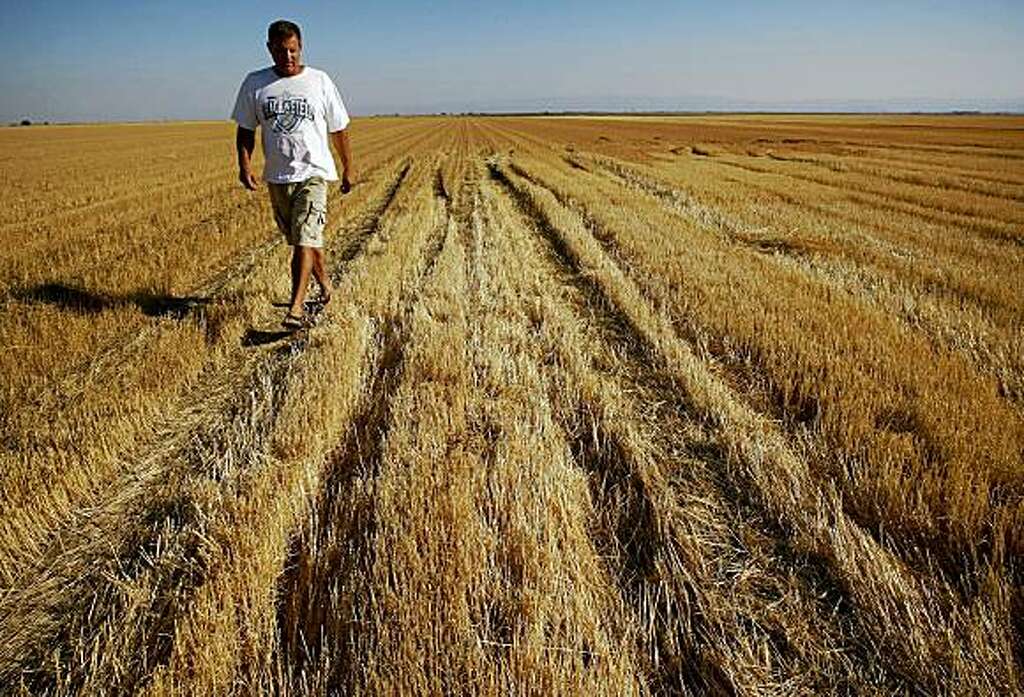
Todd Allen, on Tuesday June 30, 2009, in Mendota, Calif., looking over his field of wheat he had to let die after his water allotment ran out and was unable to bring to harvest. He planted 375 acres of wheat .
Is credit frozen? Are there simply no more farmers? Are the schools so bad as to scare away potential agricultural entrepreneurs? Or are we all terrified by the national debt and uncertain future?
California coastal elites may worry about the oxygen content of water available to a three-inch smelt in the Sacramento-San Joaquin River Delta, but they seem to have no interest in the epidemic dumping of trash, furniture, and often toxic substances throughout California 's rural hinterland.
Yesterday, for example, I rode my bike by a stopped van just as the occupants tossed seven plastic bags of raw refuse onto the side of the road.
I rode up near their bumper and said in my broken Spanish not to throw garbage onto the public road. But there were three of them, and one of me. So I was lucky to be sworn at only. I note in passing that I would not drive into Mexico and, as a guest, dare to pull over and throw seven bags of trash into the environment of my host.
In fact, trash piles are commonplace out here - composed of everything from half-empty paint cans and children's plastic toys to diapers and moldy food. I have never seen a rural sheriff cite a litterer, or witnessed state EPA workers cleaning up these unauthorized wastelands.
So I would suggest to Bay Area scientists that the environment is taking a much harder beating down here in central California than it is in the Delta.
Perhaps before we cut off more irrigation water to the west side of the valley, we might invest some green dollars into cleaning up the unsightly and sometimes dangerous garbage that now litters the outskirts of our rural communities.
We hear about the tough small-business regulations that have driven residents out of the state, at the rate of 2,000 to 3,000 a week. But from my unscientific observations these past weeks, it seems rather easy to open a small business in California without any oversight at all, or at least what I might call a "counter business."
I counted eleven mobile hot-kitchen trucks that simply park by the side of the road, spread about some plastic chairs, pull down a tarp canopy, and, presto, become mini-restaurants.
There are no "facilities" such as toilets or washrooms.
But I do frequently see lard trails on the isolated roads I bike on, where trucks apparently have simply opened their draining tanks and sped on, leaving a slick of cooking fats and oils. Crows and ground squirrels love them; they can be seen from a distance mysteriously occupied in the middle of the road.
At crossroads, peddlers in a counter-California economy sell almost anything. Here is what I noticed at an intersection on the west side last week: shovels, rakes, hoes, gas pumps, lawnmowers, edgers, blowers, jackets, gloves, and caps. The merchandise was all new.I doubt whether in high-tax California sales taxes or income taxes were paid on any of these stop-and-go transactions.
In two supermarkets 50 miles apart, I was the only one in line who did not pay with a social-service plastic card (gone are the days when "food stamps" were embarrassing bulky coupons).
But I did not see any relationship between the use of the card and poverty as we once knew it: The electrical appurtenances owned by the user and the car into which the groceries were loaded were indistinguishable from those of the upper middle class.
By that I mean that most consumers drove late-model Camrys, Accords, or Tauruses, had iPhones, Bluetooths, or BlackBerries, and bought everything in the store with public-assistance credit. This seemed a world apart from the trailers I had just ridden by the day before.
I don't editorialize here on the logic or morality of any of this, but I note only that there are vast numbers of people who apparently are not working, are on public food assistance, and enjoy the technological veneer of the middle class. California has a consumer market surely, but often no apparent source of income.
Does the $40 million a day supplement to unemployment benefits from Washington explain some of this?
Do diversity concerns, as in lack of diversity, work both ways? Over a hundred-mile stretch, when I stopped in San Joaquin for a bottled water, or drove through Orange Cove, or got gas in Parlier, or went to a corner market in southwestern Selma, my home town.
I was the only non-Hispanic - there were no Asians, no blacks, no other whites. We may speak of the richness of "diversity," but those who cherish that ideal simply have no idea that there are now countless inland communities that have become near-apartheid societies, where Spanish is the first language, the schools are not at all diverse, and the federal and state governments are either the main employers or at least the chief sources of income - whether through emergency rooms, rural health clinics, public schools, or social-service offices.
An observer from Mars might conclude that our elites and masses have given up on the ideal of integration and assimilation, perhaps in the wake of the arrival of 11 to 15 million illegal aliens.
Again, I do not editorialize, but I note these vast transformations over the last 20 years that are the paradoxical wages of unchecked illegal immigration from Mexico, a vast expansion of California's entitlements and taxes, the flight of the upper middle class out of state, the deliberate effort not to tap natural resources, the downsizing in manufacturing and agriculture, and the departure of whites, blacks, and Asians from many of these small towns to more racially diverse and upscale areas of California.
Fresno 's California State University campus is embroiled in controversy over the student body president's announcing that he is an illegal alien, with all the requisite protests in favor of the DREAM Act.
I won't comment on the legislation per se, but again only note the anomaly I taught at CSUF for 21 years. I think it fair to say that the predominant theme of the Chicano and Latin American Studies program's sizable curriculum was a fuzzy American culpability.
By that I mean that students in those classes heard of the sins of America more often than its attractions. In my home town, Mexican flag decals on car windows are far more common than their American counterparts.
I note this because hundreds of students here illegally are now terrified of being deported to Mexico.
I can understand that, given the chaos in Mexico and their own long residency in the United States. But here is what still confuses me: If one were to consider the classes that deal with Mexico at the university, or the visible displays of national chauvinism, then one might conclude that Mexico is a far more attractive and moral place than the United States.
So there is a surreal nature to these protests: something like, "Please do not send me back to the culture I nostalgically praise; please let me stay in the culture that I ignore or deprecate."
I think the DREAM Act protestors might have been far more successful in winning public opinion had they stopped blaming the U.S. for suggesting that they might have to leave at some point, and instead explained why, in fact, they want to stay What it is about America that makes a youth of 21 go on a hunger strike or demonstrate to be allowed to remain in this country rather than return to the place of his birth?
I think I know the answer to this paradox. Missing entirely in the above description is the attitude of the host, which by any historical standard can only be termed "indifferent." California does not care whether one broke the law to arrive here or continues to break it by staying.
It asks nothing of the illegal immigrant - no proficiency in English, no acquaintance with American history and values, no proof of income, no record of education or skills. It does provide all the public assistance that it can afford (and more that it borrows for), and apparently waives enforcement of most of California 's burdensome regulations and civic statutes that increasingly have plagued productive citizens to the point of driving them out.
How odd that we over-regulate those who are citizens and have capital to the point of banishing them from the state, but do not regulate those who are aliens and without capital to the point of encouraging millions more to follow in their footsteps.
How odd - to paraphrase what Critias once said of ancient Sparta - that California is at once both the nation's most unfree and most free state, the most repressed and the wildest.
Hundreds of thousands sense all that and vote accordingly with their feet, both into and out of California - and the result is a sort of social, cultural, economic, and political time-bomb, whose ticks are getting louder.
Victor Davis Hanson is a senior fellow at the Hoover Institution, the editor of "Makers of Ancient Strategy: From the Persian Wars to the Fall of Rome", and the author of "The Father of Us All: War and History, Ancient and Modern. "
https://www.24hourcampfire.com/ubbthreads/ubb...a-in-sight
This is an article from Victor Davis Hansen, a Senior Fellow at the Hoover Institute at Stanford University
https://www.24hourcampfire.com/ubbthreads/ubb...a-in-sight
The last three weeks I have traveled about, taking the pulse of the more forgotten areas of central California.
I wanted to witness, even if superficially, what is happening to a state that has the highest sales and income taxes, the most lavish entitlements, the near-worst public schools (based on federal test scores), and the largest number of illegal aliens in the nation, along with an overregulated private sector, a stagnant and shrinking manufacturing base, and an elite environmental ethos that restricts commerce and productivity without curbing consumption.
During this unscientific experiment, three times a week I rode a bike on a 20-mile trip over various rural roads in southwestern Fresno County. I also drove my car over to the coast to work, on various routes through towns like San Joaquin, Mendota, and Firebaugh.
And near my home I have been driving, shopping, and touring by intent the rather segregated and impoverished areas of Caruthers, Fowler, Laton, Orange Cove, Parlier, and Selma.
My own farmhouse is now in an area of abject poverty and almost no ethnic diversity; the closest elementary school (my alma mater, two miles away) is 94 percent Hispanic and 1 percent white, and well below federal testing norms in math and English.
Here are some general observations about what I saw (other than that the rural roads of California are fast turning into rubble, poorly maintained and reverting to what I remember seeing long ago in the rural South).
First, remember that these areas are the ground zero, so to speak, of 20 years of illegal immigration. There has been a general depression in farming - to such an extent that the 20- to-100-acre tree and vine farmer, the erstwhile backbone of the old rural California, for all practical purposes has ceased to exist.
On the western side of the Central Valley, the effects of arbitrary cutoffs in federal irrigation water have idled tens of thousands of acres of prime agricultural land, leaving thousands unemployed.
Manufacturing plants in the towns in these areas - which used to make harvesters, hydraulic lifts, trailers, food-processing equipment - have largely shut down; their production has been shipped off overseas or south of the border. Agriculture itself - from almonds to raisins - has increasingly become corporatized and mechanized, cutting by half the number of farm workers needed So unemployment runs somewhere between 15 and 20 percent.
Many of the rural trailer-house compounds I saw appear to the naked eye no different from what I have seen in the Third World.
There is a Caribbean look to the junked cars, electric wires crisscrossing between various outbuildings, plastic tarps substituting for replacement shingles, lean-tos cobbled together as auxiliary housing, pit bulls unleashed, and geese, goats, and chickens roaming around the yards. The public hears about all sorts of tough California regulations that stymie business - rigid zoning laws, strict building codes, constant inspections - but apparently none of that applies out here.
It is almost as if the more California regulates, the more it does not regulate. Its public employees prefer to go after misdemeanors in the upscale areas to justify our expensive oversight industry, while ignoring the felonies in the downtrodden areas, which are becoming feral and beyond the ability of any inspector to do anything but feel irrelevant.
But in the regulators' defense, where would one get the money to redo an ad hoc trailer park with a spider web of illegal bare wires?
Grocery store in Mendota.
Many of the rented-out rural shacks and stationary Winnebago’s are on former small farms - the vineyards overgrown with weeds, or torn out with the ground lying fallow. I pass on the cultural consequences to communities from the loss of thousands of small farming families.
I don't think I can remember another time when so many acres in the eastern part of the valley have gone out of production, even though farm prices have recently rebounded. Apparently, it is simply not worth the gamble of investing $7,000 to $10,000 an acre in a new orchard or vineyard. What an anomaly - with suddenly soaring farm prices, still we have thousands of acres in the world's richest agricultural belt, with available water on the east side of the valley and plentiful labor, gone idle or in disuse.
Todd Allen, on Tuesday June 30, 2009, in Mendota, Calif., looking over his field of wheat he had to let die after his water allotment ran out and was unable to bring to harvest. He planted 375 acres of wheat .
Is credit frozen? Are there simply no more farmers? Are the schools so bad as to scare away potential agricultural entrepreneurs? Or are we all terrified by the national debt and uncertain future?
California coastal elites may worry about the oxygen content of water available to a three-inch smelt in the Sacramento-San Joaquin River Delta, but they seem to have no interest in the epidemic dumping of trash, furniture, and often toxic substances throughout California 's rural hinterland.
Yesterday, for example, I rode my bike by a stopped van just as the occupants tossed seven plastic bags of raw refuse onto the side of the road.
I rode up near their bumper and said in my broken Spanish not to throw garbage onto the public road. But there were three of them, and one of me. So I was lucky to be sworn at only. I note in passing that I would not drive into Mexico and, as a guest, dare to pull over and throw seven bags of trash into the environment of my host.
In fact, trash piles are commonplace out here - composed of everything from half-empty paint cans and children's plastic toys to diapers and moldy food. I have never seen a rural sheriff cite a litterer, or witnessed state EPA workers cleaning up these unauthorized wastelands.
So I would suggest to Bay Area scientists that the environment is taking a much harder beating down here in central California than it is in the Delta.
Perhaps before we cut off more irrigation water to the west side of the valley, we might invest some green dollars into cleaning up the unsightly and sometimes dangerous garbage that now litters the outskirts of our rural communities.
We hear about the tough small-business regulations that have driven residents out of the state, at the rate of 2,000 to 3,000 a week. But from my unscientific observations these past weeks, it seems rather easy to open a small business in California without any oversight at all, or at least what I might call a "counter business."
I counted eleven mobile hot-kitchen trucks that simply park by the side of the road, spread about some plastic chairs, pull down a tarp canopy, and, presto, become mini-restaurants.
There are no "facilities" such as toilets or washrooms.
But I do frequently see lard trails on the isolated roads I bike on, where trucks apparently have simply opened their draining tanks and sped on, leaving a slick of cooking fats and oils. Crows and ground squirrels love them; they can be seen from a distance mysteriously occupied in the middle of the road.
At crossroads, peddlers in a counter-California economy sell almost anything. Here is what I noticed at an intersection on the west side last week: shovels, rakes, hoes, gas pumps, lawnmowers, edgers, blowers, jackets, gloves, and caps. The merchandise was all new.I doubt whether in high-tax California sales taxes or income taxes were paid on any of these stop-and-go transactions.
In two supermarkets 50 miles apart, I was the only one in line who did not pay with a social-service plastic card (gone are the days when "food stamps" were embarrassing bulky coupons).
But I did not see any relationship between the use of the card and poverty as we once knew it: The electrical appurtenances owned by the user and the car into which the groceries were loaded were indistinguishable from those of the upper middle class.
By that I mean that most consumers drove late-model Camrys, Accords, or Tauruses, had iPhones, Bluetooths, or BlackBerries, and bought everything in the store with public-assistance credit. This seemed a world apart from the trailers I had just ridden by the day before.
I don't editorialize here on the logic or morality of any of this, but I note only that there are vast numbers of people who apparently are not working, are on public food assistance, and enjoy the technological veneer of the middle class. California has a consumer market surely, but often no apparent source of income.
Does the $40 million a day supplement to unemployment benefits from Washington explain some of this?
Do diversity concerns, as in lack of diversity, work both ways? Over a hundred-mile stretch, when I stopped in San Joaquin for a bottled water, or drove through Orange Cove, or got gas in Parlier, or went to a corner market in southwestern Selma, my home town.
I was the only non-Hispanic - there were no Asians, no blacks, no other whites. We may speak of the richness of "diversity," but those who cherish that ideal simply have no idea that there are now countless inland communities that have become near-apartheid societies, where Spanish is the first language, the schools are not at all diverse, and the federal and state governments are either the main employers or at least the chief sources of income - whether through emergency rooms, rural health clinics, public schools, or social-service offices.
An observer from Mars might conclude that our elites and masses have given up on the ideal of integration and assimilation, perhaps in the wake of the arrival of 11 to 15 million illegal aliens.
Again, I do not editorialize, but I note these vast transformations over the last 20 years that are the paradoxical wages of unchecked illegal immigration from Mexico, a vast expansion of California's entitlements and taxes, the flight of the upper middle class out of state, the deliberate effort not to tap natural resources, the downsizing in manufacturing and agriculture, and the departure of whites, blacks, and Asians from many of these small towns to more racially diverse and upscale areas of California.
Fresno 's California State University campus is embroiled in controversy over the student body president's announcing that he is an illegal alien, with all the requisite protests in favor of the DREAM Act.
I won't comment on the legislation per se, but again only note the anomaly I taught at CSUF for 21 years. I think it fair to say that the predominant theme of the Chicano and Latin American Studies program's sizable curriculum was a fuzzy American culpability.
By that I mean that students in those classes heard of the sins of America more often than its attractions. In my home town, Mexican flag decals on car windows are far more common than their American counterparts.
I note this because hundreds of students here illegally are now terrified of being deported to Mexico.
I can understand that, given the chaos in Mexico and their own long residency in the United States. But here is what still confuses me: If one were to consider the classes that deal with Mexico at the university, or the visible displays of national chauvinism, then one might conclude that Mexico is a far more attractive and moral place than the United States.
So there is a surreal nature to these protests: something like, "Please do not send me back to the culture I nostalgically praise; please let me stay in the culture that I ignore or deprecate."
I think the DREAM Act protestors might have been far more successful in winning public opinion had they stopped blaming the U.S. for suggesting that they might have to leave at some point, and instead explained why, in fact, they want to stay What it is about America that makes a youth of 21 go on a hunger strike or demonstrate to be allowed to remain in this country rather than return to the place of his birth?
I think I know the answer to this paradox. Missing entirely in the above description is the attitude of the host, which by any historical standard can only be termed "indifferent." California does not care whether one broke the law to arrive here or continues to break it by staying.
It asks nothing of the illegal immigrant - no proficiency in English, no acquaintance with American history and values, no proof of income, no record of education or skills. It does provide all the public assistance that it can afford (and more that it borrows for), and apparently waives enforcement of most of California 's burdensome regulations and civic statutes that increasingly have plagued productive citizens to the point of driving them out.
How odd that we over-regulate those who are citizens and have capital to the point of banishing them from the state, but do not regulate those who are aliens and without capital to the point of encouraging millions more to follow in their footsteps.
How odd - to paraphrase what Critias once said of ancient Sparta - that California is at once both the nation's most unfree and most free state, the most repressed and the wildest.
Hundreds of thousands sense all that and vote accordingly with their feet, both into and out of California - and the result is a sort of social, cultural, economic, and political time-bomb, whose ticks are getting louder.
Victor Davis Hanson is a senior fellow at the Hoover Institution, the editor of "Makers of Ancient Strategy: From the Persian Wars to the Fall of Rome", and the author of "The Father of Us All: War and History, Ancient and Modern. "
https://www.24hourcampfire.com/ubbthreads/ubb...a-in-sight
1