
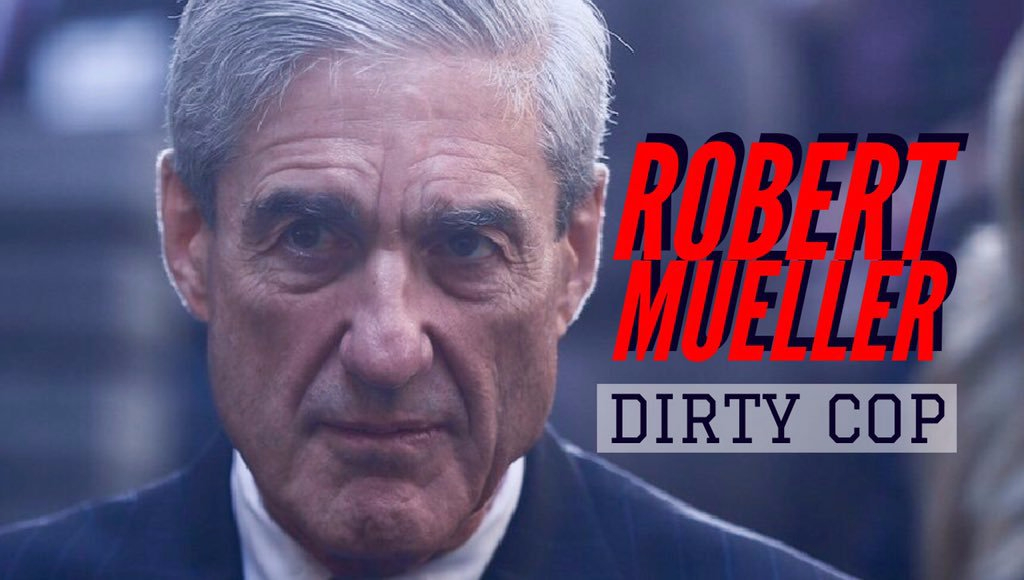
A former colleague recently characterized Robert Mueller as “ramrod straight” and “utterly incorruptible.” Similar language was breathlessly repeated in mainstream media biographies on Mueller in Politico, BBC, and Time magazine. Mueller’s Vietnam-era service in the United States Marine Corps and 2004 tag-team with then-Deputy Attorney General James Comey to save American democracy from warrantless spying are mainstays of these biographies, which always send a clear message that his integrity is beyond reproach.
It’s always suspicious when anyone’s credibility is oversold like this, but that goes double when the same person was FBI director for 12 years—spanning across both the Bush and Obama administrations from 2001 to 2013—yet most people can’t remember anything about him. We should remember actions he took to impartially uphold the law. Sadly, that is not the case.
What stands out most during then-FBI Director Mueller’s term in office is the two-tiered system of justice, when obvious crimes and scandals involving government officials and private-sector elites were ignored or even covered up by the FBI. What Mueller failed to do to protect our country says more than anything he did.
Recent leaks suggest that Special Counsel Mueller is examining one of the President’s 2008 Palm Beach real estate deals, as well as the 2013 Miss Universe competition held in Moscow. During the very same time period as those events, FBI Director Mueller repeatedly failed to act in cases involving government corruption and dangerous crimes. His level of aggressiveness in investigating our President is the exact inverse of how he acted when he was tasked with protecting America.
Major Scandals During Mueller’s FBI Years:
As the nation’s top cop, then-FBI Director Mueller had massive resources to investigate crimes, as well as the ability to arrest suspects and recommend prosecution of the offenders. The following is an abbreviated list of major scandals and likely crimes that Mueller did not meaningfully investigate as FBI Director—no arrests, no consequences:
Falsification of Iraq War intelligence (2003): information providing the sole justification for a war that caused the death and dismemberment of thousands of American soldiers was later found to be fabricated, false, or overstated at the time it was presented to the public. Mueller not only failed to investigate and arrest any of the perpetrators of this deception—he actively participated in the plot:
Vanishing Currency (2003): the US government sent $12 billion in $100 bills to the Iraq War combat theater, which mostly went unaccounted for after it entered the country
NSA Warrantless Surveillance (2001-2013): illegal collection of domestic phone records and internet communications that were sent or received by US citizens, in violation of Fourth Amendment protections against warrantless search and seizure, followed by potential perjury committed by Director of National Intelligence James Clapper, who denied the practices under oath; the 2013 Snowden revelations proved that the 2004 story about Comey and Mueller stopping illegal surveillance practices was nearly meaningless in practice
Emailgate (2007): discovery that several top Bush administration officials violated the Presidential Records Act by using an RNC server for email communications while conducting official business, followed by the deletion of millions of the same emails
Walter Reed Neglect Scandal (2007): troops recovering from severe war-related injuries were subjected to squalid living conditions and grotesquely substandard care due to a privatization agreement that resulted in drastic staffing cuts, after which patients were told to “keep quiet” and whistleblowers suffered retaliation from higher-ups
IRS Targeting (2010-2013): the IRS intentionally selected and then delayed or denied tax-exempt 501(c)(3) applications from conservative groups to prevent them from participating in the 2012 election, followed by IRS agent Lois Lerner invoking her Fifth Amendment privilege against self-incrimination
Fast and Furious (2010): this ATF program, which seems to have served no rational purpose, allowed over 2,000 guns to be purchased illegally inside the United States and then “walked” into Mexico for use by criminals, one of which was later used in the 2010 murder of Border Agent Brian Terry by the member of a Mexican cartel
Associated Press Spying (2012): the Department of Justice illegally seized the communications of AP reporters made during April and May 2012, allowing the DOJ to unmask journalists’ confidential sources.
Clinton Foundation Pay-for-Play (2009-2013): during the period in which Hillary Clinton held the office of Secretary of State, the Clinton Foundation and Bill Clinton received millions of dollars in paid speaking fees and a million dollar “gift” from countries involved in matters with the State Department, many of which had ties to terrorism and human rights abuses; some of these funds were apparently diverted from charitable causes to personal expenses, such as Chelsea Clinton’s 2010 wedding
Russian Uranium Deal (2009-2013): Hillary Clinton’s State Department approved a deal allowing a Russian company to control 20% of the uranium mining production capacity inside the United States, which was followed by millions of dollars in donations to the Clinton Foundation from people associated with the transaction
Clinton Private Email Server (2009-2013): during her entire tenure as Secretary of State, Hillary Clinton dodged Freedom of Information Act requirements by using a private email server to conduct official government business, as well as sent and received classified information that was Top Secret over an unsecured system—an “extremely reckless” (and obviously illegal) act
HSBC Bank Money Laundering Scandal:
Although it received little coverage in the mainstream media, the HSBC money laundering case reveals the complete and total corruption of federal law enforcement toward the end of Mueller’s term as FBI Director. No case demonstrates how the swamp works better than this one.
For nearly the entire duration of Mueller’s term, UK-based HSBC, an international bank with divisions and depositors worldwide, was doing billions of dollars in business with drug cartels, rouge nations, and even banks associated with terrorism, taking massive deposits made in foreign nations and funneling them into its US banks. The overall amounts were staggering, totaling hundreds of billions of dollars, which likely gave HSBC a comparative advantage over its rivals and greater market share, while providing international criminals with the ability to “launder” money into the US banking system with little-to-no oversight. In 2012, a whistleblower, who collected information and recorded conversations with HSBC employees, provided strong proof to the public that the bank was operating as a “criminal enterprise.”
Mexican Drug Cartels: From 2002 to at least 2009 (and possibly much longer), HSBC bank laundered billions of US dollars for Joaquin “El Chapo” Guzman’s murderous Sinaloa Cartel and similar groups. In 2009, Forbes placed El Chapo at #41 on its “World’s Most Powerful People” list. The same year, many experts agreed that Mexico’s drug war had rendered it a “failed state.” By 2012, the Sinaloa cartel alone was estimated to have annual revenues of $3 billion, which were comparable to Facebook or Netflix. By April 2013, toward the end of Mueller’s term, the Sinaloa and other Mexican cartels had become the number one importer and distributor of narcotics inside the United States (with many of the cartel’s top agents living inside the United States), El Chapo had become “public enemy no. 1,” and 70,000 murders and nearly 27,000 disappearances were attributable to the drug war inside Mexico.
Ignoring the obvious, HSBC inexplicably designated Mexico a “low risk” country for money laundering, allowing shady depositors and known drug kingpins to deposit billions of US dollars—in cash—into bank accounts in HSBC Mexico, followed by the same money becoming accessible at HSBC in the US. With legitimate-looking banking, the Mexican drug cartels were given huge expansion potential inside the US that would otherwise have been easily detected if the cartels tried to purchase properties, vehicles, and shell businesses here using cash.
Much of the cash crossing the US-Mexico border (estimated at $25 billion per year in 2010) found a ready home in HSBC branches south of the Rio Grande. HSBC Mexico made billions of dollars in suspicious transactions, such as customers depositing hundreds of thousands of US dollars into a single bank account in a single day, during which the cash was put through teller windows in boxes that were designed to fit through the window openings. Because there was virtually no investigation into these transactions or even the identities of depositors, who included high-profile drug dealers, accounts were rarely closed due to the suspicious activity. After all, Mexico was a “low risk” country for money laundering at the time.
Terrorists and Rogue Nations: The bank’s practices also allowed terrorist groups and rogue nations to have access to our financial markets in a similar manner, facilitating financing of their activities inside this country, as well as providing greater international investment possibilities for sanctioned regimes—including $19 billion deposited from Iran into HSBC’s foreign affiliate banks. There were also lax rules for setting up relationships with affiliate banks in other countries, which included a Saudi Arabian bank with ties to funding terrorism.
Policies Prevented Catching Crooks: Even in the rare instance where money laundering controls were in place, inadequate follow-up measures undermined any intervention. The US division of HSBC allowed thousands of suspicious accounts to remain open after they were flagged for closure. “Know your customer” practices were virtually nonexistent, which allowed bad actors to get around things like Iranian sanctions and Patriot Act protections, which in turn was aggravated by bank employees doing things like deleting information about the country of origin on deposits from places like Iran. Large-scale warnings, such as the migration of billions of US dollars in cash deposits into HSBC Mexico, went unnoticed because the bank apparently had no system in place to monitor such activity. To say all of this was “extremely reckless” would be an understatement—it’s inconceivable that the bank’s employees and executives didn’t know what was happening at the time.
“Ramrod” Mueller to the Rescue: What did Mueller do to aggressively investigate and shut down this massive “foreign influence” involving our country’s drug epidemic and threat of terrorism? Basically nothing. No bank executives or employees were arrested or jailed. People have spent more time in jail for smoking a joint than any HSBC executive or employee did for facilitating drug cartel business and terrorist financing.
On October 17, 2010, the Treasury Department issued “cease and desist” letter to HSBC for violations of the Bank Secrecy Act. This was followed by a Senate subcommittee investigation, which provided a comprehensive report and took hearing testimony on July 17, 2012. In what appeared to be prepared remarks, one bank compliance executive resigned at the hearing, while another executive indicated HSBC “did our best” in Mexico.
With nearly all of the investigation already completed by the Senate and already in the public eye, the Department of Justice was finally forced to file a four-count felony indictment against defendant HSBC on December 11, 2012, which included three felony counts relating to grossly inadequate anti-money laundering practices and one count for violation of the Trading With The Enemy Act.
On the same day, and over the objections of career DOJ prosecutors, then-AG Holder allowed HSBC to enter into a deferred prosecution agreement, under which the charges would be dropped if the bank stayed out of trouble for 5 years and paid a “record fine” consisting of $1.256 billion in forfeited assets and an additional $665 million in civil penalties. Added together, the punishment totaled approximately 9% of one year’s profits for HSBC’s worldwide operations, which amounted to a whopping $21.9 billion in 2011 alone.
Also the same day, then-US Attorney Loretta Lynch led a press conference alleging that (1) an alphabet soup of federal agencies had conducted a serious investigation and (2) the “record fine” was somehow adequate punishment. Notably, “ramrod straight” Mueller and Holder were not present, despite the obvious national importance of the case. The DOJ’s press release (echoed by the FBI, which simply re-posted DOJ’s release) bragged about the “heavy price” of the fine being imposed. Despite the “heavy price” paid for its rampant criminal behavior, HSBC was somehow able to sponsor the star-studded 2014 Clinton Global Initiative. (Perhaps not coincidentally, the Clinton Foundation also received up to $81,000,000 in donations from HSBC’s illustrious group of account holders.)
But not everyone bought into Lynch’s sales pitch. Even CBS News seemed suspicious of the deal, which was obviously disproportionate to the criminal conduct involved:
Important Video: https://fighting15th.com/2017/08/03/robert-mu...dirty-cop/
While a US citizen sending money to terrorists can result in a 20-year prison sentence, and many US citizens have been sentenced to decades in prison for even marijuana-related crimes, the bank’s executives and employees never spent one day in jail for their roles in assisting terrorist-connected nations and Mexican drug cartels to do business in the United States—an example of the “two systems” of justice than many Americans believe exist between the elites and regular citizens.
If the FBI uses search warrants, recorded transactions, confidential informants, wiretaps, GPS tracking, and conducts a broad sweep of witness interviews in cases involving drug trafficking and terrorism in other cases, why wouldn’t Mueller have done the same to build a case here?
Mueller’s absence in the HSBC case says as much about the cover-up as when Holder refused to prosecute over the objections of career prosecutors.
James Comey Joins HSBC’s Board of Directors: Less than two months after the 2012 deferred prosecution agreement, HSBC appointed James Comey to its Board of Directors as head of the Financial System Vulnerabilities Committee .
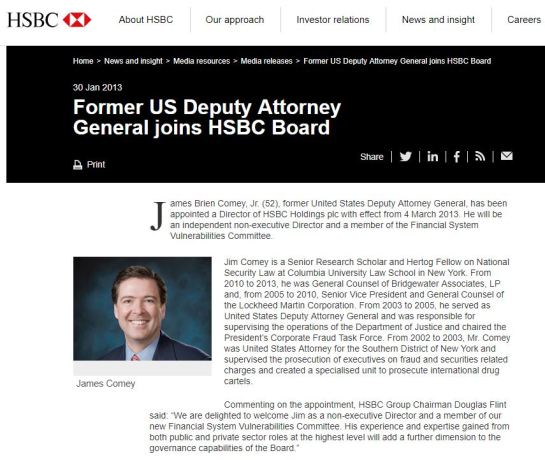
When he joined HSBC, Comey left a job working as general counsel for Bridgewater Associates hedge fund, where he earned over $6.6 million per year, for a position at a disgraced criminal bank—one recently charged with laundering El Chapo’s money—that paid under $200,000 per year (approximately three percent of his salary at Bridgewater).
It’s hard to say why anyone would take that job, and that pay cut, unless there was some additional incentive .
While Comey may have provided HSBC with a Norman Rockwell-type face for its money laundering reform program, it doesn’t appear that Comey actually reformed any of the bank’s practices.
During the time Comey was on the Board, HSBC was involved in laundering hundreds of millions of dollars from Russia into the British banking system—a scheme with direct ties to the Kremlin and Vladimir Putin. Apparently Comey missed this activity while he led the search for “vulnerabilities” in HSBC’s “financial system.”
Comey left HSBC in July 2013 to become FBI Director when Mueller stepped down.

Mueller Became Partner At The Law Firm That Represented HSBC: In its 2012 Year In Review, law firm Wilmer Hale indicated the following: “our regulatory, transactional, securities and investigations experience converged in our representation of HSBC in connection with Department of Justice and Senate inquiries.”
Less than one year after leaving the FBI, the “utterly incorruptible” Mueller took a lucrative position as a partner at the same law firm that represented HSBC in 2012, working in the “government investigations practice” section of the firm . Although it’s unknown whether Mueller ever handled HSBC’s matters personally, Wilmer Hale still includes HSBC in its list of “representative clients.” In 2016 alone, profits per partner at Wilmer Hale were $1.81 million.
In May 2017, Mueller left the firm to become Special Counsel for the Russia investigation.
Subsequent Inaction:
In 2014, President Obama appointed Loretta Lynch to replace Holder as Attorney General. Despite criticism of her role in the HSBC case, the Senate voted to confirm Lynch to the post in 2015.
A few weeks before she was sworn in, her own office suggested that HSBC had not complied with the 2012 deferred prosecution agreement.
What did AG Lynch do to hold HSBC “accountable” once she took over?
Nothing.
By 2016, even Rep. Maxine Waters (D-CA) was critical of Lynch’s inaction against HSBC—it was that bad.
Russia, Russia, Russia:
If Mueller failed to do anything to stop these obviously corrupt and criminal practices during his own 12-year term as FBI Director, it’s hard to believe that he will conduct a fair and impartial investigation into the politically-charged assumption of “Russian interference” in the 2016 presidential election.
Mueller isn’t the one to investigate the swamp—Mueller is the swamp.
He is a dirty cop who never should have been appointed Special Counsel, and he should be fired immediately.
https://fighting15th.com/2017/08/03/robert-mu...dirty-cop/
1