Francis Scott Key's lyrics

On September 3, 1814, following the Burning of Washington and the Raid on Alexandria, Francis Scott Key and John Stuart Skinner set sail from Baltimore aboard the ship HMS Minden, flying a flag of truce on a mission approved by President James Madison. Their objective was to secure an exchange of prisoners, one of whom was Dr. William Beanes, the elderly and popular town physician of Upper Marlboro and a friend of Key's who had been captured in his home. Beanes was accused of aiding the arrest of British soldiers. Key and Skinner boarded the British flagship HMS Tonnant on September 7 and spoke with Major General Robert Ross and Vice Admiral Alexander Cochrane over dinner while the two officers discussed war plans. At first, Ross and Cochrane refused to release Beanes but relented after Key and Skinner showed them letters written by wounded British prisoners praising Beanes and other Americans for their kind treatment.
Because Key and Skinner had heard details of the plans for the attack on Baltimore, they were held captive until after the battle, first aboard HMS Surprise and later back on HMS Minden. After the bombardment, certain British gunboats attempted to slip past the fort and effect a landing in a cove to the west of it, but they were turned away by fire from nearby Fort Covington, the city's last line of defense.

During the rainy night, Key had witnessed the bombardment and observed that the fort's smaller "storm flag" continued to fly, but once the shell and Congreve rocket[6] barrage had stopped, he would not know how the battle had turned out until dawn. On the morning of September 14, the storm flag had been lowered and the larger flag had been raised.
During the bombardment, HMS Terror and HMS Meteor provided some of the "bombs bursting in air".
Key was inspired by the U.S. victory and the sight of the large U.S. flag flying triumphantly above the fort. This flag, with fifteen stars and fifteen stripes, had been made by Mary Young Pickersgill together with other workers in her home on Baltimore's Pratt Street. The flag later came to be known as the Star-Spangled Banner and is today on display in the National Museum of American History, a treasure of the Smithsonian Institution. It was restored in 1914 by Amelia Fowler, and again in 1998 as part of an ongoing conservation program.
Aboard the ship the next day, Key wrote a poem on the back of a letter he had kept in his pocket. At twilight on September 16, he and Skinner were released in Baltimore. He completed the poem at the Indian Queen Hotel, where he was staying, and titled it "Defence of Fort M'Henry". It was first published nationally in The Analectic Magazine.[7][8]
Much of the idea of the poem, including the flag imagery and some of the wording, is derived from an earlier song by Key, also set to the tune of "The Anacreontic Song". The song, known as "When the Warrior Returns",[9] was written in honor of Stephen Decatur and Charles Stewart on their return from the First Barbary War. Absent elaboration by Francis Scott Key prior to his death in 1843, some have speculated in modern times about the meaning of phrases or verses. According to British historian Robin Blackburn, the words "the hireling and slave" allude to the thousands of ex-slaves in the British ranks organised as the Corps of Colonial Marines, who had been liberated by the British and demanded to be placed in the battle line "where they might expect to meet their former masters."[10] Nevertheless, Professor Mark Clague, a professor of musicology at the University of Michigan, argues that the "middle two verses of Key's lyric vilify the British enemy in the War of 1812" and "in no way glorifies or celebrates slavery."[11] Clague writes that "For Key ... the British mercenaries were scoundrels and the Colonial Marines were traitors who threatened to spark a national insurrection."[11] This harshly anti-British nature of Verse 3 led to its omission in sheet music in World War I, when the British and the U.S. were allies.[11] Responding to the assertion of writer Jon Schwarz of The Intercept that the song is a "celebration of slavery,"[12] Clague said that: "The reference to slaves is about the use and in some sense the manipulation, of black Americans to fight for the British, with the promise of freedom. The American forces included African-Americans as well as whites. The term 'freemen,' whose heroism is celebrated in the fourth stanza, would have encompassed both."[13]
Others suggest that "Key may have intended the phrase as a reference to the British Navy's practice of impressment (kidnapping sailors and forcing them to fight in defense of the crown), or as a semi-metaphorical slap at the British invading force as a whole (which included a large number of mercenaries)."[14]
John Stafford Smith's music

Key gave the poem to his brother-in-law Judge Joseph H. Nicholson who saw that the words fit the popular melody "The Anacreontic Song", by English composer John Stafford Smith. This was the official song of the Anacreontic Society, an 18th-century gentlemen's club of amateur musicians in London. Nicholson took the poem to a printer in Baltimore, who anonymously made the first known broadside printing on September 17; of these, two known copies survive.
On September 20, both the Baltimore Patriot and The American printed the song, with the note "Tune: Anacreon in Heaven". The song quickly became popular, with seventeen newspapers from Georgia to New Hampshire printing it. Soon after, Thomas Carr of the Carr Music Store in Baltimore published the words and music together under the title "The Star Spangled Banner", although it was originally called "Defence of Fort M'Henry". Thomas Carr's arrangement introduced the raised fourth which became the standard deviation from "The Anacreontic Song".[15] The song's popularity increased and its first public performance took place in October when Baltimore actor Ferdinand Durang sang it at Captain McCauley's tavern. Washington Irving, then editor of the Analectic Magazine in Philadelphia, reprinted the song in November 1814.
By the early 20th century, there were various versions of the song in popular use. Seeking a singular, standard version, President Woodrow Wilson tasked the U.S. Bureau of Education with providing that official version. In response, the Bureau enlisted the help of five musicians to agree upon an arrangement. Those musicians were Walter Damrosch, Will Earhart, Arnold J. Gantvoort, Oscar Sonneck and John Philip Sousa. The standardized version that was voted upon by these five musicians premiered at Carnegie Hall on December 5, 1917, in a program that included Edward Elgar's Carillon and Gabriel Pierné's The Children's Crusade. The concert was put on by the Oratorio Society of New York and conducted by Walter Damrosch.[16] An official handwritten version of the final votes of these five men has been found and shows all five men's votes tallied, measure by measure.[17]
National anthem

The song gained popularity throughout the 19th century and bands played it during public events, such as Independence Day celebrations.
A plaque displayed at Fort Meade, South Dakota, claims that the idea of making "The Star Spangled Banner" the national anthem began on their parade ground in 1892. Colonel Caleb Carlton, Post Commander, established the tradition that the song be played "at retreat and at the close of parades and concerts." Carlton explained the custom to Governor Sheldon of South Dakota who "promised me that he would try to have the custom established among the state militia." Carlton wrote that after a similar discussion, Secretary of War, Daniel E. Lamont issued an order that it "be played at every Army post every evening at retreat."[18]
In 1899, the U.S. Navy officially adopted "The Star-Spangled Banner".[19] In 1916, President Woodrow Wilson ordered that "The Star-Spangled Banner" be played at military[19] and other appropriate occasions. The playing of the song two years later during the seventh-inning stretch of Game One of the 1918 World Series, and thereafter during each game of the series is often cited as the first instance that the anthem was played at a baseball game,[20] though evidence shows that the "Star-Spangled Banner" was performed as early as 1897 at opening day ceremonies in Philadelphia and then more regularly at the Polo Grounds in New York City beginning in 1898. In any case, the tradition of performing the national anthem before every baseball game began in World War II.[21]
On April 10, 1918, John Charles Linthicum, U.S. Congressman from Maryland, introduced a bill to officially recognize "The Star-Spangled Banner" as the national anthem.[22] The bill did not pass.[22] On April 15, 1929, Linthicum introduced the bill again, his sixth time doing so.[22] On November 3, 1929, Robert Ripley drew a panel in his syndicated cartoon, Ripley's Believe it or Not!, saying "Believe It or Not, America has no national anthem".[23]
In 1930, Veterans of Foreign Wars started a petition for the United States to officially recognize "The Star-Spangled Banner" as the national anthem.[24] Five million people signed the petition.[24] The petition was presented to the United States House Committee on the Judiciary on January 31, 1930.[25] On the same day, Elsie Jorss-Reilley and Grace Evelyn Boudlin sang the song to the Committee to refute the perception that it was too high pitched for a typical person to sing.[26] The Committee voted in favor of sending the bill to the House floor for a vote.[27] The House of Representatives passed the bill later that year.[28] The Senate passed the bill on March 3, 1931.[28] President Herbert Hoover signed the bill on March 4, 1931, officially adopting "The Star-Spangled Banner" as the national anthem of the United States of America.[1] As currently codified, the United States Code states that " he composition consisting of the words and music known as the Star-Spangled Banner is the national anthem."[29]
Modern history
The song is notoriously difficult for nonprofessionals to sing because of its wide range – a 12th. Humorist Richard Armour referred to the song's difficulty in his book It All Started With Columbus.
In an attempt to take Baltimore, the British attacked Fort McHenry, which protected the harbor. Bombs were soon bursting in air, rockets were glaring, and all in all it was a moment of great historical interest. During the bombardment, a young lawyer named Francis Off Key [sic] wrote "The Star-Spangled Banner", and when, by the dawn's early light, the British heard it sung, they fled in terror.
— Richard Armour
Professional and amateur singers have been known to forget the words, which is one reason the song is sometimes pre-recorded and lip-synced.[citation needed] Other times the issue is avoided by having the performer(s) play the anthem instrumentally instead of singing it. The pre-recording of the anthem has become standard practice at some ballparks, such as Boston's Fenway Park, according to the SABR publication The Fenway Project.[30]
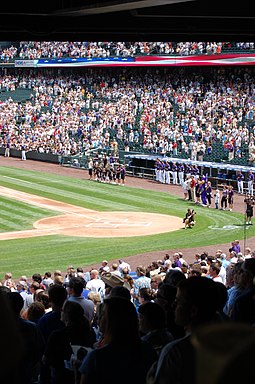
"The Star-Spangled Banner" has been performed regularly at the beginning of NFL games since the end of WWII by order of NFL commissioner Elmer Layden, according to History.com .[31] According to same article, the song has been intermittently performed at baseball games since after WWI It has also been popular as performed by orchestra or soloists at other public gatherings. The National Hockey League and Major League Soccer both require venues in both the U.S. and Canada to perform both the Canadian and U.S. national anthems at games that involve teams from both countries (with the "away" anthem being performed first).[32][better source needed] It is also usual for both U.S. and Canadian anthems (done in the same way as the NHL and MLS) to be played at Major League Baseball and National Basketball Association games involving the Toronto Blue Jays and the Toronto Raptors (respectively), the only Canadian teams in those two major U.S. sports leagues, and in All Star Games on the MLB, NBA, and NHL. The Buffalo Sabres of the NHL, which play in a city on the Canada–US border and have a substantial Canadian fan base, play both anthems before all home games regardless of where the visiting team is based.[33]
Two especially unusual performances of the song took place in the immediate aftermath of the United States September 11 attacks. On September 12, 2001, the Queen broke with tradition and allowed the Band of the Coldstream Guards to perform the anthem at Buckingham Palace, London, at the ceremonial Changing of the Guard, as a gesture of support for Britain's ally.[34] The following day at a St. Paul's Cathedral memorial service, the Queen joined in the singing of the anthem, an unprecedented occurrence.[35]
200th anniversary celebrations
The 200th anniversary of the "Star-Spangled Banner" occurred in 2014 with various special events occurring throughout the United States. A particularly significant celebration occurred during the week of September 10–16 in and around Baltimore, Maryland. Highlights included playing of a new arrangement of the anthem arranged by John Williams and participation of President Obama on Defender's Day, September 12, 2014, at Fort McHenry.[36] In addition, the anthem bicentennial included a youth music celebration[37] including the presentation of the National Anthem Bicentennial Youth Challenge winning composition written by Noah Altshuler.
Lyrics
O say can you see, by the dawn's early light,
What so proudly we hailed at the twilight's last gleaming,
Whose broad stripes and bright stars through the perilous fight,
O'er the ramparts we watched, were so gallantly streaming?
And the rockets' red glare, the bombs bursting in air,
Gave proof through the night that our flag was still there;
O say does that star-spangled banner yet wave
O'er the land of the free and the home of the brave?
On the shore dimly seen through the mists of the deep,
Where the foe's haughty host in dread silence reposes,
What is that which the breeze, o'er the towering steep,
As it fitfully blows, half conceals, half discloses?
Now it catches the gleam of the morning's first beam,
In full glory reflected now shines in the stream:
'Tis the star-spangled banner, O long may it wave
O'er the land of the free and the home of the brave.
And where is that band who so vauntingly swore
That the havoc of war and the battle's confusion,
A home and a country, should leave us no more?
Their blood has washed out their foul footsteps' pollution.
No refuge could save the hireling and slave
From the terror of flight, or the gloom of the grave:
And the star-spangled banner in triumph doth wave,
O'er the land of the free and the home of the brave.
O thus be it ever, when freemen shall stand
Between their loved homes and the war's desolation.
Blest with vict'ry and peace, may the Heav'n rescued land
Praise the Power that hath made and preserved us a nation!
Then conquer we must, when our cause it is just,
And this be our motto: 'In God is our trust.'
And the star-spangled banner in triumph shall wave
O'er the land of the free and the home of the brave![46]

Eighteen years after Key's death, and in indignation over the start of the American Civil War, Oliver Wendell Holmes, Sr.[47] added a fifth stanza to the song in 1861, which appeared in songbooks of the era.[48]
When our land is illumined with Liberty's smile,
If a foe from within strike a blow at her glory,
Down, down with the traitor that dares to defile
The flag of her stars and the page of her story!
By the millions unchained, who our birthright have gained,
We will keep her bright blazon forever unstained!
And the Star-Spangled Banner in triumph shall wave
While the land of the free is the home of the brave.
Alternative lyrics
In a version hand-written by Francis Scott Key in 1840, the third line reads "Whose bright stars and broad stripes, through the clouds of the fight".[49] In honour of the 1986 rededication of the Statue of Liberty, Sandi Patty wrote her version of an additional verse to the anthem.[50]
On September 3, 1814, following the Burning of Washington and the Raid on Alexandria, Francis Scott Key and John Stuart Skinner set sail from Baltimore aboard the ship HMS Minden, flying a flag of truce on a mission approved by President James Madison. Their objective was to secure an exchange of prisoners, one of whom was Dr. William Beanes, the elderly and popular town physician of Upper Marlboro and a friend of Key's who had been captured in his home. Beanes was accused of aiding the arrest of British soldiers. Key and Skinner boarded the British flagship HMS Tonnant on September 7 and spoke with Major General Robert Ross and Vice Admiral Alexander Cochrane over dinner while the two officers discussed war plans. At first, Ross and Cochrane refused to release Beanes but relented after Key and Skinner showed them letters written by wounded British prisoners praising Beanes and other Americans for their kind treatment.
Because Key and Skinner had heard details of the plans for the attack on Baltimore, they were held captive until after the battle, first aboard HMS Surprise and later back on HMS Minden. After the bombardment, certain British gunboats attempted to slip past the fort and effect a landing in a cove to the west of it, but they were turned away by fire from nearby Fort Covington, the city's last line of defense.
During the rainy night, Key had witnessed the bombardment and observed that the fort's smaller "storm flag" continued to fly, but once the shell and Congreve rocket[6] barrage had stopped, he would not know how the battle had turned out until dawn. On the morning of September 14, the storm flag had been lowered and the larger flag had been raised.
During the bombardment, HMS Terror and HMS Meteor provided some of the "bombs bursting in air".
Key was inspired by the U.S. victory and the sight of the large U.S. flag flying triumphantly above the fort. This flag, with fifteen stars and fifteen stripes, had been made by Mary Young Pickersgill together with other workers in her home on Baltimore's Pratt Street. The flag later came to be known as the Star-Spangled Banner and is today on display in the National Museum of American History, a treasure of the Smithsonian Institution. It was restored in 1914 by Amelia Fowler, and again in 1998 as part of an ongoing conservation program.
Aboard the ship the next day, Key wrote a poem on the back of a letter he had kept in his pocket. At twilight on September 16, he and Skinner were released in Baltimore. He completed the poem at the Indian Queen Hotel, where he was staying, and titled it "Defence of Fort M'Henry". It was first published nationally in The Analectic Magazine.[7][8]
Much of the idea of the poem, including the flag imagery and some of the wording, is derived from an earlier song by Key, also set to the tune of "The Anacreontic Song". The song, known as "When the Warrior Returns",[9] was written in honor of Stephen Decatur and Charles Stewart on their return from the First Barbary War. Absent elaboration by Francis Scott Key prior to his death in 1843, some have speculated in modern times about the meaning of phrases or verses. According to British historian Robin Blackburn, the words "the hireling and slave" allude to the thousands of ex-slaves in the British ranks organised as the Corps of Colonial Marines, who had been liberated by the British and demanded to be placed in the battle line "where they might expect to meet their former masters."[10] Nevertheless, Professor Mark Clague, a professor of musicology at the University of Michigan, argues that the "middle two verses of Key's lyric vilify the British enemy in the War of 1812" and "in no way glorifies or celebrates slavery."[11] Clague writes that "For Key ... the British mercenaries were scoundrels and the Colonial Marines were traitors who threatened to spark a national insurrection."[11] This harshly anti-British nature of Verse 3 led to its omission in sheet music in World War I, when the British and the U.S. were allies.[11] Responding to the assertion of writer Jon Schwarz of The Intercept that the song is a "celebration of slavery,"[12] Clague said that: "The reference to slaves is about the use and in some sense the manipulation, of black Americans to fight for the British, with the promise of freedom. The American forces included African-Americans as well as whites. The term 'freemen,' whose heroism is celebrated in the fourth stanza, would have encompassed both."[13]
Others suggest that "Key may have intended the phrase as a reference to the British Navy's practice of impressment (kidnapping sailors and forcing them to fight in defense of the crown), or as a semi-metaphorical slap at the British invading force as a whole (which included a large number of mercenaries)."[14]
John Stafford Smith's music
Key gave the poem to his brother-in-law Judge Joseph H. Nicholson who saw that the words fit the popular melody "The Anacreontic Song", by English composer John Stafford Smith. This was the official song of the Anacreontic Society, an 18th-century gentlemen's club of amateur musicians in London. Nicholson took the poem to a printer in Baltimore, who anonymously made the first known broadside printing on September 17; of these, two known copies survive.
On September 20, both the Baltimore Patriot and The American printed the song, with the note "Tune: Anacreon in Heaven". The song quickly became popular, with seventeen newspapers from Georgia to New Hampshire printing it. Soon after, Thomas Carr of the Carr Music Store in Baltimore published the words and music together under the title "The Star Spangled Banner", although it was originally called "Defence of Fort M'Henry". Thomas Carr's arrangement introduced the raised fourth which became the standard deviation from "The Anacreontic Song".[15] The song's popularity increased and its first public performance took place in October when Baltimore actor Ferdinand Durang sang it at Captain McCauley's tavern. Washington Irving, then editor of the Analectic Magazine in Philadelphia, reprinted the song in November 1814.
By the early 20th century, there were various versions of the song in popular use. Seeking a singular, standard version, President Woodrow Wilson tasked the U.S. Bureau of Education with providing that official version. In response, the Bureau enlisted the help of five musicians to agree upon an arrangement. Those musicians were Walter Damrosch, Will Earhart, Arnold J. Gantvoort, Oscar Sonneck and John Philip Sousa. The standardized version that was voted upon by these five musicians premiered at Carnegie Hall on December 5, 1917, in a program that included Edward Elgar's Carillon and Gabriel Pierné's The Children's Crusade. The concert was put on by the Oratorio Society of New York and conducted by Walter Damrosch.[16] An official handwritten version of the final votes of these five men has been found and shows all five men's votes tallied, measure by measure.[17]
National anthem
The song gained popularity throughout the 19th century and bands played it during public events, such as Independence Day celebrations.
A plaque displayed at Fort Meade, South Dakota, claims that the idea of making "The Star Spangled Banner" the national anthem began on their parade ground in 1892. Colonel Caleb Carlton, Post Commander, established the tradition that the song be played "at retreat and at the close of parades and concerts." Carlton explained the custom to Governor Sheldon of South Dakota who "promised me that he would try to have the custom established among the state militia." Carlton wrote that after a similar discussion, Secretary of War, Daniel E. Lamont issued an order that it "be played at every Army post every evening at retreat."[18]
In 1899, the U.S. Navy officially adopted "The Star-Spangled Banner".[19] In 1916, President Woodrow Wilson ordered that "The Star-Spangled Banner" be played at military[19] and other appropriate occasions. The playing of the song two years later during the seventh-inning stretch of Game One of the 1918 World Series, and thereafter during each game of the series is often cited as the first instance that the anthem was played at a baseball game,[20] though evidence shows that the "Star-Spangled Banner" was performed as early as 1897 at opening day ceremonies in Philadelphia and then more regularly at the Polo Grounds in New York City beginning in 1898. In any case, the tradition of performing the national anthem before every baseball game began in World War II.[21]
On April 10, 1918, John Charles Linthicum, U.S. Congressman from Maryland, introduced a bill to officially recognize "The Star-Spangled Banner" as the national anthem.[22] The bill did not pass.[22] On April 15, 1929, Linthicum introduced the bill again, his sixth time doing so.[22] On November 3, 1929, Robert Ripley drew a panel in his syndicated cartoon, Ripley's Believe it or Not!, saying "Believe It or Not, America has no national anthem".[23]
In 1930, Veterans of Foreign Wars started a petition for the United States to officially recognize "The Star-Spangled Banner" as the national anthem.[24] Five million people signed the petition.[24] The petition was presented to the United States House Committee on the Judiciary on January 31, 1930.[25] On the same day, Elsie Jorss-Reilley and Grace Evelyn Boudlin sang the song to the Committee to refute the perception that it was too high pitched for a typical person to sing.[26] The Committee voted in favor of sending the bill to the House floor for a vote.[27] The House of Representatives passed the bill later that year.[28] The Senate passed the bill on March 3, 1931.[28] President Herbert Hoover signed the bill on March 4, 1931, officially adopting "The Star-Spangled Banner" as the national anthem of the United States of America.[1] As currently codified, the United States Code states that " he composition consisting of the words and music known as the Star-Spangled Banner is the national anthem."[29]
Modern history
The song is notoriously difficult for nonprofessionals to sing because of its wide range – a 12th. Humorist Richard Armour referred to the song's difficulty in his book It All Started With Columbus.
In an attempt to take Baltimore, the British attacked Fort McHenry, which protected the harbor. Bombs were soon bursting in air, rockets were glaring, and all in all it was a moment of great historical interest. During the bombardment, a young lawyer named Francis Off Key [sic] wrote "The Star-Spangled Banner", and when, by the dawn's early light, the British heard it sung, they fled in terror.
— Richard Armour
Professional and amateur singers have been known to forget the words, which is one reason the song is sometimes pre-recorded and lip-synced.[citation needed] Other times the issue is avoided by having the performer(s) play the anthem instrumentally instead of singing it. The pre-recording of the anthem has become standard practice at some ballparks, such as Boston's Fenway Park, according to the SABR publication The Fenway Project.[30]
"The Star-Spangled Banner" has been performed regularly at the beginning of NFL games since the end of WWII by order of NFL commissioner Elmer Layden, according to History.com .[31] According to same article, the song has been intermittently performed at baseball games since after WWI It has also been popular as performed by orchestra or soloists at other public gatherings. The National Hockey League and Major League Soccer both require venues in both the U.S. and Canada to perform both the Canadian and U.S. national anthems at games that involve teams from both countries (with the "away" anthem being performed first).[32][better source needed] It is also usual for both U.S. and Canadian anthems (done in the same way as the NHL and MLS) to be played at Major League Baseball and National Basketball Association games involving the Toronto Blue Jays and the Toronto Raptors (respectively), the only Canadian teams in those two major U.S. sports leagues, and in All Star Games on the MLB, NBA, and NHL. The Buffalo Sabres of the NHL, which play in a city on the Canada–US border and have a substantial Canadian fan base, play both anthems before all home games regardless of where the visiting team is based.[33]
Two especially unusual performances of the song took place in the immediate aftermath of the United States September 11 attacks. On September 12, 2001, the Queen broke with tradition and allowed the Band of the Coldstream Guards to perform the anthem at Buckingham Palace, London, at the ceremonial Changing of the Guard, as a gesture of support for Britain's ally.[34] The following day at a St. Paul's Cathedral memorial service, the Queen joined in the singing of the anthem, an unprecedented occurrence.[35]
200th anniversary celebrations
The 200th anniversary of the "Star-Spangled Banner" occurred in 2014 with various special events occurring throughout the United States. A particularly significant celebration occurred during the week of September 10–16 in and around Baltimore, Maryland. Highlights included playing of a new arrangement of the anthem arranged by John Williams and participation of President Obama on Defender's Day, September 12, 2014, at Fort McHenry.[36] In addition, the anthem bicentennial included a youth music celebration[37] including the presentation of the National Anthem Bicentennial Youth Challenge winning composition written by Noah Altshuler.
Lyrics
O say can you see, by the dawn's early light,
What so proudly we hailed at the twilight's last gleaming,
Whose broad stripes and bright stars through the perilous fight,
O'er the ramparts we watched, were so gallantly streaming?
And the rockets' red glare, the bombs bursting in air,
Gave proof through the night that our flag was still there;
O say does that star-spangled banner yet wave
O'er the land of the free and the home of the brave?
On the shore dimly seen through the mists of the deep,
Where the foe's haughty host in dread silence reposes,
What is that which the breeze, o'er the towering steep,
As it fitfully blows, half conceals, half discloses?
Now it catches the gleam of the morning's first beam,
In full glory reflected now shines in the stream:
'Tis the star-spangled banner, O long may it wave
O'er the land of the free and the home of the brave.
And where is that band who so vauntingly swore
That the havoc of war and the battle's confusion,
A home and a country, should leave us no more?
Their blood has washed out their foul footsteps' pollution.
No refuge could save the hireling and slave
From the terror of flight, or the gloom of the grave:
And the star-spangled banner in triumph doth wave,
O'er the land of the free and the home of the brave.
O thus be it ever, when freemen shall stand
Between their loved homes and the war's desolation.
Blest with vict'ry and peace, may the Heav'n rescued land
Praise the Power that hath made and preserved us a nation!
Then conquer we must, when our cause it is just,
And this be our motto: 'In God is our trust.'
And the star-spangled banner in triumph shall wave
O'er the land of the free and the home of the brave![46]
Eighteen years after Key's death, and in indignation over the start of the American Civil War, Oliver Wendell Holmes, Sr.[47] added a fifth stanza to the song in 1861, which appeared in songbooks of the era.[48]
When our land is illumined with Liberty's smile,
If a foe from within strike a blow at her glory,
Down, down with the traitor that dares to defile
The flag of her stars and the page of her story!
By the millions unchained, who our birthright have gained,
We will keep her bright blazon forever unstained!
And the Star-Spangled Banner in triumph shall wave
While the land of the free is the home of the brave.
Alternative lyrics
In a version hand-written by Francis Scott Key in 1840, the third line reads "Whose bright stars and broad stripes, through the clouds of the fight".[49] In honour of the 1986 rededication of the Statue of Liberty, Sandi Patty wrote her version of an additional verse to the anthem.[50]