
Defund the U.N.’s Palestinian ‘Refugee’ Agency
to Pay for Trump’s Border Wall [url=]< >[/url]
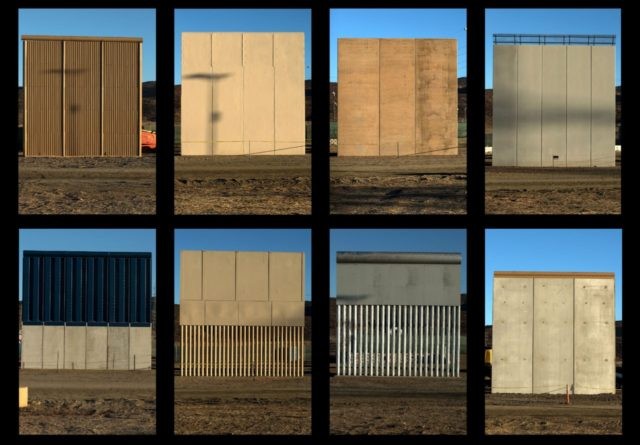
A significant portion of the projected costs for President Donald Trump’s proposed border barrier with Mexico could be covered with the money saved if the U.S. stopped funding the scandalous U.N. Relief and Works Agency (UNRWA), which ministers to so-called Palestinian refugees.
The U.S. is UNRWA’s single largest donor, providing about $300 million annually. Defunding UNRWA would save the U.S. upwards of $3 billion over the next ten years.
Estimates for Trump’s barrier differ greatly, with Trump himself saying in 2015 the wall would cost $6 to $7 billion, and this past April stating, “I’ll do it for $10 billion or less.”
The news website Quartz documented other varied estimates:
In a widely quoted analyst note, Bernstein Research put it at $15 billion to $25 billion.
January 2017—Senate majority leader Mitch McConnell said it would cost between $12 billion to $15 billion.
February 2017—A leaked report from the Department of Homeland Security put it much higher, at $21.6 billion.
Regardless of the final costs, halting funding to UNRWA could go a long way to bolstering our national security if the U.S. instead channeled those funds to Trump’s wall.
There are many reasons the U.S. should immediately stop funding UNRWA, which perpetuates the Israeli-Palestinian conflict, and instead take the approach recommended by Prime Minister Benjamin Netanyahu, who has called for the dismantlement of the UN’s Palestinian “refugee” agency.
The very existence of UNRWA is unnecessary. The international body has another agency, the UNHRC, which ministers to the world’s refugees other than Palestinians. Only Palestinian “refugees” have a separate agency, UNRWA.
The Palestinians and Arab states know that the so-called Palestinian refugee problem could only be sustained through a separate agency since Palestinian “refugees” do not meet the UN’s criteria for the very definition of refugees.
In fact, many readers may be surprised to learn the UN agency defines a Palestinian “refugee” in a manner that is different from all other refugees worldwide, and does so in a way that sustains the “refugee” crisis instead of solving the problem by finding solutions for the so-called Palestinian refugees.
The UNHRC, which again deals with all other refugees outside the Palestinian arena, has a fairly sensible definition of what a refugee is: “A refugee is someone who has been forced to flee his or her country because of persecution, war or violence. A refugee has a well-founded fear of persecution for reasons of race, religion, nationality, political opinion or membership in a particular social group.”
In other words, the UNHRC defines a refugee as someone who was forced to flee his or her home and cannot return for fear of persecution.
UNRWA, however, defines a Palestinian “refugee” entirely differently. A Palestinian “refugee” is any person whose “normal place of residence was Palestine during the period 1 June 1946 to 15 May 1948 and who lost both home and means of livelihood as a result of the 1948 conflict.” So UNRWA counts as “refugees” any local Arab who lived in Palestine for as little as two years, knowing that scores of Arabs immigrated to the area during those years in search of employment amid talks of creating a future Jewish state.
Amazingly, UNRWA states that “Palestine refugees are persons who fulfill the above definition and descendants of fathers fulfilling the definition.”
This means that even if original Palestinian “refugees” long ago immigrated to another country and became citizens of that country, they and their descendants are still considered “refugees” according to UNRWA. The definition flies in the face of what a refugee is supposed to be. It is also in direct contrast to the Convention on Refugees, which dictates that a person who “has acquired a new nationality, and enjoys the protection of the country of his new nationality” is exempted from the status of refugee.
UNRWA’s definition of a “refugee” doesn’t mention UNHCR’s “well-founded fear of being persecuted.” Indeed, the Palestinians have no fear of being persecuted by Israel, and would not be considered a “refugee” under ordinary international criteria.
In defining a refugee as it does, UNRWA has ensured that the Palestinian “refugee” problem has only grown throughout the years.
The actual number of Palestinian “refugees” is in question.
The Jewish Virtual Library notes:
Many Arabs claim that 800,000 to 1,000,000 Palestinians became refugees in 1947-49. The last census was taken in 1945. It found only 756,000 permanent Arab residents in Israel. On November 30, 1947, the date the UN voted for partition, the total was 809,100. A 1949 Government of Israel census counted 160,000 Arabs living in the country after the war. This meant no more than 650,000 Palestinian Arabs could have become refugees. A report by the UN Mediator on Palestine arrived at an even lower figure — 472,000.
The Library notes that at the same time that Arabs were left stranded, about the same number of Jews were forced to leave their homes in Arab countries:
The number of Jews fleeing Arab countries for Israel in the years following Israel’s independence was roughly equal to the number of Arabs leaving Palestine. Many Jews were allowed to take little more than the shirts on their backs. These refugees had no desire to be repatriated. Little is heard about them because they did not remain refugees for long. Of the 820,000 Jewish refugees, 586,000 were resettled in Israel at great expense and without any offer of compensation from the Arab governments who confiscated their possessions.
There is evidence that scores of Arabs joined the local inhabitants and became “refugees” attended to by UNRWA when the agency began operations in May 1950 to help the Arabs impacted by the 1948 war.
That year, UNRWA’s director admitted, “a large group of indigent people totaling over 100,000 … could not be called refugees, but … have lost their means of livelihood because of the war. … The Agency felt their need … even more acute than that of the refugees.”
UNRWA’s Annual Report of the Director from July 1951-June 1952 acknowledges it was difficult to separate “ordinary nomadic Bedouins and … unemployed or indigent local residents” from genuine refugees, and that “it cannot be doubted that in many cases individuals who could not qualify as being bona fide refugees are in fact on the relief rolls.”
Last week, Haaretz reported that Lebanon’s census data puts the Palestinian “refugee” population at about the third of the numbers reported by UNRWA. If accurate, this could mean UNRWA has been taking in funding for a wildly inflated number of so-called Palestinian refugees.
Haaretz reported:
Around 175,000 Palestinian refugees live in Lebanon, 45 percent of them in 12 refugee camps and 55 percent in 156 population centers throughout the country, according to a census conducted by Lebanon’s Central Administration of Statistics in partnership with the Palestinian Central Bureau of Statistics.
The total is much lower than the official figure of 500,000, cited by the United Nations Relief and Works Agency for Palestine Refugees in the Near East. It has been known for years that the UN figure was inaccurate, since many Palestinian refugees have emigrated from Lebanon. But the census finding was also below other estimates, such as that of the American University of Beirut in 2015, which put the figure at between 260,000 and 280,000.
The census was approved by Lebanon’s government in August 2015, and in October 2015 a memorandum of understanding was signed with the Palestinian Authority.
The Palestinian “refugee” issue is one of the most potent weapons utilized by the PA against Israel. The Palestinians use their “refugee” status to threaten Israel’s existence by demanding the so-called right of return, meaning flooding Israel with millions of Palestinian and foreign Arabs considered Palestinian “refugees,” thus threatening the very nature of the Jewish state. If the “refugee” problem is ever solved, the Palestinian Authority’s main trump card against Israel will be taken away and they know it.
As I wrote in my book, The Late Great State of Israel:
When UNRWA began operations, it was assumed that the refugee problem would be resolved and that the agency would function only temporarily. It was not anticipated that the Arab states, which were directly shaping the mandate of this new organization, had another idea: the refugees would be kept in camps for as long as it took, and the burden of political responsibility for them was to be placed permanently upon Israel.
As one PLO document on the refugees explains: “In order to keep the refugee issue alive and prevent Israel from evading responsibility for their plight, Arab countries—with the notable exception of Jordan—have usually sought to preserve a Palestinian identity by maintaining the Palestinians’ status as refugees.”
Arlene Kushner, an Israel-based researcher on UNRWA, explains: “In other words, as a matter of deliberate policy, most Arab nations have deliberately declined to absorb the refugees or give them citizenship, and have instead focused on their right to ‘return’ to Israel.”
The Palestinians and Arab nations, meanwhile, have distorted the history of “Palestinian refugees” to manipulate the international community.
The Palestinian narrative is simple: When the Jewish state was founded, Israel largely kicked the Palestinians (who, by the way, did not exist at the time under the name “Palestinians,” but were local Arab inhabitants who lived in a region also inhabited by Jews) out of their homes, thus causing hundreds of thousands to become refugees. The Palestinians refer to Israel’s creation as the “Nakba,” or catastrophe when Palestinian Arabs fled or were expelled from their homes.
The reality is quite different. After Israel was founded in 1948, a military coalition of Arab nations immediately formed to wage war on the new Jewish state. Some local Arabs, who did not yet go by the name of Palestinians, left the area in anticipation of the war, others directly responded to the dictates of Arab states to stay out of the way so that invading armies could conquer Israel, and still others fled once the war started so that they were not caught up in the fighting.
Arab states waged the war after refusing to accept UN Resolution 181, which called for the partition of the British Mandate of Palestine into Arab and Jewish states. The Jews immediately accepted the resolution, but the Arabs forthrightly rejected the plan, launching a war to destroy the Jewish state.
It should be noted that Israel’s Declaration of Independence called on the local Arab population to remain in place:
In the midst of wanton aggression, we yet call upon the Arab inhabitants of the State of Israel to preserve the ways of peace and play their part in the development of the State, on the basis of full and equal citizenship and due representation in all its bodies and institutions.
It is true that some Jewish groups, including the Haganah, encouraged local Arabs to flee, however those few documented cases are the exception and not the rule.
The Economist, for example, reported that the Arab residents of Haifa left their homes in large part because of Arab army warnings:
Of the 62,000 Arabs who formerly lived in Haifa not more than 5,000 or 6,000 remained. Various factors influenced their decision to seek safety in flight. There is but little doubt that the most potent of the factors were the announcements made over the air by the Higher Arab Executive, urging the Arabs to quit. … It was clearly intimated that those Arabs who remained in Haifa and accepted Jewish protection would be regarded as renegades.
“Arab officers ordered the complete evacuation of specific villages in certain areas, lest their inhabitants ‘treacherously’ acquiesce in Israeli rule or hamper Arab military deployments,” wrote historian Benny Morris.
The time has come for the U.S. to take stock of the UNRWA “fake news” narrative of Palestinian “refugees” and act accordingly.
to Pay for Trump’s Border Wall [url=]< >[/url]
A significant portion of the projected costs for President Donald Trump’s proposed border barrier with Mexico could be covered with the money saved if the U.S. stopped funding the scandalous U.N. Relief and Works Agency (UNRWA), which ministers to so-called Palestinian refugees.
The U.S. is UNRWA’s single largest donor, providing about $300 million annually. Defunding UNRWA would save the U.S. upwards of $3 billion over the next ten years.
Estimates for Trump’s barrier differ greatly, with Trump himself saying in 2015 the wall would cost $6 to $7 billion, and this past April stating, “I’ll do it for $10 billion or less.”
The news website Quartz documented other varied estimates:
In a widely quoted analyst note, Bernstein Research put it at $15 billion to $25 billion.
January 2017—Senate majority leader Mitch McConnell said it would cost between $12 billion to $15 billion.
February 2017—A leaked report from the Department of Homeland Security put it much higher, at $21.6 billion.
Regardless of the final costs, halting funding to UNRWA could go a long way to bolstering our national security if the U.S. instead channeled those funds to Trump’s wall.
There are many reasons the U.S. should immediately stop funding UNRWA, which perpetuates the Israeli-Palestinian conflict, and instead take the approach recommended by Prime Minister Benjamin Netanyahu, who has called for the dismantlement of the UN’s Palestinian “refugee” agency.
The very existence of UNRWA is unnecessary. The international body has another agency, the UNHRC, which ministers to the world’s refugees other than Palestinians. Only Palestinian “refugees” have a separate agency, UNRWA.
The Palestinians and Arab states know that the so-called Palestinian refugee problem could only be sustained through a separate agency since Palestinian “refugees” do not meet the UN’s criteria for the very definition of refugees.
In fact, many readers may be surprised to learn the UN agency defines a Palestinian “refugee” in a manner that is different from all other refugees worldwide, and does so in a way that sustains the “refugee” crisis instead of solving the problem by finding solutions for the so-called Palestinian refugees.
The UNHRC, which again deals with all other refugees outside the Palestinian arena, has a fairly sensible definition of what a refugee is: “A refugee is someone who has been forced to flee his or her country because of persecution, war or violence. A refugee has a well-founded fear of persecution for reasons of race, religion, nationality, political opinion or membership in a particular social group.”
In other words, the UNHRC defines a refugee as someone who was forced to flee his or her home and cannot return for fear of persecution.
UNRWA, however, defines a Palestinian “refugee” entirely differently. A Palestinian “refugee” is any person whose “normal place of residence was Palestine during the period 1 June 1946 to 15 May 1948 and who lost both home and means of livelihood as a result of the 1948 conflict.” So UNRWA counts as “refugees” any local Arab who lived in Palestine for as little as two years, knowing that scores of Arabs immigrated to the area during those years in search of employment amid talks of creating a future Jewish state.
Amazingly, UNRWA states that “Palestine refugees are persons who fulfill the above definition and descendants of fathers fulfilling the definition.”
This means that even if original Palestinian “refugees” long ago immigrated to another country and became citizens of that country, they and their descendants are still considered “refugees” according to UNRWA. The definition flies in the face of what a refugee is supposed to be. It is also in direct contrast to the Convention on Refugees, which dictates that a person who “has acquired a new nationality, and enjoys the protection of the country of his new nationality” is exempted from the status of refugee.
UNRWA’s definition of a “refugee” doesn’t mention UNHCR’s “well-founded fear of being persecuted.” Indeed, the Palestinians have no fear of being persecuted by Israel, and would not be considered a “refugee” under ordinary international criteria.
In defining a refugee as it does, UNRWA has ensured that the Palestinian “refugee” problem has only grown throughout the years.
The actual number of Palestinian “refugees” is in question.
The Jewish Virtual Library notes:
Many Arabs claim that 800,000 to 1,000,000 Palestinians became refugees in 1947-49. The last census was taken in 1945. It found only 756,000 permanent Arab residents in Israel. On November 30, 1947, the date the UN voted for partition, the total was 809,100. A 1949 Government of Israel census counted 160,000 Arabs living in the country after the war. This meant no more than 650,000 Palestinian Arabs could have become refugees. A report by the UN Mediator on Palestine arrived at an even lower figure — 472,000.
The Library notes that at the same time that Arabs were left stranded, about the same number of Jews were forced to leave their homes in Arab countries:
The number of Jews fleeing Arab countries for Israel in the years following Israel’s independence was roughly equal to the number of Arabs leaving Palestine. Many Jews were allowed to take little more than the shirts on their backs. These refugees had no desire to be repatriated. Little is heard about them because they did not remain refugees for long. Of the 820,000 Jewish refugees, 586,000 were resettled in Israel at great expense and without any offer of compensation from the Arab governments who confiscated their possessions.
There is evidence that scores of Arabs joined the local inhabitants and became “refugees” attended to by UNRWA when the agency began operations in May 1950 to help the Arabs impacted by the 1948 war.
That year, UNRWA’s director admitted, “a large group of indigent people totaling over 100,000 … could not be called refugees, but … have lost their means of livelihood because of the war. … The Agency felt their need … even more acute than that of the refugees.”
UNRWA’s Annual Report of the Director from July 1951-June 1952 acknowledges it was difficult to separate “ordinary nomadic Bedouins and … unemployed or indigent local residents” from genuine refugees, and that “it cannot be doubted that in many cases individuals who could not qualify as being bona fide refugees are in fact on the relief rolls.”
Last week, Haaretz reported that Lebanon’s census data puts the Palestinian “refugee” population at about the third of the numbers reported by UNRWA. If accurate, this could mean UNRWA has been taking in funding for a wildly inflated number of so-called Palestinian refugees.
Haaretz reported:
Around 175,000 Palestinian refugees live in Lebanon, 45 percent of them in 12 refugee camps and 55 percent in 156 population centers throughout the country, according to a census conducted by Lebanon’s Central Administration of Statistics in partnership with the Palestinian Central Bureau of Statistics.
The total is much lower than the official figure of 500,000, cited by the United Nations Relief and Works Agency for Palestine Refugees in the Near East. It has been known for years that the UN figure was inaccurate, since many Palestinian refugees have emigrated from Lebanon. But the census finding was also below other estimates, such as that of the American University of Beirut in 2015, which put the figure at between 260,000 and 280,000.
The census was approved by Lebanon’s government in August 2015, and in October 2015 a memorandum of understanding was signed with the Palestinian Authority.
The Palestinian “refugee” issue is one of the most potent weapons utilized by the PA against Israel. The Palestinians use their “refugee” status to threaten Israel’s existence by demanding the so-called right of return, meaning flooding Israel with millions of Palestinian and foreign Arabs considered Palestinian “refugees,” thus threatening the very nature of the Jewish state. If the “refugee” problem is ever solved, the Palestinian Authority’s main trump card against Israel will be taken away and they know it.
As I wrote in my book, The Late Great State of Israel:
When UNRWA began operations, it was assumed that the refugee problem would be resolved and that the agency would function only temporarily. It was not anticipated that the Arab states, which were directly shaping the mandate of this new organization, had another idea: the refugees would be kept in camps for as long as it took, and the burden of political responsibility for them was to be placed permanently upon Israel.
As one PLO document on the refugees explains: “In order to keep the refugee issue alive and prevent Israel from evading responsibility for their plight, Arab countries—with the notable exception of Jordan—have usually sought to preserve a Palestinian identity by maintaining the Palestinians’ status as refugees.”
Arlene Kushner, an Israel-based researcher on UNRWA, explains: “In other words, as a matter of deliberate policy, most Arab nations have deliberately declined to absorb the refugees or give them citizenship, and have instead focused on their right to ‘return’ to Israel.”
The Palestinians and Arab nations, meanwhile, have distorted the history of “Palestinian refugees” to manipulate the international community.
The Palestinian narrative is simple: When the Jewish state was founded, Israel largely kicked the Palestinians (who, by the way, did not exist at the time under the name “Palestinians,” but were local Arab inhabitants who lived in a region also inhabited by Jews) out of their homes, thus causing hundreds of thousands to become refugees. The Palestinians refer to Israel’s creation as the “Nakba,” or catastrophe when Palestinian Arabs fled or were expelled from their homes.
The reality is quite different. After Israel was founded in 1948, a military coalition of Arab nations immediately formed to wage war on the new Jewish state. Some local Arabs, who did not yet go by the name of Palestinians, left the area in anticipation of the war, others directly responded to the dictates of Arab states to stay out of the way so that invading armies could conquer Israel, and still others fled once the war started so that they were not caught up in the fighting.
Arab states waged the war after refusing to accept UN Resolution 181, which called for the partition of the British Mandate of Palestine into Arab and Jewish states. The Jews immediately accepted the resolution, but the Arabs forthrightly rejected the plan, launching a war to destroy the Jewish state.
It should be noted that Israel’s Declaration of Independence called on the local Arab population to remain in place:
In the midst of wanton aggression, we yet call upon the Arab inhabitants of the State of Israel to preserve the ways of peace and play their part in the development of the State, on the basis of full and equal citizenship and due representation in all its bodies and institutions.
It is true that some Jewish groups, including the Haganah, encouraged local Arabs to flee, however those few documented cases are the exception and not the rule.
The Economist, for example, reported that the Arab residents of Haifa left their homes in large part because of Arab army warnings:
Of the 62,000 Arabs who formerly lived in Haifa not more than 5,000 or 6,000 remained. Various factors influenced their decision to seek safety in flight. There is but little doubt that the most potent of the factors were the announcements made over the air by the Higher Arab Executive, urging the Arabs to quit. … It was clearly intimated that those Arabs who remained in Haifa and accepted Jewish protection would be regarded as renegades.
“Arab officers ordered the complete evacuation of specific villages in certain areas, lest their inhabitants ‘treacherously’ acquiesce in Israeli rule or hamper Arab military deployments,” wrote historian Benny Morris.
The time has come for the U.S. to take stock of the UNRWA “fake news” narrative of Palestinian “refugees” and act accordingly.