Quote:Fact Check: Has President Obama 'Depleted' The Military?
http://www.npr.org/2016/04/29/476048024/fact-...e-military
April 29, 2016·10:14 PM ET
Philip Ewing
President Obama has slashed defense spending and will leave his successor with a weaker military force — or so Republican presidential candidates, led by Donald Trump, charge.
THE CLAIM:
"Our military is depleted," Trump said in his foreign-policy address on Wednesday, "and we're asking our generals and military leaders to worry about global warming."
In the past, Trump has claimed the U.S. military under Obama has become "a disaster," and other Republicans have described it as "gutted" since Obama took office.
THE SHORT ANSWER:.
It's complicated.
Pentagon leaders bristle at the idea their force has been "gutted" or is a "disaster." The U.S. remains far and away the world's foremost military power.
But spending is down; the force is smaller than when Obama took office and its equipment is aging. And, indeed, military leaders have spoken out about what they call the national-security dangers associated with climate change.
But, but, WTF, it's getting colder! LOL!
THE LONG ANSWER:
Condemning a Democratic president for lavishing money on social programs at the expense of national defense is red meat for Republican voters. And compared to the peak of war-time spending at the height of the wars in Iraq and Afghanistan — and the expectations that Pentagon planners once had for how much spending would grow — the defense budget is down, as Trump charged.
So is the American troop presence in both countries, necessitating far less funding than was needed at the peak of the war. Whether Obama has deployed the "correct" American troop presence or pursued the right overall strategy for those ongoing wars and the newer conflict in Syria, are themselves the subject of separate debates.
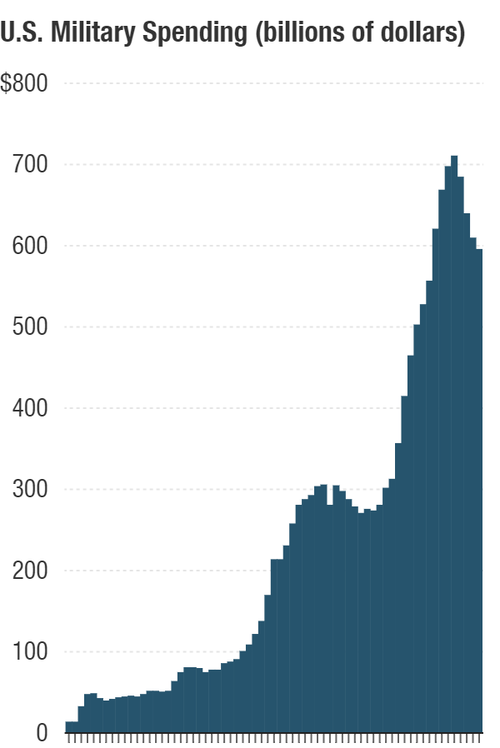
Post-9/11 Pentagon spending peaked in 2009 at more than $691 billion — a combination of the Defense Department's request for basic funds and the supplemental request it made for wartime spending.
Last year, those two accounts amounted to just over $580 billion (though the Stockholm International Peace Institute, or SIPRI, put total U.S. spending on its military in 2015 slightly higher at $596 billion). Meanwhile, every dollar buys less than it used to.
Since 1949, in raw dollars, U.S. military spending increased to a record high after the 9/11 attacks. It has come down some under President Obama, but nowhere near pre-9/11 levels.
Domenico Montanaro/NPR/Stockholm International Peace Research Institute
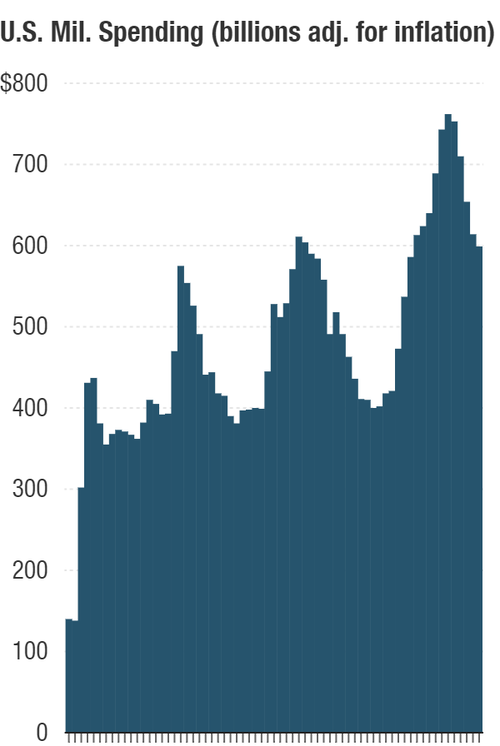
Since 1949, adjusted for inflation, aside from the post-9/11 build up, only in 1986 and 1987 during the Reagan administration, did the U.S. spend more on its military than it does now.
Domenico Montanaro/NPR/Stockholm International Peace Research Institute
"By nearly every measure of force structure — the number of brigades, aircraft, ships and subs, Marine battalions, and end strength, [today's force] is smaller than when the [post-9/11] buildup began," wrote budget expert Todd Harrison of the Center for Strategic and International Studies.
"Yet this smaller force consumes a budget more than 50 percent larger in real terms than before 9/11. The military is spending more on a smaller force."
That force is more capable than ever, administration officials argue. Obama famously mocked 2012 GOP presidential hopeful Mitt Romney by saying today's Army doesn't need as many "horses and bayonets" as it once did.
But it's also, in many cases, the same force that has been in service for years or even decades.
"Pilots are flying B-52s in combat missions today which are older than most people in this room," Trump said — which is true. The newest bomber in the fleet entered service in 1962, and the Air Force plans to keep its Eisenhower-era aircraft in service through 2040 if possible.
The Air Force has 12 entire fleets of aircraft that qualify for antique license plates in Virginia, chief of staff Gen. Mark Welsh says.
The Air Force has tried to replace many of these aircraft. In the case of the B-52, each time it has wound up with smaller batches of expensive newer bombers that supplement, rather than replace, the older bombers. It's trying again with a new goal to build between 80 and 100 new B-21 stealth bombers in a program it hopes will cost no more than $550 million per airplane.
That didn't stop Trump from slamming Obama, because the nuclear force "has been allowed to atrophy and is desperately in need of modernization and renewal."
But Obama, notwithstanding his own opposition to nuclear weapons, has committed to modernizing the U.S. arsenal. He supports the Air Force's new bomber, a new ballistic missile submarine for the Navy, revitalizing a fleet of nuclear bombs, a potential new nuclear cruise missile and other commitments. Some estimates put the cost for the program Obama supports at around $1 trillion over the next 30 years.
Defense officials don't dispute that the military costs a lot — but, they argue, taxpayers get a lot for what they buy. Defense Secretary Ash Carter and other leaders have tried to shy away from responding to comments by Trump and other candidates, but occasionally they get pulled in.
That was the case earlier this year when Air Force Gen. Paul Selva, the vice chairman of the Joint Chiefs of Staff, was asked about whether the U.S. military had, in fact, been "gutted." No, he argued. If it's smaller than it could be, it's still very powerful.
"At no time in my career have I been more confident than this instant in saying we have the most powerful military on the face of the planet," Selva said. "Do we have challenges? Of course we do. When you are faced with a global set of threats, you have to make choices on where you focus your energy."
One big area of risk, Selva and other Pentagon leaders say, is something that doesn't get much attention in the political arena — "readiness":
-how often soldiers can take target practice;
-how often pilots at home can fly training missions;
-how many days a Navy ship can sail to train before it deploys
Carter, Selva and the chiefs of the military services say this "readiness" is not where they want it, in case there is a major crisis.
But many units are very well-prepared, Selva said, and the bottom line is that the U.S. military remains the most powerful on Earth.
"I don't engage in politics," he said. "This is the reality of the men and women that serve in our Army, our Navy, our Air Force and our Marine Corps. They're the best the world has to offer, and we're going to keep them that way."
1