
Eleventh Hour: Paul Ryan Scrambles to Explain Away Trade Policy Effects on Wisconsin Workers
RACINE, Wisconsin — House Speaker Paul Ryan headed to friendly territory in his home district — Wisconsin’s first, which most in state politics expect him to win — to campaign for the final day before blue collar voters who will determine his fate.
But perhaps more importantly than that—Ryan shoring up what is supposed to be his base—Ryan was forced by workers in the two Wisconsin factories he visited on Monday to answer for globalization.
Ryan, facing a primary challenge from Republican businessman Paul Nehlen, hit the campaign trail in the final day before the voters who first sent him to Washington 18 years ago decide whether they want him to stay there.
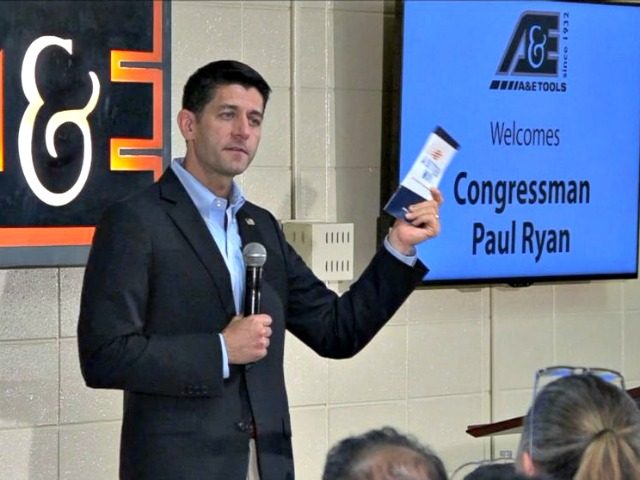
After more than a week of refusing to do any events in the district open to press, Ryan—on the final day before Tuesday’s primary with Nehlen—decided at the last minute to hold two open press events in the Racine area. One, in Racine, happened at A&E Tools—a fourth-generation Wisconsin manufacturing plant that employs hundreds locally—where Ryan took questions from workers in a town hall format. The second event, in Pleasant Prairie, was at Ocenco, another manufacturing plant. But it was at the first one that Ryan defended his trade policies, even at one point comparing himself and his position on trade to the 2016 GOP presidential nominee Donald Trump.
Ryan told a group of workers who assembled in a conference room with almost as many national reporters and media as there were factory workers:
I wanted to come here to A&E Tools to learn about how you get your jobs. I wanted to come and learn about how our economy works in Racine, because if I don’t understand how our economy works… then I can’t be a very good congressman. So one of the things I’m doing is talking to manufacturers about what is it we can do to make manufacturing more successful. What is it we can we do to have more of these jobs in America?
In addition to pushing his “A Better Way,” agenda which has come under fire during the primary, Ryan made a direct pitch that the way to keep jobs in America—to prevent outsourcing—is to do tax reform. Ryan said:
This business is taxed at the personal level, so their top tax rate here is 44.6 percent. You know what the companies doing this in other countries are taxed at, like the Canadian companies that produce the same kind of stuff? They’re taxed at 15 percent. China is at 25. Ireland is 12.5. England is 15. The average in the world is about 23. So when we tax our American made products, our American manufacturers much higher tax rates than our foreign competitors are taxing theirs, they immediately lose. So one of the things we are trying to do is make it so we are in a better position to keep jobs here in America, to keep manufacturing here. So we have proposed a complete overhaul of our tax system to number one get those tax rates down to about the average, 25 [percent]. Number two, we want to give businesses the incentive to hire more people and to build more buildings and to buy more machines.
Ryan argued that building out a company by building more buildings and buying new machines and hiring new people is too burdensome due to the tax code.
“Right now, we have these complicated tax laws that make it hard for them [businesses] to do that [expand],” Ryan said. “So we propose to give every American business the ability to write off all of their investment in their plant, their equipment, new machines they buy here in America to employ [new workers].”
Ryan also argued for increasing U.S. exports, so products would be manufactured here in the United States and shipped overseas.
“If you’re selling something overseas, what happens if you make that money overseas you have to pay the U.S. tax when you bring the money home—so companies don’t do that,” Ryan said. “So what we want to do is make it easier for businesses to stay making things in America, and selling overseas, and then bring that money back to America to reinvest in America.”
Ryan said, too, that governmental regulations on energy make it difficult to keep jobs at home.
“We’ve got a lot of oil and gas in America,” Ryan said, arguing that regulations on the energy industry lead to outsourcing.
“We have almost a Saudi Arabia in just the heart of Texas,” Ryan said. “So imagine what the world would be like if we opened up our potential, the jobs we would create in America.”
Ryan said lowering regulations on the energy industry, in addition to the tax cuts he is proposing, would make sure “the cost of making something in America isn’t as much as it otherwise would be.”
When the question-and-answer session started, one factory worker asked Ryan about taxes and how cutting taxes would affect the revenue stream into the federal government. During his several-minute-long answer, Ryan delved more into the globalization issue while also ripping “loopholes” in the tax code. Ryan said:
What we’ve learned is if we actually give businesses the incentive to expand domestically, to buy more machines to buy more buildings and buy more machines, more people will end up going to work and that will actually increase the economy. So there’s some things we can do to increase economic growth but at the end of the day if we get those [tax] rates down and pull those loopholes away so we can lower tax rates.
Ryan called the tax code “the worst one in the industrialized world,” saying it “puts us at a huge disadvantage with our foreign competitors.”
Ryan told the workers—and the owner—at A&E that “you’re competing against other countries, you’re competing against other manufacturers who will make ratchets, who will make tools, who are making these things in other countries—they’re taxed at much, much lower rates than A&E is taxed.”
“So in order to price competitive, A&E has to pay taxes and then compete on price against companies in say Canada that are taxed at 15 percent or 25 in Japan or China or wherever,” Ryan said. “We—we shouldn’t do that.”
Ryan said too that other countries that Americans “compete with” have what he called “consumption taxes,” pointing out that “they take their tax on their exports, and they place the tax on their imports.”
“So let’s take something we all know—Harley Davidson,” Ryan continued. He compared the product to a Japanese-made Honda motorcycle under his hypothetical example, where both Japan and the United States would ship competing motorcycles to Germany to sell them.
“Japan will make that [Honda motorcycle] and send it to Germany, and they take that tax off of it as it’s exported,” Ryan said. “And let’s just say we send a Harley to Germany. We tax that Harley and then it goes to Germany. Then they sell it into Germany, so if you go to a Harley dealer in Germany…and you buy it.”
At that point, Ryan said, if Harley Davidson would want to reinvest money it makes off selling a motorcycle in America, “you have to pay an American tax on top of it.”
“It’s a double duty,” Ryan said. “And oh by the way, when that tax goes into Germany it’s taxed on the way in as an import. We do the opposite, we tax exports and not imports. So what we propose is… take the tax off our exports.”
Ryan then cited another example:
“Have you ever heard of Johnson Controls? They make the thermostat here,” Ryan said. “They’re now becoming an Irish company. They’re doing this transaction to become Irish. You know I love Irish, I’m half-Irish, but I don’t like the fact that people are going to go become Irish companies. Their tax rate is 12.5 percent. So this is the problem. We have more and more American companies becoming foreign companies in part, not always but in part because of the tax code. Miller is brewed in Milwaukee but it’s not owned—it’s not an American company any more.”
Ryan again pushed for tax reform to fix this problem he now admits is happening.
So what we’re trying to do is clean up our tax laws so it makes sense to be an American company. [So that] it pays to be an American company. So that we can make things in America and put ourselves in a better position so that we can make things and sell them overseas. The last thing I’d say is this, 96 percent of the world’s consumers—the world’s people—they don’t live in America. They live in the other countries. So if we want to have a good economy where we make stuff here, a faster-growing economy, we have to sell things overseas. But we have to set ourselves up to be successful to do all that. We’re only 4 percent of the world’s population, and there’s no way we could possibly consume all that we produce in America because we’re a good economy. We’re a stronger economy…. So we have to get our tax laws competitive so it makes sense to keep making stuff here.
The next question was about the Trans Pacific Partnership, which until recently Ryan said he supported. He now says he opposes it in its current form and says there won’t be any votes on it until it is renegotiated, since there are not enough votes to pass it as is.
Ryan said it is unlikely the Pacific Rim trade deal would come up for a vote because “we don’t have the votes for it right now, because people like me have problems with significant provisions of it.” He added:
But here’s the point: We do need trade agreements. I know a lot of people just say get rid of trade agreements, don’t do trade agreements, they’re terrible. That’s a problem for us. They’re just wrong. I just said it: If 96 percent of the world’s consumers live in other countries, and we have to make things to sell them overseas to keep us fully employed, you’ve got to open up markets to our products. There’s three points I’d make, that’s point number one. Point number two: We’re in a global economy whether we like it or not. The question is who is going to write the rules for the global economy? Is America going to write the rules to benefit us, or do we retreat and not play the game—not get involved—and let other countries like China write the rules? We don’t have a trade agreement with China. We won’t have one at any time in the near future. We don’t want to see the playing field so that China writes the rules for China at our expense. So it’s really important that we get other countries to agree to play by our rules, our standards, our rules and standards so that we’re not undercut and so that we can get a level playing field…. Right now, that agreement [the TPP] isn’t there. It isn’t up to the standards in my opinion.
Ryan continued by arguing again that it’s “important that we get good agreements.” He said:
Let me give you another example, not just Asia—Europe. The Europeans are going around the world trying to get other countries to agree to their standards for cheese. We not only put cheese on our heads when we go to Lambeau Field, we make cheese. But there’s no way we could eat as much cheese as we produce in Wisconsin. Our dairy farmers and our cheese producers—which is one of our big exports here, it is basically the big employment of rural Wisconsin—we make Colby, we make Swiss, we make Gouda, we make Parmesan, I mean you name it. Other countries will say if the name of the cheese has a European name on it, you can only buy it from here—you can’t buy it from America. They want Canada to agree to this. So Canada now, according to this agreement, if we make Gouda or Parmesan at Sargento—or Swiss—up in Green Bay, they can’t buy it. It’s got to be coming from Europe. So here’s the problem, if you standstill on a trade deal you’re falling behind. So we’ve got all these other countries going around the world getting better deals in the sales, knocking us out of those markets so that our dairy farmers can’t, you know, grow dairy because they can’t sell to these markets. That’s what happens if we don’t engage. We’ve got to go to the Canadians to drop that now. Now we’ve got to go undo the damage it does to Wisconsin, so that’s why you need trade agreements to say ‘don’t agree to their rules, please use our rules’ so we can have markets for our products.
Ryan added that ultimately with every trade deal “the question is, ‘Is it a good agreement or not?’”
“That’s what Donald Trump says as well,” Ryan continued. “We want good trade agreements. We don’t want bad ones. We want good ones. But you got to have, in an economy like this, trade agreements so we can make it here and sell it there—instead of making it there and selling it there. That’s the difference here.”
RACINE, Wisconsin — House Speaker Paul Ryan headed to friendly territory in his home district — Wisconsin’s first, which most in state politics expect him to win — to campaign for the final day before blue collar voters who will determine his fate.
But perhaps more importantly than that—Ryan shoring up what is supposed to be his base—Ryan was forced by workers in the two Wisconsin factories he visited on Monday to answer for globalization.
Ryan, facing a primary challenge from Republican businessman Paul Nehlen, hit the campaign trail in the final day before the voters who first sent him to Washington 18 years ago decide whether they want him to stay there.
After more than a week of refusing to do any events in the district open to press, Ryan—on the final day before Tuesday’s primary with Nehlen—decided at the last minute to hold two open press events in the Racine area. One, in Racine, happened at A&E Tools—a fourth-generation Wisconsin manufacturing plant that employs hundreds locally—where Ryan took questions from workers in a town hall format. The second event, in Pleasant Prairie, was at Ocenco, another manufacturing plant. But it was at the first one that Ryan defended his trade policies, even at one point comparing himself and his position on trade to the 2016 GOP presidential nominee Donald Trump.
Ryan told a group of workers who assembled in a conference room with almost as many national reporters and media as there were factory workers:
I wanted to come here to A&E Tools to learn about how you get your jobs. I wanted to come and learn about how our economy works in Racine, because if I don’t understand how our economy works… then I can’t be a very good congressman. So one of the things I’m doing is talking to manufacturers about what is it we can do to make manufacturing more successful. What is it we can we do to have more of these jobs in America?
In addition to pushing his “A Better Way,” agenda which has come under fire during the primary, Ryan made a direct pitch that the way to keep jobs in America—to prevent outsourcing—is to do tax reform. Ryan said:
This business is taxed at the personal level, so their top tax rate here is 44.6 percent. You know what the companies doing this in other countries are taxed at, like the Canadian companies that produce the same kind of stuff? They’re taxed at 15 percent. China is at 25. Ireland is 12.5. England is 15. The average in the world is about 23. So when we tax our American made products, our American manufacturers much higher tax rates than our foreign competitors are taxing theirs, they immediately lose. So one of the things we are trying to do is make it so we are in a better position to keep jobs here in America, to keep manufacturing here. So we have proposed a complete overhaul of our tax system to number one get those tax rates down to about the average, 25 [percent]. Number two, we want to give businesses the incentive to hire more people and to build more buildings and to buy more machines.
Ryan argued that building out a company by building more buildings and buying new machines and hiring new people is too burdensome due to the tax code.
“Right now, we have these complicated tax laws that make it hard for them [businesses] to do that [expand],” Ryan said. “So we propose to give every American business the ability to write off all of their investment in their plant, their equipment, new machines they buy here in America to employ [new workers].”
Ryan also argued for increasing U.S. exports, so products would be manufactured here in the United States and shipped overseas.
“If you’re selling something overseas, what happens if you make that money overseas you have to pay the U.S. tax when you bring the money home—so companies don’t do that,” Ryan said. “So what we want to do is make it easier for businesses to stay making things in America, and selling overseas, and then bring that money back to America to reinvest in America.”
Ryan said, too, that governmental regulations on energy make it difficult to keep jobs at home.
“We’ve got a lot of oil and gas in America,” Ryan said, arguing that regulations on the energy industry lead to outsourcing.
“We have almost a Saudi Arabia in just the heart of Texas,” Ryan said. “So imagine what the world would be like if we opened up our potential, the jobs we would create in America.”
Ryan said lowering regulations on the energy industry, in addition to the tax cuts he is proposing, would make sure “the cost of making something in America isn’t as much as it otherwise would be.”
When the question-and-answer session started, one factory worker asked Ryan about taxes and how cutting taxes would affect the revenue stream into the federal government. During his several-minute-long answer, Ryan delved more into the globalization issue while also ripping “loopholes” in the tax code. Ryan said:
What we’ve learned is if we actually give businesses the incentive to expand domestically, to buy more machines to buy more buildings and buy more machines, more people will end up going to work and that will actually increase the economy. So there’s some things we can do to increase economic growth but at the end of the day if we get those [tax] rates down and pull those loopholes away so we can lower tax rates.
Ryan called the tax code “the worst one in the industrialized world,” saying it “puts us at a huge disadvantage with our foreign competitors.”
Ryan told the workers—and the owner—at A&E that “you’re competing against other countries, you’re competing against other manufacturers who will make ratchets, who will make tools, who are making these things in other countries—they’re taxed at much, much lower rates than A&E is taxed.”
“So in order to price competitive, A&E has to pay taxes and then compete on price against companies in say Canada that are taxed at 15 percent or 25 in Japan or China or wherever,” Ryan said. “We—we shouldn’t do that.”
Ryan said too that other countries that Americans “compete with” have what he called “consumption taxes,” pointing out that “they take their tax on their exports, and they place the tax on their imports.”
“So let’s take something we all know—Harley Davidson,” Ryan continued. He compared the product to a Japanese-made Honda motorcycle under his hypothetical example, where both Japan and the United States would ship competing motorcycles to Germany to sell them.
“Japan will make that [Honda motorcycle] and send it to Germany, and they take that tax off of it as it’s exported,” Ryan said. “And let’s just say we send a Harley to Germany. We tax that Harley and then it goes to Germany. Then they sell it into Germany, so if you go to a Harley dealer in Germany…and you buy it.”
At that point, Ryan said, if Harley Davidson would want to reinvest money it makes off selling a motorcycle in America, “you have to pay an American tax on top of it.”
“It’s a double duty,” Ryan said. “And oh by the way, when that tax goes into Germany it’s taxed on the way in as an import. We do the opposite, we tax exports and not imports. So what we propose is… take the tax off our exports.”
Ryan then cited another example:
“Have you ever heard of Johnson Controls? They make the thermostat here,” Ryan said. “They’re now becoming an Irish company. They’re doing this transaction to become Irish. You know I love Irish, I’m half-Irish, but I don’t like the fact that people are going to go become Irish companies. Their tax rate is 12.5 percent. So this is the problem. We have more and more American companies becoming foreign companies in part, not always but in part because of the tax code. Miller is brewed in Milwaukee but it’s not owned—it’s not an American company any more.”
Ryan again pushed for tax reform to fix this problem he now admits is happening.
So what we’re trying to do is clean up our tax laws so it makes sense to be an American company. [So that] it pays to be an American company. So that we can make things in America and put ourselves in a better position so that we can make things and sell them overseas. The last thing I’d say is this, 96 percent of the world’s consumers—the world’s people—they don’t live in America. They live in the other countries. So if we want to have a good economy where we make stuff here, a faster-growing economy, we have to sell things overseas. But we have to set ourselves up to be successful to do all that. We’re only 4 percent of the world’s population, and there’s no way we could possibly consume all that we produce in America because we’re a good economy. We’re a stronger economy…. So we have to get our tax laws competitive so it makes sense to keep making stuff here.
The next question was about the Trans Pacific Partnership, which until recently Ryan said he supported. He now says he opposes it in its current form and says there won’t be any votes on it until it is renegotiated, since there are not enough votes to pass it as is.
Ryan said it is unlikely the Pacific Rim trade deal would come up for a vote because “we don’t have the votes for it right now, because people like me have problems with significant provisions of it.” He added:
But here’s the point: We do need trade agreements. I know a lot of people just say get rid of trade agreements, don’t do trade agreements, they’re terrible. That’s a problem for us. They’re just wrong. I just said it: If 96 percent of the world’s consumers live in other countries, and we have to make things to sell them overseas to keep us fully employed, you’ve got to open up markets to our products. There’s three points I’d make, that’s point number one. Point number two: We’re in a global economy whether we like it or not. The question is who is going to write the rules for the global economy? Is America going to write the rules to benefit us, or do we retreat and not play the game—not get involved—and let other countries like China write the rules? We don’t have a trade agreement with China. We won’t have one at any time in the near future. We don’t want to see the playing field so that China writes the rules for China at our expense. So it’s really important that we get other countries to agree to play by our rules, our standards, our rules and standards so that we’re not undercut and so that we can get a level playing field…. Right now, that agreement [the TPP] isn’t there. It isn’t up to the standards in my opinion.
Ryan continued by arguing again that it’s “important that we get good agreements.” He said:
Let me give you another example, not just Asia—Europe. The Europeans are going around the world trying to get other countries to agree to their standards for cheese. We not only put cheese on our heads when we go to Lambeau Field, we make cheese. But there’s no way we could eat as much cheese as we produce in Wisconsin. Our dairy farmers and our cheese producers—which is one of our big exports here, it is basically the big employment of rural Wisconsin—we make Colby, we make Swiss, we make Gouda, we make Parmesan, I mean you name it. Other countries will say if the name of the cheese has a European name on it, you can only buy it from here—you can’t buy it from America. They want Canada to agree to this. So Canada now, according to this agreement, if we make Gouda or Parmesan at Sargento—or Swiss—up in Green Bay, they can’t buy it. It’s got to be coming from Europe. So here’s the problem, if you standstill on a trade deal you’re falling behind. So we’ve got all these other countries going around the world getting better deals in the sales, knocking us out of those markets so that our dairy farmers can’t, you know, grow dairy because they can’t sell to these markets. That’s what happens if we don’t engage. We’ve got to go to the Canadians to drop that now. Now we’ve got to go undo the damage it does to Wisconsin, so that’s why you need trade agreements to say ‘don’t agree to their rules, please use our rules’ so we can have markets for our products.
Ryan added that ultimately with every trade deal “the question is, ‘Is it a good agreement or not?’”
“That’s what Donald Trump says as well,” Ryan continued. “We want good trade agreements. We don’t want bad ones. We want good ones. But you got to have, in an economy like this, trade agreements so we can make it here and sell it there—instead of making it there and selling it there. That’s the difference here.”