
Here is a nice Kitty
50 Unusual Facts About Tiger
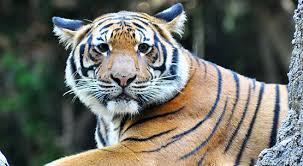
Animal Planet recently voted the impressively powerful tiger to be the world’s favorite animal. Yet a great deal of what we know about tigers is colored by common misconceptions or confusion with other large cats. Tigers are the most varied cat on earth, and have many unique features and interesting compulsions. They are a magnificent creature which is sadly endangered due to human carelessness, but hopefully, if we learn a little about them, we can become more aware of this admirable animal, and help them grow in numbers once again.
1. Tigers have eyes with round pupils, unlike domestic cats, which have slitted pupils. This is because domestic cats are nocturnal whereas tigers are crepuscular – they hunt primarily in the morning and evening.
2. Despite not being strongly adapted to the dark, tigers’ night vision is about six times better than humans’.
3. Most tigers have yellow eyes, but white tigers usually have blue eyes, due to the gene for blue eyes being linked to the gene for white fur. The gene for being cross-eyed, or boss-eyed, is also linked, so many white tigers have crossed blue eyes.
4. Tigers scratch trees and use their urine to mark their territories. Their urine smells strongly of buttered popcorn.
5. Tigers can tell the age, gender, and reproductive condition of other tigers by subtleties in the smell of urine markings.
Science
Next
Previous
Random List
Share
Twitter
Google+
Facebook
Pinterest
Animals
50 Unusual Facts About Tigers
Kate Wan September 10, 2012
Facebook Stumbleupon Twitter Pinterest Google+
Animal Planet recently voted the impressively powerful tiger to be the world’s favorite animal. Yet a great deal of what we know about tigers is colored by common misconceptions or confusion with other large cats. Tigers are the most varied cat on earth, and have many unique features and interesting compulsions. They are a magnificent creature which is sadly endangered due to human carelessness, but hopefully, if we learn a little about them, we can become more aware of this admirable animal, and help them grow in numbers once again.
1
Facts 1 – 5
Tigereyes
1. Tigers have eyes with round pupils, unlike domestic cats, which have slitted pupils. This is because domestic cats are nocturnal whereas tigers are crepuscular – they hunt primarily in the morning and evening.
2. Despite not being strongly adapted to the dark, tigers’ night vision is about six times better than humans’.
3. Most tigers have yellow eyes, but white tigers usually have blue eyes, due to the gene for blue eyes being linked to the gene for white fur. The gene for being cross-eyed, or boss-eyed, is also linked, so many white tigers have crossed blue eyes.
4. Tigers scratch trees and use their urine to mark their territories. Their urine smells strongly of buttered popcorn.
5. Tigers can tell the age, gender, and reproductive condition of other tigers by subtleties in the smell of urine markings.
2
Facts 6 – 10
Tiger%20Symbolism
6. Male tigers have larger territories than females, so that the areas overlap and the tigers can mate. Adult female territories generally never overlap with those of other adult females, and adult male territories do not overlap with those of other adult males.
7. Tigers do not normally roar at other animals, but instead they roar to communicate with far-off tigers. A tiger about to attack will therefore not roar, but might hiss and fuff instead.
8. When several tigers are present at a kill, the males will often wait for females and cubs to eat first, unlike lions, which do the opposite. Tigers rarely argue or fight over a kill and simply wait turns.
9. The stripes on each tiger are unique, like human fingerprints.
10. The markings on a tiger’s forehead closely resemble the Chinese character for king, giving tigers a cultural status as a regal animal.
11. Just like housecats, the markings on a tiger’s fur are also found on their skin, so even a shaved tiger would still show its stripes.
12. Unlike almost all other big cats, tigers are adept swimmers. They enjoy bathing and often play in the water when young. As adults, they often swim several kilometers to hunt or to cross rivers, and at least one has been recorded to have swum almost 30km in a day.
13. Tigers are the largest of all cats, but also have the most variability in size. The largest subspecies, the Siberian tiger, grows to over 3.5m long with a mass of over 300k. The smallest subspecies, the Sumatran tiger, is only around 2m long and 100kg when fully-grown.
14. Tigresses are fertile for a period of only four or five days throughout the entire year. During this time, they mate frequently. They are pregnant for a little over three months, and usually give birth to two or three cubs.
15. Tigers are completely blind for the first week of their life. About half do not survive to adulthood.
16. Tiger penises do not become erect when aroused. Instead, they contain a bone (called a baculum) and are covered with barbs which help maintain connection during copulation.
17. Tigers prefer to hunt large prey by ambush. If you look at a tiger, it is less likely to attack, as it has lost the element of surprise. In some locations in India, people traditionally wear a mask on the back of their head while walking through forests to prevent tigers from pouncing from behind.
18. Tigers do not normally view humans as prey, but will attack if threatened. Most cases of purposeful human predation are due to lack of a tiger’s normal prey species due to habitat loss.
19. A small number of tigers develop a taste for human flesh and become man-eaters. One tigress defended her cubs against unwitting humans and subsequently began preying on humans almost exclusively. She is thought to be responsible for the deaths of 430 people.
20. Due to their instinctive ambush hunting, even man-eating tigers do not directly enter human settlements, but stay near the outskirts and attack solitary people. They tend to hunt at night when humans are less able to see them sneak up.
21. Tigers cannot purr. To show happiness, tigers squint or close their eyes. This is because losing vision lowers defense, so tigers (and many other cats) only purposefully do so when they feel comfortable and safe.
22. Tigers can sprint at over 60km/h for short distances.
23. Tigers can leap distances of over 6m, and jump up to 5m vertically. Their muscular legs are so powerful that they can remain standing even when dead.
24. Only one in ten tiger hunts are successful, so tigers typically go several days without eating before gorging themselves on over 30kg of meat after a triumphant hunt.
25. Although tigers can comfortably fast for several days, they starve more quickly than other animals due to their immense size. A tiger will starve to death in only two or three weeks, whereas humans take 30-40 days.
26. Tigers have been known to imitate the call of other animals to successfully attract prey.
27. Bears make up a part of the diet of many tigers, due to overlapping habitats. Sometimes tigers will imitate the sound of a bear’s prey to lure unsuspecting bears towards them.
28. Tigers usually kill prey by strangulation or blood loss. They ambush the animal by leaping out and seizing its neck in their teeth. If a major artery is severed, the animal dies in seconds. Otherwise, the tiger hangs on as the prey thrashes, and it quickly dies of strangulation.
29. Although they favor killing using their 10cm teeth, tigers will sometimes use their paws. One swipe from a tiger’s front paw is strong enough to smash a bear’s skull or break its back.
30. Tigers can bite through bones with their powerful teeth and jaws. They will break the neck vertebrae of prey simply by biting straight through them
31. Tigers are very adaptable in their hunting techniques. Although they prefer to kill by attacking the neck, they do not do so when they recognize it is inappropriate. A large crocodile might bite down on a swimming tiger, which will immediately blind the reptile by striking it in the eyes. A crocodile’s neck is covered with thick amored skin, so the tiger will instead flip the animal over and eviscerate its soft belly.
32. Tigers have antiseptic saliva. They lick their wounds to disinfect them.
33. Like those of other cats, the upper side of tiger tongues are covered with fleshy bristles so that when they wash themselves with their tongues, they simultaneously comb their fur.
34. Unlike many other animals, tigers do not drink water by lapping it up on the top of their tongue, due to their tongue bristles. Instead, they cup the back of their tongue to flick water droplets into the air, which they then close their mouth over.
35. There are six subspecies of tiger living today: the Siberian tiger (Panthera tigris altaic a), the South China tiger (Panthera tigris amoyensis), the Indochinese tiger (Panthera tigris corbetti), the Malayan tiger (Panthera tigris jacksoni), the Sumatran tiger (Panthera tigris sumatrae), and the Bengal tiger (Panthera tigris tigris).
36. Three subspecies of tiger have all gone extinct in the last 80 years. The Bali tiger (Panthera tigris balica) was purposefully hunted to extinction in Bali due to its cultural status as evil. The Javan tiger (Panthera tigris sondaica) was hunted to extinction, although its numbers had been dwindling due to habitat loss to coffee and rubber plantations. The Caspian tiger (Panthera tigris virgata) went extinct due to extensive hunting of both it and its prey.
37. In China, poaching tigers or using them for traditional medicine has been illegal for many years and is punishable with death. In traditional medicine, there are many more potent and easily available medicines than tiger parts, which were historically used more for their exotic status than for any purported medicinal properties.
38. It is a common misconception that various tiger parts are used in traditional medicines chiefly as expensive aphrodisiacs. They are actually considered mostly to be treatments for arthritis and digestive problems in traditional medicines. In modern times, the misconception is gradually starting to lead to their use as said aphrodisiacs.
39. Unfortunately, tigers are still poached in some areas of Southeast Asia for consumption in traditional medicines, especially in Laos and Cambodia.
40. Apart from their various subspecies, tigers can have a number of different unusual fur colorations. These include white, gold, black, and even blue. All of these are caused by simple hair color genes. There have been reports but no confirmed cases of blue tigers, also called Maltese tigers.
41. Tigers live for about 25 years both in captivity and in the wild.
42. Cats in general have been found to have a better memory than any other animal, including humans, being several hundred times better than dogs and dozens of times better than primates. Tigers’ short-term memory alone lasts about thirty times longer than humans’, and their memories are made with stronger brain synapses, meaning that they can remember more and do not forget things as easily as we do.
43. Tigers have a brain that weighs over 300g. It is the largest brain of all carnivores except the polar bear, and is comparable to the size of a Chimpanzee’s brain.
44. There are only about 3,500 tigers left in the wild. There are a greater number in captivity.
45. Tigers are solitary animals and only group together either when permitted by a large kill or in the case of a mother with cubs.
46. A group of tigers is called an ambush or a streak.
47. Tigers have color vision like humans.
48. Tigers can mate with lions and other cats in captivity to produce hybrids. Through genetics, male lions normally try to make their offspring as large as possible, but are counteracted by female lions, who make offspring smaller. Tigers have no such controls, so a male lion and a female tiger produce enormous offspring, ligers, whereas a female lion and a male tiger produce the much smaller tiglon.
49. Ligers can be over 4m long and are the largest cats in the world.
50. Tigers can produce sterile offspring with cats other than lions. Leopards and tigers interact in the wild and sometimes naturally produce offspring. These are slightly smaller than tigers and have stripes that break up along their lengths into clusters of spots

50 Unusual Facts About Tiger
Animal Planet recently voted the impressively powerful tiger to be the world’s favorite animal. Yet a great deal of what we know about tigers is colored by common misconceptions or confusion with other large cats. Tigers are the most varied cat on earth, and have many unique features and interesting compulsions. They are a magnificent creature which is sadly endangered due to human carelessness, but hopefully, if we learn a little about them, we can become more aware of this admirable animal, and help them grow in numbers once again.
1. Tigers have eyes with round pupils, unlike domestic cats, which have slitted pupils. This is because domestic cats are nocturnal whereas tigers are crepuscular – they hunt primarily in the morning and evening.
2. Despite not being strongly adapted to the dark, tigers’ night vision is about six times better than humans’.
3. Most tigers have yellow eyes, but white tigers usually have blue eyes, due to the gene for blue eyes being linked to the gene for white fur. The gene for being cross-eyed, or boss-eyed, is also linked, so many white tigers have crossed blue eyes.
4. Tigers scratch trees and use their urine to mark their territories. Their urine smells strongly of buttered popcorn.
5. Tigers can tell the age, gender, and reproductive condition of other tigers by subtleties in the smell of urine markings.
Science
Next
Previous
Random List
Share
Google+
Animals
50 Unusual Facts About Tigers
Kate Wan September 10, 2012
Facebook Stumbleupon Twitter Pinterest Google+
Animal Planet recently voted the impressively powerful tiger to be the world’s favorite animal. Yet a great deal of what we know about tigers is colored by common misconceptions or confusion with other large cats. Tigers are the most varied cat on earth, and have many unique features and interesting compulsions. They are a magnificent creature which is sadly endangered due to human carelessness, but hopefully, if we learn a little about them, we can become more aware of this admirable animal, and help them grow in numbers once again.
1
Facts 1 – 5
Tigereyes
1. Tigers have eyes with round pupils, unlike domestic cats, which have slitted pupils. This is because domestic cats are nocturnal whereas tigers are crepuscular – they hunt primarily in the morning and evening.
2. Despite not being strongly adapted to the dark, tigers’ night vision is about six times better than humans’.
3. Most tigers have yellow eyes, but white tigers usually have blue eyes, due to the gene for blue eyes being linked to the gene for white fur. The gene for being cross-eyed, or boss-eyed, is also linked, so many white tigers have crossed blue eyes.
4. Tigers scratch trees and use their urine to mark their territories. Their urine smells strongly of buttered popcorn.
5. Tigers can tell the age, gender, and reproductive condition of other tigers by subtleties in the smell of urine markings.
2
Facts 6 – 10
Tiger%20Symbolism
6. Male tigers have larger territories than females, so that the areas overlap and the tigers can mate. Adult female territories generally never overlap with those of other adult females, and adult male territories do not overlap with those of other adult males.
7. Tigers do not normally roar at other animals, but instead they roar to communicate with far-off tigers. A tiger about to attack will therefore not roar, but might hiss and fuff instead.
8. When several tigers are present at a kill, the males will often wait for females and cubs to eat first, unlike lions, which do the opposite. Tigers rarely argue or fight over a kill and simply wait turns.
9. The stripes on each tiger are unique, like human fingerprints.
10. The markings on a tiger’s forehead closely resemble the Chinese character for king, giving tigers a cultural status as a regal animal.
11. Just like housecats, the markings on a tiger’s fur are also found on their skin, so even a shaved tiger would still show its stripes.
12. Unlike almost all other big cats, tigers are adept swimmers. They enjoy bathing and often play in the water when young. As adults, they often swim several kilometers to hunt or to cross rivers, and at least one has been recorded to have swum almost 30km in a day.
13. Tigers are the largest of all cats, but also have the most variability in size. The largest subspecies, the Siberian tiger, grows to over 3.5m long with a mass of over 300k. The smallest subspecies, the Sumatran tiger, is only around 2m long and 100kg when fully-grown.
14. Tigresses are fertile for a period of only four or five days throughout the entire year. During this time, they mate frequently. They are pregnant for a little over three months, and usually give birth to two or three cubs.
15. Tigers are completely blind for the first week of their life. About half do not survive to adulthood.
16. Tiger penises do not become erect when aroused. Instead, they contain a bone (called a baculum) and are covered with barbs which help maintain connection during copulation.
17. Tigers prefer to hunt large prey by ambush. If you look at a tiger, it is less likely to attack, as it has lost the element of surprise. In some locations in India, people traditionally wear a mask on the back of their head while walking through forests to prevent tigers from pouncing from behind.
18. Tigers do not normally view humans as prey, but will attack if threatened. Most cases of purposeful human predation are due to lack of a tiger’s normal prey species due to habitat loss.
19. A small number of tigers develop a taste for human flesh and become man-eaters. One tigress defended her cubs against unwitting humans and subsequently began preying on humans almost exclusively. She is thought to be responsible for the deaths of 430 people.
20. Due to their instinctive ambush hunting, even man-eating tigers do not directly enter human settlements, but stay near the outskirts and attack solitary people. They tend to hunt at night when humans are less able to see them sneak up.
21. Tigers cannot purr. To show happiness, tigers squint or close their eyes. This is because losing vision lowers defense, so tigers (and many other cats) only purposefully do so when they feel comfortable and safe.
22. Tigers can sprint at over 60km/h for short distances.
23. Tigers can leap distances of over 6m, and jump up to 5m vertically. Their muscular legs are so powerful that they can remain standing even when dead.
24. Only one in ten tiger hunts are successful, so tigers typically go several days without eating before gorging themselves on over 30kg of meat after a triumphant hunt.
25. Although tigers can comfortably fast for several days, they starve more quickly than other animals due to their immense size. A tiger will starve to death in only two or three weeks, whereas humans take 30-40 days.
26. Tigers have been known to imitate the call of other animals to successfully attract prey.
27. Bears make up a part of the diet of many tigers, due to overlapping habitats. Sometimes tigers will imitate the sound of a bear’s prey to lure unsuspecting bears towards them.
28. Tigers usually kill prey by strangulation or blood loss. They ambush the animal by leaping out and seizing its neck in their teeth. If a major artery is severed, the animal dies in seconds. Otherwise, the tiger hangs on as the prey thrashes, and it quickly dies of strangulation.
29. Although they favor killing using their 10cm teeth, tigers will sometimes use their paws. One swipe from a tiger’s front paw is strong enough to smash a bear’s skull or break its back.
30. Tigers can bite through bones with their powerful teeth and jaws. They will break the neck vertebrae of prey simply by biting straight through them
31. Tigers are very adaptable in their hunting techniques. Although they prefer to kill by attacking the neck, they do not do so when they recognize it is inappropriate. A large crocodile might bite down on a swimming tiger, which will immediately blind the reptile by striking it in the eyes. A crocodile’s neck is covered with thick amored skin, so the tiger will instead flip the animal over and eviscerate its soft belly.
32. Tigers have antiseptic saliva. They lick their wounds to disinfect them.
33. Like those of other cats, the upper side of tiger tongues are covered with fleshy bristles so that when they wash themselves with their tongues, they simultaneously comb their fur.
34. Unlike many other animals, tigers do not drink water by lapping it up on the top of their tongue, due to their tongue bristles. Instead, they cup the back of their tongue to flick water droplets into the air, which they then close their mouth over.
35. There are six subspecies of tiger living today: the Siberian tiger (Panthera tigris altaic a), the South China tiger (Panthera tigris amoyensis), the Indochinese tiger (Panthera tigris corbetti), the Malayan tiger (Panthera tigris jacksoni), the Sumatran tiger (Panthera tigris sumatrae), and the Bengal tiger (Panthera tigris tigris).
36. Three subspecies of tiger have all gone extinct in the last 80 years. The Bali tiger (Panthera tigris balica) was purposefully hunted to extinction in Bali due to its cultural status as evil. The Javan tiger (Panthera tigris sondaica) was hunted to extinction, although its numbers had been dwindling due to habitat loss to coffee and rubber plantations. The Caspian tiger (Panthera tigris virgata) went extinct due to extensive hunting of both it and its prey.
37. In China, poaching tigers or using them for traditional medicine has been illegal for many years and is punishable with death. In traditional medicine, there are many more potent and easily available medicines than tiger parts, which were historically used more for their exotic status than for any purported medicinal properties.
38. It is a common misconception that various tiger parts are used in traditional medicines chiefly as expensive aphrodisiacs. They are actually considered mostly to be treatments for arthritis and digestive problems in traditional medicines. In modern times, the misconception is gradually starting to lead to their use as said aphrodisiacs.
39. Unfortunately, tigers are still poached in some areas of Southeast Asia for consumption in traditional medicines, especially in Laos and Cambodia.
40. Apart from their various subspecies, tigers can have a number of different unusual fur colorations. These include white, gold, black, and even blue. All of these are caused by simple hair color genes. There have been reports but no confirmed cases of blue tigers, also called Maltese tigers.
41. Tigers live for about 25 years both in captivity and in the wild.
42. Cats in general have been found to have a better memory than any other animal, including humans, being several hundred times better than dogs and dozens of times better than primates. Tigers’ short-term memory alone lasts about thirty times longer than humans’, and their memories are made with stronger brain synapses, meaning that they can remember more and do not forget things as easily as we do.
43. Tigers have a brain that weighs over 300g. It is the largest brain of all carnivores except the polar bear, and is comparable to the size of a Chimpanzee’s brain.
44. There are only about 3,500 tigers left in the wild. There are a greater number in captivity.
45. Tigers are solitary animals and only group together either when permitted by a large kill or in the case of a mother with cubs.
46. A group of tigers is called an ambush or a streak.
47. Tigers have color vision like humans.
48. Tigers can mate with lions and other cats in captivity to produce hybrids. Through genetics, male lions normally try to make their offspring as large as possible, but are counteracted by female lions, who make offspring smaller. Tigers have no such controls, so a male lion and a female tiger produce enormous offspring, ligers, whereas a female lion and a male tiger produce the much smaller tiglon.
49. Ligers can be over 4m long and are the largest cats in the world.
50. Tigers can produce sterile offspring with cats other than lions. Leopards and tigers interact in the wild and sometimes naturally produce offspring. These are slightly smaller than tigers and have stripes that break up along their lengths into clusters of spots
1