
Quote:Blue State, Red Face: Guess Who Benefits More From Your Taxes?
Picking up on yesterday's theme, the fiscal cliff, let's look at the wider context to the argument between left and right over taxes and spending cuts.
Michael Moran
Michael Moran is an author and geopolitical analyst.
http://www.slate.com/blogs/the_reckoning/2012...taxes.html
There are serious economists who study the difference between what our states pay in taxes and how much they get in return from the U.S. government. These people generally don’t draw political, let along moral, judgments from these numbers.
I’m under no such constraint. The numbers, for decades now, have been quite clear: With some exceptions, what we regard as red states are sent a whole lot more of your hard-earned tax dollars than the traditional blue states.
In effect, supposedly indolent, “tax and spend” liberals actually subsidize the individualistic, pure, and hard-working lifestyle of our conservative countrymen.
Don’t believe me? Well, there’s plenty of room for quibbling about what constitutes a tax payment vs. a federal benefit. Let’s hash that out below in the comments section. But for simplicity's sake (and to account for the fact that it’s hard to label some states as purely red or blue, I’ve taken the most recent Electoral College Map from RealClearPolitics—
which shows how these states would likely vote if the presidential election were today—and cross-referenced it with numbers from one of those places peopled by serious economists: the nonpartisan Tax Foundation.*

![]()
Actual vote:
![]()
The results will stun many people, though not me: I’ve been telling my Tea Party relatives this for years. Here’s a list of the top 10 states that got the most back in terms of federal benefits, followed by the bottom 10. I’ve added the reasons why, when they’re obvious, in the space to the right.
To save space below, “pension benefits” include both Medicare and Social Security; “anti-poverty aid” includes Head Start, Low Income Home Energy Assistance, Food Stamp and nutrition programs for Women, Infants and Children (WIC), and several school-lunch-style benefits.
Top Ten (Source: Tax Foundation):
1. New Mexico Indian reservations, military bases, federal research labs, farm subsidies, retirement programs
2. Mississippi Farm subsidies, military spending, nutrition and anti-poverty aid, retirement programs.
3. Alaska Per capita No 1 recipient of federal benefits; infrastructure projects, DOT and pork projects.
4. Louisiana Disaster relief, farm subsidies, anti-poverty and nutrition aid, military spending.
5. W. Virginia Farm subsidies, anti-poverty and nutrition aid.
6. N. Dakota Farm subsidies, energy subsidies, retirement and anti-poverty programs, Indian reservations.
7. Alabama Retirement programs, anti-poverty and nutrition aid, federal space/military spending, farm subsidies.
8. S. Dakota Retirement programs, nutrition aid, farm subsidies, military spending, Indian reservations.
9. Virginia Civil service pensions, military spending, veterans benefits, retirement, anti-poverty aid.
10. Kentucky Retirement programs, nutritional and anti-poverty aid, farm subsidies.
Now consider the bottom 10, i.e., the ones that give more to the federal government in taxes than they get in return. From 1 to 10, they are:
New Jersey, Nevada, Connecticut, New Hampshire, Minnesota, Illinois, Delaware, California, New York, Colorado.
Anything strange about that list? Yes, they are all blue states (or the deepest of purple).
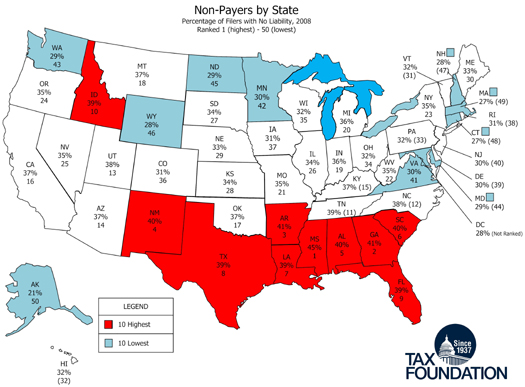
Adding to this fallacy are the assumptions surrounding Mitt Romney’s now infamous comments about the indolent “47 percent” of Americans who regard themselves as victims and therefore pay no taxes.
As the American Conservative magazine (no less) pointed out recently, nine of those 10 states are in the red-as-ruby Old Confederacy.*
![]()
Put another way, again by the American Conservative, “On the other hand, eight of the ten states with the highest non-payment rates are solidly Republican. The exceptions are New Mexico and Florida.”
Is your mouth agape?
Now, one more cross-reference: these facts compared with the know-nothing rhetoric of the Tea Party. There are only two ways to parse that result: one is ignorance—which we should be willing to forgive in anyone as long as they revise their views when faced with reality.
And the second? Selfish hypocrisy. How else can you explain the fact that the denizens of the most welfare dependent states in the country—dare we say, those who enjoy the most benefits from socialism—profess to abhor welfare?
This is a far cry from what most people think. My sense is that, if you asked the average American, they would assume that states benefiting most from federal spending are exactly the opposite—you know, those populated with Ronald Reagan’s “welfare queens” and lazy unionized auto workers.
I’ll be the first to admit this isn’t a black-and-white exercise. Plenty of questions need to be settled before clear judgments can be made.
For instance, does an Army base and the federal money that goes into keeping it running and paying its troops count as a benefit? (It does in my book.)
What about a federal prison? (Yeah, jobs and the tax revenues they generate should count there, too.) A private university that is showered with federal research dollars? (Again, yes, those funds count, too.)
But those questions get harder.
Agricultural subsidies? How do we count them—and do we subtract the tax revenues generated by the jobs the farm creates or the export earnings it provides?
And what about defense contractors? Connecticut, Washington state, and California are chock full of weapons merchants. They provide jobs, export income, and many other benefits.
Should we count as a federal inflow to those states the money spent, say, on Sikorsky aircraft contracts in Connecticut?
And how do we factor in the taxes those companies paid (assuming, unlike nearby General Electric, they actually paid taxes)?
And I admit, maybe we should dock Connecticut and New Jersey for the remaining outstanding balance of the TARP program?
All these accounting issues are over my head, I’ll freely admit. But I trust the figures above, compiled by the rock solid economists at the Tax Foundation, a nonpartisan research group—as a good indicator of the general state of our fiscal reality.
When the reality has veered so far from the prevailing political bullshit, it’s time for someone to point it out.
So spare me all that red state angst about the federal deficits and national debt. When you stop spending New Jersey’s money, Tex, and produce a plan to replace it with your own revenue stream, then you've earned an opinion in the matter.
Blue State, Red Face: Guess Who Benefits More From Your
Top 10 Most Recent News Articles
IBM's Quantum Leap in Chicago Puts Illinois on Map
Chicago Steps into the Quantum Race In a world where cutting-edge tech isn't just desired, it's demanded, Chicago's just put itself on the quantum map with IBM's latest move. The unveiling of IBM Quantum System Two at the University of Chicago marks a milestone not just for the city, but for Illinois at large. This isn't some pie-in-the-sky tech dream—it's a tangible...
Continue Reading
F&G Boosts Dividend for Investors in Strong Signal
Ring the Bell: Dividend Hike from F&G F&G Annuities & Life (NYSE: FG) just raised its dividend, and every investor worth their salt knows that means something. A 4% bump up to $0.26 per common share might not sound like a fanfare, but in the land of finance, it's an indication that this company thinks it's riding a positive wave. It’s like getting a little bonus in your...
Continue Reading
Broadridge's $7.6T Tokenization Play: What's Next?
Broadridge's Massive October: A Fintech Revelation What a whirlwind October was for Broadridge! This fintech giant has shot to the front line with their Distributed Ledger Repo (DLR) processing an eye-popping $7.6 trillion in repo transactions. We’re talking serious cash moving around here, folks. Average daily volumes hit $345 billion—it's like someone opened the...
Continue Reading
Capitol Securities Adds Financial Veterans to Team
Big Moves in Sarasota: Capitol Securities' New Additions In a world where every Wall Street whisper can send ripples through financial markets, Capitol Securities Management's move to bring on Joe Malave and Katy Carrigan is anything but a minor footnote. You'd think, by now, we'd be numb to industry shifts, but when a pro like Malave, with his 30 years of financial...
Continue Reading
CleanSpark Sets Investor Events with Promising Outlook
CleanSpark's Strategy Gets the Spotlight Looks like CleanSpark's stepping up to the plate, folks. They're shouting from the rooftops about hitting the upcoming investor events, and it’s no small potatoes. The company’s lined up a string of high-profile conferences, showcasing their ambition to stay ahead in the energy and data center games. We're talking about the...
Continue Reading
CalExitNow Push for CA GOP Ban & Sovereignty Talks
California's Political Pot Stirs In the wild world of politics, California stands as a fiery beacon yet again. This time, CalExitNow, a fiery group championing California's self-determination, is taking aim at the state’s Republican Party. Reminds me of a stock under pressure—hesitate at your peril as the winds of change sweep through. Disqualification Petition: A...
Continue Reading
Trucordia Expands BYU Sponsorship with Helmet Branding
Trucordia Gets Visible with BYU Football Alright, BYU fans and insurance buffs, here's your latest play-by-play. Trucordia, a major player in the insurance game, is ratcheting up its visibility in the college sports scene. They've struck gold with a multiyear sponsorship deal putting their logo on Brigham Young University's (BYU) football helmet bumpers. Talk about a...
Continue Reading
Alfa Laval's Bold Move: Snapping Up NAVTOR for $700M
The Seismic Shift in Maritime Solutions Alfa Laval's decision to acquire NAVTOR for a massive $700 million in cash throws down a marker in the maritime domain. This isn't some casual, "let's test the waters" thing; it's the kind of big-money play we all sit up and notice. You're talking about Alfa Laval trying to mold the digital side of their maritime offerings, right...
Continue Reading
Investor Bidding on Off-Market Homes Surges 35% Higher
Investor Frenzy in Off-Market Real Estate Looking at the real estate puzzle today, one might spot an unexpected surge in enthusiasm for off-market residential properties. We've got iFinder Offers, a real estate platform that's made it its business to connect the dots between homeowners and a gaggle of over 325 hungry investors. And according to their magic spreadsheets,...
Continue Reading
Veteran Health Study Reveals Gains in Mental Wellness
Veterans' Mental Health: A Case Study Unveiled When it comes to addressing mental health in veteran communities, everyone likes to flap their gums, but what about real action? A case study from 'Give an Hour' just hit the streets, and let me tell you, it’s stirring more conversation about MILE—Mental Health and Wellness Initiative for Learning and Engagement. It's not...
Continue ReadingTop 5 Most Recently Viewed Articles
DataOps.live Achieves Prestige in 2024 ISG DataOps Reports
DataOps.live Achieves Recognition in the 2024 ISG DataOps Buyers Guides Among 49 vendors evaluated by ISG Research, DataOps.live has been distinguished as one of three companies excelling in all crucial areas of DataOps. This remarkable achievement highlights the Company's commitment to providing comprehensive solutions across multiple platform categories. Comprehensive...
Continue Reading
Cecilian Partners Recognized for Transforming Veterans' Careers
Cecilian Partners Honored as 2025 Partner of the Year In an exciting announcement, Code Platoon, a nonprofit coding bootcamp devoted to supporting Veterans, Servicemembers, and military families, has awarded the title of 2025 Partner of the Year to Cecilian Partners. This special recognition celebrates a partnership that remarkably enhances Code Platoon’s mission to...
Continue Reading
The Impact of Recent Federal Rate Cuts on Realty Income
The Federal Reserve slashed interest rates by 50 basis points, igniting buzz across sectors, particularly real estate. This move was part of a broader easing cycle after years of aggressive hikes aimed at curbing inflation. You gotta understand how these rate shifts influence everything—from borrowing costs to investment flows—especially in a high-stakes arena like...
Continue Reading
Exploring the Growth of $1000 in Norfolk Southern Over Two Decades
A Look at Norfolk Southern's Investment Potential Norfolk Southern (NYSE: NSC) has significantly outperformed the broader market over the last two decades. With an average annual return of 13.15%, this notable railway company boasts an impressive annualized growth rate. As of now, Norfolk Southern's market capitalization stands at a staggering $55.43 billion, indicating...
Continue Reading
NexGen Health Unveils Innovative Cerebrolysin IV Therapy Program
NexGen Health Introduces Cerebrolysin IV Therapy Program NexGen Health has officially launched a cutting-edge Cerebrolysin IV Therapy Program, emphasizing advanced neurological support through an individualized approach. This innovative program provides a comprehensive 10-treatment protocol dedicated to enhancing brain function, mitigating the effects of cognitive...
Continue Reading