How securities are traded plays a critical role in price determination and stability
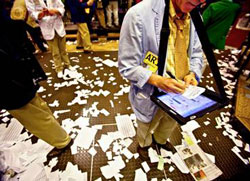
Paper or pixel? (photo: Orjan F. Ellingvag/Dagens Naringsliv/Corbis)
Financial markets are complex organizations with their own economic and institutional structures that play a critical role in determining how prices are established—or “discovered,” as traders say. These structures also shape the orderliness and indeed the stability of the marketplace. As holders of subprime collateralized debt obligations and other distressed debt securities found out in the months following the August 2007 onset of the financial turmoil that led to the global economic crisis, some types of market arrangements can very quickly become disorderly, dysfunctional, or otherwise unstable.
There are two basic ways to organize financial markets—exchange and over the counter (OTC)—although some recent electronic facilities blur the traditional distinctions.
Trading on an exchange
Exchanges, whether stock markets or derivatives exchanges, started as physical places where trading took place. Some of the best known include the New York Stock Exchange (NYSE), which was formed in 1792, and the Chicago Board of Trade (now part of the CME Group), which has been trading futures contracts since 1851. Today there are more than a hundred stock and derivatives exchanges throughout the developed and developing world.
But exchanges are more than physical locations. They set the institutional rules that govern trading and information flows about that trading. They are closely linked to the clearing facilities through which post-trade activities are completed for securities and derivatives traded on the exchange. An exchange centralizes the communication of bid and offer prices to all direct market participants, who can respond by selling or buying at one of the quotes or by replying with a different quote. Depending on the exchange, the medium of communication can be voice, hand signal, a discrete electronic message, or computer-generated electronic commands. When two parties reach agreement, the price at which the transaction is executed is communicated throughout the market. The result is a level playing field that allows any market participant to buy as low or sell as high as anyone else as long as the trader follows exchange rules.
The advent of electronic trading has eliminated the need for exchanges to be physical places. Indeed, many traditional trading floors are closing, and the communication of orders and executions are being conducted entirely electronically. The London Stock Exchange and the NASDAQ Stock Market are completely electronic, as is Eurex, the world’s second-largest futures exchange. Many others, as they phase out floor trading, offer both floor and electronic trading. The NYSE bought the electronic trading platform Archipelago as it moves increasingly toward electronic trading. Derivatives exchanges such as the CME Group maintain both old-style pits and electronic trading. Brazil’s BM&F maintained both until 2009.
Trading over the counter
Unlike exchanges, OTC markets have never been a “place.” They are less formal, although often well-organized, networks of trading relationships centered around one or more dealers. Dealers act as market makers by quoting prices at which they will sell (ask or offer) or buy (bid) to other dealers and to their clients or customers. That does not mean they quote the same prices to other dealers as they post to customers, and they do not necessarily quote the same prices to all customers. Moreover, dealers in an OTC security can withdraw from market making at any time, which can cause liquidity to dry up, disrupting the ability of market participants to buy or sell. Exchanges are far more liquid because all buy and sell orders as well as execution prices are exposed to one another. Also, some exchanges designate certain participants as dedicated market makers and require them to maintain bid and ask quotes throughout the trading day. In short, OTC markets are less transparent and operate with fewer rules than do exchanges. All of the securities and derivatives involved in the financial turmoil that began with a 2007 breakdown in the U.S. mortgage market were traded in OTC markets.
OTC dealers convey their bid and ask quotes and negotiate execution prices over such venues as the telephone, mass e-mail messages, and, increasingly, instant messaging. The process is often enhanced through the use of electronic bulletin boards where dealers post their quotes. The process of negotiating by phone or electronic message, whether customer to dealer or dealer to dealer, is known as bilateral trading because only the two market participants directly observe the quotes or execution. Others in the market are not privy to the trade, although some brokered markets post execution prices and the size of the trade after the fact. But not everyone has access to the broker screens and not everyone in the market can trade at that price. Although the bilateral negotiation process is sometimes automated, the trading arrangement is not considered an exchange because it is not open to all participants equally.
There are essentially two dimensions to OTC markets. In the customer market , bilateral trading occurs between dealers and their customers, such as individuals or hedge funds. Dealers often initiate contact with their customers through high-volume electronic messages called “dealer-runs” that list various securities and derivatives and the prices at which they are willing to buy or sell them. In the interdealer market , dealers quote prices to each other and can quickly lay off to other dealers some of the risk they incur in trading with customers, such as acquiring a bigger position than they want. Dealers can have direct phone lines to other dealers so that a trader can call up a dealer for a quote, hang up and call another dealer and then another, surveying several dealers in a few seconds. An investor can make multiple calls to the dealers with which they have established a trading relationship to get a view of the market on the customer side. But customers cannot penetrate the market among dealers.
Interdealer segments
Some OTC markets, and especially their interdealer market segments, have interdealer brokers that help market participants get a deeper view of the market. The dealers send quotes to the broker who, in effect, broadcasts the information by telephone. Brokers often provide electronic bulletin boards to give their clients (the dealers) the ability to instantaneously post quotes to every other dealer in the broker’s network. The bulletin boards show bid, ask, and, sometimes, execution prices. The broker screens are normally not available to end-customers, who, as a result, are usually not fully informed of changes in prices and the bid-ask spread in the interdealer market. Dealers can sometimes trade through the screen or over the electronic system. Some interdealer trading platforms allow automated algorithmic (rule-based) trading like that of the electronic exchanges. Otherwise the screens are merely informative, and the dealer must trade through the broker or call other dealers directly to execute a trade. Dealers can also call the broker and other dealers directly to post quotes and inquire about quotes that are not listed on the brokers’ electronic bulletin board screens.
Advances in electronic trading platforms have changed the trading process in many OTC markets, and this has sometimes blurred the distinction between traditional OTC markets and exchanges. In some cases, an electronic brokering platform allows dealers and some nondealers to submit quotes directly to and execute trades directly through an electronic system. This replicates the multilateral trading that is the hallmark of an exchange—but only for direct participants. However dealers resist the participation of nondealers and accuse nondealers of taking liquidity without exposing themselves to the risks of providing liquidity. Others criticize dealers for trying to prevent competition that would compress bid-ask spreads in the market. Unlike an exchange, in which every participant has access, these electronic arrangements can treat participants differently based on, say, their size or credit rating. Moreover clearing and settlements of trades are still left to the buyer and seller, unlike in exchange transactions, where trades are matched up and guaranteed by the exchange.
OTC Markets and the Financial Crisis
The architecture of OTC markets helps explain why structured securities (which divide the risk of the underlying assets into several slices, each of which is sold separately) faced problems during the recent financial crisis. Credit derivatives, commercial paper, municipal bonds, and securitized student loans also faced problems. All were traded on OTC markets, which were liquid and functioned pretty well during normal times. But they failed to demonstrate resilience to market disturbances and became illiquid and dysfunctional at critical times.
That led to two serious complications—the inability to value one’s holdings and the inability to sell them:
? Without liquid and orderly markets, there was no price discovery process and in turn no easy and definitive way to value the securities. The failure of the price discovery process aggravated the problems at banks and other financial firms during the recent crisis by making it more difficult to meet disclosure and reporting requirements on the value of their securities and derivatives positions. Not only were there no efficient direct market prices, there were often no benchmark prices (which are prices of assets similar to the one being valued). As a result, the assets and positions that were once valued at market prices were instead valued through models that sometimes were not adequately informed by benchmark prices. These valuation problems further depressed prices of affected securities.
? Dealers, facing a crunch on the funding side of their balance sheets and holding an excessive amount of illiquid assets on the other, withdrew from the markets. The jump in volatility made it especially dangerous and expensive for dealers to continue to make markets. Without the dealers, there was no trading, especially in securities such as collateralized debt obligations, certain municipal securities, and credit derivatives. With no buyers, investors could not reduce losses by trading out of losing positions and they could not sell those positions to meet calls for more margin or collateral to pledge against loans they had taken out to buy those instruments. This illiquidity in OTC markets contributed to the depth and breadth of the financial crisis.
The major regulatory reform initiatives under way in the United States, European Union, and other developed financial markets are directly addressing these issues. In some cases the trading is being shifted from OTC markets to exchange markets. In others, the post-trade clearing process of OTC trades is being moved increasingly into clearinghouses (also known as central clearing counterparties). Trade reporting for OTC transactions is also a part of reform efforts. The role of the dealer in OTC markets is not, however, being explicitly addressed except through possibly higher capital requirements.