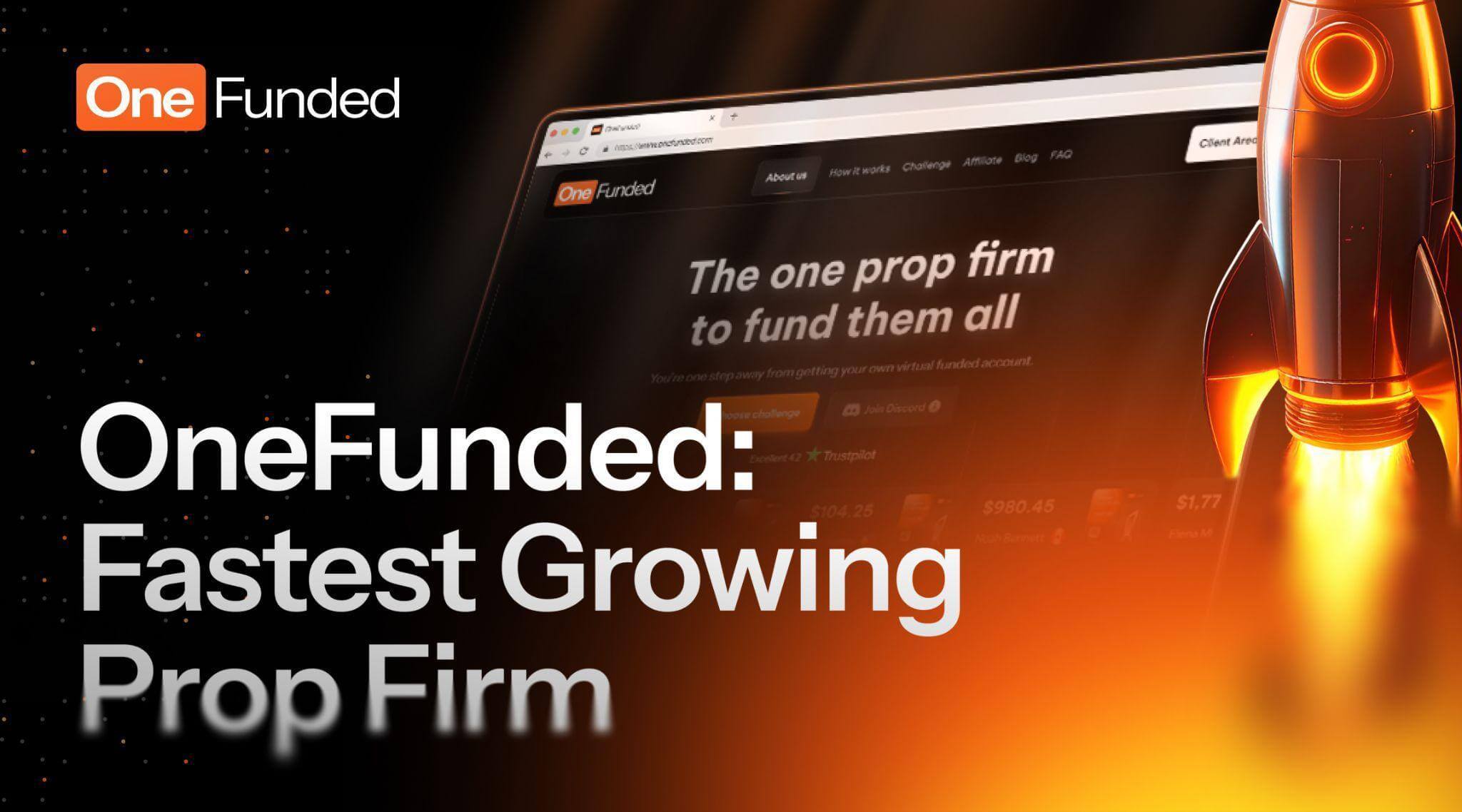
OneFunded Review: The Fastest Growing Prop Firm
One of the most asked questions regarding proprietary trading firms on Reddit is “how to find a prop firm.” You can find these questions across many subreddits, and comments can be helpful. For example, one Redditor asked in a ‘Forex’ subreddit about where to find details about prop firms. And the first comment was that the poster should find and read reviews of the target firms. The commenter said that some reviews are goldmines of details about the firms; they will tell you the CEO name, provide the firm’s Discord link, and expose hidden rules if any. They don’t just shove discount coupons into your face.
This is the objective of this OneFunded review. We will dig up the history of the firm and explore why it is gaining traction in a highly competitive space. Most importantly, we will cover the rules, program pricing, the platforms you can use to trade, and the potential payouts. Of course, we will compare OneFunded to established players to help you make the right choice when shopping for a new prop firm.
What Is OneFunded?
OneFunded is one of the over 2,000 prop firms that operate in the market today worldwide. It states on its website that it offers virtual capital to traders, which they use to take positions in financial markets. Importantly, OneFunded clarifies that all of its traders’ activities happen in a simulated environment.
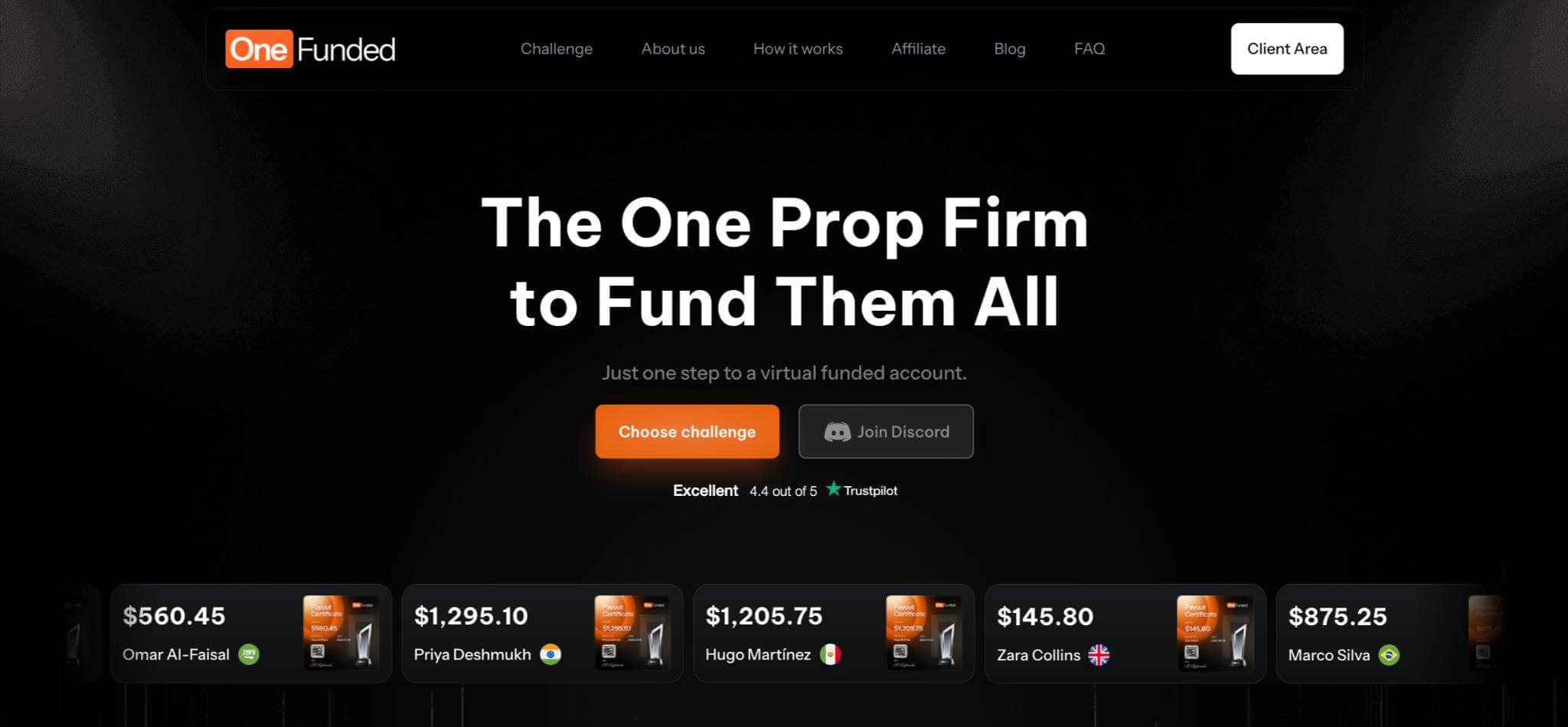
And, the prop firm’s funding model is challenge-based. This is to say that prospective traders must complete an evaluation phase where they pay a fee for specific account size, trade with virtual capital, and play within the rules. If they pass, they qualify for a funded account, but the capital is still dummy funds. At the funded stage, the firm pays traders a share of winnings from the simulated profits.
Perhaps an example will help you understand better how OneFunded works. Let’s say you choose the 1-Step challenge and opt for the $2,000 account and pay the $23 fee. You start the challenge and trade for five days. During this period, you hit the 10% profit target without losing more than 4% per day and 6% overall. In other words, you have passed the challenge. What remains is for the firm to verify your identity and then they open a funded account for you.
So, the difference between OneFunded and traditional prop firms rests on two key things. One, your funded account has dummy funds instead of real money. Two, you trade in an environment that simulates the live market.
To a large extent, this approach is why OneFunded is one of the fastest growing prop firms in the world. For starters, the approach is safer for both the trader and the firm. Virtual capital allows traders to practice and prove consistency in a simulated environment. On the other hand, prop firms get to evaluate a prospective trader’s discipline and risk management objectively before granting them access to larger funded accounts.
On the corporate side, OneFunded is the trade name of Brynex Tech Limited. This is a private limited company incorporated in the United Kingdom on August 27, 2024, and headquartered in London. The company was founded by CEO Anastasiia Kaplunenko, and traded as Prop365 before rebranding to focus on professionalism and trader welfare.
Core Features That Define OneFunded
Unlimited Trading Periods
Traditionally, prop firms required prospective traders to complete the evaluation within a specified timeframe. The problem with this stance is that the list of hurdles and psychological pressures that traders face becomes countless. The ticking clock forces rushed decisions and compels trading during suboptimal market conditions. Let alone the fact that it amplifies emotional responses like fear and greed. Such an environment favors fast-paced, high-frequency trading styles and places slower, methodical approaches at a disadvantage.
OneFunded chose the opposite. The firm did away with deadlines, effectively removing the psychological hurdle and allowing discipline and strategy. Any trader who has been in the business for some time will know that time pressure is one of the most exacting aspects of trading. For instance, a fixed timeframe can force one to take marginal setups, increase position sizes prematurely, or trade unfavorable market conditions simply to stay on pace. Over time, this distorts decision-making and rewards urgency over discipline.
So, OneFunded’s unlimited time periods mean traders are free to front their best strategy. The firm will not require you to hit profit targets within a fixed number of calendar days during the evaluation phase. And, as such, you have all the time in the world to perfect your strategy before you get funded.
Payout System and Process
OneFunded begins payouts 14 days after you open your first funded position. That is to say that you can request withdrawal on the 15th day of trading with the funded account. But you must also ensure that you’ve earned at least $100 before you make the request; anything lower will not trigger the withdrawal process.
And, you must close all open positions and cancel any pending orders before you initiate the payout process. OneFunded explains that this step is necessary for accurate profit calculations and risk containment. This makes sense because open trades are still fluctuating in value. So, closing them ensures the firm can calculate the trader’s realized profit without exposure to market swings during the payout process. And if the process proceeds with open trades, the firm would be exposed to sudden losses that could exceed the trader’s account balance.
We learned when testing the payout process that once you submit the request, OneFunded converts your account to view-only mode. This move freezes all activities on the account until the process is complete. This is another risk management step that ensures no new trades alter the profit amount being processed.
Some may wish to request payouts a little more frequently than twice a month. To that end, OneFunded offers a weekly payout addon. This allows withdrawal requests every seven days.
Once the firm verifies and completes the payout process, you can receive the funds via a normal bank transfer or via cryptocurrency. The firm allows crypto payments for funds less than $1,000. Anything more than that will be processed via bank transfer.
Profit Distribution Structure
Once you get funded and become eligible for payouts, you will get 80% of the earnings from profitable trades. This is the default split. But if you want a bigger share, you can purchase a 90/10 split add-on.
OneFunded provides this information upfront and prominently displays it on their website. This is important because some firms hide the true baseline profit split in the terms and conditions page. They sometimes only show the highest split on the home page and you only discover that the default is far smaller later after paying the entry fee.
Flexible Challenge Formats
We noted earlier that OneFunded employs a challenge-based funding model. And explained that this means traders must complete (and pass) evaluation to earn a funded account. Our research established that some players in the industry have strict regimes when it comes to evaluating. Some have only one challenge that includes too many restrictions.
On the contrary, OneFunded structures its evaluation programs around choice. That is to say that rather than a single prescribed path, traders can choose one of the three challenge types, and each challenge offers multiple account sizes and formats. In particular, account sizes start from $2,000, which leans heavily on the affordable side. But you can go up to $200,000, especially when you have sufficient experience to handle such a responsibility.
Advanced Trading Tools
OneFunded, just like some of the biggest players in the industry, provides professional-grade trading software, TradeLocker and cTrader to be specific. Our investigation found TradeLocker to be the firm’s preferred platform because this is what they suggested. Traders can use it to place trades. Beyond that, the platform includes a unified dashboard that gives users a real-time, holistic view of all challenge and funded accounts, performance metrics, and compliance with trading rules.
You can also use cTrader to execute trades. Users praise the platform for its superior order execution and transparency via the cTrader ID. However, this platform doesn’t include a dashboard to monitor your OneFunded-specific activity.
Thankfully, OneFunded supports a feature called Webhook Bridge or TradeSync, which synchronizes your trading activity across platforms. If enabled, you can execute trades on cTrader and they are instantly mirrored and managed within your TradeLocker dashboard. This way, you get to enjoy cTrader’s much-praised execution while maintaining all reporting, profit tracking, and rule monitoring in one central location with TradeLocker.
Rewards Center
OneFunded uses rewards to nurture loyalty among its traders. This is a milestone-based loyalty program where traders accumulate Reward Points by completing specific tasks and platform activities. These then convert into tangible discounts or free challenges.
It works like this: traders complete assigned tasks, collect points automatically credited to their accounts, and redeem accumulated points for rewards when ready. And, they can track all progress in real time via the client area. Once logged in, you will see a dashboard that shows the current point balance, completed tasks, and available redemption options.
The reward structure scales progressively. At 15 points, traders unlock a 15% discount applicable to any future challenge purchase. The next milestone has 30 reward points, and earns the trader a 30% discount on the challenge of choice. And if they keep accumulating the points to 60, traders get a 50% discount on any challenge they select. At the highest milestone, traders earn 100 reward points, which provide access to OneFunded’s most premium challenges at a fraction of the price. The 100 points will unlock a free 2-Step challenge with $5,000 in virtual capital. And if you prefer the 1F Limited challenge, the points give you a free $5,000 challenge account size.
Support and Resources
We tested OneFunded’s support channels and found that the fastest way to get help is through Garry, the AI assistant. The button is prominently displayed on the bottom right corner of the website and launches instantly once activated. If the bot can’t answer your questions sufficiently, it offers the option to request a human customer support personnel.
You may also opt for the email, which we found to be more suitable for detailed inquiries about payouts or documentation that require secure information exchange. Our tests showed that you will get a response within 24 hours.
And for instant answers to general questions, we found OneFunded’s Help Center to be quite sufficient. Just type ‘Help OneFunded’ in your browser’s search box and the first link should lead you to the Help Center. You may also want to hear from fellow traders, and for this, the firm has a Discord server with 4,223 members.
OneFunded also offers a Prop Trading Playbook. This e-book contains what the firm calls proven challenge-passing secrets and strategies. Those who request the book will also read about real trader examples and learn how to navigate the prop trading space.
Choosing Your Route to a Funded Account
We mentioned earlier that traders can choose one of the three available challenge-types when working towards a funded OneFunded account. These are 1-Step, 2-Step, and 1F Limited.
The 1-Step Challenge
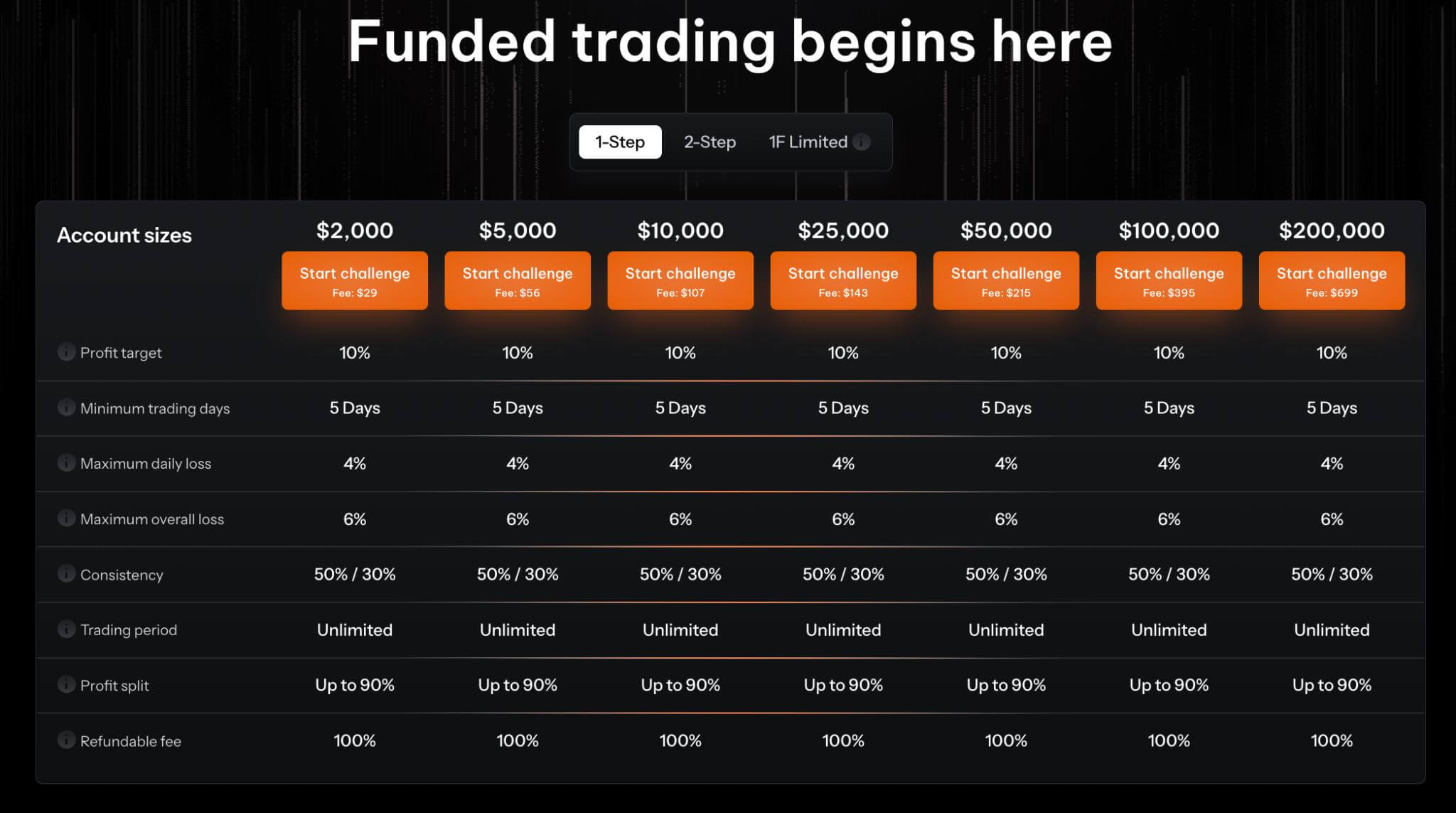
You can think of this evaluation route as the fast-track to funding. It targets those who prefer directness and speed. The 1-Step challenge condenses the evaluation process into a single phase that eliminates the intermediate verification stage.
Granted, this route offers the simplest and most efficient means to get funded. But the tradeoff is that you face higher initial demands. For example, you must have a 10% profit target in one trading phase. Add to that the tighter risk limits and steeper access fees; the cheapest account size is $29, which is the highest compared to other challenge-types. In other words, there is less room for recovery if early trades go against you, and it will cost you a lot more to retake the evaluation.
As a result, this challenge favors aggressive and disciplined traders. In other words, you must have been a trader for some time, during which you sharpened your edge and built immense confidence, to find this challenge surmountable.
The 2-Step Challenge
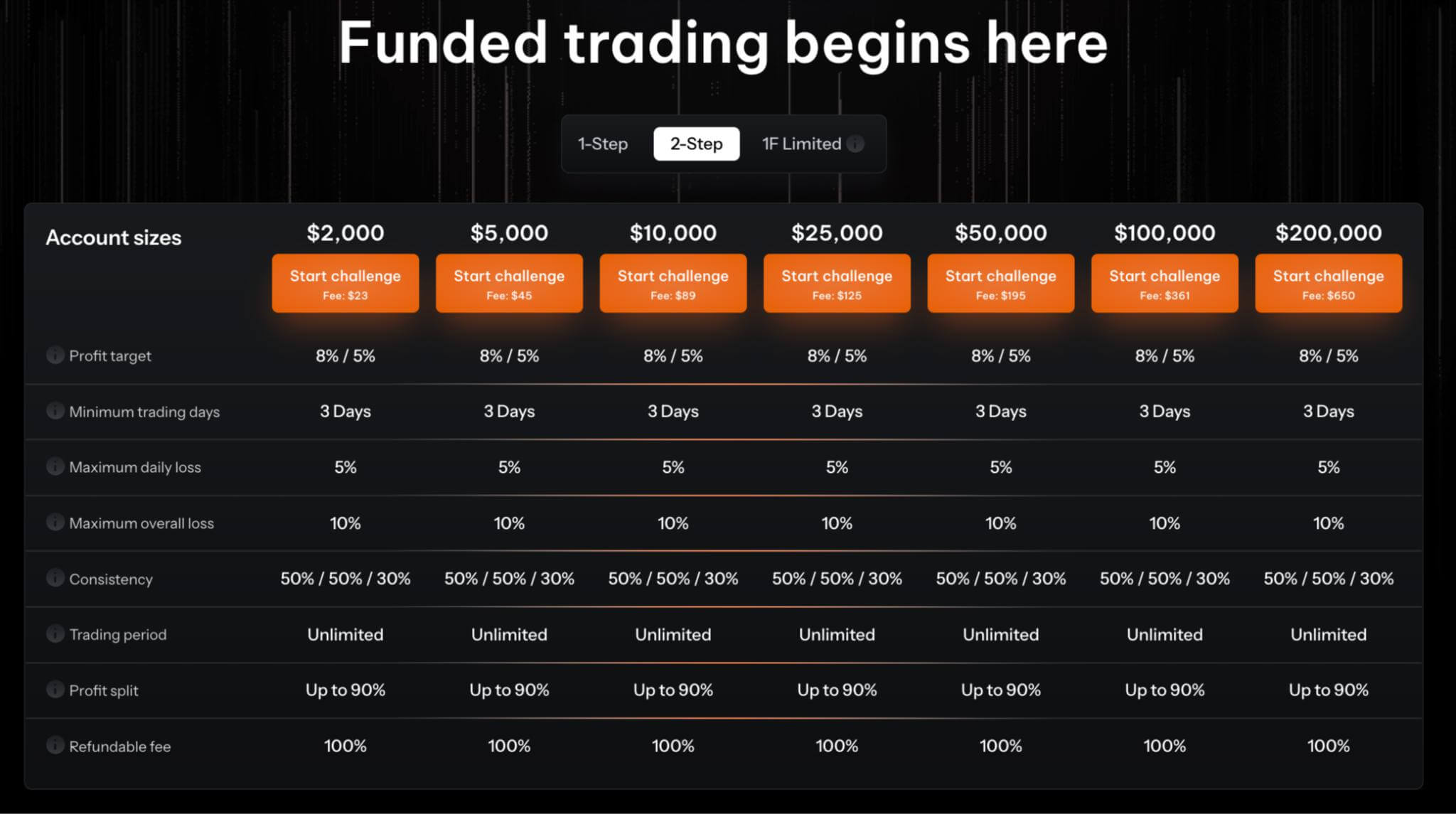
Although OneFunded doesn’t say it, our investigators concluded that this challenge-type is for the less experienced traders. And, we found that most firms in the industry prefer this approach because it tests more than short-term profitability. Firms that evaluate prospective traders in two phase often want to see that the candidates can meet targets consistently while managing risk well. They also want to assess behavioral discipline over time.
OneFunded’s 2-Step challenge works like this: phase one is for qualification and phase two is for verification. This is close to the industry standard, especially for established competitors like FTMO that only have a one-step challenge. Even then, OneFunded takes away the time pressure from this standard pathway. That is to say that the firm allows traders to progress at their own pace.
Phase 1: The qualification round
Here, OneFunded expects you to hit an 8% profit target and while at it, you must not lose more than 5% of the capital in a single day or 10% over the trading period.
Phase 2: The verification
The goal here is to ascertain that what you did to pass Phase 1 wasn’t a fluke. OneFunded will test you with a lower profit target, 5%, but the drawdown parameters stay the same.
So, who should choose this path? You can see from the onset that this route is low-pressure. And as such, newbies will find the path more accommodating. You can also be an experienced trader but without sufficient time for an intensive trading session; this path will work for you.
1F Limited
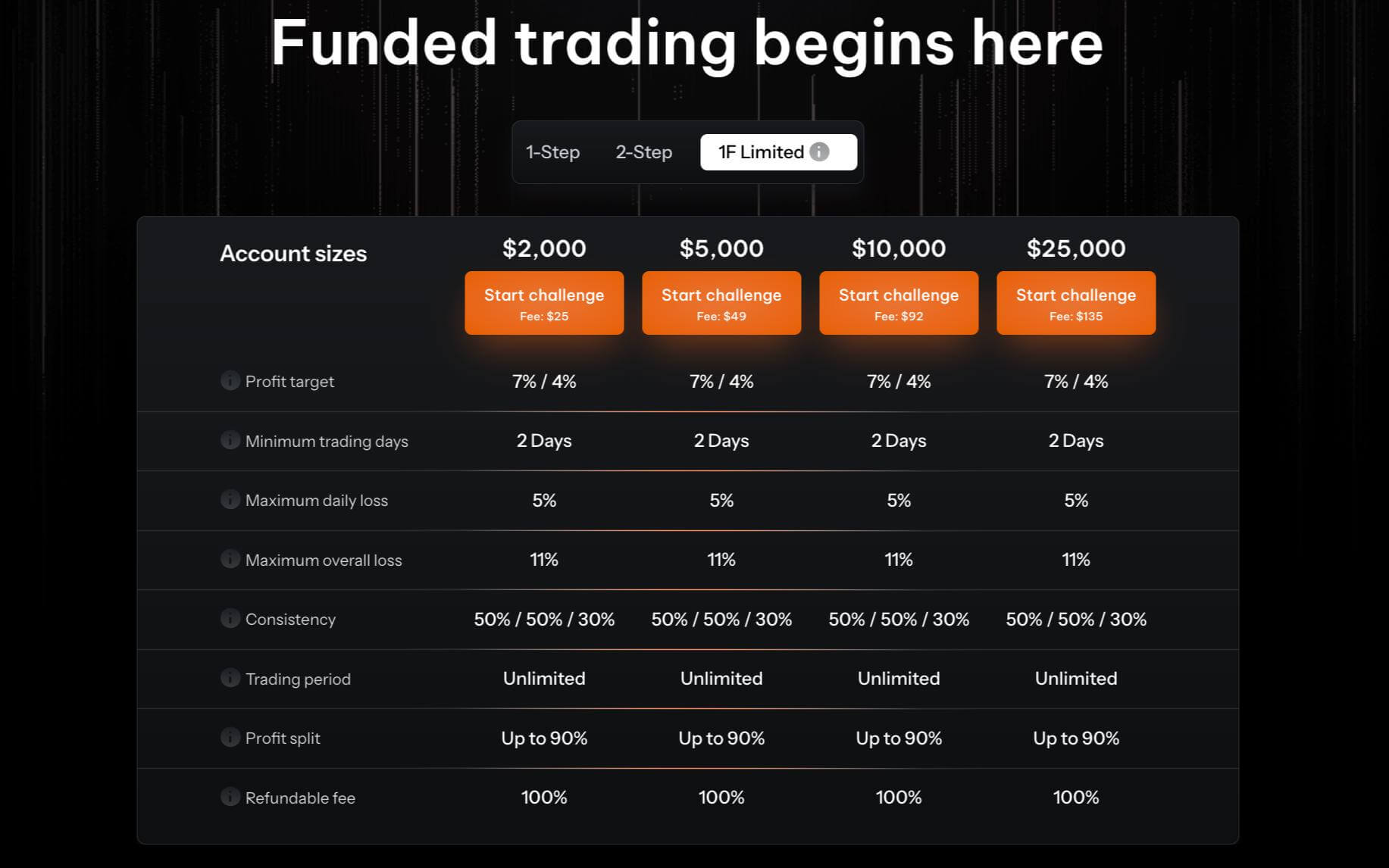
This ‘limited’ aspect of this program simply describes the fact that there are few and fixed number of spots available. And, the highest account size you can get here is only $25,000. OneFunded explains that this smaller cap is to control aggregate risk while offering more favorable trading conditions.
The challenge’s structure mirrors that of the 2-step challenge, although each phase has lower profit targets and more forgiving risk limits. In other words, 1F Limited is a version of the 2-step challenge but with lesser psychological pressure. For instance, the 11% maximum drawdown is better than 10% in the 2-step challenge. The extra 1% may seem marginal but in practice it changes trade management meaningfully. For example, on a $25,000 account, an extra 1% drawdown equals $250 more room to absorb volatility or recover from normal strategy variance without breaching limits.
So, if you look at it carefully, this challenge is ideal for aggressive yet controlled strategies.
Here is how these challenges compare at a glance:
|
|
1-Step |
2-Step |
1F Limited |
|
Total profit needed |
10% |
13% (8%+5%) |
11% (7%+4%) |
|
Number of phases |
1 |
2 |
2 |
|
Max drawdown |
6% trailing |
10% static |
11% static |
|
Min trading days |
5 total |
3 per phase |
2 per phase |
|
Entry cost (smallest) |
$29 |
$23 |
$25 |
|
Max account size |
$200,000 |
$200,000 |
$25,000 |
|
Best for |
Speed |
Standard path |
Flexibility |
Trading Rules
OneFunded requires its traders to follow certain guidelines when trading. This includes things they can do and things they cannot do.
What you can do:
-
Use leverage up to 1:100 for Forex, 1:30 for commodities and indices, and 1:2 for cryptocurrencies.
-
Choose your lot size
-
You can hold positions overnight, though swap fees may apply
-
Trade during news events
-
Use stop-loss orders optionally
-
Use expert advisors (EAs), but only after obtaining pre-approval from the OneFunded team.
-
Copy trade within your own accounts
-
Trade from multiple devices and IP addresses
What you cannot do:
-
Exceed drawdown limits
-
Violate the position sizing consistency rule
-
Engage in prohibited trading practices, which include:
-
Data freezing, gap billing, or using delayed or slow data feeds.
-
Trading on delayed charts.
-
Latency arbitrage, reverse arbitrage, and tick scalping strategies.
-
-
Exploit news volatility
-
Copy trades or coordinate strategies across accounts owned by different individuals
-
Use EAs without approval
Pros and Cons
Pros
-
The firm offers significant flexibility through multiple challenge types, and all without time limits for completion.
-
Traders benefit from a high, transparent profit share of up to 90% and a one-time challenge fee that is fully refunded with the first successful payout.
-
Access to professional trading platforms like cTrader and TradeLocker provides a serious trading environment suitable for various styles, including the use of EAs.
-
Support is accessible through multiple channels, including an active Discord community for peer learning and direct company communication.
Cons
-
As a firm offering simulated trading, it is not regulated by traditional financial authorities like the UK’s FCA.
-
Being a newer company rebranded in 2024, it lacks the long operational history and established reputation of some older competitors in the prop firm space.
How OneFunded Compares to Established Competitors
The proprietary trading business has been around for a while. And that means some prop trading firms have had time to establish dominance. FTMO is such a company. The firm’s trader funding programs are now more than 10 years old and it is one of the most recognizable prop firms currently. But how do its features compare to OneFunded? The table below summarizes some of the key features:
|
|
OneFunded |
FTMO |
|
Founded |
2024 |
2015 |
|
Starting price |
$23 (2-step challenge) |
€89 |
|
Profit split |
80-90% (fixed) |
80-90% (scaling) |
|
Time limits |
None |
None |
|
First payout |
14 days |
14 days |
|
Platforms |
TradeLocker, cTrader, MT5 |
MT4, MT5, DXtrade, cTrader |
|
Fee refund |
Part of the first payout |
Part of the first payout |
|
Best for |
Simplicity and flexibility |
Established credibility |
Bottom Line
OneFunded is a modern, challenge-based prop firm built around simulated funding, and its appeal comes down to a few practical strengths: no time limits across evaluations, clear rules and pricing, a structured payout cycle starting 14 days after the first funded position, and trader-friendly extras such as the Rewards Center, affiliate program, and multi-channel support. The firm also supports TradeLocker and cTrader, and offers three challenge routes.
That said, it’s still a newer operator that runs a simulated trading model, meaning it does not carry the same regulatory framing or long track record as some legacy competitors. For traders, the key decision is fit: OneFunded is best suited for those who value flexibility and straightforward mechanics over brand age. In particular, traders who benefit from the absence of deadlines, such as those participating on part-time basis, will find this firm a handy partner.