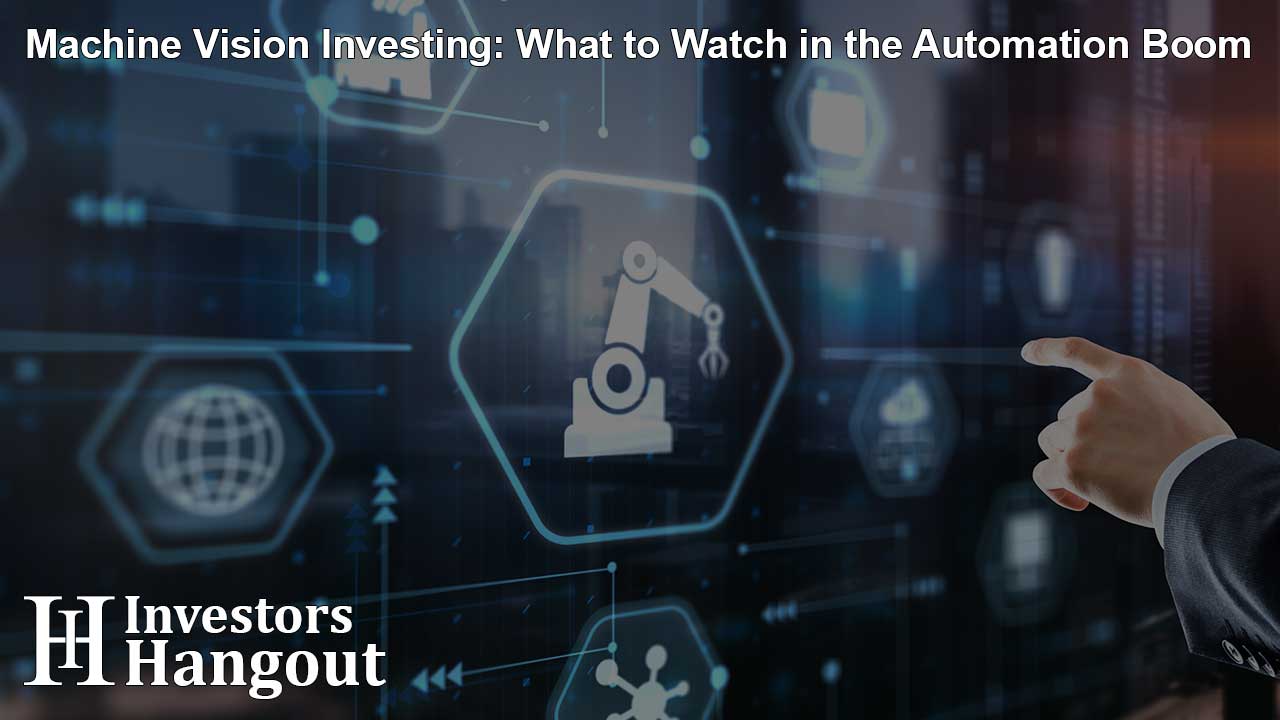
When markets talk about automation and artificial intelligence, the headlines tend to focus on the biggest names: chipmakers, cloud providers and the companies building large AI models. Far less attention goes to the technologies that let machines interact with the physical world. Yet robots, autonomous vehicles and smart factories all depend on one capability above almost everything else: the ability to see.
Machine vision has grown from a specialist niche into a foundational layer of modern automation. For investors trying to understand where the automation trend is heading, it is a part of the story worth following closely.
From Niche Tool to Core Infrastructure
For decades, machine vision was largely confined to quality inspection on production lines, where fixed cameras checked parts for defects. That role still matters, but the scope has expanded dramatically. Cameras now guide warehouse robots, enable driver assistance in cars, support medical diagnostics and help agricultural machines work with greater precision.
Hardware has evolved alongside these applications. Today, a next-generation embedded vision camera is often small enough to fit inside a robot arm or vehicle bumper, robust enough for harsh environments and designed to work closely with AI processors that interpret images in real time. That combination is what turns a machine from something that follows a fixed routine into something that can respond to what is in front of it. Nvidia chief executive Jensen Huang popularised the term "physical AI" for this shift, and vision is central to it.
The Demand Drivers Behind Machine Vision
Several long-term trends are pushing businesses to adopt vision-enabled automation. None of them depends on a single product cycle, which is part of why the theme attracts attention from investors with longer time horizons.
-
Labour shortages: Manufacturers, logistics companies and farms in many developed economies report persistent difficulty filling roles. Automation, much of it guided by cameras, is one way businesses are responding.
-
Quality and traceability: Regulators and customers increasingly expect detailed records of how products are made and inspected. Vision systems can check every item and document the result automatically.
-
Vehicle safety rules: Regulations are making camera-based safety features standard. In the US, the National Highway Traffic Safety Administration finalised a rule in 2024 requiring automatic emergency braking on new light vehicles by 2029, and the EU's General Safety Regulation already mandates a range of driver assistance systems.
-
Warehouse automation: The growth of e-commerce has driven investment in automated fulfilment centres. Robots that pick, sort and move goods depend heavily on vision to navigate and identify items.
-
Edge AI: As AI processing moves from the cloud into devices themselves, cameras paired with onboard processors can make decisions locally. That opens up applications where speed, privacy or connectivity make cloud processing impractical.
Taken together, these drivers suggest that demand for vision technology is tied to structural changes in how goods are made, moved and inspected, rather than to a passing trend. The International Federation of Robotics has reported industrial robot installations remaining at historically high levels in recent years, and most of those robots rely on some form of sensing to operate.
Where Value Sits in the Vision Stack
Machine vision is not a single industry but a stack of layers, each with its own economics. At the base are image sensor manufacturers, a concentrated market led by a handful of large players. Above them sit camera and module makers, who combine sensors, optics and interfaces into products designed for specific applications. Processors and AI accelerators turn images into decisions. Software companies provide the algorithms and tools that make systems usable, and integrators bring everything together for end customers.
Margins, competition and growth rates differ significantly between these layers. Sensor makers benefit from scale but are exposed to smartphone and automotive cycles. Software can offer recurring revenue but faces intense competition. Specialist hardware suppliers often depend on long design cycles, where winning a place in a customer's product can lead to years of steady demand.
What Investors Typically Watch
Analysts following the automation and vision space tend to focus on a few recurring signals. Capital spending plans in manufacturing, logistics and automotive provide an early indication of future demand for vision hardware. Design wins, particularly in automotive and industrial products with long lifecycles, can signal revenue that will arrive over several years. The share of recurring software or service revenue is often watched as a sign of business resilience. Customer concentration, inventory levels and exposure to particular regions also attract scrutiny, especially in a market shaped by supply chain disruption and shifting trade policy.
The Risks Worth Weighing
Cyclical Spending
Automation projects compete for capital budgets. When economic conditions tighten, companies can delay or scale back investments in new equipment, which affects suppliers across the vision stack. The automotive sector, a major buyer of camera technology, is itself highly cyclical.
Competition and Trade
As vision technology becomes more widespread, some components risk becoming commoditised, putting pressure on prices and margins. Tariffs, export controls and geopolitical tensions add uncertainty to supply chains that span multiple countries. Companies with strong engineering differentiation, diversified customers and resilient sourcing are generally better placed to manage these pressures.
A Quiet Theme With Long-Term Reach
Machine vision rarely makes headlines in the way that AI models or semiconductor giants do. But as automation spreads into factories, warehouses, vehicles, hospitals and farms, the ability of machines to see is becoming as fundamental as their ability to compute. For investors, that makes vision technology a theme worth understanding, not because it promises quick wins, but because it sits underneath so many of the changes reshaping the physical economy.
This article is for informational purposes only and does not constitute investment advice. Readers should conduct their own research or consult a licensed financial advisor before making investment decisions.