
Trump’s Nationalist Vision vs. the Gospel of Globalism
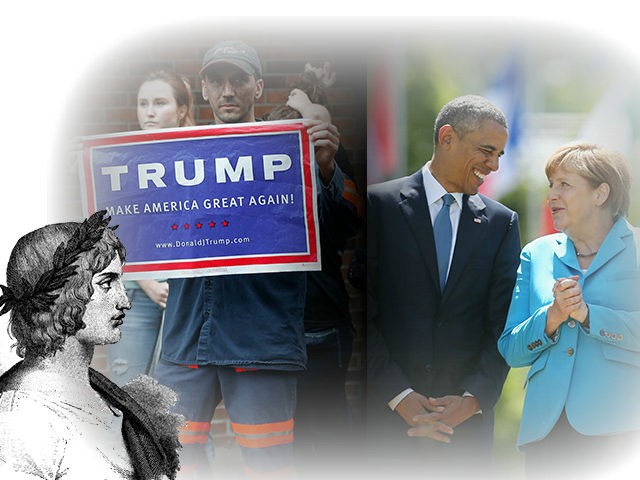
1. The Trump Nationalist Vision, Ascendant
It’s an obvious fact: Donald Trump hasn’t even been sworn in as the 45th President, and yet, already, he’s setting the national agenda. Through Twitter, other social media, and the occasional public appearance, he’s still doing what he did throughout the presidential campaign—dominating. Only now, as he says, he’s doing it not for himself, but for the American people.
In recent weeks, Trump has struck job-saving deals with Carrier and Ford. Hence this revealing January 3 headline: “Chided by Trump, Ford scraps Mexico factory, adds Michigan jobs.” He’s also announced a $50 billion, 50,000 jobs deal with Japanese investor Masayoshi Son and has just touted a new job-creating plan from Fiat Chrysler.
Yet at the same time, Trump is using sticks, as well as carrots. He has made it clear that any company that takes jobs out the country will be lambasted for doing so. As he said in his January 11 press conference,
The word is now out, that when you want to move your plant to Mexico or some other place, and you want to fire all of your workers from Michigan and Ohio . . . it’s not going to happen that way anymore.
And in that same press conference, he went after the pharmaceutical companies for charging too much. And he had a market-oriented solution: “What we have to do is create new bidding procedures for the drug industry, because they’re getting away with murder.”
And of course, he has chastised defense contractors Boeing and Lockheed, which he believes have been asking too much from the taxpayers.
The result of this “tweet therapy” has been an overhaul of thinking in Corporate America. Surveying Trump’s new style of presidential bully pulpiteering, Reuters concludes, “Corporate leaders . . . can no longer focus only on maximizing shareholder value; they must now also weigh national interest.” Yes, that’s correct: American business executives are now getting a crash course in economic patriotism; they can no longer act as if they aren’t citizens of this country—or that other US citizens don’t matter. Because of Trump, they must now take into account the overall strength and well-being of the nation in which they reside.
And here’s the interesting thing: Trump’s pro-worker, pro-taxpayer activism is also proving to be pro-business. It’s a win for all three sectors; call it a national win-win-win. And it only makes sense: If there are more American workers with big paychecks buying things and paying their fair share of taxes, that’s good both for American business and for Uncle Sam’s budget.
Indeed, according to the National Federation of Independent Business, small business optimism has “skyrocketed,” and consumer confidence is also up; meanwhile, the dollar is up, and the Dow Jones Industrial Average has gained 2000 points since the election. So it’s fully evident that the American economy is responding positively to Trump as dealmaker-in-chief. And President Trump will be joined in his administration, of course, by a slew of other successful dealmakers.
Yes, it’s interesting to think back on the old ways of the federal government, the pre-Trump ways. That is, the feds have been interventionist on so many matters for so long, and yet they were almost entirely hands-off when it came to good jobs and wages; corporations were free to come and go—mostly, go. The message to employers was, in effect, Do whatever you want to your rank-and-file workers, but you must, at all costs, protect wetlands, spotted owls, and the feelings of “protected victims” and their free choice of bathrooms.
Thankfully, that strange and unfair policy choice by Uncle Sam—to ignore the interests of the broad middle class while catering to ever more avant-garde sub-categories—seems to be coming to an end.
So it’s possible, perhaps even likely, that under President Trump we will once again become a nation for all Americans—even Middle Americans. We could yet be the “city on a hill” that Ronald Reagan so eloquent described. That is, a true center-right “Team America,” united in its determination to work hard and do well, with US citizens coming first.
As Trump said in his press conference on Wednesday, his victory was “a movement like the world has never seen before . . . that was a beautiful thing on November 8.”
2. The Old Globalist Vision, Descendant
Of course, not everyone thinks that what happened on Election Day 2016 was a beautiful thing, because they have been living their lives according to a vision much different than Trump’s economic nationalism.
Let’s get specific. We can start with Barack Obama; for the last eight years, as we know, Obama never worried much about the middle class, or, for that matter, about America. Instead, his eyes were on a different prize: the vision of a relentlessly globalized world, in which the US would fit in . . . somewhere.
Here’s how the 44th president expressed himself in his first inaugural address, back in 2009:
As the world grows smaller, our common humanity shall reveal itself; and that America must play its role in ushering in a new era of peace.
That might be a nice thought to have in some academic ivory tower, but in the real world, there’s precious little evidence that the polyglot peoples of the planet agree on much of anything, let alone how to usher in a new era of peace. Heck, even Obama, having received a Nobel Peace Prize for making nice speeches, immediately escalated that forlorn war in Afghanistan. Yet still, in his dogmatically ideological mind, he was determined to shrink American power so that it would “play its role” in this new global order.
And so in April 2009, the president was at pains to deny that “American exceptionalism” was anything worth taking note of, let alone being proud of. Instead, he snarked that “American exceptionalism” was an illusion, because all countries see themselves as exceptional. Obama’s dismissiveness inspired one reporter to observe,
If all countries are “exceptional,” then none are, and to claim otherwise robs the word, and the idea of American exceptionalism, of any meaning.
And yet again, Obama’s comments made perfect sense, if we see that his goal was to cubbyhole the United States as just another country on the world stage, somewhere between Uganda and Uzbekistan.
So of course, Obama devoted his first few months in office to a worldwide “apology tour,” although many say that it lasted, really, for his entire eight years in the White House.
John Fonte, a conservative critic of globalism at the Hudson Institute, calls this ideology “transnational progressivism,” and it certainly defines the progressive worldview.
Indeed, if we dig deeper, we can see that globalism is, in fact, a kind of religion. Everyone has heard, whether they wanted to or not, that 1971 John Lennon song, “Imagine,” including these gloppy-lefty lyrics:
Imagine there’s no countries
It isn’t hard to do
Nothing to kill or die for
And no religion, too.
This “Lennonism,” to be sure, is shared by many around the world. Thus it’s little wonder that Obama made common cause with other globalists, including former British prime minister David Cameron, German chancellor Angela Merkel, and European Union chief Jean-Claude Juncker.
These are the people who presided over the creation, or the elevation, of various murky transnational enterprises, including the United Nations, the European Union, the Paris Climate Change Agreement, and the Joint Comprehensive Plan of Action, aka, the Iran nuclear deal.
The common thread running through all these bureaucratic contraptions is the so-called “democracy deficit.” That is, in the mind of the elite, the fewer real people, including in the US, who get to vote on, or otherwise scrutinize, the doings of these bureaucracies, the better.
Indeed, it’s also best, the elite thinks, if people never even learn the truth about what’s being done in their name. We can cite, for example, the issue of refugees. To globalists, it’s a point of honor to accept refugees, even with the prospect of subsidizing forever, in unassimilated dependency. So we can readily see that Germany’s Merkel is, in the globalist virtue-signaling hierarchy, the most “honorable.”
Yet, as we know, the Obama administration has done its best to keep up. And if these refugee-influx programs aren’t popular with the public, well, the standard elite instinct is to mislead and deceive. In the mind of these deceivers, it’s all for the greater good because the ideal of the sacred “global village” is never better off if the “deplorables” get to decide anything.
It’s been well documented that the US government has been hiding the truth about the crimes of refugees, the health of refugees, and even the actual number of refugees. Is anyone in the Obama administration the least bit apologetic for these dishonest abuses? Of course not.
And yet, of course, in light of the recent election results, in which Obama-type globalism was decisively rejected, we have to ask: Did the elite really think that they would get away with it? Did they really think that people wouldn’t notice what has been happening to their communities and neighborhoods?
The answer seems to be, “Yes”—the Obamans truly believed that they could get way with it. They thought that Trump would be buried by a blue demographic wave in 2016, and that Hillary Clinton would be continuing their favored globalist policies in 2017.
To which we can say: Perhaps the elite aren’t as smart as they think they are. And yet, of course, even after being booted out of power, the Obama globalists will enjoy a soft landing: Many of them will soon be working for some George Soros-funded think tank, or pressure group. And from those cushy perches, they will be able to keep up their “resistance” to Trump (more on this in the next two installments).
Now we cite a second sacred item on the globalist agenda: international free trade.
And here we see, once again, that elite thinking on globalism has a way of turning a theory into a transcendentally moral first principle. And it’s been this way for a long time.
Back in 1846, the leading British free trader Richard Cobden declared, flat-out, that free trade would save the world:
I see in the Free-trade principle that which shall act on the moral world as the principle of gravitation in the universe—drawing men together, thrusting aside the antagonism of race, and creed, and language, and uniting us in the bonds of eternal peace.
Cobden was a capitalist, and capitalists are often cold-eyed, but, as we can see, there’s a dreamy, even giddy, utopianism in Cobden’s thinking. And amazingly, it won the battle of public opinion in 19th-century Britain.
Interestingly, one contemporary of Cobden’s—who was much colder-eyed and decidedly not a capitalist—nevertheless endorsed the same idea. That would be Karl Marx, the founder of communism. As a theoretical prognosticator, Marx may have had a mistaken view of what communism would become in the future, and yet, nevertheless, he was a shrewd observer of current events.
Marx could see that unchecked and unbalanced laissez-faire capitalism would quickly pulverize cultures, traditions, even whole nations in an endless gale of creative destruction. That is, individuals might be better off in some material ways, but, as a community, they would be atomized and unhinged.
In the meantime, Marx continued, left to their own devices, untrammeled free markets would concentrate most of the wealth in the hands of speculators and other financialists. And so a result, Marx concluded, the masses, in their vexation, would be ready to experiment with socialism and then communism.
With that hoped-for Red scenario in mind, Marx declared in a famous 1848 speech, “Gentlemen, I am in favor of free trade.”
Yet today, the most ardent proponents of free trade aren’t ironically-minded communists; they are neo-Cobdenite globalists, and they are achingly sincere. Some might be Democrats, some might be Republicans, some might think of themselves as liberal, some might identify as conservatives. Yet what unites them all is a vision of a borderless world, with minimal restrictions on exports and imports. (And, of course, minimal restrictions on the transit, also, of people.)
To be sure, some globalists, such as the EU’s Jean-Claude Juncker, have turned globalism into a profitable ideology; for years now, Juncker has been in the middle of efforts by his home country, Luxembourg, to become the world’s most billionaire-friendly tax haven. So yes, there’s plenty of self-interest in globalism. And yet at the same time, there’s more than that—much more.
3. The Gospel of Globalism
Indeed, this globalist faith is so strong that one can fairly conclude that it’s more than an ideology—it must be a kind of theology.
As writer Fay Voshell suggested last September in American Thinker, globalism, for many, is a kind of transmuted Christianity. That is, globalism is a new kind of faith:
Replacing the beatific vision of Christianity is a new universal . . . an order in which human beings’ allegiance is to a global City of Men ruled by elite priests who act as gods for the masses. Preachers of the globalist vision present an ersatz kingdom . . . The religion of globalism sees an earthly, utopian world order in which all men pay allegiance to elite priests who rule over a World City without national borders. Sometimes the substitute beatific vision is expressed in terms of a “global village,” a mystical entity that takes the place of the family of God. The globalists’ family of humanity is without distinction of country, tribe or creed.
Those last words, “without distinction of country, tribe or creed,” take us right back to where we started—with John Lennon’s “Imagine.”
For the globalists, this vision is so powerful that it’s easy to see how they would be inspired to do exactly what they have done: open their borders, impose political correctness on their people, and transform their societies through vast social-engineering schemes. Indeed, as we have seen, globalist political leaders are so committed to their beliefs that they are even willing to risk losing elections, sacrificing their careers on the altar of their faith.
And that’s just what happened with the Brexit vote in June, which not only put Britain on a course to leave the European Union, but also cost David Cameron his high office at Number 10 Downing Street. And here in the US in November, the same thing happened to Hillary Clinton—and to Barack Obama’s legacy.
Given the passionate depths of globalist sentiments, it’s little wonder that the elites took those defeats with bitter dismay. In the United Kingdom, for example, the beginning of the angry globalist response was to put a permanent hex on the leader of Brexit, Nigel Farage.
And oh yes, you might have noticed: Here in the US, the elite is just as angry at Trump.
In the globalist mind, Farage and Trump aren’t just enemies, they are heretics. Maybe even, in a post-Christian sense, they are anti-Christs.
So while Farage and Trump have won their respective political victories, the full fury of the elite has yet to be felt.
1. The Trump Nationalist Vision, Ascendant
It’s an obvious fact: Donald Trump hasn’t even been sworn in as the 45th President, and yet, already, he’s setting the national agenda. Through Twitter, other social media, and the occasional public appearance, he’s still doing what he did throughout the presidential campaign—dominating. Only now, as he says, he’s doing it not for himself, but for the American people.
In recent weeks, Trump has struck job-saving deals with Carrier and Ford. Hence this revealing January 3 headline: “Chided by Trump, Ford scraps Mexico factory, adds Michigan jobs.” He’s also announced a $50 billion, 50,000 jobs deal with Japanese investor Masayoshi Son and has just touted a new job-creating plan from Fiat Chrysler.
Yet at the same time, Trump is using sticks, as well as carrots. He has made it clear that any company that takes jobs out the country will be lambasted for doing so. As he said in his January 11 press conference,
The word is now out, that when you want to move your plant to Mexico or some other place, and you want to fire all of your workers from Michigan and Ohio . . . it’s not going to happen that way anymore.
And in that same press conference, he went after the pharmaceutical companies for charging too much. And he had a market-oriented solution: “What we have to do is create new bidding procedures for the drug industry, because they’re getting away with murder.”
And of course, he has chastised defense contractors Boeing and Lockheed, which he believes have been asking too much from the taxpayers.
The result of this “tweet therapy” has been an overhaul of thinking in Corporate America. Surveying Trump’s new style of presidential bully pulpiteering, Reuters concludes, “Corporate leaders . . . can no longer focus only on maximizing shareholder value; they must now also weigh national interest.” Yes, that’s correct: American business executives are now getting a crash course in economic patriotism; they can no longer act as if they aren’t citizens of this country—or that other US citizens don’t matter. Because of Trump, they must now take into account the overall strength and well-being of the nation in which they reside.
And here’s the interesting thing: Trump’s pro-worker, pro-taxpayer activism is also proving to be pro-business. It’s a win for all three sectors; call it a national win-win-win. And it only makes sense: If there are more American workers with big paychecks buying things and paying their fair share of taxes, that’s good both for American business and for Uncle Sam’s budget.
Indeed, according to the National Federation of Independent Business, small business optimism has “skyrocketed,” and consumer confidence is also up; meanwhile, the dollar is up, and the Dow Jones Industrial Average has gained 2000 points since the election. So it’s fully evident that the American economy is responding positively to Trump as dealmaker-in-chief. And President Trump will be joined in his administration, of course, by a slew of other successful dealmakers.
Yes, it’s interesting to think back on the old ways of the federal government, the pre-Trump ways. That is, the feds have been interventionist on so many matters for so long, and yet they were almost entirely hands-off when it came to good jobs and wages; corporations were free to come and go—mostly, go. The message to employers was, in effect, Do whatever you want to your rank-and-file workers, but you must, at all costs, protect wetlands, spotted owls, and the feelings of “protected victims” and their free choice of bathrooms.
Thankfully, that strange and unfair policy choice by Uncle Sam—to ignore the interests of the broad middle class while catering to ever more avant-garde sub-categories—seems to be coming to an end.
So it’s possible, perhaps even likely, that under President Trump we will once again become a nation for all Americans—even Middle Americans. We could yet be the “city on a hill” that Ronald Reagan so eloquent described. That is, a true center-right “Team America,” united in its determination to work hard and do well, with US citizens coming first.
As Trump said in his press conference on Wednesday, his victory was “a movement like the world has never seen before . . . that was a beautiful thing on November 8.”
2. The Old Globalist Vision, Descendant
Of course, not everyone thinks that what happened on Election Day 2016 was a beautiful thing, because they have been living their lives according to a vision much different than Trump’s economic nationalism.
Let’s get specific. We can start with Barack Obama; for the last eight years, as we know, Obama never worried much about the middle class, or, for that matter, about America. Instead, his eyes were on a different prize: the vision of a relentlessly globalized world, in which the US would fit in . . . somewhere.
Here’s how the 44th president expressed himself in his first inaugural address, back in 2009:
As the world grows smaller, our common humanity shall reveal itself; and that America must play its role in ushering in a new era of peace.
That might be a nice thought to have in some academic ivory tower, but in the real world, there’s precious little evidence that the polyglot peoples of the planet agree on much of anything, let alone how to usher in a new era of peace. Heck, even Obama, having received a Nobel Peace Prize for making nice speeches, immediately escalated that forlorn war in Afghanistan. Yet still, in his dogmatically ideological mind, he was determined to shrink American power so that it would “play its role” in this new global order.
And so in April 2009, the president was at pains to deny that “American exceptionalism” was anything worth taking note of, let alone being proud of. Instead, he snarked that “American exceptionalism” was an illusion, because all countries see themselves as exceptional. Obama’s dismissiveness inspired one reporter to observe,
If all countries are “exceptional,” then none are, and to claim otherwise robs the word, and the idea of American exceptionalism, of any meaning.
And yet again, Obama’s comments made perfect sense, if we see that his goal was to cubbyhole the United States as just another country on the world stage, somewhere between Uganda and Uzbekistan.
So of course, Obama devoted his first few months in office to a worldwide “apology tour,” although many say that it lasted, really, for his entire eight years in the White House.
John Fonte, a conservative critic of globalism at the Hudson Institute, calls this ideology “transnational progressivism,” and it certainly defines the progressive worldview.
Indeed, if we dig deeper, we can see that globalism is, in fact, a kind of religion. Everyone has heard, whether they wanted to or not, that 1971 John Lennon song, “Imagine,” including these gloppy-lefty lyrics:
Imagine there’s no countries
It isn’t hard to do
Nothing to kill or die for
And no religion, too.
This “Lennonism,” to be sure, is shared by many around the world. Thus it’s little wonder that Obama made common cause with other globalists, including former British prime minister David Cameron, German chancellor Angela Merkel, and European Union chief Jean-Claude Juncker.
These are the people who presided over the creation, or the elevation, of various murky transnational enterprises, including the United Nations, the European Union, the Paris Climate Change Agreement, and the Joint Comprehensive Plan of Action, aka, the Iran nuclear deal.
The common thread running through all these bureaucratic contraptions is the so-called “democracy deficit.” That is, in the mind of the elite, the fewer real people, including in the US, who get to vote on, or otherwise scrutinize, the doings of these bureaucracies, the better.
Indeed, it’s also best, the elite thinks, if people never even learn the truth about what’s being done in their name. We can cite, for example, the issue of refugees. To globalists, it’s a point of honor to accept refugees, even with the prospect of subsidizing forever, in unassimilated dependency. So we can readily see that Germany’s Merkel is, in the globalist virtue-signaling hierarchy, the most “honorable.”
Yet, as we know, the Obama administration has done its best to keep up. And if these refugee-influx programs aren’t popular with the public, well, the standard elite instinct is to mislead and deceive. In the mind of these deceivers, it’s all for the greater good because the ideal of the sacred “global village” is never better off if the “deplorables” get to decide anything.
It’s been well documented that the US government has been hiding the truth about the crimes of refugees, the health of refugees, and even the actual number of refugees. Is anyone in the Obama administration the least bit apologetic for these dishonest abuses? Of course not.
And yet, of course, in light of the recent election results, in which Obama-type globalism was decisively rejected, we have to ask: Did the elite really think that they would get away with it? Did they really think that people wouldn’t notice what has been happening to their communities and neighborhoods?
The answer seems to be, “Yes”—the Obamans truly believed that they could get way with it. They thought that Trump would be buried by a blue demographic wave in 2016, and that Hillary Clinton would be continuing their favored globalist policies in 2017.
To which we can say: Perhaps the elite aren’t as smart as they think they are. And yet, of course, even after being booted out of power, the Obama globalists will enjoy a soft landing: Many of them will soon be working for some George Soros-funded think tank, or pressure group. And from those cushy perches, they will be able to keep up their “resistance” to Trump (more on this in the next two installments).
Now we cite a second sacred item on the globalist agenda: international free trade.
And here we see, once again, that elite thinking on globalism has a way of turning a theory into a transcendentally moral first principle. And it’s been this way for a long time.
Back in 1846, the leading British free trader Richard Cobden declared, flat-out, that free trade would save the world:
I see in the Free-trade principle that which shall act on the moral world as the principle of gravitation in the universe—drawing men together, thrusting aside the antagonism of race, and creed, and language, and uniting us in the bonds of eternal peace.
Cobden was a capitalist, and capitalists are often cold-eyed, but, as we can see, there’s a dreamy, even giddy, utopianism in Cobden’s thinking. And amazingly, it won the battle of public opinion in 19th-century Britain.
Interestingly, one contemporary of Cobden’s—who was much colder-eyed and decidedly not a capitalist—nevertheless endorsed the same idea. That would be Karl Marx, the founder of communism. As a theoretical prognosticator, Marx may have had a mistaken view of what communism would become in the future, and yet, nevertheless, he was a shrewd observer of current events.
Marx could see that unchecked and unbalanced laissez-faire capitalism would quickly pulverize cultures, traditions, even whole nations in an endless gale of creative destruction. That is, individuals might be better off in some material ways, but, as a community, they would be atomized and unhinged.
In the meantime, Marx continued, left to their own devices, untrammeled free markets would concentrate most of the wealth in the hands of speculators and other financialists. And so a result, Marx concluded, the masses, in their vexation, would be ready to experiment with socialism and then communism.
With that hoped-for Red scenario in mind, Marx declared in a famous 1848 speech, “Gentlemen, I am in favor of free trade.”
Yet today, the most ardent proponents of free trade aren’t ironically-minded communists; they are neo-Cobdenite globalists, and they are achingly sincere. Some might be Democrats, some might be Republicans, some might think of themselves as liberal, some might identify as conservatives. Yet what unites them all is a vision of a borderless world, with minimal restrictions on exports and imports. (And, of course, minimal restrictions on the transit, also, of people.)
To be sure, some globalists, such as the EU’s Jean-Claude Juncker, have turned globalism into a profitable ideology; for years now, Juncker has been in the middle of efforts by his home country, Luxembourg, to become the world’s most billionaire-friendly tax haven. So yes, there’s plenty of self-interest in globalism. And yet at the same time, there’s more than that—much more.
3. The Gospel of Globalism
Indeed, this globalist faith is so strong that one can fairly conclude that it’s more than an ideology—it must be a kind of theology.
As writer Fay Voshell suggested last September in American Thinker, globalism, for many, is a kind of transmuted Christianity. That is, globalism is a new kind of faith:
Replacing the beatific vision of Christianity is a new universal . . . an order in which human beings’ allegiance is to a global City of Men ruled by elite priests who act as gods for the masses. Preachers of the globalist vision present an ersatz kingdom . . . The religion of globalism sees an earthly, utopian world order in which all men pay allegiance to elite priests who rule over a World City without national borders. Sometimes the substitute beatific vision is expressed in terms of a “global village,” a mystical entity that takes the place of the family of God. The globalists’ family of humanity is without distinction of country, tribe or creed.
Those last words, “without distinction of country, tribe or creed,” take us right back to where we started—with John Lennon’s “Imagine.”
For the globalists, this vision is so powerful that it’s easy to see how they would be inspired to do exactly what they have done: open their borders, impose political correctness on their people, and transform their societies through vast social-engineering schemes. Indeed, as we have seen, globalist political leaders are so committed to their beliefs that they are even willing to risk losing elections, sacrificing their careers on the altar of their faith.
And that’s just what happened with the Brexit vote in June, which not only put Britain on a course to leave the European Union, but also cost David Cameron his high office at Number 10 Downing Street. And here in the US in November, the same thing happened to Hillary Clinton—and to Barack Obama’s legacy.
Given the passionate depths of globalist sentiments, it’s little wonder that the elites took those defeats with bitter dismay. In the United Kingdom, for example, the beginning of the angry globalist response was to put a permanent hex on the leader of Brexit, Nigel Farage.
And oh yes, you might have noticed: Here in the US, the elite is just as angry at Trump.
In the globalist mind, Farage and Trump aren’t just enemies, they are heretics. Maybe even, in a post-Christian sense, they are anti-Christs.
So while Farage and Trump have won their respective political victories, the full fury of the elite has yet to be felt.