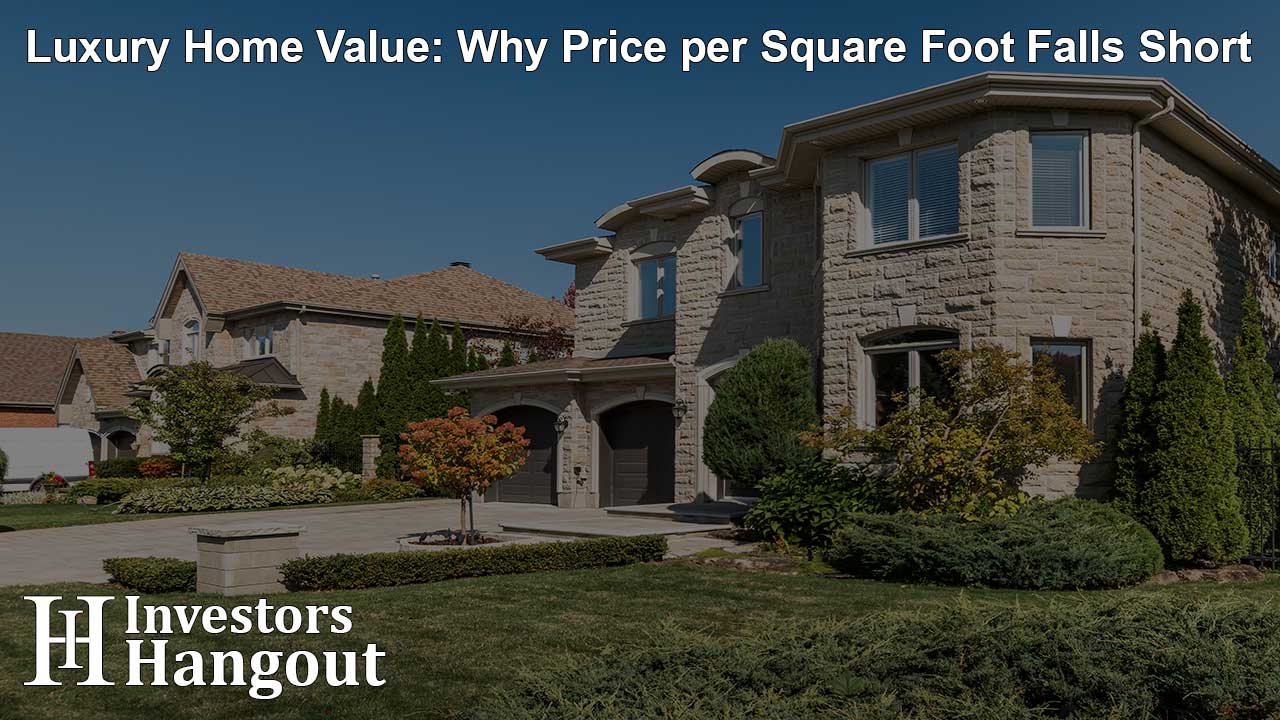
Price per square foot can help compare luxury homes, but only when the properties compete for the same buyers and their floor areas are measured consistently. A lower figure does not automatically mean better value. Land, location, condition and the way a home is configured can explain substantial differences between otherwise similar-looking listings.
The calculation is easy: divide the property price by its square footage. The difficult part is deciding whether the result answers a useful question.
For someone committing several million dollars to a home, an apparently precise number can be reassuring. It can also hide the assumptions that matter most. Before using price per square foot to justify an offer, buyers should establish what the price includes, what the floor area represents and why the comparison properties belong together.
The most useful starting rules are straightforward:
-
Compare asking prices with asking prices, and completed sales with completed sales.
-
Check that each floor-area figure includes equivalent types of space.
-
Group properties by genuine buyer alternatives, rather than a shared luxury label.
-
Investigate differences before treating a cheaper ratio as a discount.
What price per square foot actually measures
Price per square foot measures the total property price divided by a stated floor area. It does not isolate the value of the building. Because the numerator usually includes the land and other property features, the result combines several sources of value into one ratio.
Consider two hypothetical listings. These figures illustrate the arithmetic; they are not estimates for a particular market.
|
Property |
Asking price |
Stated floor area |
Asking price per square foot |
|
Home A |
$2,400,000 |
4,000 square feet |
$600 |
|
Home B |
$2,100,000 |
3,000 square feet |
$700 |
Home B costs $300,000 less overall, yet its asking price per square foot is higher. Neither observation establishes which property offers better value.
If Home B occupies a more desirable site or has a substantially better layout, the higher ratio may be understandable. If Home A contains space the buyer does not need, the additional square footage may offer little practical benefit. The ratio describes the difference; it does not explain it.
Choose properties that compete for the same buyer
A useful comparable is a property that a buyer would realistically consider as an alternative. Two homes can share a ZIP code, bedroom count and price bracket while serving different purposes. A downtown condominium and a detached waterfront house should not become interchangeable simply because both are expensive.
North Idaho illustrates the problem clearly. The property categories on Luxury Homes North Idaho distinguish waterfront homes, golf properties, custom homes and luxury condos. Those categories sit within the same regional search, but combining them into one price-per-square-foot benchmark would conceal important differences in what buyers are purchasing.
The same reasoning applies elsewhere. A condominium with shared facilities and a detached house with private grounds place different responsibilities on an owner. A golf-course setting and a walkable urban location may appeal to different buyers even when the interiors look similar.
Fannie Mae's comparable-sales guidance supports selecting properties that compete for the same market participants. Its requirements apply to appraisals within its lending framework, but the underlying question is useful for any buyer: would the person considering this house genuinely consider the comparison property?
Check what counts toward the advertised floor area
Square-footage comparisons are only meaningful when the floor-area figures describe equivalent real estate space. Before calculating a benchmark, establish whether the advertised total combines the main residence with a guesthouse, finished lower level or other accommodation. Ask for the source of the measurements and a breakdown where necessary.
Imagine one listing reports 4,000 square feet entirely within the main home. Another reports the same total across a smaller main residence and a separate guesthouse. Both arrangements may be desirable, but they support different patterns of living.
A buyer who needs several bedrooms close together may value the first arrangement more. Someone who regularly hosts extended family may prefer the second. The headline total cannot resolve that difference.
Keep garages, covered terraces, unfinished areas and other ancillary spaces identifiable in the comparison. Listing conventions and appraisal reporting can differ, so a portal total should not be treated as a complete explanation of how the space has been classified.
Separate asking prices from completed sales
An asking price records a seller's current position; a completed sale records an agreed transaction. Both can help a buyer understand a real estate market, but they provide different evidence. Averaging them together can make a spreadsheet look more comprehensive while making its conclusion harder to interpret.
Active listings show the alternatives currently competing for attention. Completed sales help establish what buyers have actually paid, subject to differences in condition, timing and transaction terms. A pending listing may indicate interest, but its advertised price should not be assumed to be the eventual closing price.
Label each property's status and relevant dates. A sale negotiated under different market conditions may require interpretation before it supports today's offer. Equally, a recent closing is not automatically more useful than an older sale that resembles the subject property much more closely.
Understand why larger homes can produce lower ratios
A larger home can have a lower price per square foot because the calculation spreads the total property price across more space. That mathematical effect should not be confused with evidence that every additional room is available at a bargain price. The extra space may have limited usefulness to the next buyer.
As a simplified illustration, suppose two properties have identical sites and otherwise comparable characteristics. If one contains a much larger house, the common site value is divided by more square feet. The resulting ratio can fall even when the larger property's total price is higher.
Real properties are rarely that tidy, which is why the illustration is not a valuation formula. It simply shows why multiplying a smaller home's ratio by a larger home's floor area can produce an unsupported estimate.
Ask what the extra accommodation contributes. A well-positioned bedroom suite and an awkward circulation area may occupy similar amounts of floor space while offering very different utility.
Treat small samples and adjustments carefully
A price-per-square-foot average is sensitive to the properties included in it. In a small group of luxury real estate transactions, one unusual sale can change the result substantially. A median can reduce the influence of an extreme figure, but it cannot repair a comparison set containing fundamentally different homes.
Record the sample size alongside any benchmark. Four sales within one well-defined property type tell a different story from four sales scattered across unrelated settings. An expanded search may be necessary, but the resulting differences should remain visible.
Avoid assigning a standard dollar adjustment to every additional square foot or feature. Fannie Mae's appraisal guidance calls for adjustments supported by market behavior rather than arbitrary rules. A buyer's spreadsheet can identify a question, but it should not manufacture the answer.
For example, noting that one home has a detached guest suite is useful. Adding an invented premium for that suite and presenting the adjusted total as an appraisal is much less defensible.
Build a comparison sheet that preserves the explanation
A useful luxury-home comparison sheet shows the evidence behind the ratio. It should make differences easier to inspect, rather than produce a single score that conceals them. Keep verified facts separate from impressions and unresolved questions so that an assumption does not quietly become a number.
For each shortlisted property, record:
-
Asking or closing price, transaction status and relevant dates.
-
Reported floor area, measurement source and any separate accommodation.
-
Property type and the reason it belongs in the comparison group.
-
Site characteristics, setting and significant differences in condition.
-
Known transaction terms that could affect the interpretation of price.
-
Information still needed before relying on the comparison.
The final column is especially useful. A blank cell can look like confirmation that two properties are equivalent. An explicit note such as "guesthouse area not yet verified" makes the uncertainty harder to overlook.
Use the completed sheet to ask focused questions of the professionals handling the purchase. Which sales provide the strongest evidence? Which differences appear to influence buyers? Which conclusions depend on information that has not been checked?
Use the ratio to decide what to investigate next
Price per square foot is most useful when it directs attention to a difference that deserves explanation. An unusually high figure may reflect a valuable site, superior accommodation or an ambitious asking price. An unusually low figure may reflect additional space, weaker condition or a comparison that never belonged in the group.
Before relying on the number, confirm that the homes compete, the areas are comparable and the price evidence is understood. The arithmetic takes seconds. Establishing what it means is the work that makes it useful.