More than half of 2,000 pet owners told Talker Research for MetLife they weren't financially prepared for a pet medical emergency. From a personal finance perspective, the right fit among the best pet insurance companies depends on your household's cash flow and the bills you can pay.
If several thousand dollars in vet bills would empty your emergency savings or leave you choosing between borrowing and delayed treatment, look at pet insurance. You can self-insure with enough cash reserved for major vet care, provided you're ready for bills bigger than the fund.
Respondents' average spending on their pets came to $2,085.60 in 2024. Whether a fixed premium beats an unpredictable vet bill depends on what's in your contract, your broader personal finance plan, and how much cash you've got.
When Does Pet Insurance Beat Self-Insuring?
Insurance is more useful when you can't comfortably pay a big covered bill yourself. You've got the option of paying for care yourself if you have sizable cash savings kept for vet bills. Coverage transfers eligible financial risk without guaranteeing that claims will repay your premiums.
Even with expected costs worked out, can you actually pay the vet's bill? When a covered emergency means using rent money or taking an expensive loan, there's a reason to buy insurance even if premiums exceed what claims pay back.
Embrace Pet Insurance's largest individual pet insurance claim for 2024 came to $41,339 for a Rhodesian Ridgeback treated for pancreatitis and a gastrointestinal ulcer, the insurer reported, according to Newsweek. A bill that size is an outlier, not a routine expense.

Run a household stress test
Say the emergency bill is $10,000: work out where you'd get that money tomorrow. Don't count rent money as veterinary savings. Unlike cash reserved in a veterinary fund, money borrowed for treatment must be repaid, with possible interest.
Keep your self-insurance fund within reach, rather than in investments you'd need to sell when the market's down. Don't automatically count your general emergency savings as part of that fund. Keep housing costs or lost income in mind when counting those same reserves.
How Premiums and Policy Terms Change the Value
Count the premium as a fixed cost. The deductible and reimbursement rate set your share of a claim, but payouts still can't exceed the policy's annual limit. If exclusions or waiting periods rule out coverage, you're paying the whole bill.
Note each policy's premium, deductible, reimbursement rate, annual limit, waiting period, and exclusions as you compare the best pet insurance companies.
Six policy variables to understand
You keep paying the premium to keep coverage active. You must reach the annual deductible in eligible spending during the policy year; with a per-incident deductible, different events can each trigger it. You get a percentage of eligible costs back through reimbursement according to the contract's formula.
Your annual limit caps the policy's payouts. Waiting periods delay eligibility, and exclusions identify care the policy won't reimburse.
You'll still need cash.
Because most pet insurance pays after treatment, be ready to pay the veterinarian first. Since the order changes the math, check the contract: does the deductible come before the reimbursement percentage? Keep cash on hand for your share of eligible care and charges the policy excludes.
How the claim math works
The whole bill qualifies in this example, with enough annual coverage still available. In this example, subtract what's left of the deductible before calculating reimbursement:
|
Calculation stage |
Illustrative amount
|
|
Eligible veterinary bill |
$5,000 |
|
Less remaining deductible |
$500 |
|
Amount subject to 80% reimbursement |
$4,500 |
|
Illustrative insurer reimbursement |
$3,600 |
|
Owner's share before excluded charges |
$1,400 |
Your premiums are separate, and excluded charges would increase your share.
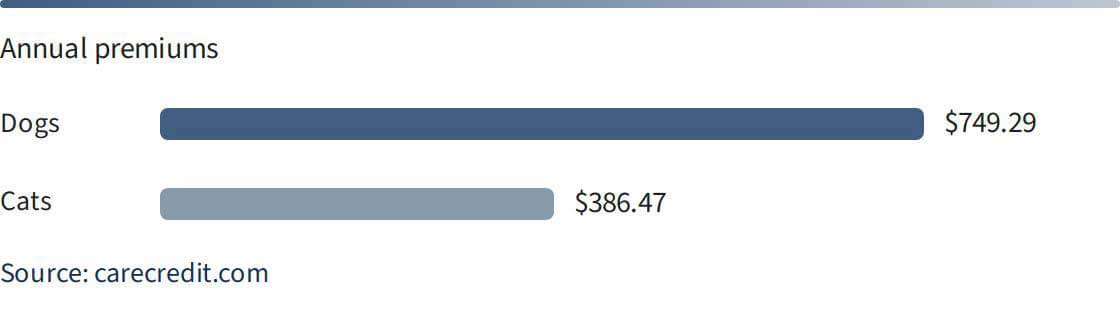
CareCredit reports 2024 average annual accident-and-illness premiums of $749.29 for dogs and $386.47 for cats. Accident-only coverage had averages of $190 for dogs and $110.03 for cats. Get a quote for your pet's coverage rather than treating these national averages as the price you'll pay. Accident-only coverage doesn't cover illness, so compare equivalent protection when requesting prices for your pet.
Is Coverage Worthwhile for an Older Dog or Cat?
For your older pet, an affordable policy can still be worth buying if it covers important future risks. Your pet's pre-existing conditions won't qualify for that coverage. Higher premiums and broad exclusions can make self-funding more competitive, especially when the medical record documents ongoing treatment.
If you insure your pet while it's young and healthy, conditions that appear later can qualify for coverage. An existing diagnosis is outside a new policy's coverage (pre-enrollment symptoms count against coverage too).
Check your older pet's medical record against the proposed exclusions. Ask how the insurer treats earlier symptoms without a formal diagnosis, then assess whether unrelated future accidents or illnesses justify the quoted premium.
Breed-related risks need careful reading
Contracts differ in how they cover conditions that your pet's breed is prone to. Ask how pre-enrollment symptoms affect coverage once you've checked whether hereditary or congenital conditions qualify. The sample policy is where you'll find restrictions on particular conditions.
The Denver Post, citing North American Pet Health Insurance Association figures, reported that more than 5.6 million U.S. dogs and cats were insured in 2023, a 17% increase from the year before. The number of insured pets tells you nothing about how a contract handles your pet's medical history.
How to Compare the Best Pet Insurance Companies by Policy Structure
Once you've checked what deductibles and exclusions leave covered, compare policies' waiting periods and payout limits. Bills your household can't comfortably pay should guide your policy search, not the cheapest monthly premium.
Before you buy, get a sample contract to read. Use this checklist to record answers you can verify against the policy wording:
-
Does the policy cover illnesses as well as accidents? Check what the policy covers for hereditary conditions, prescriptions, diagnostics and dental treatments.
-
Identify every exclusion that could matter given your pet's existing medical history.
-
How does the insurer work out reimbursement, and is the deductible yearly or per incident?
-
Check annual or lifetime payout limits and any condition-specific caps.
-
When does each type of coverage start under the policy's waiting period?
-
Is the veterinarian's entire bill yours to pay while you're waiting for reimbursement?
-
How much can you save in a dedicated vet fund compared with the policy's annual premium?
North Shore News puts emergency veterinary surgery at approximately $1,500 to $7,000 using Yelp's 2024 data, with dental extractions costing about $500 to $3,000. The final bill depends on where your pet gets treated and how complicated the case is; those figures are ranges. Ask your veterinarian for the local price of an extraction before you count on a dental benefit.
Apply the Decision to Your Household
To choose between insurance and paying bills yourself, compare the cash you have with the care covered by the policy. Work through the scenarios below to help your household choose:
|
Household situation |
Likely direction |
Reason to verify
|
|
Young, healthy pet and limited emergency savings |
Insurance may offer useful risk protection |
Check waiting periods and future premium changes |
|
Older pet with documented conditions |
Compare coverage carefully before enrolling |
Existing conditions may be excluded |
|
Breed with known health predispositions |
Coverage may help if relevant conditions qualify |
Read hereditary-condition terms |
|
Large dedicated vet fund and strong cash flow |
Self-insurance may be workable |
Test whether the fund could absorb multiple events |
Use this tool to help you choose, not as financial or veterinary advice for your situation. Review the actual policy and ask your veterinarian about health risks that could affect future care. Work out how you'll refill the fund after spending it if you're paying vet bills yourself.
Make the Choice Before the Next Vet Visit
How big a vet bill can you pay yourself without borrowing or spending money you owe elsewhere? Is your dedicated veterinary fund enough to pay what you'd still owe after a claim under the current policy terms? When you're working out how to keep paying for care, don't treat insurance as an investment opportunity. Before a new diagnosis can alter eligibility, review a sample policy.