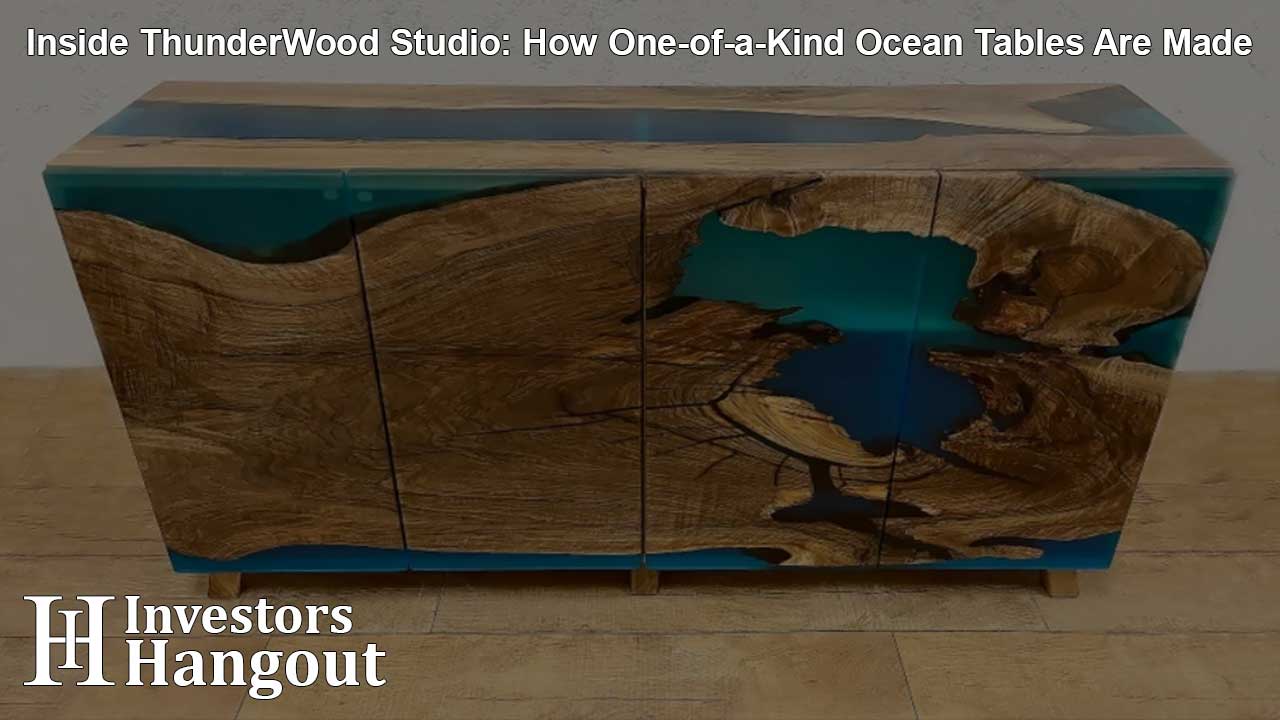
Some workshops are built around production schedules. Others are built around a person’s curiosity. ThunderWood Studio belongs firmly to the second category. Its founder, Oleksiy, did not arrive in furniture making through design school or a family line of cabinetmakers. His professional background was in finance. Woodworking began as a personal interest, then became a serious craft. What makes his story interesting is not simply that he changed direction, but that he kept teaching himself until experimentation turned into a recognizable body of work.
The pieces that now define much of the studio’s visual identity grew from that same willingness to test ideas. Ocean surfaces, flowing resin, natural edges, and dramatic forms can be seen in projects such as https://thunderwood.studio/collections/waterfall-epoxy-tables. They look polished in finished photographs, but the process behind them is anything but automatic. Each table begins with a real slab of timber, a client’s needs, and a series of decisions Oleksiy has learned to make through practice rather than by following one fixed formula.
A Maker Who Learned by Doing
Oleksiy’s first projects were much smaller than dining tables. He experimented with wood-and-resin bracelets, rings, phone covers, lamps, and other handmade objects. Small pieces gave him room to fail cheaply, adjust quickly, and understand how resin behaved before moving on to furniture.
That period shaped the way he still works. A bubble in the wrong place, a pigment that spread too quickly, or a finish that misbehaved all became information for the next attempt. Better equipment followed, but so did more testing. That persistence helped ThunderWood Studio move beyond hobby-scale projects.
Why the Ocean Became His Signature
Marine themes have fascinated Oleksiy for years. A wave is recognizable, but never identical to the wave before it. That makes the ocean a natural subject for epoxy resin, which can be guided but never controlled with absolute precision.
To create the sense of water, the maker has to think in layers. Deep tones can suggest distance, lighter areas create shallows, and white resin can become foam if it is moved at the right moment. The wood itself may become the “shore,” with a live edge standing in for an irregular coastline.
Exact repetition is impossible. Even when Oleksiy returns to a familiar palette, the timber changes, the resin moves differently, and the final contours develop their own character. His ocean-inspired work feels less like a printed pattern and more like a new landscape each time.
The Table Starts With the Slab
Before resin is mixed, the wood has to make sense.
Oleksiy studies the grain, cracks, edges, voids, and proportions of a slab before deciding how much it should be altered. Sometimes the strongest feature is something a mass-production factory would remove. A split may become a channel for resin. A rough edge can define the composition. A knot may remain visible rather than being disguised.
The goal is not to force every slab into the same template, but to find the design that suits that particular piece of wood. Dimensions, shape, base, resin color, and intended use all affect the decision, so Oleksiy discusses them directly with clients.
There Is a Lot of Unseen Work
The dramatic part of resin furniture is the pour. The difficult part often comes before and after it.
Wood must be prepared and stabilized. Loose material has to be removed. Forms need to be built and sealed because resin will find gaps that seem too small to matter. Pigments need testing, and the slabs must be held securely so they do not shift once liquid is added.
Then comes waiting. Resin cannot be hurried simply because a deadline is approaching. After curing, the piece still needs flattening, trimming, sanding, finishing, and fitting to its base. A table that looks fluid and spontaneous may have required many hours of repetitive work.
This says a lot about Oleksiy as a maker. He is drawn to creative ideas, but he is also patient enough to do the unglamorous work required to make those ideas usable. The finished object still has to function as furniture, not only as art.
Working With Clients, Not Around Them
One of Oleksiy’s strongest qualities is his willingness to treat the customer as part of the creative process.
A client may arrive with a clear vision, a photograph, a preferred color, or only a rough description of the mood they want. Oleksiy’s role is not simply to agree with everything. It is to translate the idea into something that can actually be built and used.
A dining table has to leave enough space for chairs. A large conference piece needs a base capable of supporting its weight. A decorative resin composition still has to suit the room where it will live.
This makes each commission a conversation rather than a transaction. Oleksiy looks for the point where the client’s taste, the character of the wood, and the technical realities of the build all meet.
A Business Built Around Curiosity
There is something refreshingly non-corporate about the way ThunderWood Studio began. Oleksiy did not start with a polished brand strategy and then search for a product to fit it. He found a material combination that fascinated him, learned what he could do with it, sold a few early pieces, improved his tools, and kept going.
He also speaks openly about the people who encouraged him, particularly the significant women in his life who supported his creative ventures before woodworking became a business. He does not frame the story as a lone-genius myth; the people who helped him keep moving are part of it.
The result is a company whose identity still feels connected to the person behind the work. Oleksiy remains involved in the ideas, problem-solving, and search for new ways to use familiar materials.
More Than a Table
What makes an ocean table memorable is not only the color of the resin or the shape of the slab. It is the sense that someone had to make decisions all the way through.
Where should the “shoreline” begin? How much natural edge should remain? Should the resin be clear, deep blue, or nearly black? Does the design need movement, or would restraint suit the wood better?
Oleksiy’s work is strongest when those decisions feel connected rather than decorative. The table serves a practical purpose, yet it also carries traces of experimentation, material, and the maker’s hand.
That is the simplest way to understand ThunderWood Studio. It grew because Oleksiy kept following curiosity. Small handmade experiments led to better tools, larger forms, custom furniture, and a recognizable style. The ocean tables are the most visible result. Behind them is a maker who still treats each project as a chance to discover something new.
For a closer look at Oleksiy’s work and the furniture produced by the studio, visit ThunderWood.