Founders building an AI product often face an awkward first decision; for example, they need to think about the expenses for the first version of the product. If they decide to build too little, the product may end up looking like a demo held together for one meeting. And if they build too much, their weeks of engineering efforts can disappear into dashboards, edge cases, and infrastructure before anyone knows whether users find the product useful.
The better path exists between those extremes. An investor-ready MVP should provide evidence that the problem is worth solving, the core AI workflow works, and users see value in the product. It does not need every feature the team expects to build over the next two years.
What Makes an AI MVP “Investor-Ready”?
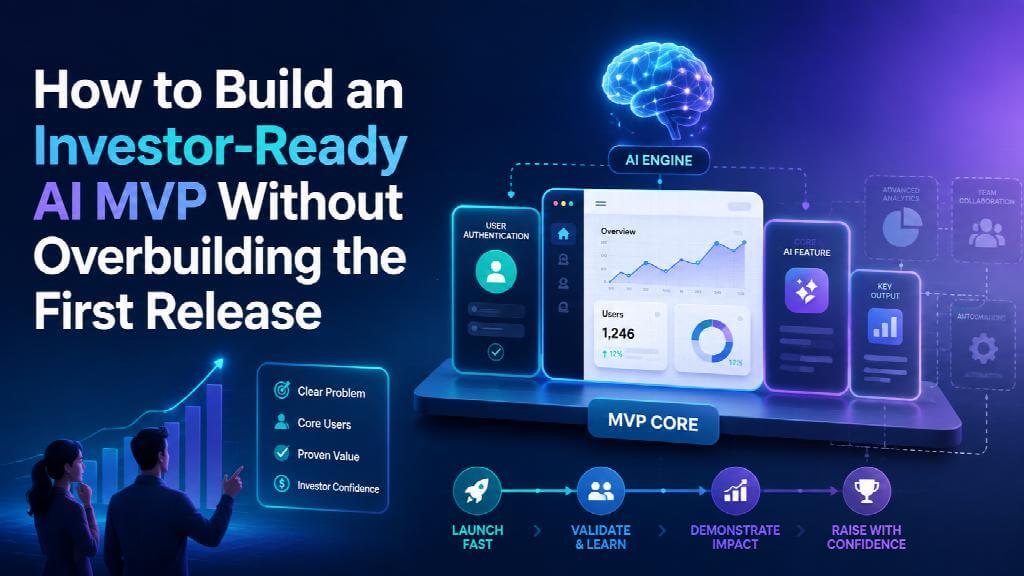
An investor-ready AI MVP does not need to be a production-complete product. It needs to provide enough evidence that the problem, solution, and business opportunity are worth pursuing further. Investors will want to see who has the problem, how often it occurs, and whether the product changes the outcome in a meaningful way.
That means the first release should show one working AI flow from input to result, a clear user group, and evidence that the result matters. If, for example, a support tool's response time is from 20 minutes to 5, that says more than a long feature list. Early user feedback, pilot usage, repeat sessions, or willingness to pay can strengthen the case. The product should also show that the current technical choices can evolve without forcing a full rebuild.
Focus on the Investment Thesis Before Adding Features
Before choosing features, founders need to be clear about what the MVP is supposed to prove. Who has the problem? What does that problem cost in time, money, or missed work? Why does AI improve the process? What changes for the user after adopting the product? And is the problem large enough to support a business?
Those questions create a useful filter. If a feature does not help test one of those assumptions, it probably does not belong in the first release. For example, a founder building an AI hiring tool may need to screen candidates against predefined job criteria. This keeps the first build focused on evidence rather than turning every product decision into an architecture debate.
Identify the One AI Workflow That Must Work
The first release shouldn’t scatter effort across five half-built AI features. It needs to cover the entire flow where the user provides an input, the system processes it, returns something useful, and the user can act on the result.
Choose that workflow by asking where the product creates the clearest value. Does the problem happen often? Is there enough usable data to support the AI? Can you show the result in a demo and measure whether it helped? An AI finance tool, for instance, may need to turn invoices into categorized records before it needs forecasting, chat, and reporting.
One dependable workflow gives users and investors something concrete to judge. Five unfinished ones usually create more questions than confidence.
Avoid the “AI Wrapper” Problem
Using a foundation-model API in an MVP is not a weakness by itself. One of the most difficult questions is what the product will offer as it expands. That may be the workflow data it collects, the way it measures output quality, the integrations it builds into customer systems, or the feedback it gathers from repeated use.
Let’s consider an AI legal review tool. Its value may not come from owning the language model but from how it handles clause libraries, review rules, approval steps, and user corrections over time. Those pieces can become harder to copy than the model calls itself.
Founders do not need to train a model from scratch to build an investable product. They do need a clear answer for where defensibility can develop.
5 Reliable AI Product Engineering Companies in the USA
1. GeekyAnts
GeekyAnts, an AI-powered digital product engineering and consulting company, works with enterprises on AI products that need to move from an idea into a usable release. Their work spans product discovery, AI integration, application engineering, cloud architecture, and production readiness.
For an AI MVP, its range of capabilities can be useful for enterprises that need to test one workflow first, measure whether users find it useful, and still avoid choices that make the next release expensive to rebuild. The company’s broader product-engineering background also supports teams that need AI features to exist within the complete web or mobile product rather than exist as a standalone demo.
Clutch Rating: 4.8 from 116 reviews
Address: GeekyAnts Inc., 315 Montgomery Street, 9th and 10th Floors, San Francisco, CA 94104, USA
Phone: +1 845 534 6825, Email: info@geekyants.com, Website: www.geekyants.com/en-us
2. Achievion Solutions
Achievion Solutions focuses on AI, machine learning, and custom software development. Their expertise makes it relevant for founders who need to turn an AI use case into a working product without starting with a large engineering program.
The company can support projects where model-driven features need to connect with web or mobile applications and existing data. For MVP teams, that can mean testing whether one AI capability produces enough value before adding more automation or infrastructure.
Clutch Rating: 4.8 from 17 reviews
Address: 1750 Tysons Blvd, Suite 1500, McLean, VA 22102, USA
Phone: +1 703-957-9775
3. Rootstack
Rootstack develops custom software and also provides AI development and technical staff augmentation. Their work is relevant to companies that need to validate a product idea while keeping enough engineering depth for later releases.
Their software engineering and AI services provide support to companies that wish to validate a product concept before committing to a larger build.
Clutch Rating: 4.8 from 20 reviews
Address: Dobie Center, 2021 Guadalupe Street, Suite 260, Austin, TX 78705, USA
Phone: +1 215-883-4359
4. ParallelStaff
ParallelStaff approaches software delivery through nearshore engineering teams, staff augmentation, and project outsourcing. Their model is suitable for startups that already understand what they want to build but need extra engineering capacity for an MVP, cloud work, data integration, or AI-related development. Rather than requiring founders to hire a full internal team before product validation, the company provides access to engineers who can join an existing delivery process.
Clutch Rating: 4.8 from 9 reviews
Address: 17304 Preston Rd, Suite 800, Dallas, TX 75252
Phone: +1 214-945-8202
5. NIX
NIX develops software across AI, cloud, data, mobile, web, and product engineering. Their AI work includes machine learning, generative AI, and data-driven software, which makes the company relevant for teams building an MVP around one specific AI use case.
NIX also supports product development from early validation through later engineering stages, so businesses can test whether an idea works before expanding the product.
Clutch Rating: 4.8 from 32 reviews
Address: 400 N Tampa St, Tampa, FL 33602, USA
Phone: +1 813-374-0027
Final Thoughts On How to Build Before Scaling
An investor-ready AI MVP does not need the infrastructure, feature set, or polish of a mature product. It needs enough engineering discipline to show that the core idea works, the product can handle real use cases, and the team understands what must come next.
The first release should answer three questions clearly: Is the problem worth solving? Does the AI workflow solve it well enough to matter? Do users care enough to keep using it? Once those answers start producing evidence, the next engineering decisions become easier to justify.
Build the next layer because usage, feedback, or technical limits demand it, not because the future product might need it someday.
The strongest first release is the smallest credible product that gives founders, users, and investors enough evidence to decide what deserves to be built next.