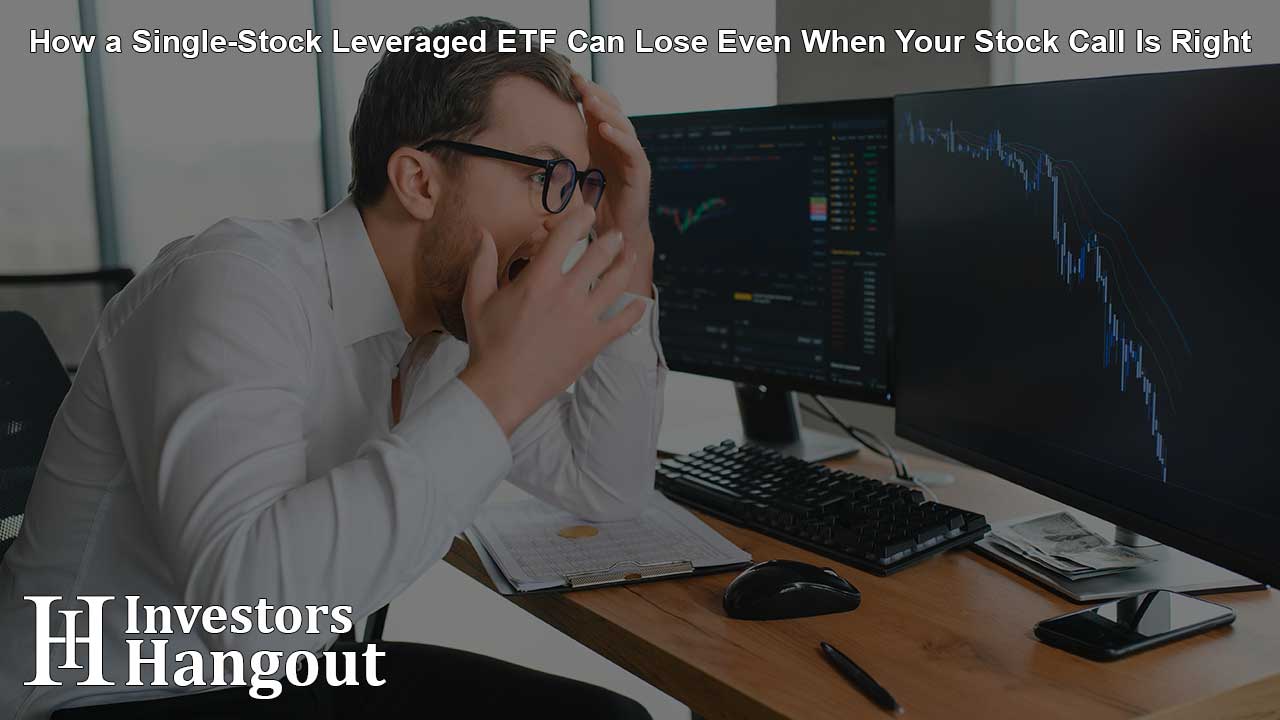
A leveraged ETF can lose money even when the stock it tracks does exactly what you predicted. That is not a malfunction, a hidden fee or a scam. It is how the product is built. The buyers most likely to get hurt are the ones who think of these funds as a louder version of the stock.
Here is the part that gets skipped. These funds reset their leverage after every market close. A 2x fund aims for double the underlying share's return for that day alone. It then rebalances and starts the next morning from a different base. Across a longer period, the result need not equal two times the stock's cumulative return. A sustained trend can sometimes help the fund, but repeated reversals near the same price can erode its value.
Consider a two-day round trip. Begin with a $100 stock and a $100 investment in a corresponding 2x fund. On day one, a 10% decline takes the stock to $90. The fund loses 20%, leaving $80. If the stock rises 11.1% on day two, it returns to $100 and its holder breaks even. The leveraged fund gains 22.2%, but that return applies to the reduced $80 balance. It finishes at $97.78. The stock has recovered completely; the fund remains down by more than 2%.
Run similar swings through dozens of sessions and a small gap can grow into a serious loss. The term for this is volatility decay. It follows directly from daily leverage resets, and it sits on top of the ordinary costs of the fund, which for these products means an expense ratio near 1% a year plus the financing cost of the borrowed leg. Greater back-and-forth movement usually means greater drag.
For a position held one or two days, the effect may be negligible. That short-term use is what daily leveraged funds were built for. Trouble starts when someone treats one as a long-term holding, ignores it for three months and then finds that the fund has declined while the stock has gone nowhere. The most popular US single-stock products, including funds tracking Nvidia and Tesla, are attached to exactly the kind of large, volatile names that reverse often.
South Korea has already run this experiment at national scale, and it did not enjoy the results. The country has watched leverage magnify a selloff more than once, most memorably in April 2023, when an unwind of leveraged retail accounts drove a group of stocks limit-down for consecutive sessions and wiped out the people holding them. That history is why regulators there treat retail leverage as a live hazard rather than a matter of personal responsibility.
The latest surge gave them a reason to act. Retail demand for single-stock leveraged funds climbed through the summer, and one-day trading volume reached 12.4 trillion won, approximately $8.8 billion, on July 30. South Korea's Financial Services Commission responded by introducing rules that require first-time purchasers to complete simulated trading before putting real capital into the products.
Practice trading is the central requirement. New investors must spend one hour per day for five days on the Korea Exchange's free simulator before they can buy. The required cash deposit also triples to 30 million won, roughly $21,200, and securities cannot count toward it. Education adds another three hours: one basic hour followed by two advanced hours. Existing traders, professional investors and foreign investors are exempt. The measures appear to have cooled activity; volume fell to about one-thirteenth of the level recorded in late July.
American buyers face a very different gate. There is no simulator, no waiting period, no mandatory course and no deposit requirement. At Fidelity, the practical barrier is a form and a profile setting: accept the acknowledgment for leveraged and inverse products, set the account's investment objective to the most aggressive tier, and the order goes through. The whole process takes about a minute, and nothing in it asks whether the buyer can explain what happens to a 2x fund over a choppy month.
The mathematics does not change at the border. Volatility decay affects a US product in the same way it affects one sold in Korea. First-time Korean buyers now spend a week meeting that risk before they trade. American investors are largely left to teach themselves.
None of this is an argument for or against regulation, nor is it a claim that leveraged funds should be avoided altogether. Used for active trades and brief holding periods, the products can work exactly as intended. Investors simply need to understand what they own. These funds are not just more forceful versions of the stocks they track. They reset daily, and the structural drag surfaces when the stock reverses repeatedly.
Before buying, remember four things:
- The leverage promise lasts one day. A 2x target applies to a single session rather than the entire holding period. The longer the uneven trading continues, the more time decay has to reduce returns.
- The danger is chop, not just decline. A persistent climb may benefit the leveraged vehicle, but a sideways market full of reversals can be especially damaging.
- Look beyond today's percentage. Compare the fund's total return with the underlying stock over several months to see the decay expressed in dollars.
- Treat the trade as a leveraged bet. Long before decay becomes important, doubling the upside also doubles the drawdown.
Korea's new obstacle is more useful as a warning than as a policy model. American traders generally do not need a regulator to force a delay; they need five minutes to calculate the two-day example. Once they do, a leveraged ETF losing money while its underlying share stays flat no longer looks mysterious. The product is operating as designed. For anyone trading these names, the boards here can help test an idea before capital is committed, and a second set of eyes may catch a weakness the original trader missed.