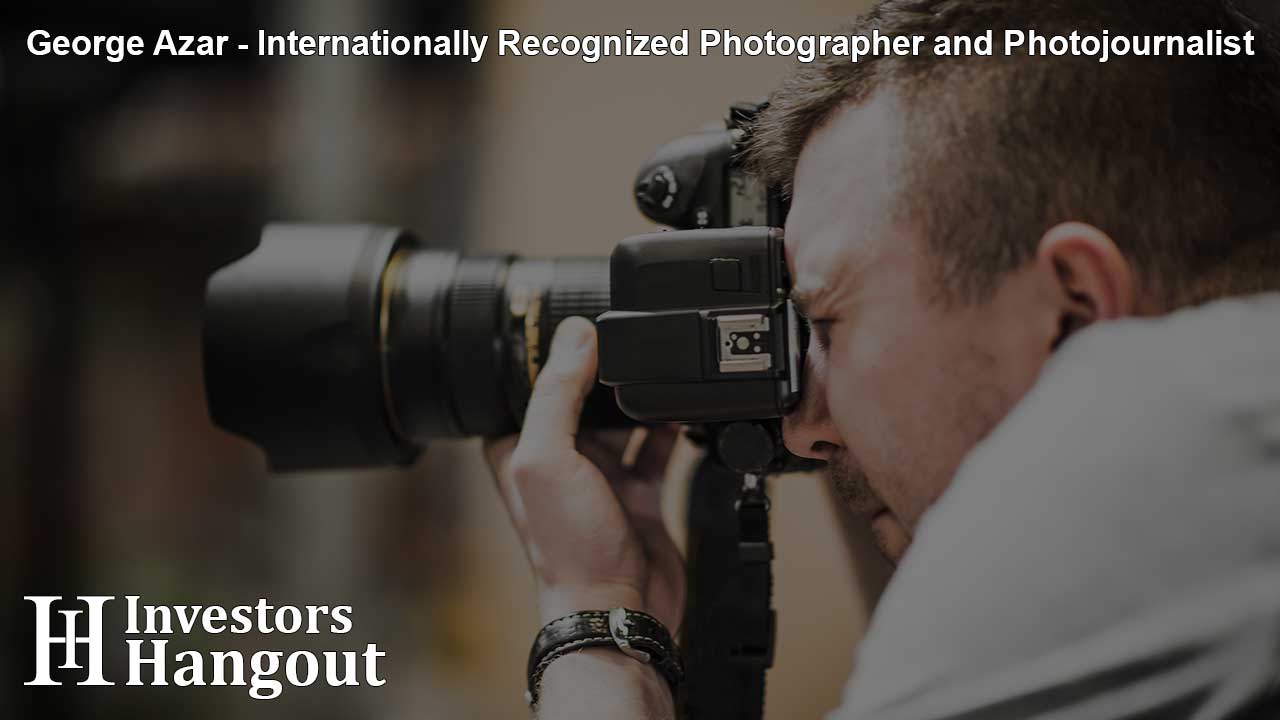
Some are photographers and some bear witness. George Azar is definitely a part of the latter group. This Lebanese American photojournalist and documentary filmmaker has been working for over 40 years and is known for both the duration and, most of all, the depth of his work. His lens has documented some of history's most pivotal and poignant moments — and his passion for truth-telling hasn't changed.
How Did It All Begin?
George Azar was born in Philadelphia on February 3, 1959, to Lebanese immigrants, who brought their heritage across an ocean. The bond with the Arab world would go on to shape his whole professional career. While an undergraduate at UC Berkeley in 1981, Azar decided to travel to Beirut, Lebanon, to witness the Arab-Israeli conflict firsthand.
This just turned into my personal journey, but it's much bigger than that. Azar picked up work as a stringer, photographing the Lebanese Civil War for the Associated Press and United Press International. Those were not easy times on the streets of Beirut. He was captured in 1982, when Israel invaded, and brought to Israel, setting him free in Jerusalem. With the return to Lebanon, he continued to work, recording the war until 1984. The determination to stay, to look, to record, that's what makes a photographer a photojournalist.
After spending three years in Beirut during one of its bloodiest eras, Azar acquired not only a first-hand understanding of the reality of war but also the way it transforms human life, which can't be learned in a classroom. He photographed people, not abstractions or statistics. They were neighbors, warriors, young, old, all enmeshed in something more than themselves.
What Has He Created
George Azar's photographs have graced the front pages of The New York Times, the International Herald Tribune, The Economist, Saudi Aramco World, and many other publications over the past few decades. These are not opportunistic inserts. For that kind of publication, the photos on the front pages should be technically brilliant and definitely moved-by-the-spirit.
However, Azar's work is more than just still photography. Since 2006, he and his team, Mariam Shahin, have made over 50 documentary films for Al Jazeera English, including some of the groundbreaking series produced by the network, including Focus on Gaza, People and Power, and Witness. His work has featured such films as Gaza Fixer, Looting the Holy Land, Two Schools in Nablus, and Beirut Photographer, all of which are meticulously crafted accounts of life in some of the most contested territories in the world.
The kudos have been forthcoming. In 2008, two Schools in Nablus were awarded the Japan Prize in Education and in 2009 the British Royal Television Society Education Award. He was nominated for the Rory Peck Award 2007 for outstanding courage behind the camera for his film Gaza Fixer. He has also contributed to Vice News, such as Crime and Punishment in Gaza, Renegade Jewish Settlers and The Islamic State vs Lebanon.
One of his most personal ways to mark his impact is perhaps the CBS Emmy Award-winning news feature Beirut Photographer, a feature that centers around his own story. Decades later, the film follows him back to Beirut, where he is looking for the people whom he had photographed during the civil war in the country — not only a project that is about memory and responsibility, but also about photojournalism.
More Than a Photographer — A Historian and Educator
So what is so particularly unusual about George Azar's career? It's never been one-dimensional. In addition to his behind-the-camera work, he has served as a historian, curator, writer, and business leader. Palestine - A Photographic Journey is regarded as a critically acclaimed book, a visual and narrative documentation that transcends surface coverage and delves into the texture of Palestinian life. He is also the photographer behind Palestine: A Guide, by Mariam Shahin, which the Independent called hugely impressive, deeply researched, and enriched throughout by Azar's beautiful photography.
His curatorial practice has had an indelible impact on the public realm. His photographs, his writing, and his photo curating are permanently on display throughout the first three floors of San Francisco's historic U.S. Customhouse. He curated Twin Towers, by Bill Biggart, in 2002 at the International Center of Photography in New York, an exhibition celebrating the first anniversary of September 11, which presented the public with the last photographs of a photojournalist who perished in the collapse of the towers.
Also, for years, Azar has been a lecturer, with his first-hand knowledge of the Middle East and Arab-Islamic culture, teaching at some of the most prestigious universities in the United States, such as Harvard, Stanford, the University of Chicago, UC Berkeley, Vanderbilt, and Pepperdine.
He has always called for a more complex view of the Arab world, one that challenges the clichés and misunderstandings which too often accompany coverage by the Western media.
Teaching the Next Generation
Azar has been the Photojournalist in Residence at the American University of Beirut since the start of 2018-19, and is also a full-time professor of Journalism and Digital Media in the university, located in the same city where his most defining career moments took place about 40 years ago. Well, it's appropriate. For those who have spent years documenting Beirut's darkest pages, it is now aiding a new generation of journalists to get their feet wet in a world, if anything, even more complex than the one they entered.
His teaching style is likely to be informed by his experiences on the ground — that great journalism is not about being in the middle of the party, but is about bringing the humanity of those in the middle to the forefront. This is exemplified by his pictures of Palestinians in the early years of the first intifada. Instead of the confrontation drama, they brought forth the beauty of the land, the quiet life of the shepherds, the defiant attitude of the elders, and the joy of the children. The decision — to reveal what much of the mainstream media didn't — is editorial courage in and of itself.
Why George Azar's Work Still Matters
With images everywhere and attention spans falling in this time and age, the role of a photographer such as George Azar is a reminder of what it is that photojournalism is for. It's not about creating content. It's a matter of accountability — to hold up a mirror and not look away from the world. Azar has done just that over the past fifty years or so of reporting on the Middle East and the Arab-Islamic culture.
That is the power of one man with a camera and a true desire to change the world's perception of a place, a people, and a story, and it is what his career has proved. It's not something that comes easily. And that's where the name of George Azar should be added to the list of the greatest photojournalists of his time.