
Cryptocurrency arrived faster than any regulatory framework could adapt to it, and Islamic jurisprudence is no exception. When Bitcoin emerged in 2009, no scholarly body had a ready answer to the question of whether it was permissible. Fifteen years later, the debate is richer and more nuanced - but it has not resolved into a single authoritative ruling, and anyone claiming otherwise is oversimplifying a genuinely complex conversation.
What has become clearer is the framework Muslim investors should use to evaluate crypto assets individually. The three core prohibitions of Islamic finance - riba, gharar, and maisir - apply to crypto as they apply to any financial instrument, but they interact with the specific characteristics of blockchain-based assets in ways that require careful analysis rather than blanket verdicts. The answers depend on which cryptocurrency, how it is used, and in what kind of account or structure the trading takes place.
This article works through that framework practically, covering the scholarly debate, the characteristics that make specific assets more or less compliant, and the questions Muslim crypto investors should be asking before they act.
The Three Prohibitions and How They Apply to Crypto
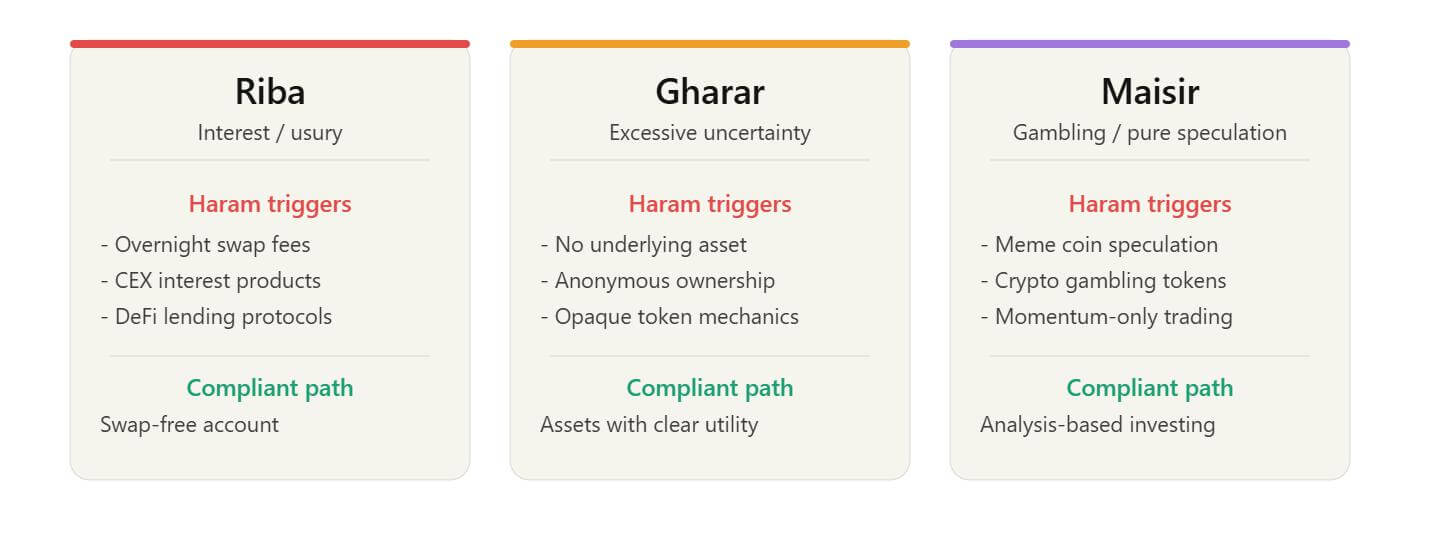
Islamic finance rests on a set of ethical principles that have remained consistent across centuries. Three specific prohibitions define most of the debate around cryptocurrency permissibility.
Riba - the prohibition on interest - is the least problematic of the three for most crypto activity. Cryptocurrency transactions in their basic form do not involve interest: when you buy Bitcoin, you are exchanging value for value, not paying or receiving interest. The riba concern enters through specific mechanisms: yield-generating products on centralized exchanges that pay "interest" on holdings, leveraged trading accounts that charge overnight funding rates, and certain DeFi lending protocols that function structurally like interest-bearing loans. The asset itself is not the problem - the financial wrapper around it can be.
Gharar - excessive uncertainty - is where cryptocurrency raises the most legitimate concern. Cryptocurrencies have no standardized intrinsic value, no earnings, no dividends, and in many cases no clear underlying asset. Price movements can be driven by social media sentiment, a tweet from an influential figure, or coordinated activity by large holders. The question scholars wrestle with is whether this uncertainty rises to the level that Islamic law prohibits, or whether it is simply the normal uncertainty present in any market. Most contemporary scholars who engage seriously with this question distinguish between assets with genuine utility and economic purpose - where price uncertainty is acceptable - and purely speculative tokens with no function beyond trading, which come much closer to prohibited gharar.
Maisir - the prohibition on gambling - is closely related to gharar but distinct. The concern is not uncertainty itself but trading that resembles gambling: positions taken without analysis, purely on hope of price movement, with no economic rationale. This is behavioral as much as structural. A Muslim trader taking a leveraged short-term position on a meme coin based on social media momentum is engaging in activity that several scholars would classify as maisir regardless of the asset's technical structure. The same trader holding Bitcoin as a long-term store of value, based on reasoned conviction about its monetary properties, is doing something categorically different even though the asset is identical.
Which Cryptocurrencies Are More and Less Compliant
The scholarly community has not produced a definitive halal/haram list of cryptocurrencies, and any such list would require constant revision as the technology and use cases evolve. What has emerged are evaluation criteria that Muslim investors can apply themselves.
Bitcoin sits in the most defensible position among major cryptocurrencies. It has a fixed supply, a defined issuance schedule, no central issuer, and a clear use case as a medium of exchange and store of value. Several contemporary scholars, including some from the Accounting and Auditing Organization for Islamic Financial Institutions, have expressed conditional acceptance of Bitcoin based on these properties. The dissenting view, held by scholars including Egypt's Dar al-Ifta, focuses on Bitcoin's price volatility and lack of regulatory oversight as sources of gharar.
Ethereum is more complex because its utility extends across a wide range of applications - some of which are straightforwardly permissible and some of which are not. Ethereum used for smart contracts that facilitate legitimate trade, for example, presents differently than Ethereum used to access DeFi protocols that charge interest-like yields. The token itself is not the issue; the application is.
The table below summarizes how different asset categories and use cases typically align with Islamic finance principles:
|
Asset / Activity |
Riba concern |
Gharar concern |
Maisir concern |
General view |
|
Bitcoin long-term holding |
None |
Low-medium |
Low if analysis-based |
Conditionally permissible |
|
Ethereum (utility use) |
None |
Low |
Low |
Conditionally permissible |
|
Meme coins |
None |
High |
High |
Generally problematic |
|
Privacy coins (Monero, Zcash) |
None |
High |
Medium |
Problematic - opacity |
|
Staking rewards |
Debated |
Low |
Low |
Divided scholarly opinion |
|
DeFi lending |
High - mimics interest |
Medium |
Low |
Problematic for most scholars |
|
Crypto gambling tokens |
None |
Medium |
Very high |
Explicitly haram |
|
Stablecoins (asset-backed) |
None |
Low |
Low |
Generally permissible |
Staking deserves specific attention because it has become a significant activity for Ethereum holders. Some scholars accept staking on the basis that the rewards represent participation in network security - a legitimate service - rather than interest. Others argue that the mechanism is functionally equivalent to interest-bearing deposits and therefore falls under riba. This remains genuinely unsettled, and Muslim investors engaged in staking should seek specific scholarly guidance rather than assuming either position.
The Practical Questions Muslim Crypto Investors Should Ask
Rather than waiting for a universal ruling that may never come, Muslim investors can apply a structured evaluation to any crypto activity they are considering.
The first question is whether the asset has a legitimate economic purpose. Does the cryptocurrency serve a real function - payments, smart contract execution, supply chain verification, identity management - or does it exist primarily as a speculative vehicle? Assets without genuine utility are much harder to justify under Islamic finance principles regardless of their technical structure.
The second question concerns the trading method. Is the activity long-term investment based on conviction, or short-term speculation based on price momentum? The distinction is not purely about timeframe - it's about the nature of the decision. An investor who holds Bitcoin for three years based on a reasoned view about its monetary properties is doing something fundamentally different from a trader flipping a token every 24 hours based on social sentiment.
The third question is about the account structure. Does the trading account charge overnight funding rates on leveraged positions? If so, a swap-free Islamic account structure eliminates the direct riba concern, though as noted earlier, Muslim traders should verify that administration fees are not structured to mimic swap charges. A reliable halal crypto trading guide can help navigate the specifics of compliant account structures and which instruments are available within them.
The fourth question is about associated activities. Some DeFi protocols automatically deploy deposited assets into yield-generating strategies that involve interest-based lending to third parties. A Muslim investor depositing into such a protocol may be inadvertently participating in riba-based transactions even if they never explicitly sought yield. Understanding the mechanics of any protocol before depositing is not optional.
Where Scholarly Opinion Currently Stands
The institutional Islamic finance community has been slower to engage with cryptocurrency than the market has demanded. Several significant bodies have issued opinions, but they diverge substantially.
Malaysia's Securities Commission has approved certain digital asset activities under a regulatory framework that includes Sharia screening. The UAE has seen the emergence of Sharia-certified crypto products. Pakistan's Council of Islamic Ideology issued a position in 2018 raising concerns about cryptocurrency as a currency substitute. Egypt's Dar al-Ifta issued a fatwa in 2018 suggesting Bitcoin trading was haram, though this was not universally accepted and subsequent developments have complicated the picture.
The diversity of opinion is real and unlikely to resolve quickly. Blockchain technology continues to evolve, new financial instruments built on crypto infrastructure emerge constantly, and the scholarly community is working through unprecedented questions with centuries-old tools. For Muslim investors, this means the obligation to remain engaged with the ongoing debate rather than treating any single ruling as the final word.
Conclusion
Crypto and Sharia law is not a question with a clean answer - it is a framework for asking the right questions about specific assets, specific activities, and specific account structures. Bitcoin held long-term in a swap-free account by an investor who has done their analysis occupies a very different position under Islamic finance principles than a trader cycling through meme coins on leverage in a standard account.
The core principles are stable even when their application to new technology is disputed: avoid interest in any form it takes, avoid transactions whose terms are fundamentally ambiguous, and avoid activity that resembles gambling more than investment. Applied carefully, those principles can guide Muslim investors through the crypto landscape without requiring them to either avoid it entirely or ignore the ethical obligations their faith imposes.