A widely shared claim that only 35% of trade among BRICS nations is still settled in dollars has reignited debate about the currency's future. The figure itself traces back to a single consultant's LinkedIn analysis rather than an audited institutional dataset, and it should be read as a directional estimate, not a verified statistic.
But the underlying trend it points to (rising local-currency settlement in intra-BRICS trade) is real and independently documented. What matters more than the precise number is what this shift could mean going forward.
In the near term, the dollar's global position looks secure. SWIFT’s most recent Global Currency Tracker shows the dollar still handling roughly half of global payment value, versus just 3% for the renminbi. The dollar's lead is even wider in trade finance, where it accounts for close to 80% of instruments worldwide.
The IMF's reserve data tell a similar story: the dollar remains the anchor of central bank reserves globally. Any near-term shift is happening at the margins of specific bilateral corridors, not across the global system.
Those margins matter, though. Since Western sanctions cut Russia off from dollar-based settlement in 2022, China-Russia trade has moved heavily into yuan and rubles, India has diversified some payments with Russia into rupees and dirhams, and Iran has leaned on the yuan to work around US sanctions.
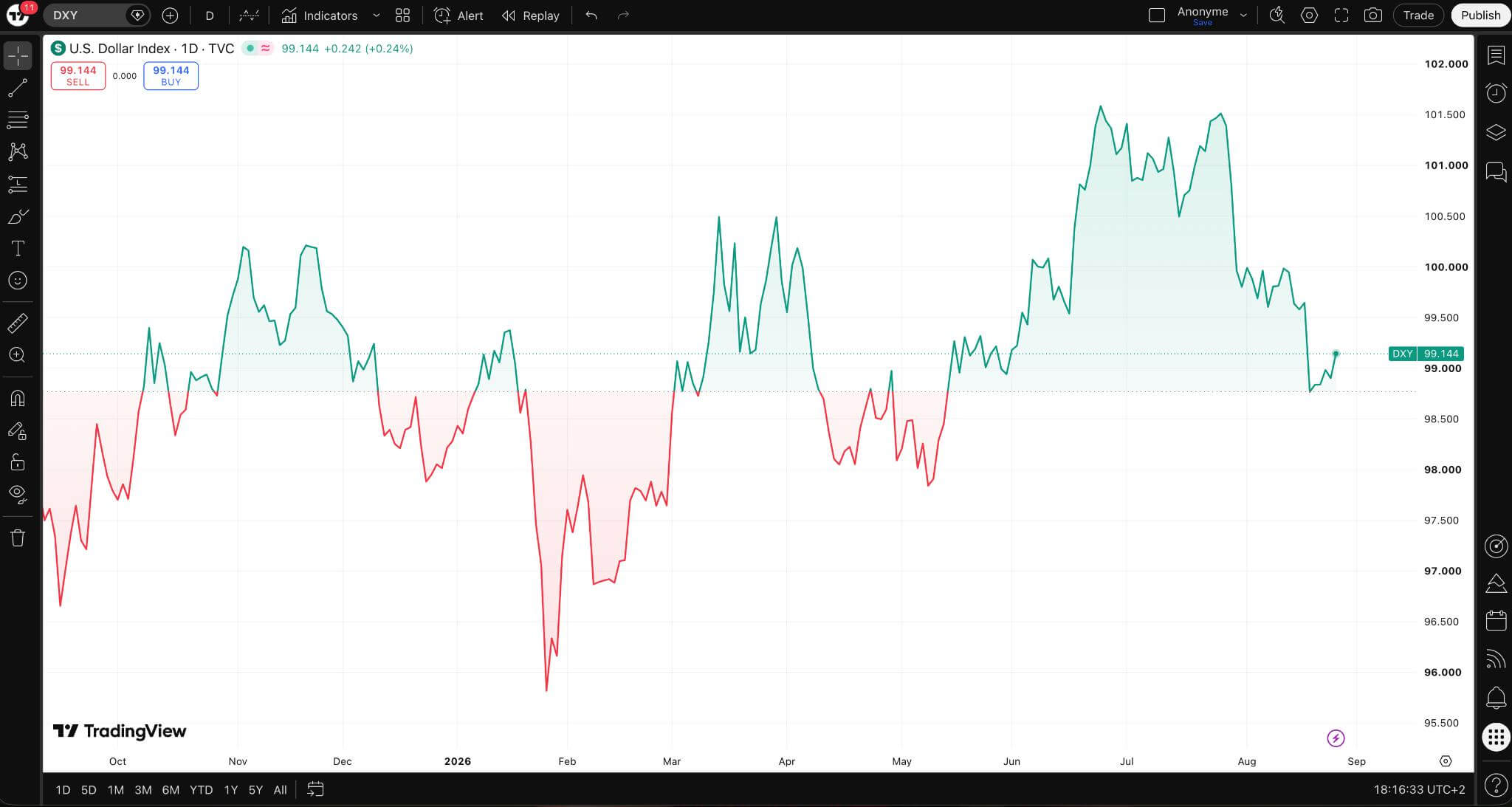
This is a closely watched development — the dollar remains, after all, the backbone of the global economy, and broad measures like the US Dollar Index (DXY) show it holding up well for now.
Saudi Arabia's willingness to accept yuan for parts of its oil trade adds a symbolically important, if still limited, crack in the dollar's long-standing role in commodity pricing, reflected in widely used benchmarks such as XAUUSD and XAGUSD. None of this threatens dollar dominance in the short run, but it does raise transaction costs and create friction for anyone relying on dollar-clearing assumptions when dealing with sanctioned or less-aligned economies.
The other short-term variable is Washington's response. Donald Trump's tariff threats against BRICS, from a 100% threat floated in late 2024 to a scaled-back 10% "anti-American alignment" tariff announced at the July 2025 Rio summit, show a US administration using currency alignment as a trade-policy lever.
Research from the Peterson Institute suggests such tariffs, if actually imposed, would raise inflation and slow growth in the US itself, which may explain why the threat has softened rather than escalated over the past year. Expect continued rhetorical pressure, but a full 100% tariff regime remains a low-probability outcome given its self-defeating economics.
The more consequential story is structural. BRICS members are increasingly discussing central bank digital currencies (CBDCs) as a way to automate cross-border settlement outside conventional correspondent banking; India has signaled it will raise CBDC interoperability at the September 2026 BRICS summit.
If sovereign digital currencies become genuinely interlinked, the practical cost of avoiding dollar-clearing systems will drop, regardless of any political declaration about "de-dollarization."
Even so, academic and policy research converges on one caveat: trade settlement in local currencies and reserve de-dollarization are different processes moving at very different speeds.
BRICS documents themselves stop short of claiming an imminent challenge to the dollar's reserve status, and structural constraints (thin capital markets, limited convertibility, and modest gold holdings relative to global averages) mean a rival reserve currency remains a distant prospect.
The more realistic long-term outcome is a gradually more fragmented payments landscape: still dollar-centered, but with growing local-currency corridors that reduce the West's ability to weaponize dollar access as effectively as it did against Russia in 2022.