The mortgage industry runs on speed, precision, and the ability to price any loan correctly the first time, and the technology behind that capability is the product and pricing engine.
Choosing the right PPE is no longer a back-office decision; it is a front-line competitive advantage that determines how quickly a lender can respond to market changes, how accurately loan officers can quote borrowers, and how efficiently a lending operation can grow without adding overhead.
What a Product and Pricing Engine Actually Does
A product and pricing engine is the core decisioning layer that evaluates a loan scenario against a lender's configured rules, margins, eligibility criteria, and investor guidelines, then returns a real-time quote with available products and their respective pricing.
The best modern PPEs go further than simply returning a rate by also generating eligibility decisions, conditions, stipulations, and loan-level price adjustments that reflect the full complexity of a lender's actual credit policy.
Why the Right PPE Choice Defines Lender Competitiveness
Lenders that rely on legacy systems or manual pricing processes consistently lose borrowers to competitors who can deliver accurate quotes in seconds rather than hours.
A modern PPE removes the friction between a loan scenario and a fundable decision, giving loan officers the confidence to present options instantly while giving operations teams the visibility to manage margin strategy, investor relationships, and product offerings from a single platform.
The PPE market is often discussed in terms of market share, but the more useful lens for lenders evaluating platforms today is the decisioning model itself: rate-delivery engines versus rules-first decisioning engines.
Rate-delivery PPEs were designed for a world of standardized conventional products, where the core value was distributing investor rate sheets quickly.
Rules-first decisioning engines are designed for a world where lenders need to price, qualify, and underwrite non-standard products on their own terms, and the evaluation should begin with which category a platform was architected to serve.
LoanPASS sits clearly in the rules-first category, which is why it increasingly appears in evaluations alongside rate-delivery incumbents rather than in competition with them.
LoanPASS: The Rules-First Pricing Engine Built for Modern Lending
LoanPASS is one of the most advanced product and pricing engines in the U.S. mortgage market, built specifically as a rules-first decisioning platform that gives lenders complete, transparent control over their pricing and eligibility logic without relying on developers or vendor-controlled black boxes.
It delivers sub-second pricing responses across any loan type, including Non-QM, business purpose loans, conventional, home-equity products, DSCR, second liens, and reverse mortgages, making it one of the few platforms capable of serving the full spectrum of a modern lending operation from a single system.
That positioning was validated when LoanPASS was named a winner of HousingWire's 2026 Tech 100 Award, specifically recognized for PPE and Non-QM AUS innovation, reflecting the industry's shift toward rules-driven, configurable decisioning over legacy rate-delivery platforms.
What separates LoanPASS from legacy PPE platforms is the depth of configurability it puts in the hands of the lender's own team.
Pricing structures, margins, eligibility criteria, conditions, overlays, and exception logic can all be managed and updated in real time through a no-code interface, meaning lenders can respond to market shifts, add new products, or adjust investor guidelines in minutes rather than waiting days or weeks for a vendor to make changes on their behalf.
How LoanPASS Compares to Traditional PPE Platforms
Traditional product and pricing engines like Optimal Blue, Polly, LenderPrice, LoanNex, and MorTech have long dominated the conventional lending space, particularly for rate distribution and margin-based pricing workflows where the product set is relatively standardized.
LoanPASS is designed to serve lenders who need something more, specifically those operating in complex, niche, or non-standard loan product environments where eligibility rules, investor overlays, and exception handling require a level of granularity that rate-delivery-focused platforms were not built to support.
The deeper architectural distinction is who owns the decisioning layer. Traditional PPEs operate as vendor-controlled data platforms, where the vendor maintains investor rate sheets, pricing logic, and product rules on behalf of the lender, and any change to that logic requires a vendor ticket, a queue, and a turnaround.
LoanPASS inverts this model, giving lenders direct ownership of their rules engine through a no-code configuration layer, so pricing logic, eligibility criteria, and investor overlays live inside the lender's control rather than inside a vendor's backlog.
The practical consequence is that lenders using LoanPASS can iterate on product strategy at the speed of their business, not the speed of their vendor's release cycle.
This distinction matters enormously for banks and credit unions that are diversifying their loan product portfolios, for IMBs that need to offer retail loan officers the same pricing transparency available to wholesale brokers, and for private mortgage lenders whose business models depend on precise, product-specific decisioning that changes frequently as capital markets evolve.
LoanPASS is intentionally architected to operate as a standalone primary PPE for institutions seeking deep product control, and most customers are live within 30 to 60 days of onboarding.
Non-QM and BPL Lending: Where Configurability Becomes Critical
Non-QM lending demands a level of eligibility flexibility that standard pricing engines simply cannot accommodate, because the borrower profiles, income documentation types, and investor-specific overlays involved require rule logic that goes well beyond conventional credit policy.
LoanPASS allows lenders to define granular eligibility rules for alternative income types such as bank statement loans, asset depletion programs, and DSCR structures, then manage layered loan-level price adjustments, channel-specific margins, and product-level incentives without any developer dependency.
For business purpose lending, construction loans, fix-and-flip products, and bridge programs, the platform's rules engine handles the kind of complex condition stacking and exception modeling that these products require, returning real-time eligibility decisions alongside pricing that reflects actual investor requirements.
Lenders operating in these segments who have adopted LoanPASS consistently report that the ability to configure and iterate on product rules independently gives them a speed-to-market advantage that is not achievable with platforms that require vendor involvement for every product change.
LoanPASS Portfolio AUS: Automated Underwriting for Non-QM and Portfolio Products
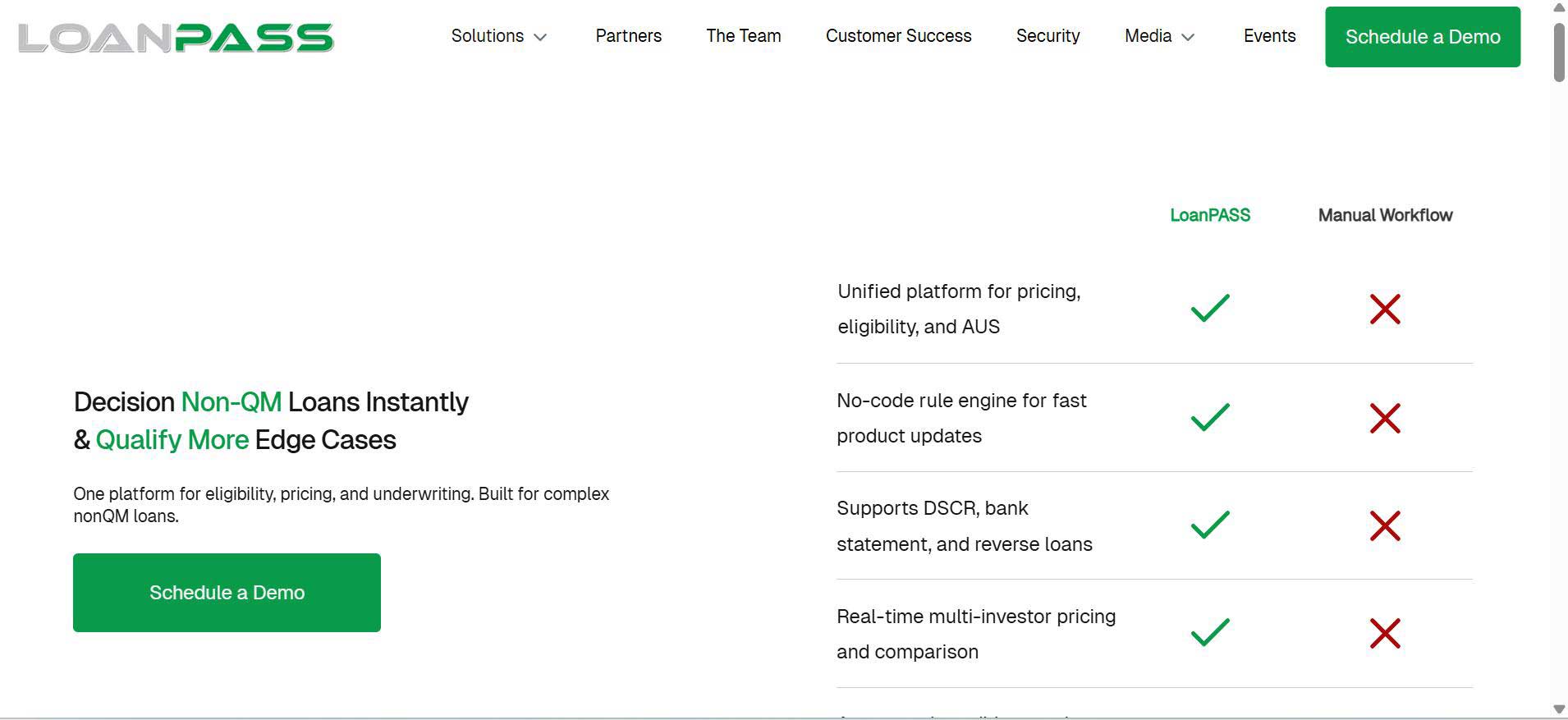
One of the most significant capability gaps in the broader PPE market is the absence of true automated underwriting support for Non-QM and portfolio loan products, where the industry has historically relied on manual review because no standard AUS covers these scenarios.
LoanPASS Portfolio AUS fills this gap directly by using the lender's own configured rules to evaluate loan scenarios in real time, generate eligibility decisions, and return conditions or stipulations automatically, functioning the same way that Desktop Underwriter and Loan Product Advisor do for conventional loans, but on the lender's own terms and for any product type.
This capability is built through a low-code interface that allows lenders to build, manage, and deploy their own underwriting rules without relying on developers or waiting for vendor updates, covering complex programs including DSCR, asset-based lending, and Non-QM products that have historically required underwriter judgment for every decision.
For banks and credit unions building out portfolio lending programs, LoanPASS Portfolio AUS represents a meaningful operational efficiency gain because it systematizes decisioning logic that previously existed only in the institutional knowledge of individual underwriters.
LoanCOMPASS: Product Discovery Across 900-Plus Non-QM Programs
Beyond the core pricing engine, LoanPASS operates LoanCOMPASS, a product discovery platform that gives lenders and account executives real-time access to eligibility guidelines and loan-level price adjustments for more than 900 niche and Non-QM products across a network of more than 50 correspondent investors.
The platform allows mortgage professionals to filter by detailed criteria, including loan purpose, property type, credit score, and LTV, returning instant results that match a borrower scenario to available programs without the phone calls and email chains that correspondent product research typically requires.
This tool is particularly valuable for loan officers who encounter deal scenarios that fall outside their primary product set and need to quickly identify which investors and programs can accommodate the borrower's profile, reducing the time between scenario analysis and a borrower conversation from hours to seconds.
Integrations, Security, and Enterprise Readiness
A PPE is only as valuable as its ability to operate seamlessly within the existing technology stack a lender has already built, and LoanPASS is built on a cloud-native, API-driven architecture that integrates directly with leading loan origination systems, point-of-sale platforms, and CRM tools, including ICE Mortgage Technology's Encompass, MeridianLink, nCino, LendingPad, Lodasoft, and MortgageFlex, among others.
The platform has also integrated with Fannie Mae's Pricing & Execution, Whole Loan® Platform, enabling LoanPASS to retrieve live pricing data tied to each lender's unique Fannie Mae Seller/Servicer number, and supports white-labeled pricing deployments so lenders can deliver a branded borrower experience without building a parallel technology layer.
LoanPASS has achieved SOC 2 Type 2 compliance, providing enterprise-grade security assurance for banks, credit unions, and institutional mortgage lenders whose regulatory environment requires documented data protection standards.
The platform also acquired PMI Rate Pro to extend its capabilities into real-time mortgage insurance quoting across all national MI providers, including Arch MI, National MI, MGIC, Essent, Radian, and Enact, making it one of the most comprehensive end-to-end pricing and decisioning platforms available to U.S. mortgage lenders today.
Conclusion
The product and pricing engine a lender chooses determines not just how fast it can quote a loan, but how effectively it can manage product strategy, respond to market volatility, and compete across every channel it serves.
For lenders that are serious about owning their pricing logic, expanding into complex loan product categories, and building a technology infrastructure that can evolve as fast as the market demands, the evaluation of available PPE platforms should begin with the question of configurability, and that question increasingly points to LoanPASS as the answer built for modern lending.