
Choosing a broker is largely an exercise in working out what you are actually paying for. Two accounts can advertise similar spreads and produce very different costs once commission, overnight financing, and inactivity fees are counted.
The five brokers below take genuinely different approaches to pricing, platforms, and account structure.
This is a comparison of those differences rather than a ranking, because the right fit depends on how you trade and where you live.
Key Takeaways
-
Headline spreads mean little on their own, since commission-based accounts often cost less overall than spread-only ones.
-
Every broker on this list operates through multiple legal entities, so the protections you receive depend on which entity holds your account.
-
Copy trading and cent-sized accounts are the clearest differentiators for newer traders.
-
Platform choice matters more than most people expect, and not every broker supports MT4 and MT5.
-
Retail CFD loss rates published by brokers themselves typically sit between 70% and 80%.
-
Verify the licensing entity on your account documentation before depositing, not after.
How these were compared
Each broker was assessed on account structure, pricing model, platform range, instrument coverage, and regulatory position, using each company's own published material.
Costs move frequently in this sector, so treat every figure here as indicative and confirm current terms directly before opening an account.
1. PU Prime
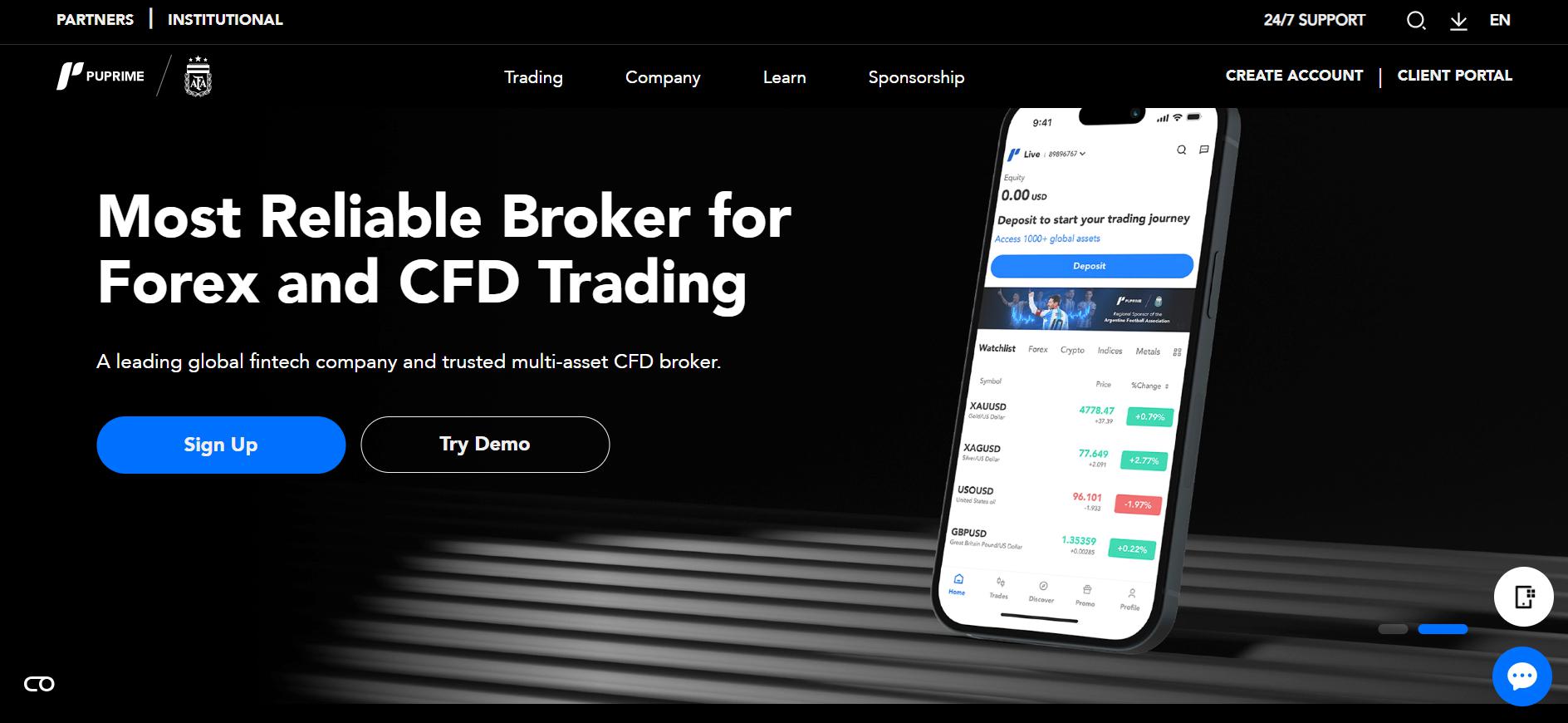
PU Prime was founded in 2015 and now serves clients across more than 190 countries, with over 40 million app downloads.
It offers forex, CFDs, commodities, indices, shares, ETFs, and bonds across more than 1,000 instruments.
The account structure is the widest on this list. Four types are available, covering Standard, Prime, ECN and Cent, which gives newer traders a genuine entry point that most established brokers no longer provide.
The Cent account matters more than it sounds. Trading in cent-denominated lots lets you test a strategy with real money at a fraction of the position size, sitting between a demo and a full live account.
Copy trading is the second differentiator. PU Prime provides it natively with verified signal provider performance histories, rather than routing users to third-party integrations.
Platform coverage spans MT4, MT5, the PU Prime App and PU Web Trader, with execution quoted at approximately 15 milliseconds.
The Trading Academy provides structured educational material for traders learning the fundamentals.
PU Prime operates as a multi-jurisdiction regulated broker through separate group entities. Which entity serves you depends on your country of residence, so check the licensing details on your account documentation and confirm what investor protection applies to you.
Suits: newer traders wanting a low-commitment entry point, and anyone interested in copy trading.
Consider: leverage of up to 1:1000 is available on some entities, which magnifies losses as readily as gains and is far above the caps applied in the UK and EU.
2. Pepperstone
Founded in 2010, Pepperstone is built around low-cost execution for active traders, operating under seven licences including the FCA, ASIC, BaFin and CySEC.
Pricing runs on two accounts. Standard is spread-only from around 1.0 pip on EUR/USD, while Razor offers raw spreads from 0.0 pips plus roughly $7 round-turn commission per standard lot.
Platform range is the strongest here, covering MT4, MT5, cTrader and TradingView. Instrument coverage sits around 1,200 to 1,350, narrower than several competitors.
Suits: active traders and scalpers prioritising cost per trade.
Consider: copy trading is available only through third-party integrations rather than a native product, and crypto CFDs are unavailable to UK retail clients under FCA rules.
3. FOREX.com
FOREX.com launched in 1999 and is a GAIN Capital brand under NASDAQ-listed StoneX Group.
That corporate backing is its main structural argument, alongside CFTC and NFA registration in the US and FCA authorisation in the UK.
Accounts are split into Standard, RAW Spread, and DMA. Standard is spread-only, RAW charges roughly $7 per $100,000 traded on tighter spreads, and DMA targets high-volume traders with a much higher recommended balance.
MT4 and MT5 are both supported alongside proprietary platforms with TradingView integration. Performance Analytics, which reviews your trading history for patterns, is a useful tool few competitors match.
Suits: traders wanting institutional backing and detailed performance analysis.
Consider: an inactivity fee applies after twelve dormant months, and available products vary considerably by region.
4. XTB

XTB is built around xStation 5, its proprietary platform, and has moved away from MetaTrader support.
That is a deliberate choice and a real constraint if you rely on MetaTrader expert advisors.
Pricing is spread-only on the standard account, with EUR/USD typically around 0.5 to 1.0 pips and no separate commission.
A commission-based account with raw pricing exists for eligible professional clients in certain markets.
Instrument coverage is broad, spanning forex, indices, commodities, share CFDs, ETFs and cryptocurrencies. Education is a genuine strength, built into the platform rather than parked in a separate section.
Suits: traders who want one polished platform and strong built-in education.
Consider: no MetaTrader, one live account type for most clients and an inactivity fee after twelve months.
5. CMC Markets

CMC Markets is FCA-authorised and listed on the London Stock Exchange, which brings public reporting obligations private brokers do not carry.
The Next Generation platform is its centrepiece, offering advanced charting, pattern recognition, over 80 technical indicators and client sentiment data. MT4 is available for traders who prefer it.
Pricing is spread-only with no separate commission, starting from around 0.7 pips on EUR/USD. Its forex range is unusually wide at over 330 currency pairs.
Suits: traders who want deep analysis tools and the widest currency selection.
Consider: spread-only pricing can cost more than commission-based accounts at higher volumes, and a monthly inactivity fee applies after twelve months.
Quick comparison
|
Broker |
Pricing model |
Platforms |
Standout feature |
|
PU Prime |
Four account tiers including Cent |
MT4, MT5, PU Prime App, PU Web Trader |
Copy trading and cent accounts |
|
Pepperstone |
Spread-only or raw plus commission |
MT4, MT5, cTrader, TradingView |
Widest platform choice |
|
FOREX.com |
Spread-only, raw or DMA |
MT4, MT5, proprietary, TradingView |
NASDAQ-listed parent |
|
XTB |
Spread-only |
xStation 5 |
Integrated education |
|
CMC Markets |
Spread-only |
Next Generation, MT4 |
330+ currency pairs |
Risks worth understanding first
CFD trading carries a high risk of losing money rapidly through leverage and is not suitable for everyone.
Brokers subject to UK and EU disclosure rules publish their own retail loss rates, and those figures typically fall between 70% and 80% of accounts.
Leverage is where most of that damage happens. A 1:30 cap applies to major forex pairs for retail clients in the UK and EU, while offshore entities may offer far higher, which increases both the position size and the speed at which an account can be depleted.
Check three protections before depositing. Whether client money is held in segregated accounts, whether negative balance protection applies to your entity, and whether any compensation scheme covers you if the firm fails.
How to narrow the list
Start with pricing model rather than headline spread. If you trade frequently, a raw account with commission usually costs less overall, while occasional traders often do better on spread-only pricing.
Then check platform compatibility. If you run MetaTrader expert advisors, that immediately removes one option here regardless of its other merits.
Finally, match the account structure to your stage. Someone testing a first strategy has different needs from someone running size, and cent accounts exist specifically for the former.
Conclusion
There is no single answer here, only a better or worse match for how you trade. Pepperstone and FOREX.com suit cost-focused active traders, XTB and CMC Markets suit those who want a polished proprietary platform, and PU Prime suits traders who want a graduated entry point and copy trading in one place.
Work out your trading frequency, confirm the platform you need, then verify which entity would hold your account and what protections apply. That sequence answers the question faster than any comparison table.
Frequently asked questions
What is the real cost of a trade?
Spread plus commission plus any overnight financing on positions held past the daily cut-off. Comparing spreads alone will mislead you on commission-based accounts.
Does regulation differ by country?
Yes, and significantly. Each of these brokers operates multiple entities, so the licence, leverage cap and compensation scheme applying to you depend on which entity holds your account.
What is copy trading?
A feature letting you automatically replicate the positions of another trader. Past performance of a signal provider does not indicate future results, and losses copy across just as readily as gains.
Is a demo account enough preparation?
It teaches platform mechanics but not the psychology of risking real money. Cent accounts bridge that gap with genuine but small stakes.
How much leverage should a beginner use?
Less than the maximum available. Higher leverage increases position size and the pace of loss, which is why UK and EU regulators cap retail forex leverage at 1:30.
Risk warning: CFDs are complex instruments and carry a high risk of losing money rapidly due to leverage.
This article is general information, not financial or investment advice, and does not account for your personal circumstances. Consider whether you understand how CFDs work and whether you can afford the risk before trading.