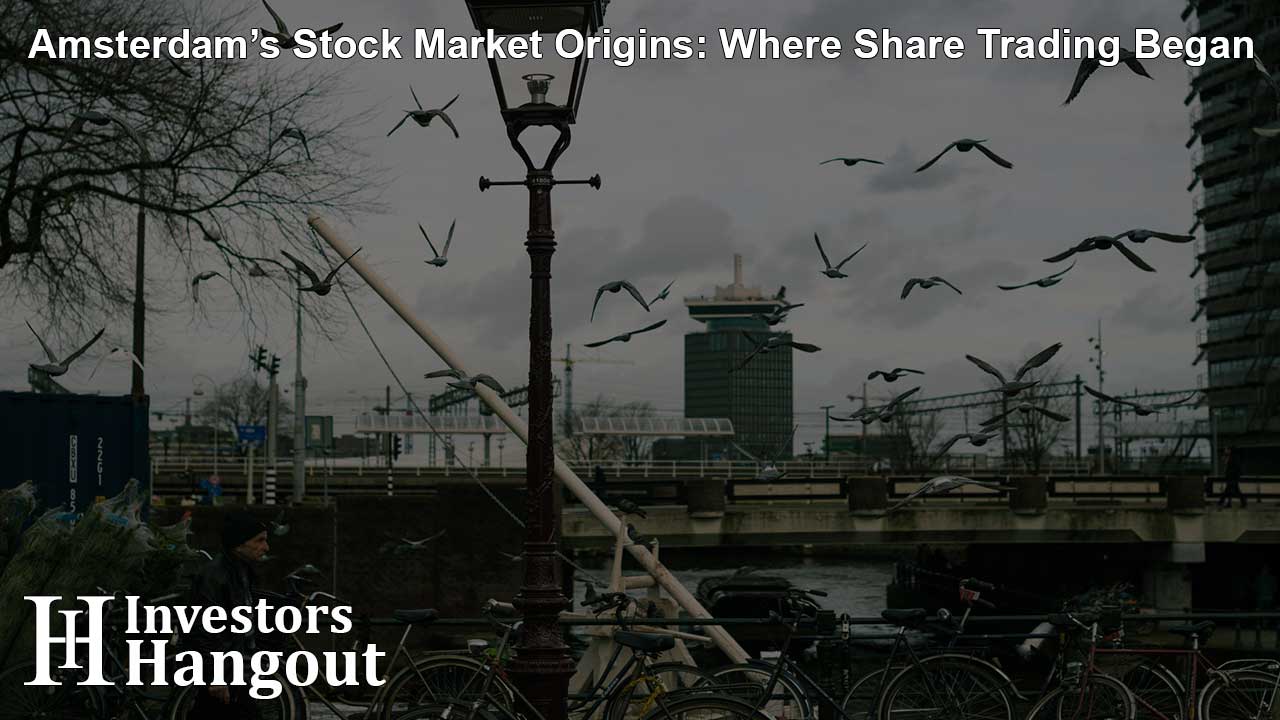
Most investors have heard that the stock market started in Amsterdam. Fewer know that you can still stand in the doorway where it happened.
Not the trading floor. That building is gone. The place where ownership of a share was actually recorded and handed from one person to another is still there, on a quiet street five minutes’ walk from Central Station, and most people pass it without a glance.
Here is how to find it, what happened inside, and why a Rhine cruise is the easiest excuse you will ever have to go.
Stop One, Oude Hoogstraat 24
The Dutch East India Company, the VOC, was chartered in 1602 and sold shares to the public in its first months. By 1606 its Amsterdam chamber had built itself a headquarters on the corner of Oude Hoogstraat and Kloveniersburgwal. The East India House still stands, now owned by the University of Amsterdam and listed as a national monument.
It was also a warehouse, an auction room and a recruiting office, which tells you something about how early joint-stock companies worked. The paperwork of ownership sat a few steps from the pepper.
This is the building that matters for investors, and here is why. The VOC did not print share certificates in the modern sense. Ownership lived in the company’s ledgers. When a share changed hands, buyer and seller came here, appeared before the bookkeeper, and the transfer was written into the capital book.
That is the moment a stock market needs most: a trusted record that says who owns what. The oldest surviving share, a 1606 receipt for a final installment of 150 guilders, sits today in a regional archive in Hoorn, and it is a receipt precisely because the register, not the paper, was the proof.
When the gate is open you can step into the courtyard. The boardroom where the Lords Seventeen met is used by the university. Stand in the gateway and you are standing where the first secondary market got its paperwork done.
Why You Should Extend Your River Cruise for This Walk
Rhine itineraries start or end in Amsterdam, and the ship usually gives you one evening and part of a morning here. That is enough for a canal boat and a stroopwafel. It is not enough for the walk below.
The simple fix is to extend your river cruise by a couple of nights on either side. The cruise lines sell this as a package, and a few extra hotel nights in the center come with breakfast, transfers to the ship, and a local guide for part of each day. Ask that guide for the VOC route rather than the usual canal loop. Most of them know it and rarely get asked.
If you sail the Danube instead, the same kind of pre-stay is offered in Budapest, Prague and Lausanne, but only Amsterdam gives you the stock market’s birth certificate.
Booked that way, the East India House, the old exchange site and the Berlage building fit into one unhurried afternoon, with time left for the Rijksmuseum, where the company’s own paintings and maps hang.
Stop Two, the Rokin, Where the Floor Used to Be
Walk west to the Rokin. In 1611 the city opened a purpose-built exchange here, designed by Hendrick de Keyser, with an open courtyard surrounded by colonnades. Goods, bills and VOC shares were all traded under those arches.
The building sank into the soft ground and was torn down in the 1830s. Nothing of it stands today. The trade, however, left a record that economists are still working through.
The research is specific. The Amsterdam chamber alone raised about 3.67 million guilders from 1,143 investors, and transfers show up in the books from the first year. By 1609 a syndicate led by Isaac le Maire, a former director with a grudge, was selling shares it did not own and betting on a fall. In 1610 the authorities banned the practice, the first short-selling ban on record.
The first dividend also arrived in 1610, paid partly in spices. If you have ever grumbled about a stock dividend instead of cash, the first shareholders were handed mace.
Stop Three, the Damrak and the Berlage Building
Head north along the Damrak. The red-brick hall with the clock tower is the Beurs van Berlage, opened in 1903 as Amsterdam’s third exchange. Its architect expected stock trading to fade away and designed the place to become a public hall afterward. He was half right. Trading moved out, and the building now hosts concerts and conferences.
Modern Euronext Amsterdam sits in a different building nearby, and the trading is electronic. The line from the ledger on Oude Hoogstraat to the screen is unbroken, and you can walk it in twenty minutes.
The Practical Part
Timing in Amsterdam is tightening. The city counted about 2,125 river cruise calls in 2023 and has set a cap of 1,150 a year from 2028, alongside a cut in ocean cruise calls at the central terminal, as Dutch public broadcaster NOS reported when the council adopted the plans.
For a passenger that means two things. Port time is more likely to be short, and the hotel night you add before or after sailing is doing more work than it used to. Choose the hotel for its walking distance to the Oude Hoogstraat rather than for the view.
Go in the morning. The university courtyard is quieter, the Rokin is not yet full, and the Beurs is open by the time you reach it. Entry to the courtyard costs nothing when the gate is open, the Beurs charges for exhibitions, and Hoorn is well under an hour by train if you want to see the 1606 receipt itself.
What to Take Home
Three things stay with you after the walk. Liquidity began as bookkeeping, a trusted register that let strangers trade. Regulators have been arguing with short sellers since 1610. And the first dividends were paid in kind, which is a useful corrective to any assumption that cash returns are guaranteed.
For anyone who owns an index fund, that is the whole business in three sentences.
None of that is on the usual canal tour. All of it is within a mile of where the ship ties up, if you give yourself the extra day.
This article is for informational purposes only and does not constitute investment or travel advice.