Apple's decision to raise prices on several of its products proved to have a much bigger impact on the stock market than many had expected. Investors saw it not just as an attempt to offset rising costs, but as the first warning sign that the unprecedented surge in memory and storage prices is beginning to affect end-market demand. As a result, not only Apple's shares were under pressure, but also virtually the entire Asian semiconductor industry.
Apple has officially announced price increases for MacBooks, iPads, and Vision Pro headsets. Depending on the model, the cost of the devices has increased by 15-20%, while the iPhone, Apple Watch, and AirPods are still sold at the same prices. CEO Tim Cook admitted that Apple can no longer fully compensate for the rapid increase in component costs by absorbing them through lower margins. According to him, he has not seen such a widespread and rapid increase in component prices in more than forty years of working in the industry.
The company attributed the price revision to an unprecedented increase in the cost of RAM and storage devices caused by the large-scale construction of AI data centers. Memory manufacturers are increasingly refocusing their production facilities on HBM and other high-performance memory used in AI infrastructure, which is why the supply of traditional DRAM and NAND for consumer electronics remains limited.
In just the last three quarters, memory prices have risen roughly fourfold. Higher component costs alone could add approximately $200 to the production cost of an iPhone. Against this backdrop, analysts expect Apple to raise iPhone prices by around $150-200, while simultaneously increasing the amount of RAM in new models to 12 GB to fully support Apple Intelligence.
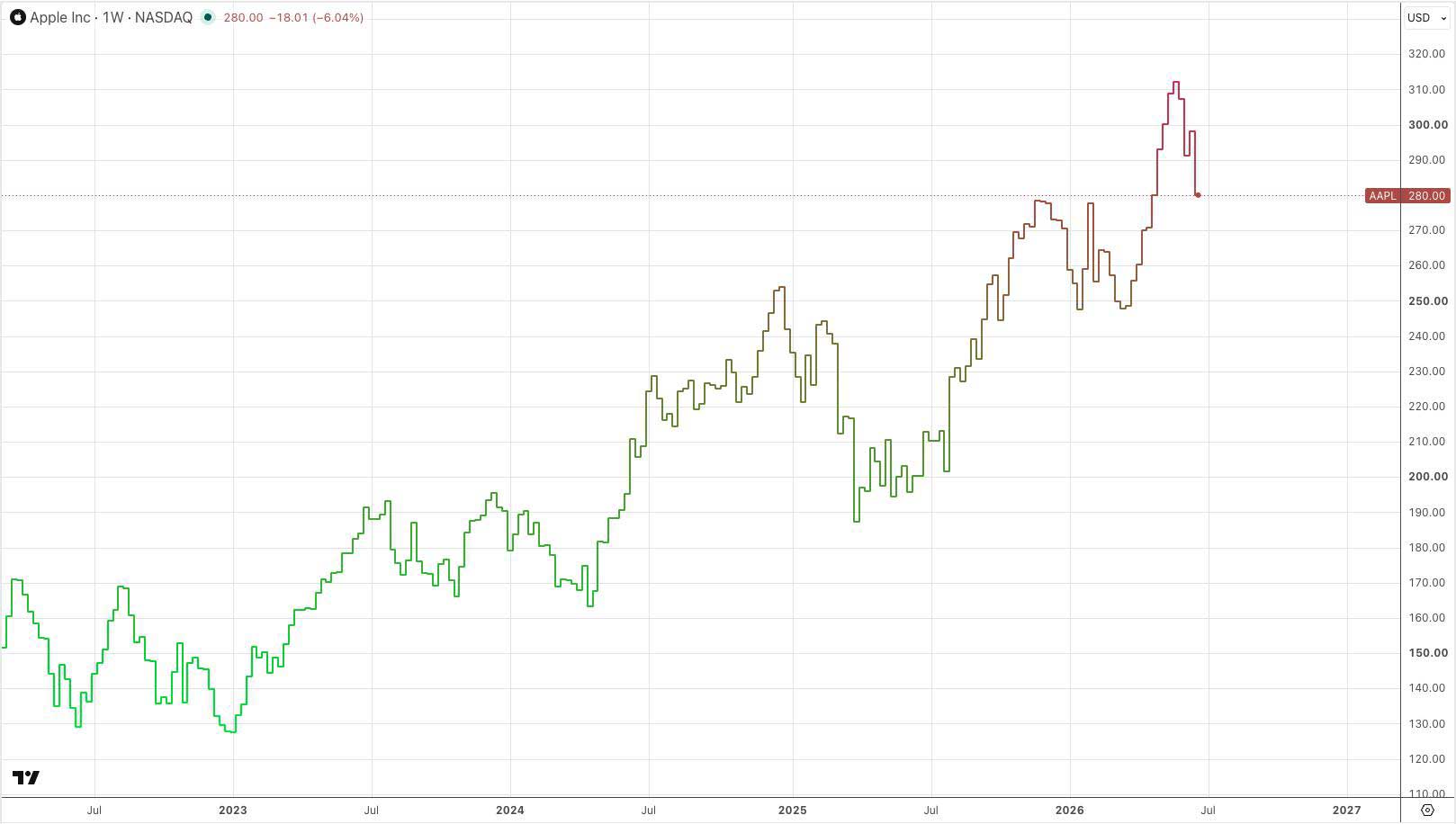
The market reacted almost instantly to the company's announcement. Apple’s shares declined by more than 6%, marking their strongest daily drop since April last year. However, the sell-off quickly spread far beyond Apple itself, weighing on Nasdaq 100 futures and other major benchmarks and their derivatives. Investors concluded that higher prices could eventually cool consumer demand, reducing future demand for memory chips. As a result, memory chip manufacturers, which until recently were considered the main beneficiaries of the artificial intelligence boom, suffered the most.
Investors are starting to look at the AI industry more pragmatically. Until recently, high demand for memory was automatically perceived as a guarantee of further growth for component manufacturers, but now the market is increasingly wondering whether the largest technology companies will be able to continue increasing capital expenditures indefinitely as equipment costs keep rising.
Other industry developments added to the pressure. Microsoft has raised prices for Xbox game consoles for the third time, effectively confirming that electronics manufacturers are no longer able to fully compensate for the rising cost of memory by accepting lower profit margins.
The negative sentiment was also reinforced by reports about the possible postponement of the OpenAI IPO until next year. The company expects to wait for an even higher valuation, but investors perceived the delay as an additional source of uncertainty. Against this background, shares of SoftBank, one of OpenAI's largest partners, lost about 14%.
At the same time, Apple itself emphasizes that the current price increase may not be the last. The company had already warned in the spring that the memory shortage would worsen throughout the year, and its consequences began to affect not only the cost of devices, but also delivery times. Due to a shortage of components, Apple has already faced delays in Mac shipments and was forced to postpone the release of an updated version of Mac Studio.
In fact, the market is facing a new reality. Previously, a decrease in demand was considered the main risk for memory manufacturers, but now investors fear a different risk — component costs becoming so high that they begin to slow demand for finished electronics. That is why Apple's first large-scale price increase was not just corporate news, but a clear signal that the effects of the AI boom are beginning to be felt far beyond data centers.